
Learn
Plain-English explainers on carbon, from the terms people mix up to the rules that put a price on them. Each one has a diagram, worked examples from different sectors, and the standards and laws behind it, with the date they were last checked.
The elements
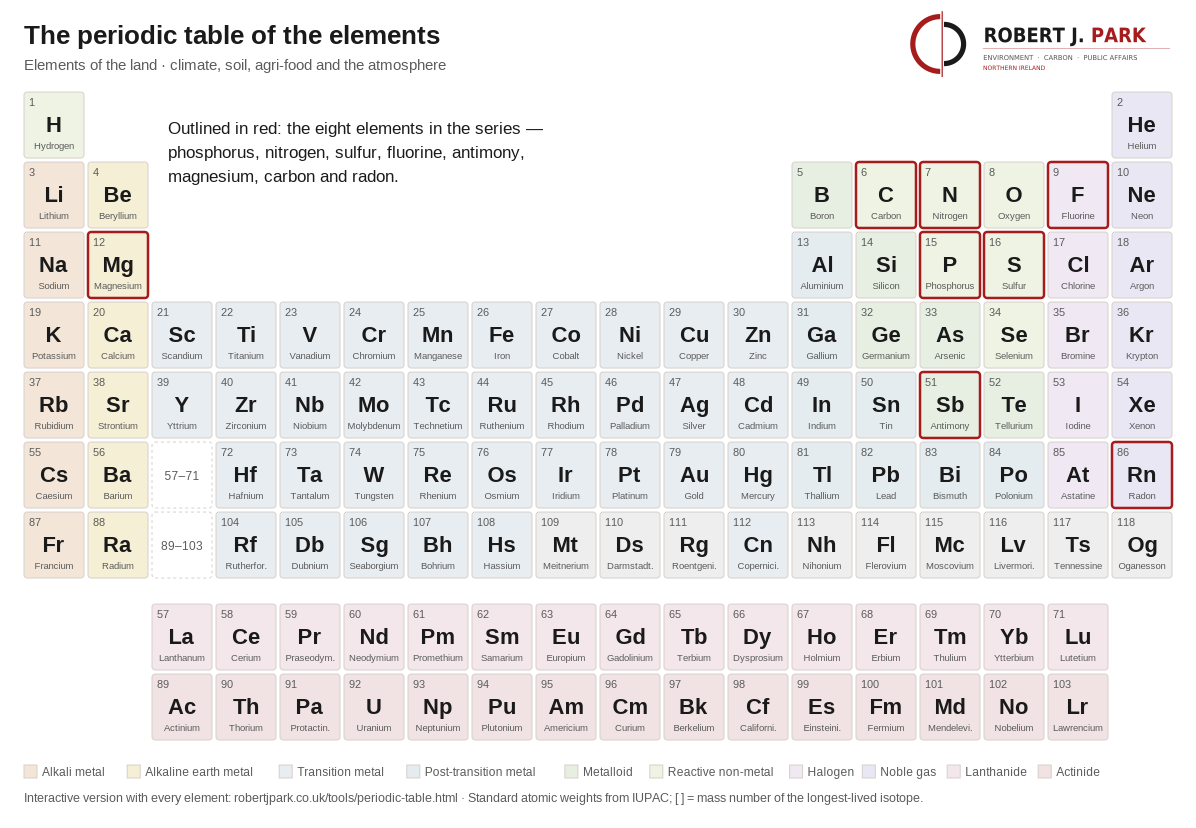
The interactive periodic table has a short briefing on all 118 elements, from hydrogen to oganesson. Hover over an element for what it means for climate, greenhouse gases, the air, land, soil, water and health. Click it for where it occurs in nature, its part in pollution, how it is made and used, its health effects and hazards, and how it was discovered.
Each element is getting its own deep-dive page too, with its quirks and its part in climate, soil, engineering, politics and commerce, starting with those most tied to our work: see the element deep dives. You can add what you know on every page.
Read why I built it, or find it with the other dashboards.
The law on every element gives a legal briefing on all 118: where each comes from, how it must be handled, how it forms compounds, and its effects on climate, carbon and the environment, with the law in Northern Ireland, the UK and, under the Windsor Framework, the EU. The same briefing appears as “Law and handling” on each element’s deep-dive page.
Eight elements have a full briefing of their own, with safety and COSHH notes, UN numbers and the compounds you meet in nature, manufacturing and the climate. Download them as PDFs:
- Phosphorus: the nutrient behind Lough Neagh’s algal blooms
- Nitrogen: ammonia, nitrate and nitrous oxide
- Sulfur: from acid rain to crop nutrient and slurry gas
- Fluorine: F-gases, PFAS and fluoride
- Antimony: the critical mineral nobody has heard of
- Magnesium: chlorophyll, grass tetany and rock weathering
- Carbon: the element we count
- Radon: the gas from the ground a tighter house can trap
Future technologies
The future technologies map sets out 169 environmental and energy technologies that people are working on today, in a laboratory, a pilot plant or a working site, and a good many of them in Northern Ireland. They build up in thirteen maps of thirteen, from the most enabling near-term technologies to frontier ideas that cannot yet run at useful scale. Arrows show which technologies make others more relevant, practical, cost-beneficial or necessary. General information, not advice.
Hover over a technology for a three-line description; click it for a short article on what it is, where it stands, the Northern Ireland angle, the law and consents, what you can do now, what is not yet verified, and the sources. The articles were researched in November 2026 from primary and official sources where they exist. Where a law line has been checked against the legislation, that is a research check, not legal advice.
Explainers
Carbon basics
-
Embodied carbon or embedded emissions: what is the difference?
Embodied carbon is the building world's term for all the carbon in making, building, maintaining and disposing of something, except the energy used to run it. Embedded emissions is the EU carbon border tax's term for a much narrower, legally defined slice: the emissions from producing a good. And the UK's own carbon border tax calls that narrow slice "embodied".
Introductory · 10-minute read
-
What is a carbon life cycle?
A carbon life cycle follows a product or building from its raw materials to the end of its life and counts the greenhouse gases released at each stage, so you can see where the carbon really is and be clear about which part of the journey a number covers.
Introductory · 9-minute read
-
Why is everything counted as “carbon”?
“Carbon” is shorthand. Carbon accounts cover seven greenhouse gases, several of which contain no carbon at all, such as nitrous oxide, sulphur hexafluoride and nitrogen trifluoride. Each is converted into the amount of carbon dioxide that would trap the same heat over 100 years, so they can be added up in one currency: tonnes of CO₂ equivalent (CO₂e).
Intermediate · 15-minute read
-
CO₂e and global warming potential, in detail
CO₂e (carbon dioxide equivalent) puts every greenhouse gas into one unit: kilograms of gas multiplied by its global warming potential (GWP). A GWP compares the heat one kilogram of a gas traps over a set period, usually 100 years, with one kilogram of CO₂. It depends on two things: how strongly the gas absorbs heat and how long it lasts. That is why a short-lived gas can have a tiny GWP however potent it is, and why the same gas has different GWPs over 20 and 100 years.
Intermediate · 17-minute read
Energy and industry
-
Hydrogen by colour: grey, blue, green and the rest
Every colour of hydrogen is the same molecule, H₂. The colour describes how it was made, and so how much greenhouse gas came with it: from about 22–26 kg of CO₂e per kilogram for coal-based “brown” hydrogen to near zero for “green” hydrogen made with renewable power. The rules ignore the colours and set a number instead: 2.4 kg per kg in the UK.
Intermediate · 13-minute read
-
Carbon capture and carbon negative
Carbon capture and storage (CCS) catches CO₂ from a chimney before it escapes, which cuts emissions. Carbon dioxide removal takes CO₂ back out of the air, which can make something “carbon negative”. Nature already removes billions of tonnes a year; engineered removal is under a thousandth of that so far. Neither is a substitute for cutting emissions first.
Intermediate · 14-minute read
-
Medicines and fossil fuels
Most synthetic medicines are built from carbon that started as oil or gas, and so are most syringes, drips and blister packs. But the carbon in the tablet is tiny. The footprint comes from making it: many reaction steps, large volumes of solvent and energy. In England medicines are about a quarter of the NHS footprint, and a few products, such as some inhalers and anaesthetic gases, warm the planet directly when used. Never change a medicine for carbon reasons without a clinician.
Introductory · 11-minute read
-
Fracking: what is burned and what leaks
Fracking cracks open shale rock deep underground to release natural gas, which is mostly methane. Burned, a kilogram of methane makes 2.74 kg of CO₂, less than coal for the same electricity. Leaked, the same kilogram counts as 28–30 kg of CO₂e over 100 years and over 80 over 20. So the leaks decide whether shale gas is a cleaner bridge or not. Northern Ireland has never fracked; a Bill to end all onshore oil and gas licensing, fracking included, completed its Further Consideration Stage on 17 November 2026; its Final Stage is still to come.
Introductory · 12-minute read
Land, food and water
-
Fertiliser and the nitrogen cycle
Nitrogen fertiliser is made by pulling nitrogen out of the air with hydrogen from natural gas. Its carbon footprint comes in two halves: CO₂ and nitrous oxide at the factory, and nitrous oxide and ammonia from the field. The carbon border taxes count only the factory half; a farm's footprint must count both.
Intermediate · 14-minute read
-
Peat bogs: carbon stores that leak
Peat is half-rotted moss and plants, preserved for thousands of years because a waterlogged bog keeps oxygen out. Wet, it slowly stores carbon. Drained, dug or burned, it rots and breathes the carbon back out as CO₂. In Northern Ireland peat emitted about 2.3 million tonnes of CO₂e in 2024, about an eighth of the total. Rewetting is the cure.
Introductory · 13-minute read
-
Permafrost: worse than the ice caps?
Permafrost is ground that stays frozen for at least two years, and the soils of the permafrost region hold up to almost twice as much carbon as the whole atmosphere. As it thaws, that old plant matter rots into CO₂ and methane, adding to warming. Melting ice sheets raise the sea; thawing permafrost raises the carbon in the air. On carbon, permafrost is the bigger worry.
Introductory · 11-minute read
-
Lough Neagh and cyanobacteria
Cyanobacteria, often called blue-green algae, are ancient bacteria that made the oxygen we breathe. Fed too much phosphorus, in warm, still, clear water, they bloom, and some make toxins. Lough Neagh, which supplies about 40% of Northern Ireland's drinking water, had serious blooms in 2023, 2024 and 2025. The main cure is less phosphorus from farms and sewage, but the lough will take years to recover.
Introductory · 14-minute read
-
Acid rain to acid seas
Acid rain came from sulphur and nitrogen oxides, mostly from burning coal, and Europe largely fixed it: UK sulphur dioxide emissions fell by about 99% between 1970 and 2024. Ocean acidification comes from carbon dioxide dissolving into the sea, and it is still getting worse. Together with melting ice, darker water and a projected weakening of the Atlantic circulation, it shows how warming changes the sea, and how the sea changes warming.
Intermediate · 14-minute read
-
Fish guts and seashells: waste or resource?
A fillet is often only a third of a whitefish; the rest is heads, frames, guts and skin, and shellfish leave piles of shell. Those by-products can become fish oil, feed, collagen, chitosan, liming material and fertiliser instead of a disposal bill. But a seashell is not a simple carbon store: making it released CO₂ in the sea, and burning it for lime releases the rest. The value is in using it, not in claiming credits for it.
Introductory · 11-minute read
Materials and buildings
-
Block, lime, brick or prefab?
Most of a new wall's carbon is released before anyone lives behind it: in the cement kiln, the brick kiln and the steel mill. Concrete block and brick carry carbon from burning fuel and, for cement and lime, from the limestone itself. Timber frame usually comes out lower, by about a quarter in one Irish study of a small social home. Lime mortar wins some CO₂ back and lets bricks be reused. 'Prefab' describes how a house is built, not what it is made of, so it is not automatically low-carbon.
Introductory · 12-minute read
-
The circular economy is a life cycle too
A circular economy keeps products and materials in use for as long as possible, in loops: repair, reuse, refurbish, remanufacture, and only then recycle. Recycling is the outermost loop, not the first, because it throws away the energy and work already put into the product. In 2024/25 Northern Ireland's councils recycled about half the waste they collected, the same as the year before; the law asks for 70% of waste to be recycled by 2030.
Introductory · 11-minute read
Claims, credits and markets
-
Offsets: the good, the ugly and the harmful
A carbon offset is a credit for one tonne of CO₂e cut or removed somewhere else, bought to balance your own emissions. The best are real, extra, measured and lasting; many are not. Cut your own emissions first, then use only verified, durable credits, and describe them honestly: in the EU, product claims of being “carbon neutral” through offsetting have been banned since 27 September 2026.
Intermediate · 14-minute read
Is it true?
-
Was it the Sun? The solar cycle and climate
The Sun drives our weather and has changed the climate in the past, but it is not behind the warming since the mid-20th century. Satellites have measured the Sun's output since 1978 and found no upward trend, while temperatures have risen, and the upper atmosphere has cooled, which a brighter Sun would not do.
Introductory · 11-minute read
-
Contrails and “chemtrails”: is it true?
The white lines behind planes are contrails: ice clouds made from the water vapour in jet exhaust. They are not harmless to the climate. Spreading contrails warm the planet more than all the CO₂ aviation has ever emitted, though the figure is far less certain. There is no evidence that planes are secretly spraying chemicals. Solar geoengineering is real as research, with a few small, public experiments, but it is not being deployed.
Introductory · 11-minute read
More explainers are on the way. If there is a term you keep meeting and want explained, tell me.
Practise
Test yourself once you have read the explainers. All of these run in your browser and store nothing.
- Scope Sort: sort 22 everyday activities into Scope 1, 2, 3 or “not counted”.
- The Carbon Crossword: 24 carbon terms with easy and hard clues.
- Acronym Match: 33 acronyms, from CBAM to SBTi.
- Pillar Clash: ten dilemmas where environmental, social and governance goals pull apart.
- Planet Check: a 28-question GCSE quiz, with a printable worksheet (PDF).
Go further
- The interactive periodic table: every element, with its environmental, engineering, geological, chemical and land context.
- The Scopes Map: Scope 1, 2 and 3 on one diagram, with all fifteen Scope 3 categories.
- Is my part or chemical a CBAM good?: the commodity codes that most often catch NI manufacturers.
- All tools and dashboards.