
Block, lime, brick or prefab?
In short
Most of a new wall's carbon is released before anyone lives behind it: in the cement kiln, the brick kiln and the steel mill. Concrete block and brick carry carbon from burning fuel and, for cement and lime, from the limestone itself. Timber frame usually comes out lower, by about a quarter in one Irish study of a small social home. Lime mortar wins some CO₂ back and lets bricks be reused. 'Prefab' describes how a house is built, not what it is made of, so it is not automatically low-carbon.
Most new homes in Northern Ireland are built the way they have been for decades: two leaves of concrete block, a cavity, insulation and a coat of render. It works, it is familiar and every builder knows how to do it. It also carries a carbon cost that is paid in full on the first day, long before the heating is switched on.
This page looks at where that carbon comes from, how block, brick, lime, timber and factory-built homes compare, and why the answer is less tidy than the brochures suggest. It builds on Embodied or embedded carbon?.
In short
| Concrete block | Fired clay brick | Lime | Timber frame | “Prefab” (MMC) | |
|---|---|---|---|---|---|
| Where the CO₂ comes from | Cement: limestone broken down in the kiln, plus fuel | Fuel for the kiln, mostly gas | Limestone broken down, plus fuel | Sawmilling, drying, transport | Depends on the material used |
| Takes CO₂ back? | A little, slowly | No | Air lime, partly, over years | Stores carbon while the wood lasts | Depends |
| Reusable? | Rarely, if laid in cement mortar | Yes, if laid in lime mortar | Mortar lets bricks be reused | Yes, if designed for it | Depends on how it is joined |
| Lifetime | Long | Centuries | Long, needs care | Long if kept dry | Depends |
Where the CO₂ comes from
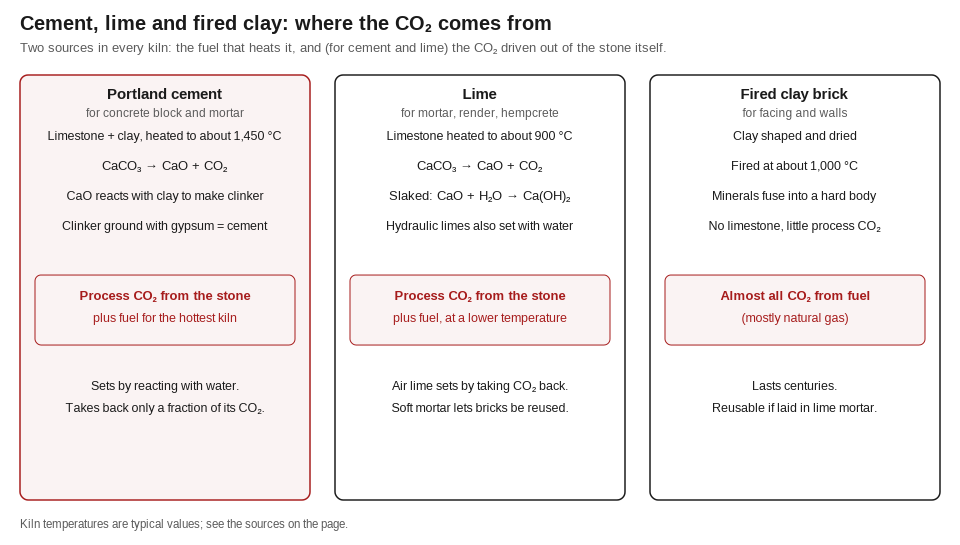
Cement is the glue in concrete block, mortar and render. Limestone (calcium carbonate) and clay are heated to about 1,450 °C. The heat drives CO₂ out of the stone:
CaCO₃ → CaO + CO₂
The calcium oxide then reacts with the clay to make clinker, which is ground with a little gypsum into cement. The IPCC’s default is 0.52 kg of CO₂ from the rock for every kg of clinker, before any fuel is counted. No change of fuel can remove that part; only less clinker, or carbon capture, can. The IPCC’s older review put cement at about 5% of world CO₂, roughly half from the rock and half from energy.
Lime comes from the same reaction at a lower temperature, about 900 °C. Per kilogram it releases more process CO₂ than clinker, because it is nearly pure calcium oxide: the IPCC default is 0.75 kg CO₂ per kg of high-calcium lime and 0.59 kg for hydraulic lime, plus the fuel.
Fired clay brick contains no limestone. Clay is shaped, dried and fired at over 1,000 °C (Brick Development Association, a trade body), so its CO₂ comes almost entirely from the fuel, mostly natural gas.
The lime cycle: back to stone
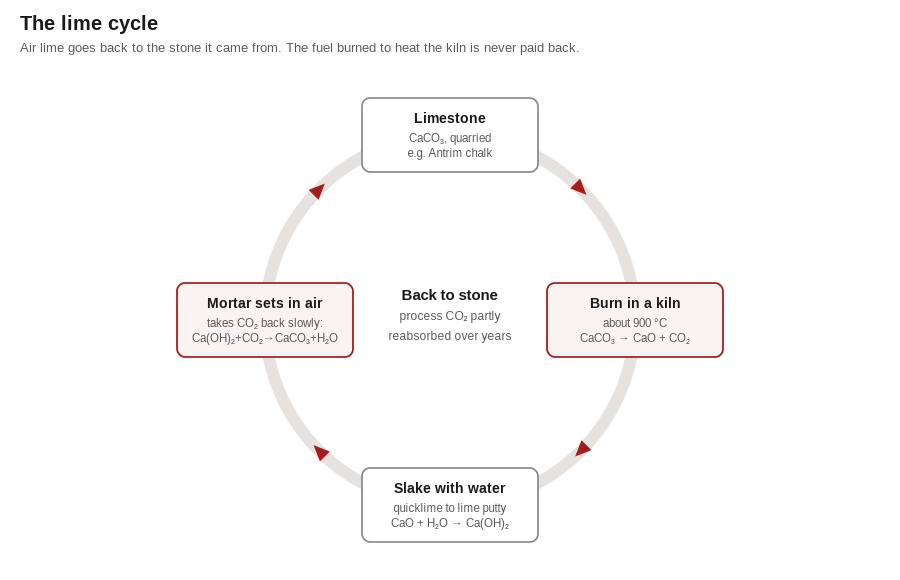
Quicklime is slaked with water to make lime putty:
CaO + H₂O → Ca(OH)₂
Air lime (non-hydraulic) then sets by taking CO₂ back out of the air:
Ca(OH)₂ + CO₂ → CaCO₃ + H₂O
It is a genuine loop, but not a perfect one. The fuel used to heat the kiln is never paid back. Carbonation is slow and stops where air cannot reach, and hydraulic limes set partly with water, as cement does, so they take back less. One modelling study of hempcrete found the lime binder reabsorbed only 18.5–38.4% of the CO₂ released in making it (Journal of Cleaner Production, 2020). Cement and concrete also reabsorb a little over their lives, but only a fraction.
The bigger benefit of lime is practical. Lime mortar is softer than the brick, so a lime-mortared wall can be taken down and the bricks cleaned and used again. Research reviewed by Zhou and colleagues (2020) found about 85% of bricks laid in lime mortar could be separated cleanly; cement mortar, used widely from the 1920s, makes that far harder. A Finnish study published in March 2026 found reclaimed bricks carried 86–95% less carbon than new ones.
Kilogram for kilogram, and house for house
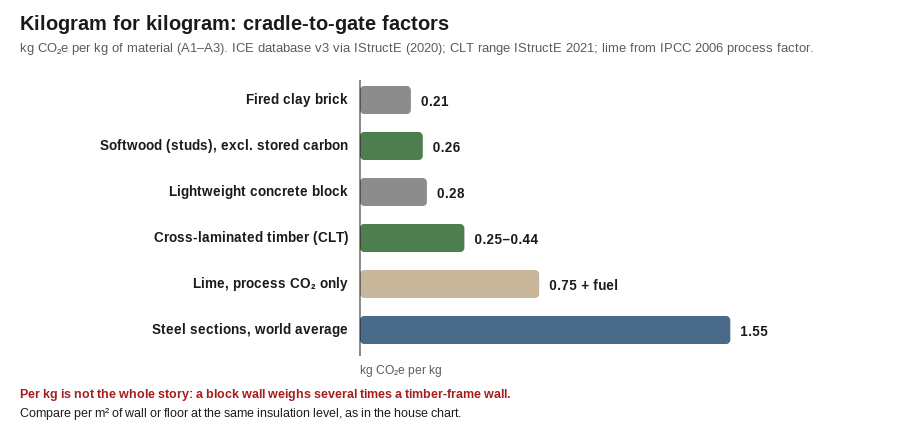
The usual source for these factors is the ICE database (Inventory of Carbon and Energy), started at the University of Bath and now run by Circular Ecology. The figures above are from version 3 (2019) as published by the Institution of Structural Engineers in 2020. ICE has since reached version 5 (June 2026), so check the current release before using a number in a real assessment.
Per kilogram, brick and block look much the same as timber. That comparison misleads, because a masonry wall uses several times the weight of material. The fair test is per square metre of wall, or of floor, for walls built to the same insulation standard.
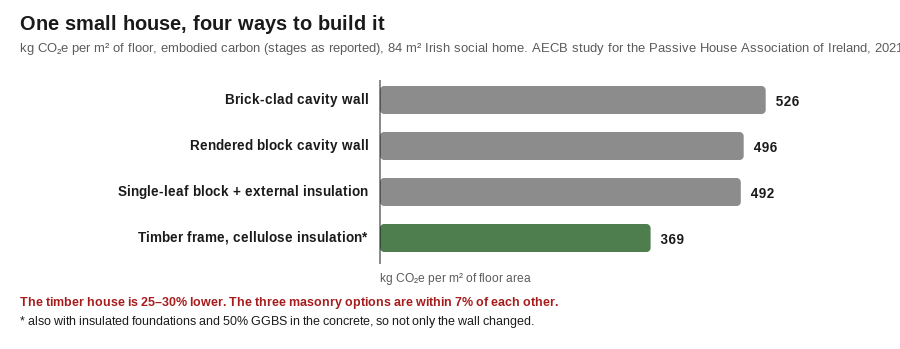
An AECB study for the Passive House Association of Ireland, reported in August 2021, modelled the same 84 m² social home four ways (the report seen does not say exactly which life-cycle stages were counted). The three masonry versions came out within 7% of each other at about 500 kg CO₂e per m² of floor; the timber-frame version, which also used insulated foundations and less cement in the concrete, was about 370. A separate pair of Irish houses modelled in 2021 gave 353 against 218 kg CO₂e per m². Both studies are small, but the direction matches a 2024 policy study for Essex councils: timber structure with natural insulation cut upfront carbon in low-rise homes by about 40%, and the biggest single items in every home were concrete, bricks, blocks, plasterboard and metals. The substructure and structure together (foundations, slabs, frame and walls) often account for over half of the upfront carbon, and foundations and slabs are concrete whatever the walls are made of.
Benchmarks
| Benchmark | Limit for new homes | Covers | Status |
|---|---|---|---|
| LETI 2030 band A (as reproduced in the Essex study) | Under 300 kg CO₂e per m² | Upfront, A1–A5 | Voluntary; bands based on buildings of 6 storeys or more |
| Essex proposed policy for low-rise homes | Under 500 kg CO₂e per m², plus 15% contingency | Upfront, A1–A5 | Proposed, June 2024 |
| RIBA 2030 Climate Challenge (v2) | 625 kg CO₂e per m² for 2025 | Whole life, A–C | Voluntary, August 2021 |
| UK Net Zero Carbon Buildings Standard | Version 1 published 10 March 2026 | Whole life | Voluntary; residential limits not checked here |
| NI Building Regulations | No embodied carbon requirement found | As at 17 November 2026 (not confirmed with the Department of Finance) |
Hempcrete: “carbon negative”?
Hempcrete is hemp shiv (the woody core of the stalk) mixed with a lime binder. The hemp took CO₂ from the air as it grew, and the lime takes some back as it sets, so it is often sold as carbon negative.
The evidence says: sometimes. A 2020 study of 36 mixes found the best came out at about −16 kg CO₂e per m² of wall, but denser mixes, and any with Portland cement, were net emitters. A 2024 US study found hempcrete was carbon negative only when hemp made up at least 20% of the weight and the lime’s carbonation was counted. Counting the stored plant carbon also depends on the accounting rules (EN 15804+A2), and on the wall lasting.
“Prefab” and modern methods
Modern methods of construction (MMC) is the official term. The government’s 2019 framework sorts it into seven categories, from whole volumetric modules (category 1) and flat-pack panels (category 2) to site-based productivity gains (category 7).
MMC changes where a house is built, not what it is made of. A factory-built steel or concrete module can carry as much carbon as a block house; a timber-panel system usually carries less because it is timber. Factory building can cut waste and improve quality, but no general figure for those savings was verified for this page.
It has also been a hard business. House by Urban Splash went into administration in May 2022; Legal & General paused its modular homes factory in spring 2023; and Ilke Homes went into administration at the end of June 2023 with net debts of over £319 million, including about £68 million owed to Homes England.
The whole life
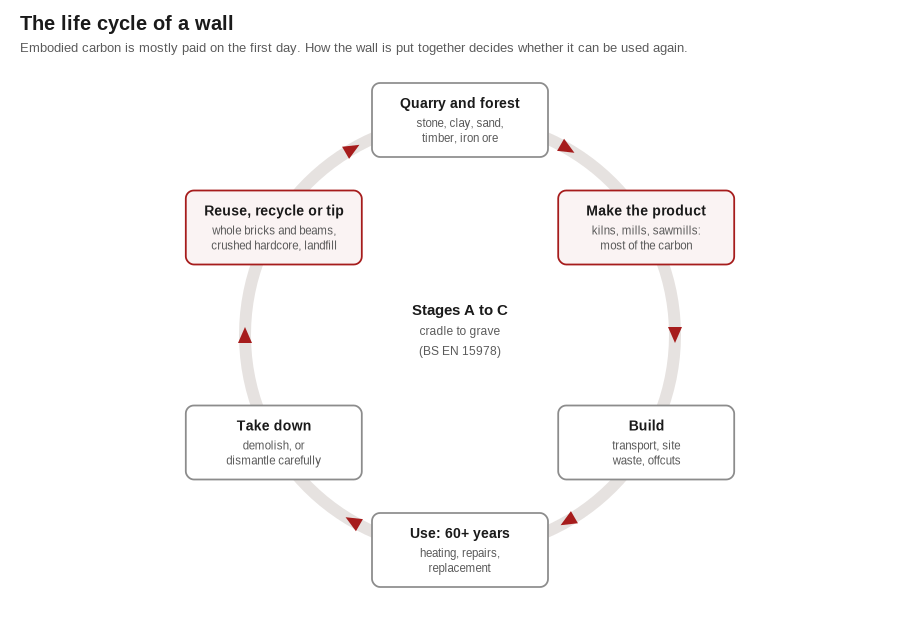
Thermal mass is often given as the reason heavy walls pay back over time. An NHBC Foundation study by BRE (2011) found it made little difference to UK homes: the largest overall CO₂ difference between masonry and timber-frame houses over 60 years was 4%. As homes get better insulated and the grid gets cleaner, embodied carbon becomes the larger share of a new home’s lifetime footprint (my reasoning from that study, not a sourced figure).
Why it matters in Northern Ireland
- Block and render is the default. That NI new homes are mostly cavity block was not confirmed in an official statistic for this page, but it is what most builders and buyers see.
- NI makes its own cement. Cookstown (about 0.5 million tonnes a year, sold by Holcim in January 2022) and Mannok at Derrylin, Co Fermanagh (trade press). Local cement is not low-carbon cement; ask for each product’s EPD.
- A large building programme. The Executive’s housing supply strategy aims for 100,000 homes by 2039, a third of them social. The Housing Executive’s first new homes in about 25 years, six semi-detached houses at Sunningdale Gardens in north Belfast, were built using modern methods of construction to Passivhaus standard, and in May 2025 it sought a feasibility study comparing MMC with traditional masonry, including carbon.
- Energy rules, not carbon rules. The Part F uplift came into force on 30 June 2022 and governs how much energy a new home uses. There is no NI rule yet on the carbon built into it.
- Climate targets. The Climate Change Act (Northern Ireland) 2022 sets net zero by 2050 and at least 48% below the baseline by 2030. Construction materials are counted mostly as someone else’s emissions (the cement plant’s, or another country’s), which is why the embodied carbon of a council or housing association’s buildings sits in its Scope 3.
Think of a cake
| Baking a cake | Building a wall |
|---|---|
| The oven’s gas bill | Fuel for the kiln |
| Baking powder giving off gas as it rises | Limestone giving off CO₂ as it turns to lime |
| A cake that is mostly flour | A wall that is mostly block: heavy, so the total adds up |
| A lighter sponge | Timber frame: less material for the same job |
| Icing that peels off cleanly | Lime mortar: the bricks can be used again |
| Icing set like concrete | Cement mortar: the bricks usually go to hardcore |
| A cake from a factory | MMC: it is still the recipe that matters |
Examples
Housing associations and councils
Choosing a structure for 40 social homes
A housing association is deciding between block cavity and timber frame for a scheme of 40 two-storey homes of about 84 m².
| Rendered block cavity | Timber frame | |
|---|---|---|
| Embodied carbon (AECB study, illustrative) | About 496 kg CO₂e per m² | About 369 kg CO₂e per m² |
| Per home (84 m²) | About 41,700 kg | About 31,000 kg |
| Scheme of 40 | About 1,670 tonnes | About 1,240 tonnes |
The lesson: on these figures, timber frame saves about 430 tonnes across the scheme (my arithmetic, from a single study). Ask for a whole-life assessment of your own design and check the foundations and slabs, which are a large item. These numbers are an illustration, not a design figure.
Heritage and repair
Repointing an old stone or brick building
A council owns a pre-1920 building laid in lime mortar and has a quote to repoint it in cement.
What to know: lime mortar is softer and more breathable than the stone or brick, and lets the units be reused later. Cement mortar is harder than old bricks, traps moisture and can make the bricks crack instead of the joints.
The lesson: repair like with like. Using lime is a conservation choice first, but it also keeps the bricks reusable at the end of the building’s life.
Manufacturing
A block or precast maker selling to public clients
A County Tyrone block maker is asked by a council contractor for the product’s carbon footprint.
What to do: commission an Environmental Product Declaration (EPD) to EN 15804, which gives the A1–A3 figure in kg CO₂e per tonne or per m³ (or per block). Most of the result will be the cement, so the main levers are less clinker (using GGBS or other cement replacements, where supply allows) and a lower-carbon cement supplier.
The lesson: public clients are starting to ask. A verified EPD lets the product compete on numbers rather than claims.
Common mistakes
- Comparing per kilogram. Compare per m² of wall or floor at the same insulation standard.
- “Lime is carbon neutral.” It takes back part of its process CO₂, slowly. The fuel is never repaid.
- “Prefab is low-carbon.” It depends on the material, not on the factory.
- “Hempcrete is always carbon negative.” Only some mixes, counted in a particular way.
- Forgetting the foundations. Concrete slabs and footings are a large item, whatever the walls are made of.
- Counting the timber’s stored carbon as a saving at the gate. Report it separately, and only if the timber is sustainably sourced and the building lasts.
Previous: CO₂e and global warming potential · Next: The circular economy is a life cycle too · Related: Carbon capture and carbon negative
Sources
Checked 17 November 2026. All per-unit figures are in kg CO₂e.
- Chemistry and process factors: IPCC 2006 Guidelines, Volume 3, chapter 2, mineral industry (0.52 kg CO₂ per kg clinker; 0.75 and 0.59 per kg lime) · IPCC AR4 WG3, chapter 7.4.5 (cement share and split; 2003 estimate) · Brick Development Association, Sustainability report 2020 (trade body; firing over 1,000 °C).
- Material factors: Orr, Gibbons and Arnold, A brief guide to calculating embodied carbon, The Structural Engineer, July 2020 (ICE v3 values) · IStructE, Mass timber embodied carbon factors (1 December 2021) · Circular Ecology, ICE database (v5, June 2026; check licence terms).
- Houses and benchmarks: Passive House Plus, cavity wall builds can meet RIBA targets (31 August 2021; AECB study for PHAI) · Walsh, Embodied carbon in masonry versus timber frame, Engineers Journal (26 April 2021) · Essex Design Guide, Embodied carbon policy study, technical evidence (June 2024; LETI bands reproduced) · RIBA, 2030 Climate Challenge: aligning the targets (19 August 2021) · IStructE, UK Net Zero Carbon Buildings Standard version 1 (10 March 2026).
- Lime, reuse and hempcrete: Zhou et al. 2020, reclaiming end-of-life bricks, Developments in the Built Environment 2 · Salmio and Huuhka, reclaimed bricks, Buildings and Cities 7(1) (18 March 2026) · Theoretical carbon storage of hempcrete, Journal of Cleaner Production 266 (2020) · Shanbhag, Dixit and Sideris, hempcrete LCA, Developments in the Built Environment 20 (December 2024).
- MMC: MHCLG, MMC definition framework (29 March 2019) · Bisnow, modular collapses (29 June 2023; trade press) · Housing Today, Ilke collapsed with debts of £319m (trade press).
- Whole life: NHBC Foundation NF34, Operational and embodied carbon in new build housing (BRE, October 2011).
- Northern Ireland: Department of Finance, improved energy performance standards (Part F in force 30 June 2022) · NIHE, first Housing Executive homes in 25 years · Housing Today, 100,000 homes by 2039 · CemNet, a new cement player in NI (28 January 2022; trade press) · Climate Change Act (Northern Ireland) 2022.
- Not checked against a primary source: the slaking and carbonation equations (standard chemistry); the share of NI homes built in block; that NI building regulations contain no embodied carbon requirement; the Housing Executive MMC tender (seen through a tender aggregator); the example scheme figures, which are my arithmetic from one study.
Facts and definitions last checked against the standards and official sources on 17 November 2026. General information, not legal, tax or customs advice.