
Fish guts and seashells: waste or resource?
In short
A fillet is often only a third of a whitefish; the rest is heads, frames, guts and skin, and shellfish leave piles of shell. Those by-products can become fish oil, feed, collagen, chitosan, liming material and fertiliser instead of a disposal bill. But a seashell is not a simple carbon store: making it released CO₂ in the sea, and burning it for lime releases the rest. The value is in using it, not in claiming credits for it.
Walk past a fish processor in Kilkeel or Portavogie and you will see the problem: for every box of fillets or prawn tails, there is a bin of heads, frames, guts and shell. Some of it goes to rendering or fishmeal; some of it costs money to get rid of.
The same material is valuable elsewhere. Fish oil, collagen for cosmetics, chitosan for water treatment, calcium for hens and lime for fields can all come from the bits the customer never sees. This page follows those by-products through the biological loop of the circular economy, and asks a sharper question: is a seashell a carbon store?
In short
| Part | Share | What it can become | The catch |
|---|---|---|---|
| Fillet | About a third of cod, haddock or whiting; about half of herring or mackerel | Food | Yields vary widely |
| Heads and frames | Most of the rest | Fishmeal, fish oil, protein, garden fertiliser (blood, fish and bone) | Needs collection and a plant |
| Guts (viscera) | About 5% of a fish | Oil, enzymes, silage, biogas | Spoils fast |
| Skin and scales | Varies | Collagen, gelatine, leather | Needs clean handling |
| Mollusc shell | Up to 75% of a mussel or oyster | Lime, poultry grit, aggregate, filters | Heavy; transport eats the benefit |
| Prawn and crab shell | Most of the waste at a prawn plant | Chitin and chitosan, oil, pigment | Processing uses acid, alkali and heat |
One fish, many products
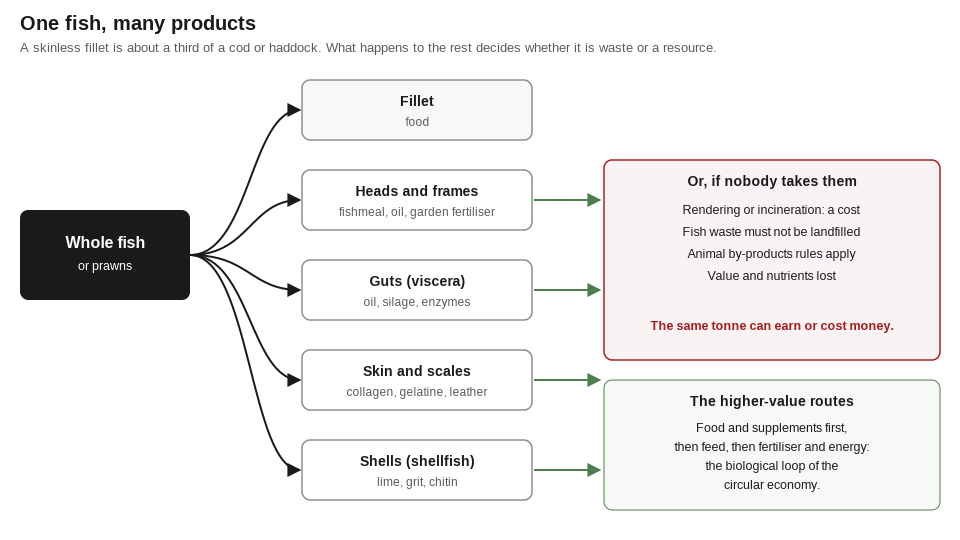
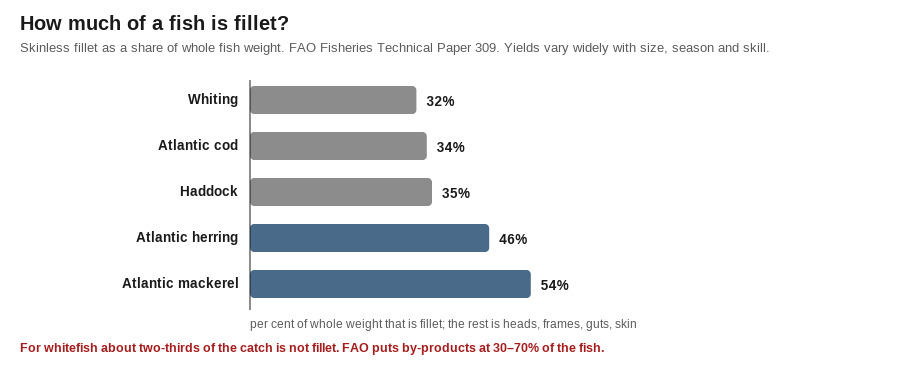
The UN Food and Agriculture Organization (FAO) puts fish processing by-products at 30–70% of the whole fish. They already matter: in 2022 by-products made up 34% of the world’s fishmeal and 53% of its fish oil (FAO, State of World Fisheries and Aquaculture 2024).
- Fish oil is concentrated in the liver and gut area.
- Collagen and gelatine come mainly from skin and scales.
- Viscera are a cheap source of enzymes, and can be made into protein hydrolysates for feed or fertiliser (Pelagia in Shetland began making the UK’s first liquid fish hydrolysate from salmon-farm by-products in 2019, according to Seafish).
- Silage: minced fish kept with a little acid, so its own enzymes turn it to a stable liquid feed.
- Anaerobic digestion turns what is left into biogas; a 2025 review of 39 studies found yields vary widely, and mixing fish waste with other feedstocks often helps.
- Garden fertiliser: fishmeal is one of the three ingredients of blood, fish and bone (below).
Blood, fish and bone
The Royal Horticultural Society lists blood, fish and bone among the animal-based organic fertilisers and recommends it as a slow-release feed for fruit. It is three by-products in one box:
- Dried blood, from abattoirs, supplies quick nitrogen (sold on its own at about 12% nitrogen).
- Fishmeal supplies nitrogen and some phosphorus.
- Bonemeal supplies phosphorus and calcium. Bone mineral is a calcium phosphate close to hydroxyapatite, Ca₁₀(PO₄)₆(OH)₂, the phosphate cousin of the calcium carbonate in shells. It dissolves slowly, which is why the phosphorus is released over months: one brand’s label declares 2.5% phosphorus, of which only 0.3% is soluble in water.
Brands differ a lot. Labels checked for this page range from NPK 5-3-5 (Levington) and 5-5-6 (Vitax) to 3-9-3 (Westland). Potassium usually comes from added potash, because animal by-products carry little of it.
Two cautions. First, the phosphorus is the same nutrient that feeds the Lough Neagh blooms, so a high-phosphorus feed should go only where a soil test says it is needed, and never near water. Second, by-product fertilisers are a carbon saving only in the sense that they recycle nitrogen and phosphorus already made, rather than fixing new nitrogen in a Haber–Bosch plant or mining new phosphate rock; no footprint for blood, fish and bone itself was found.
The chemistry of shells
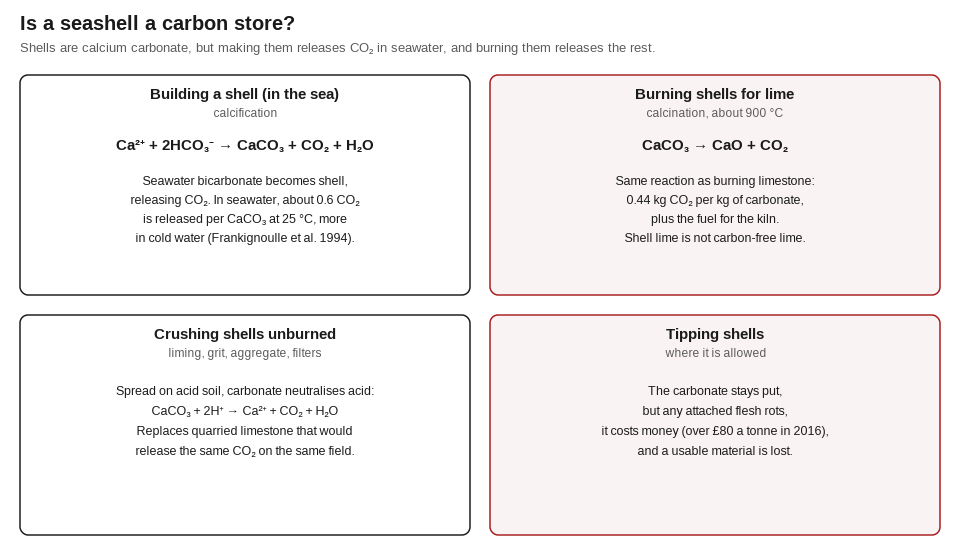
Mussel and oyster shells are 95–99.9% calcium carbonate, with a little protein holding the crystals together (Morris and colleagues, 2019). Oysters build mostly calcite; some clams build aragonite, a different crystal form of the same compound.
Building a shell releases CO₂. In seawater, carbon is mostly held as bicarbonate. To make a shell, a mussel combines calcium with bicarbonate:
Ca²⁺ + 2HCO₃⁻ → CaCO₃ + CO₂ + H₂O
Seawater’s chemistry soaks some of that up again, but not all: about 0.6 CO₂ is released for each unit of carbonate at 25 °C, and more in colder water (Frankignoulle and colleagues, 1994). On balance, growing shells pushes CO₂ towards the air, not away from it. A 2025 review by Pernet and colleagues, Cracking the myth: bivalve farming is not a CO₂ sink, concluded that the evidence does not support treating mussel or oyster farming as a carbon sink, and that field measurements are needed before any carbon credits are claimed. (A rebuttal has been published; the debate is not over.)
Burning shells releases the rest. Shell can replace limestone as a source of lime, but it is the same reaction:
CaCO₃ → CaO + CO₂
That is 0.44 kg of CO₂ for every kg of carbonate (arithmetic from the formula weights, 44 ÷ 100), plus the fuel for the kiln. Shell lime is recycled lime, not carbon-free lime.
Crushed, unburned shell is often the better use. It can replace quarried limestone for liming acid soils, as calcium grit for laying hens (where crushed oyster shell performs as well as limestone), as aggregate, or as a filter that captures phosphate and metals. One study cited by Morris found no benefit over landfill once the shell had to travel more than about 320 km, so it works best close to where it is produced.
Scientists are now testing the reverse: Goossens and colleagues (Biogeosciences, 2026) buried crushed mussel shell in seabed mud to see whether dissolving it could cancel the CO₂ released when it grew. About 6% dissolved in 24 weeks. That is research, not a market.
From prawn shell to chitosan
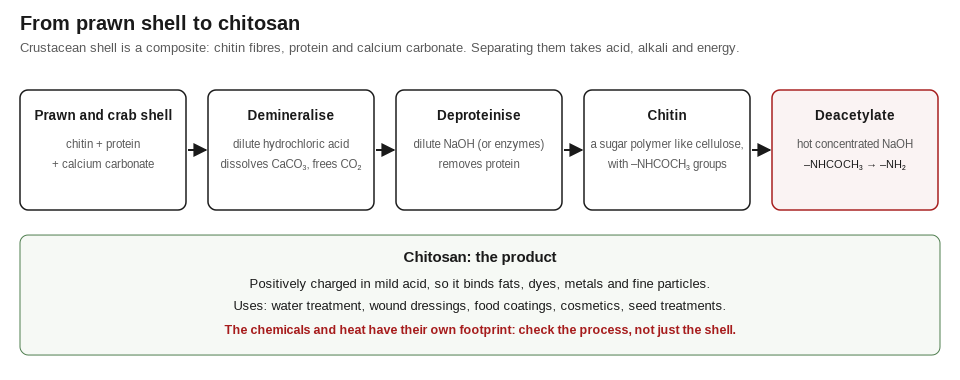
Crustacean shell is a composite: about 20–30% chitin and 30–50% calcium carbonate, with protein, fat and pigment. Chitin is the second most common natural polymer after cellulose, and looks like it, except that each sugar unit carries an acetyl-amino group (–NHCOCH₃).
- Demineralise: dilute hydrochloric acid dissolves the carbonate: CaCO₃ + 2HCl → CaCl₂ + CO₂ + H₂O.
- Deproteinise: dilute sodium hydroxide, or enzymes, removes the protein.
- Deacetylate: hot, concentrated sodium hydroxide (40–50%, around 100 °C, for hours) strips the acetyl groups, leaving amino groups (–NH₂). The product is chitosan (Younes and Rinaudo, 2015).
In mild acid those amino groups pick up a positive charge, so chitosan grabs negatively charged particles, oils, dyes and some metals. It is used in water treatment, wound dressings, food coatings and cosmetics. In Great Britain, CuanTec in Fife makes chitosan from Nephrops shell and Pennosan in Wales makes water-treatment products from crustacean shell (as reported by Seafish).
The chemicals and heat have their own footprint, so chitosan is only a good use of shell if the process is efficient. Check the process, not just the source.
The rules
(Checked 17 November 2026. Not legal advice.)
| Rule | What it says | Status in NI |
|---|---|---|
| Animal By-Products Regulation (EC) No 1069/2009, Article 10 | Aquatic animals and their parts (except sea mammals) with no signs of transmissible disease, by-products from aquatic animals at food plants, and “shells from shellfish with soft tissue or flesh” are Category 3, the lowest-risk class (Art. 10(i), (j), (k)) | Applies in NI under the Windsor Framework (on DAERA’s list, July 2026), with Regulation (EU) No 142/2011 |
| Animal By-Products (Enforcement) Regulations (NI) 2015 | How DAERA enforces the EU rules in NI | In force |
| Mixed loads | A mixture takes the highest-risk category in it | DAERA guidance |
| Organic fertilisers from animal protein, Regulation (EU) No 142/2011, Annex XI, Chapter II | Must be mixed with a component such as lime or manure so they cannot be used as feed; this does not apply to ready-to-sell packs of up to 50 kg for the final consumer, such as garden boxes of blood, fish and bone | Applies in NI with the main ABP Regulation |
| Landfill | NetRegs guidance: fish waste must not be landfilled or buried | Current guidance |
| Clean shell | Shell with no flesh appears to fall outside Category 3 | Not confirmed; ask DAERA or NIEA. No NI rule on spreading shell on land was found (Scotland has one, authorisation B6) |
| End of waste | When processed shell stops being waste | No NIEA position found |
Why it matters in Northern Ireland
- A shellfish fleet. In 2024 the NI fleet landed 50,821 tonnes of fish and shellfish worth £63.1 million; shellfish was 48.7% of the value. Nephrops (prawns, sold as scampi) is the single most valuable species: 6,279 tonnes from the western Irish Sea in 2024, from stocks the Assembly’s research service says are declining (NI Assembly research paper, 15 April 2026, citing DAERA).
- Tonnes of shell. A Kilkeel processor told UTV in June 2024 that the town’s factories produce about 1,000 tonnes of waste prawn shell a year (a news report, not an official figure).
- Shellfish farms. Mussels and Pacific oysters in the sea loughs produced just over 3,000 tonnes worth over £4 million in 2018 (AFBI), and the shell is most of the weight.
- Local research. Kilkeel Seafoods, the NI Fish Producers’ Organisation and Queen’s University were reported in 2024 to be studying prawn-shell chitosan for removing phosphate from Lough Neagh (news reports; the study itself was not found). Teagasc’s all-island AIMBio project, funded by the Shared Island Fund, has pilot sites including Rathlin Island. Queen’s used 10 tonnes of clean scallop shell to help rebuild horse mussel reef in Strangford Lough in 2010.
- Phosphate and Lough Neagh. Shell and chitosan both bind phosphate, the nutrient behind the Lough Neagh blooms. That is promising, but no product has been shown to work at the scale of the lough.
Think of a box of blood, fish and bone
Most gardeners already own a fish by-product: the box of blood, fish and bone in the shed.
| A box of blood, fish and bone | The by-product economy |
|---|---|
| Dried blood: quick-acting nitrogen | Blood from abattoirs, a Category 3 by-product |
| Fishmeal: nitrogen and some phosphorus | Heads, frames and guts, cooked, dried and ground |
| Bonemeal: slow-release phosphorus and calcium | Bone mineral, a calcium phosphate: the phosphate twin of a shell’s carbonate |
| Potash added to balance the mix | Animal by-products carry little potassium |
| The NPK figures on the label | The value is in the nutrients, measured and declared |
| “Dogs may dig it up” on the pack | Why animal by-products come with rules |
| Sprinkled on the vegetable patch | The biological loop: nutrients back to the soil |
Examples
Food and drink
A prawn processor with a shell problem
A County Down processor tails Nephrops and pays to get rid of the heads and shell.
Options, in order of value: sell or partner for chitosan, oil or pigment (the head waste holds oil, up to about 11.5% in summer in one study); supply a protein and feed processor; send it to anaerobic digestion; rendering as the last resort. All of it stays Category 3 animal by-product while flesh is attached, so it must move with the right paperwork to an approved plant.
The lesson: volume and steady supply decide which route works. Several processors together are a better partner for a chitosan plant than one.
Agriculture and food
A mussel farm and a tillage farm
A mussel farm has cleaned, crushed shell; a nearby farm buys ground limestone to lime its fields.
What the chemistry says: spread on acid soil, shell does the same job as limestone and releases the same CO₂ as it neutralises the acid. The gain is not a carbon store: it is avoided quarrying, avoided waste disposal and short haulage. Check first with DAERA whether shell with any flesh on it can go to land in NI, and how it must be treated.
The lesson: sell it as a local liming product, not as a carbon credit.
Public sector
A council with a harbour
A council owns a fishing harbour and is asked to back a by-products hub.
What to weigh: steady tonnages from local processors; an approved site under the animal by-products rules; markets for oil, protein, shell and chitosan; and the costs of transport. Councils can also buy the products, such as shell-based filter media or chitosan for water treatment, once they are proven.
The lesson: the business case comes from collection at scale and local buyers. Carbon is a co-benefit, counted honestly.
Common mistakes
- “Shells lock up carbon.” Making them released CO₂ in the sea; burning them releases the rest.
- “Shell lime is zero-carbon lime.” It gives off the same 0.44 kg of CO₂ per kg of carbonate as limestone.
- “It is just waste.” In law it is an animal by-product until the flesh is gone, with rules on how it moves.
- “Chitosan is always green.” The acid, alkali and heat count too.
- “Mussel farms earn carbon credits.” The evidence does not support it yet.
- Forgetting transport. Shell is heavy; beyond a few hundred kilometres the benefit can vanish.
Previous: The circular economy is a life cycle too · Next: Medicines and fossil fuels · Related: From acid rain to acid seas
Sources
Checked 17 November 2026.
- Scale and uses: FAO, Fish by-products utilization (25 April 2021) · FAO, State of World Fisheries and Aquaculture 2024 (2022 data) · FAO Fisheries Technical Paper 309, yield and nutritional value of fish species, table 1 · Ideia et al. 2019, Waste and Biomass Valorization, doi:10.1007/s12649-019-00739-1 (viscera about 5%; oil, collagen, enzymes) · Seafish, Driving a circular economy in seafood supply chains · Shandu et al. 2025, Environmental and Climate Technologies 29(1), doi:10.2478/rtuect-2025-0070 (fish waste biogas review).
- Shells and carbon: Morris, Backeljau and Chapelle 2019, Shells from aquaculture, Reviews in Aquaculture 11 · Pernet et al. 2025, Cracking the myth: bivalve farming is not a CO₂ sink, Reviews in Aquaculture 17 · Frankignoulle, Canon and Gattuso 1994, Limnology and Oceanography 39 (the CO₂ released by calcification; as implemented in the seacarb package) · Goossens et al. 2026, Biogeosciences 23, doi:10.5194/bg-23-6447-2026.
- Chitin and chitosan: Younes and Rinaudo 2015, Chitin and chitosan preparation from marine sources, Marine Drugs 13 · Kou, Peters and Mucalo, Chitosan: a review of sources and preparation methods (University of Waikato) · Blood, fish and bone: RHS, Fertilisers and garden jobs: fertilisers · product labels: Vitax (5-5-6; phosphorus 0.3% water-soluble, 2.2% acid-soluble), Levington (5-3-5), Westland (3-9-3, retailer listing) · Regulation (EU) No 142/2011, Annex XI, Chapter II (mixing rule and 50 kg exemption) · Nephrops head oil: Marine Drugs, December 2016.
- Rules: Regulation (EC) No 1069/2009, Article 10 (EUR-Lex) · DAERA, Windsor Framework legislation list (July 2026) · DAERA, Animal products general guidance · Seafish, Animal by-products: handling, use and disposal · NetRegs, Fish waste disposal · Scottish Government, authorisation B6, crustacean shells to land (Scotland only).
- Northern Ireland: NI Assembly Research and Information Service, NI’s marine and freshwater fish stock health (15 April 2026, citing DAERA) · AFBI, Shellfish management · ITV/UTV, prawns and Lough Neagh (11 June 2024; news) · Teagasc, Fishing for value (16 December 2025) · Queen’s University, shell cultch deployment, Strangford Lough.
- Not checked against a primary source: that clean shell falls outside Category 3; any NI rule on spreading shell; the 1,000 tonnes of Kilkeel prawn shell; port-by-port landings; fish silage details (the source found is marked “do not quote”); the calcification and calcination equations and the bone-mineral formula (standard chemistry); the 12% nitrogen of dried blood (supplier labels); that the potassium in blood, fish and bone comes from added potash. The examples are illustrative.
Facts and definitions last checked against the standards and official sources on 17 November 2026. General information, not legal, tax or customs advice.