
Medicines and fossil fuels
In short
Most synthetic medicines are built from carbon that started as oil or gas, and so are most syringes, drips and blister packs. But the carbon in the tablet is tiny. The footprint comes from making it: many reaction steps, large volumes of solvent and energy. In England medicines are about a quarter of the NHS footprint, and a few products, such as some inhalers and anaesthetic gases, warm the planet directly when used. Never change a medicine for carbon reasons without a clinician.
The paracetamol in your cupboard started as crude oil or natural gas. So did most of the plastic in a hospital: the syringe, the drip bag, the blister pack. Medicine is one of the least visible ways we depend on fossil fuels, and one of the hardest to replace.
That is no reason to feel guilty about taking a tablet. It is a reason to understand where the carbon actually sits, because it is rarely where people expect. The atoms in the pill matter little. The way it is made matters a lot, and a few medicines release warming gases when they are used.
This page is about carbon, not treatment. Nothing here is medical advice. Anyone who uses an inhaler or other medicine should keep using it as prescribed, and talk to their GP, nurse or pharmacist before any change.
In short
| The molecule | Making it | Using it | |
|---|---|---|---|
| Where the carbon is | A few carbon atoms per molecule, mostly from oil or gas | Energy, solvents, many reaction steps, waste | Mostly none, except propellants and anaesthetic gases |
| Size | Small | Usually the largest part | Large for a few products |
| Who can change it | Chemists, over years | Manufacturers and suppliers | Clinicians and patients, together |
From oil and gas to the medicine cabinet
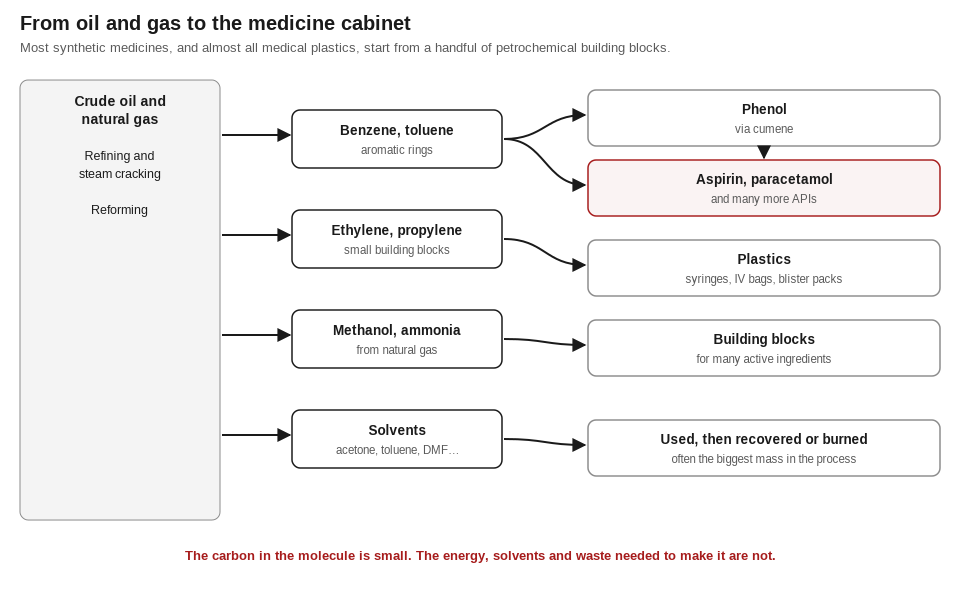
The chemical industry takes about 11% of the world’s oil and 8% of its gas, and more than half of that is used as raw material, not fuel (International Energy Agency, figures for 2015). Medicines are a small slice of that, but they draw on the same building blocks:
- Benzene and toluene, the ring-shaped molecules at the heart of many drugs.
- Ethylene and propylene, the small units that make plastics and many reagents.
- Methanol and ammonia, made from natural gas.
- Solvents such as acetone and toluene, used in large volumes and then recovered or burned.
No reliable figure was found for the share of medicines made from fossil feedstocks. The safe statement is that most synthetic small-molecule medicines are built from carbon that started as oil or gas. Medicines made by fermentation or from plants, and biological medicines such as vaccines and antibodies, follow different routes, though they still use fossil-derived energy, plastics and chemicals.
Two everyday medicines
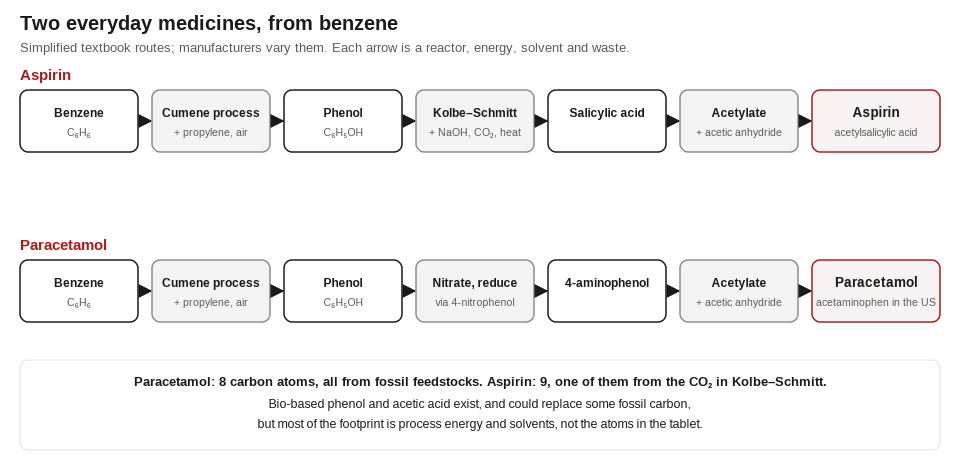
Aspirin (acetylsalicylic acid, C₉H₈O₄) on the classic route:
- Benzene to phenol by the cumene process: benzene and propylene make cumene, which is oxidised by air and split into phenol and acetone.
- Phenol to salicylic acid by the Kolbe–Schmitt reaction: sodium phenoxide is heated with CO₂ under pressure. Medicine-making that uses CO₂ as a raw material is not new.
- Acetylation: salicylic acid + acetic anhydride → aspirin + acetic acid.
Paracetamol (C₈H₉NO₂) is commonly made by nitrating phenol, reducing the product to 4-aminophenol, and acetylating that with acetic anhydride. Some plants start from nitrobenzene instead.
Almost every carbon atom on these routes traces back to oil or gas; in aspirin, one of the nine comes from the CO₂ used in the Kolbe–Schmitt step. Bio-based phenol and acetic acid exist, but they would change only a small part of the footprint, because most of it is in the process.
The real footprint: making it
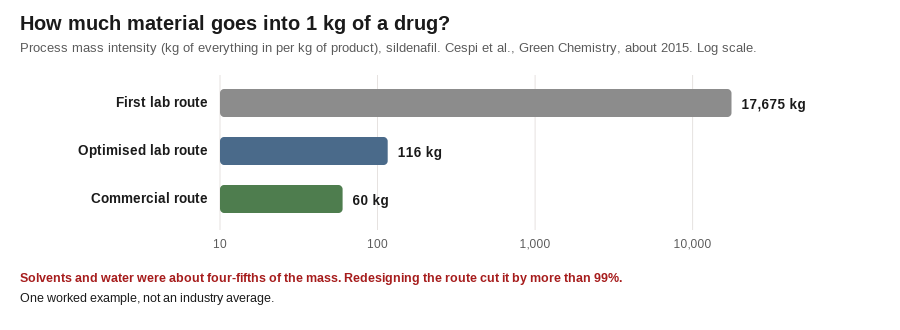
Chemists measure efficiency with process mass intensity (PMI): the total kilograms of everything that goes in (raw materials, reagents, solvents, water) for each kilogram of finished active ingredient.
In one published case (Cespi and colleagues, Green Chemistry), the first laboratory route to sildenafil used 17,675 kg of material per kg of drug. The commercial route used 60 kg. Solvents and water were about four-fifths of the mass. Each kilogram of solvent has to be made, heated, recovered or burned, so PMI is a good guide to carbon.
That is why the green chemistry principles (Anastas and Warner, 1998) focus on fewer steps, catalysts instead of excess reagents, safer and recycled solvents, and lower temperatures. Continuous manufacturing, solvent recovery and electric process heat all help, though none were checked against a primary source for this page.
For the industry as a whole, Belkhir and Elmeligi (Journal of Cleaner Production, 2019) found pharmaceutical companies emitted about 55% more greenhouse gas per million dollars of revenue than car makers, using 2015 data from a small sample of companies. It is a rough comparison, but it shows the sector is not a light user of energy.
The life cycle of a medicine
Inhalers and anaesthetic gases
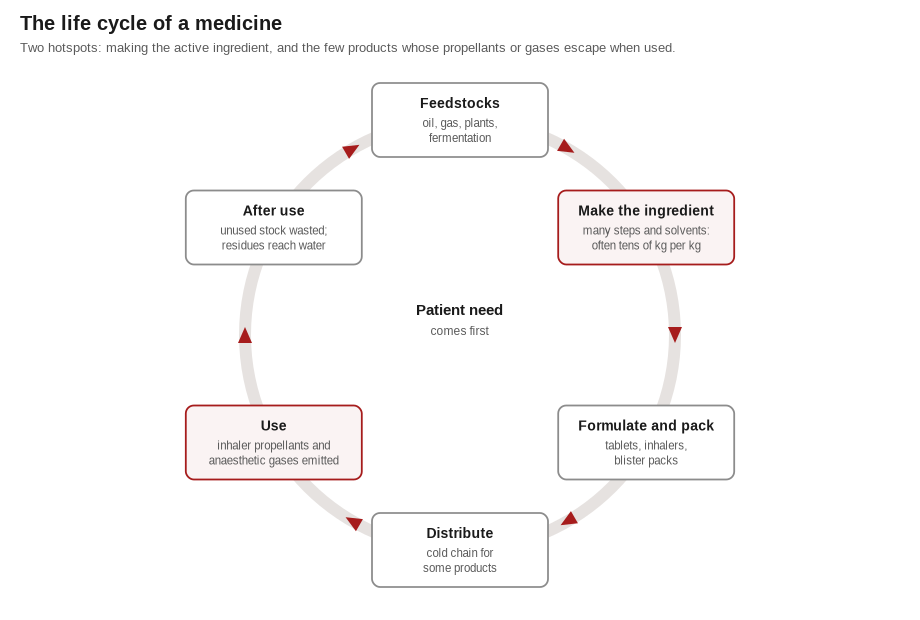
A few medicines are greenhouse gases themselves, or are pushed out by one.
- Metered-dose inhalers (the “puffer” type) use a propellant, usually the HFC gases HFA-134a or HFA-227ea, which escapes with every puff. Dry-powder inhalers have no propellant and a far smaller footprint. NICE’s patient decision aid (2019) put the difference at an order of magnitude or more, but says people who need a metered-dose inhaler should absolutely keep using one; switching is a decision to make with a clinician where more than one inhaler suits.
- New propellants are arriving. The UK medicines regulator, the MHRA, approved Chiesi’s Clenil Modulite beclometasone inhalers using the lower-warming propellant HFA-152a, describing them as the world’s first lower-carbon beclometasone inhalers (21 July 2026). GSK filed an EU application for a lower-carbon Ventolin on 4 September 2026, claiming about 92% lower emissions per inhaler, with launches from 2027 if approved. No UK approval for it was found.
- Desflurane, an anaesthetic gas, warms the climate about 2,500 times as much as the same weight of CO₂ (NHS England). The NHS in England committed in January 2023 to end its routine use by early 2024, avoiding about 40,000 tonnes of CO₂e a year. Sevoflurane, the usual alternative, has a GWP of about 195; nitrous oxide 273 (IPCC AR6 values as cited in 2025 research).
For what GWP means, see CO₂e and global warming potential.
The rules
(Checked 17 November 2026.)
| Rule | What it does | In NI? | Status |
|---|---|---|---|
| EU F-gas Regulation (EU) 2024/573, Art. 13(8) | Bans desflurane as an anaesthetic unless strictly necessary on medical grounds; the hospital must keep the justification | Yes, under the Windsor Framework (DoH NI impact assessment, 2024) | Ban from 1 January 2026 |
| Same Regulation | Ends the quota exemption for metered-dose inhalers; adds labelling; phases HFCs out by 2050 | Yes | In force 11 March 2024 (published 20 February 2024) |
| GB F-gas rules | Separate regime for England, Scotland and Wales | No | Whether GB restricts desflurane or inhalers was not checked |
| NHS Net Zero Supplier Roadmap | Carbon reduction plans for NHS England suppliers, proportionate for all new contracts since April 2024; product-level footprints to follow; NHS will stop buying from suppliers not meeting its net zero commitment by 2030 | Applies to NI firms that sell to NHS England | Latest version June 2026; the April 2027 milestones were not checked |
| UK-wide medicine licences | MHRA licences cover NI under the Windsor Framework | Yes | From 1 January 2025 |
Why it matters in Northern Ireland
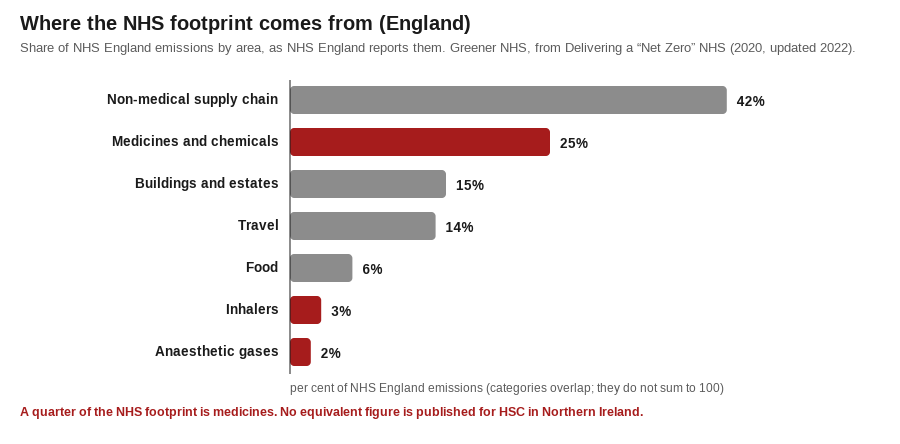
- No HSC figure. NHS England publishes its footprint by area; no equivalent breakdown was found for Health and Social Care in Northern Ireland. The Department of Health’s Valuing Medicines strategy (September 2025) covers about £875 million a year of medicines spending but gives no carbon figures.
- Desflurane has mostly gone. HSC organisations reported in 2023 that its use had mainly stopped (Department of Health impact assessment, 2024). The EU ban now applies in NI from 1 January 2026.
- Two rulebooks. NI hospitals follow the EU F-gas Regulation; hospitals in Great Britain follow GB rules. Suppliers working across both need to know which applies.
- A life-science base. NI makes and develops medicines and diagnostics for UK and world markets. Firms selling into the NHS in England already face the supplier roadmap, and big pharmaceutical customers are asking their suppliers for product carbon footprints.
- Fewer wasted medicines. The biggest carbon saving from a medicine is one that did not need to be made: unused, out-of-date and returned stock. Valuing Medicines targets waste for cost reasons; the carbon benefit follows.
Think of a cake again
| A cake | A medicine |
|---|---|
| Flour, sugar and eggs | Petrochemical building blocks |
| The cake on the plate | The active ingredient in the tablet |
| Gas for the oven, hours of mixing | Energy for many reaction steps |
| The washing-up | Solvents: often most of the mass |
| A better recipe with fewer bowls | Green chemistry: fewer steps, less solvent |
| Candles that burn when you serve it | Propellants and anaesthetic gases released in use |
| A cake nobody eats | Wasted medicines: all the footprint, none of the benefit |
Examples
Manufacturing
An NI medicines maker asked for a product footprint
A County Antrim manufacturer supplies a generic tablet to NHS England and is asked for a carbon reduction plan and, later, a product carbon footprint.
What to do: measure the process mass intensity and energy use of each step; get footprints from suppliers of the active ingredient and solvents (usually the biggest items); and set out a plan covering solvent recovery, heat and power, and route improvements. Check which requirements apply from April 2027 in the NHS’s milestone document.
The lesson: in this sector the footprint sits upstream with the chemistry. Ask for supplier data now; it takes time to get.
Public sector
A health trust looking at anaesthetic gases
A trust wants to cut the climate impact of its theatres.
What the evidence says: desflurane is now banned in NI except where strictly necessary on medical grounds. The next items are nitrous oxide, much of which is lost through leaks from piped systems rather than given to patients (not checked against a primary source here), and the choice of sevoflurane or intravenous anaesthesia where clinicians judge it suitable.
The lesson: fix the leaks first; it saves gas and money without changing any patient’s care.
Healthcare and the home
A pharmacy and inhaler reviews
A community pharmacy wants to help patients whose asthma is poorly controlled.
What to know: a patient whose asthma is well controlled needs fewer reliever inhalers, and that is often one of the largest carbon savings available. Where a clinician and patient agree that a dry-powder inhaler suits, it has a much lower footprint. Lower-carbon propellants are starting to reach the market. Used inhalers should be returned to a pharmacy, not thrown in the bin, so the remaining gas can be dealt with.
The lesson: good care and lower carbon point the same way. The patient’s needs come first, every time.
Common mistakes
- “My tablets are a big part of my footprint.” For most people they are not; a few products, such as some inhalers, are the exceptions.
- Changing an inhaler on your own to cut carbon. Never without a clinician.
- “Bio-based ingredients will fix it.” Most of the footprint is the process and solvents, not the atoms.
- “Medicines are exempt from climate rules.” Desflurane is restricted, inhaler propellants are being phased down, and NHS suppliers face carbon requirements.
- Assuming GB and NI rules are the same. The EU F-gas Regulation applies in NI; GB has its own.
Previous: Fish guts and seashells · Next: Fracking: what is burned and what leaks · Related: Hydrogen by colour · Why is everything counted as “carbon”?
Sources
Checked 17 November 2026.
- Feedstocks: International Energy Agency, From energy to chemicals (2018; 2015 data) · Vitanza et al. 2025, One Health Advances 3:36 (medicines’ raw materials often non-renewable).
- Process mass intensity: Cespi et al., Life cycle inventory improvement in the pharmaceutical sector, Green Chemistry (about 2015; sildenafil).
- Industry footprint: Belkhir and Elmeligi 2019, Journal of Cleaner Production 214, 185–194, doi:10.1016/j.jclepro.2018.11.204 (via McMaster University).
- NHS: NHS England, Greener NHS: areas of focus · NHS England, Putting anaesthetic emissions to bed (January 2023) · NHS England, Net Zero Supplier Roadmap (June 2026).
- Inhalers: Pharmaceutical Journal, NICE decision aid on greener inhalers (8 April 2019) · MHRA, lower-carbon beclometasone inhalers approved · GSK, EU submission for lower-carbon Ventolin (4 September 2026; company statement).
- Anaesthetic GWPs: Espinosa et al. 2025, updated GWPs of isoflurane and sevoflurane, Environmental Science: Processes & Impacts.
- Rules and NI: Regulation (EU) 2024/573 (Article 13(8)) · Department of Health NI, F-gas impact assessment for the Windsor Framework Democratic Scrutiny Committee (2024) · Department of Health NI, Valuing Medicines strategy launched (September 2025).
- Not checked against a primary source: the aspirin and paracetamol routes (standard textbook chemistry); the share of medicines from fossil feedstocks; nitrous oxide losses from piped systems; the GB F-gas position; the NHS supplier roadmap’s April 2027 milestones; green chemistry methods beyond the sildenafil example. The examples are illustrative.
Facts and definitions last checked against the standards and official sources on 17 November 2026. General information, not legal, tax or customs advice.