
Fracking: what is burned and what leaks
In short
Fracking cracks open shale rock deep underground to release natural gas, which is mostly methane. Burned, a kilogram of methane makes 2.74 kg of CO₂, less than coal for the same electricity. Leaked, the same kilogram counts as 28–30 kg of CO₂e over 100 years and over 80 over 20. So the leaks decide whether shale gas is a cleaner bridge or not. Northern Ireland has never fracked; a Bill to end all onshore oil and gas licensing, fracking included, completed its Further Consideration Stage on 17 November 2026; its Final Stage is still to come.
Few words in energy policy start an argument faster than fracking. For its supporters it is a home-grown fuel that helped the United States cut its power-sector emissions. For its opponents it means leaking methane, earthquakes and water risks, and decades more fossil fuel. In Fermanagh it brought out some of the largest protests in recent Northern Ireland history.
This page sets out what fracking is, what is burned and what leaks, and what the evidence says on each side, with dates. It is not legal advice, and it makes no allegations about any company or person.
In short
| Burning the gas | Leaking the gas | |
|---|---|---|
| What happens | CH₄ + 2O₂ → CO₂ + 2H₂O | Methane escapes unburned |
| Per kg of methane | 2.74 kg CO₂ | 28 kg CO₂e (100 years, AR5); 82.5 (20 years, AR6) |
| Where | Power station, boiler, factory | Wells, flowback, pipes, compressors, old wells |
| How well measured | Well: it is in the fuel bills | Poorly: inventories often undercount |
| Can it be cut? | Only by burning less gas | Yes, often cheaply: fix leaks, stop venting and flaring |
What fracking is
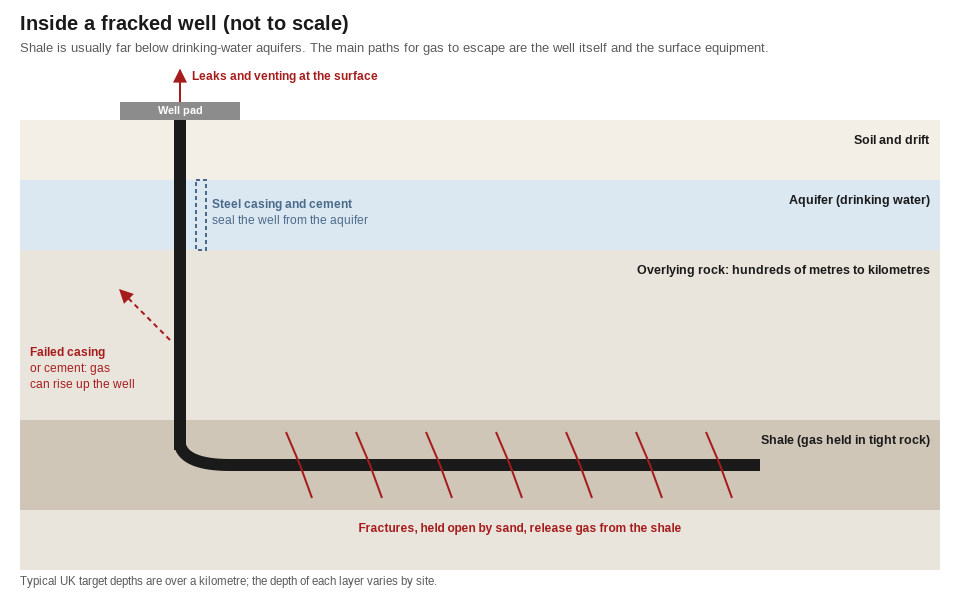
Shale is a fine-grained rock that holds gas in pores too tight for it to flow on its own. Hydraulic fracturing pumps fluid down a well at high pressure to crack the rock, and sand props the cracks open so gas can flow back up. Modern wells drill down and then sideways along the shale for long distances.
The fluid is mostly water and sand. The Royal Society and Royal Academy of Engineering (June 2012) gave a typical mix of about 94.6% water, 5.2% sand and 0.17% additives such as acids, scale inhibitors and biocides. What comes back up, the flowback and later produced water, carries salts and naturally occurring radioactive materials from deep rock, and has to be treated as waste; in England an operator needs a radioactive substances permit before production.
What is burned
Shale gas is mostly methane. Burned:
CH₄ + 2O₂ → CO₂ + 2H₂O
Every 16 g of methane makes 44 g of CO₂, so 1 kg of methane gives 2.74 kg of CO₂, or about 0.18 kg CO₂ per kWh of heat (gross calorific value; about 0.20 on net) (my arithmetic for pure methane, close to the government’s factor for natural gas). That is the CO₂ that shows on a gas bill.
Gas has less carbon per unit of energy than coal, and gas power stations are more efficient. The US Energy Information Administration found gas generation emits roughly 40% of the CO₂ of coal for the same electricity, and US power-sector CO₂ in 2015 was 21% below 2005, mainly because gas and renewables displaced coal.
Supporters also make an energy-security case: when the UK Government lifted England’s pause in September 2022, it framed the decision as part of boosting domestic energy production and energy security.
What leaks
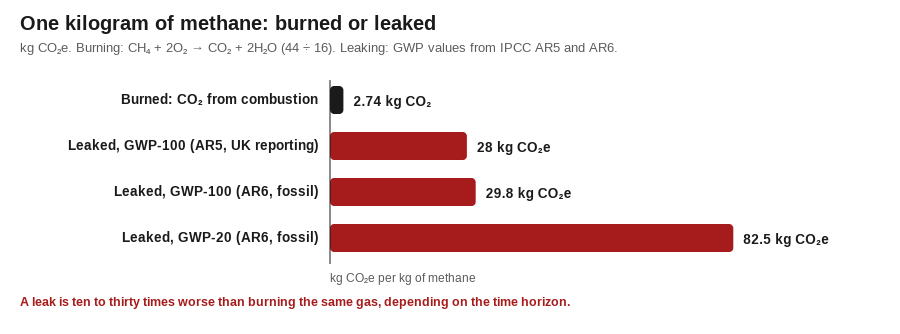
Methane that escapes before it is burned is a far stronger greenhouse gas than the CO₂ it would have become, although it lasts only about 12 years in the air (see CO₂e and global warming potential). So the climate case for gas depends heavily on how much leaks.
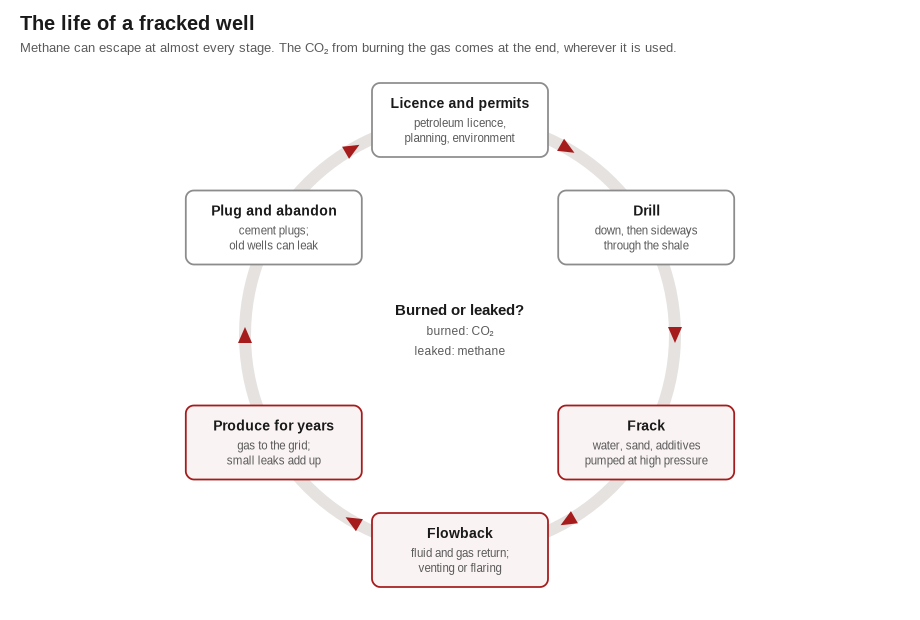
- The US supply chain. Alvarez and colleagues (Science, June 2018) measured methane across the US oil and gas supply chain and found about 2.3% of gross gas production escaped in 2015, about 60% more than the official inventory, mostly from abnormal conditions and equipment faults that inventories miss. Over 20 years, they found, that leaked methane warms about as much as the CO₂ from burning the gas (they compared radiative forcing over 20 years; the simpler GWP-20 arithmetic in the chart below gives a little less).
- A few big leakers. Brandt and colleagues (Science, February 2014) found official US figures were too low, and that a tiny share of sources gave a large share of leaks. They still found switching power stations from coal to gas beneficial over 100 years.
- Worldwide. The International Energy Agency’s Global Methane Tracker 2026 puts the global average upstream methane intensity of oil and gas at about 1%, and says about 30% of fossil-fuel methane could be avoided at no net cost. (That is a narrower measure than the 2.3% US supply-chain figure, so the two are not directly comparable.)
- Exported gas. Howarth (Energy Science & Engineering, October 2024) estimated that US liquefied natural gas shipped abroad has a footprint 33% greater than coal on a 20-year basis. Critics, including the Breakthrough Institute (a think tank, not peer reviewed), argued an earlier draft overstated it; the final paper changed some assumptions. The debate continues.
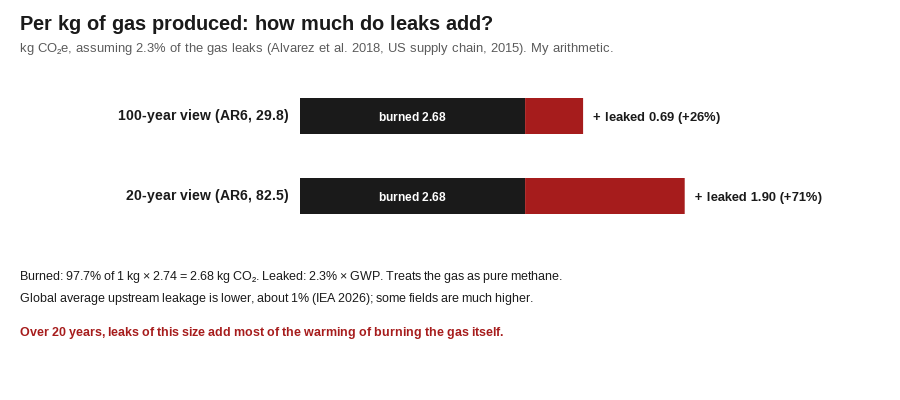
Wells themselves. Davies and colleagues (Marine and Petroleum Geology, 2014) reviewed 25 sets of data and found the share of wells with some failure of a barrier or of well integrity ranged from 1.9% to 75%, depending on how it was defined. A failed barrier is not always a leak to the surface, but it is the main route for gas to escape underground.
Earthquakes and water
Earthquakes. Fracking at Preese Hall near Blackpool caused tremors of magnitude 2.3 on 1 April 2011 and 1.5 on 27 May 2011, which the British Geological Survey and a government review linked to fluid injected near a fault. From December 2012 England used a “traffic light” system that paused work at magnitude 0.5. At Preston New Road in Lancashire a magnitude 2.9 tremor on 26 August 2019 stopped operations, and on 2 November 2019 the government imposed a moratorium in England, saying it was not possible to predict the size or likelihood of fracking tremors.
Water. The US Environmental Protection Agency’s final assessment (December 2016) found fracking activities can affect drinking water under some circumstances, mostly through spills, faulty wells, poorly treated wastewater and water taken in dry areas, but data gaps meant it could not say how often. The Royal Society and Royal Academy of Engineering (2012) judged that cracks reaching aquifers from depth were very unlikely, and that the main risks were faulty wells and surface spills, which could be managed with good regulation.
The rules
(Checked 17 November 2026. Not legal advice.)
| Place | Position | Dates |
|---|---|---|
| Northern Ireland | Petroleum Exploration and Licensing (Repeal) Bill: removes the Department for the Economy’s power to grant onshore petroleum licences, ending all onshore oil and gas exploration and production, including fracking | Introduced 13 April 2026 (NIA Bill 31/22-27); Further Consideration Stage completed 17 November 2026, with no amendments tabled; Final Stage (not yet scheduled) and Royal Assent to come. Once enacted: the Petroleum Exploration and Licensing (Repeal) Act (Northern Ireland) 2026 |
| Northern Ireland, meanwhile | No new licence applications accepted or processed (administrative pause); planning policy presumes against unconventional hydrocarbon extraction | Pause since 29 April 2024 (Executive endorsed 5 December 2024); SPPS since September 2015 |
| England | Moratorium on fracking. The Energy Independence Bill (Bill 176, as introduced) does not name fracking: it works through licensing, and in the English onshore area would allow new “transitional energy certificates” only where getting petroleum is incidental to carbon dioxide storage, gas storage or geothermal energy | Moratorium from 2 November 2019, lifted 22 September 2022, reinstated 27 October 2022; Bill announced 13 May 2026, before Parliament (stage not checked) |
| Scotland | Moratorium from January 2015; the Scottish Government does not support unconventional oil and gas | Policy confirmed October 2019 |
| Wales | Does not support fracking | Statement December 2018 |
| Republic of Ireland | Onshore fracking banned by law (Act No. 15 of 2017) | 6 July 2017 |
Why it matters in Northern Ireland
- Never fracked. Onshore exploration in NI goes back to 1965, with 18 exploration wells and no commercial production (NI Assembly Research and Information Service, April 2026).
- Fermanagh. One of four licences granted in 2011 covered parts of Fermanagh and drew strong local opposition. The Environment Minister refused planning permission for an exploratory borehole in August 2014, and the licence was terminated in October 2014. Two applications made in 2016, for areas around Lough Neagh and the Lough Allen Basin, were never decided.
- Woodburn, near Carrickfergus. An exploratory oil well was drilled in Woodburn Forest from 10 March to 16 June 2016, on land owned by NI Water. No oil was found and the site was restored by September 2016. NI Water said the work would not involve fracking. A judicial review by a local resident was dismissed in August 2017 because the works were over.
- The public view. The Department for the Economy’s 2024 consultation drew 382 responses, 95% of which backed a moratorium and ban. Research for the Department in 2021 concluded onshore production would not bring significant local economic benefit or lower prices.
- Climate law. The Climate Change Act (Northern Ireland) 2022 sets net zero by 2050 and 80% renewable electricity by 2030; NI reached 47% in the 12 months to December 2025. The Department says the Bill fits that law.
- NI still burns gas. Ending local production does not end local use. Gas used in NI comes in by pipeline, so its leaks happen elsewhere: they are part of the footprint all the same.
Think of a leaking fuel can
| A fuel can | Shale gas |
|---|---|
| Petrol you burn in the mower | Gas you burn for heat or power: 2.74 kg CO₂ per kg |
| Petrol that drips from a cracked can | Methane that leaks before it is burned |
| The drip is small, but the fumes are worse than the exhaust | A small leak can outweigh much of the CO₂ benefit |
| You only notice the drips if you look | Leaks are often missed by inventories |
| Fix the can and the mower is fine | Fix leaks and stop venting, and gas is cleaner |
| Buy a battery mower | Use less gas altogether |
Examples
Manufacturing
A factory comparing fuels
A County Antrim manufacturer compares the footprint of its gas boilers with a switch to heat pumps.
What to know: its reported Scope 1 emissions use the government’s factor for burning gas. The leaks happen upstream, in someone else’s supply chain, and appear only in Scope 3 (fuel- and energy-related activities, the “well-to-tank” factors). Both are real.
The lesson: count the well-to-tank emissions too. They make the case for electrifying heat a little stronger than Scope 1 alone suggests.
Public sector
A council asked about a gas licence
A council receives questions from residents about whether fracking could come to its area.
What to say: the Department for the Economy has not accepted or processed licence applications since April 2024, planning policy presumes against unconventional extraction, and a Bill to end onshore licensing altogether completed its Further Consideration Stage on 17 November 2026. Check its final stages before giving a firm answer.
The lesson: answer with dates and stages, not slogans. The position is about to become law, but is not law yet.
Energy and industry
A buyer of imported gas
A business with a large gas contract wants to understand the climate footprint of its supply.
What to ask: where the gas comes from; whether it arrives as liquefied gas or by pipeline; and whether the producer reports methane intensity to a recognised standard, such as the UN’s Oil and Gas Methane Partnership 2.0 (not checked for this page). A supplier with low measured leakage is genuinely lower-carbon.
The lesson: gas is not one product. Its footprint depends on the leaks along its route.
So, is fracking cleaner than coal?
| Claim | Verdict |
|---|---|
| Burning gas emits less CO₂ than burning coal for the same electricity | True: about 40% of coal’s CO₂ for US power stations |
| Switching US power from coal to gas cut emissions | True, alongside renewables |
| Leaks can wipe out the advantage over coal | On a 20-year view, at high leak rates, yes; over 100 years, gas usually stays ahead for power. Howarth (2024) argues exported LNG equals or exceeds coal even over 100 years; this is disputed |
| Fracking contaminates drinking water | Under some circumstances, mostly spills and faulty wells, not cracks from depth (US EPA 2016; Royal Society and RAEng 2012) |
| Fracking causes earthquakes | True for small tremors in Lancashire; usually minor, but hard to predict |
| Fracking would cut NI energy prices | Not supported by research for the Department for the Economy (2021) |
| NI has banned fracking | Not yet in law: the Bill completed its Further Consideration Stage on 17 November 2026; Final Stage and Royal Assent to come |
Common mistakes
- Counting only the CO₂ from burning. The leaks can add a quarter or more.
- Quoting one leak rate as “the” rate. Leakage varies hugely by field, operator and measurement method.
- Mixing time horizons. Say whether a comparison uses 20 or 100 years.
- “Fracking poisons the water table.” The evidence points mainly to surface spills and faulty wells.
- “Ending fracking ends gas use.” NI still burns imported gas, and its leaks count.
Previous: Medicines and fossil fuels · Next: Contrails and “chemtrails” · Related: Hydrogen by colour
Sources
Checked 17 November 2026.
- Process and risks: Royal Society and Royal Academy of Engineering, Shale gas extraction in the UK (June 2012) · Environment Agency, radioactive substances permits for onshore oil and gas (updated 23 January 2020; England).
- Combustion and coal comparison: US EIA, Today in Energy, 13 May 2016.
- Leaks: Alvarez et al. 2018, Assessment of methane emissions from the US oil and gas supply chain, Science · Brandt et al. 2014, Methane leaks from North American natural gas systems, Science 343 · IEA, Global Methane Tracker 2026 · Howarth 2024, Energy Science & Engineering 12(11), doi:10.1002/ese3.1934 · Breakthrough Institute, critique of the preprint (think tank; not peer reviewed) · Davies et al. 2014, Oil and gas wells and their integrity, Marine and Petroleum Geology 56.
- Earthquakes: British Geological Survey, Blackpool earthquakes · Written Ministerial Statement, exploration for shale gas (13 December 2012) · GOV.UK, Government ends support for fracking (2 November 2019) · Energy Update written statement (22 September 2022) · Shale gas exploration statement, 27 October 2022 (read via a transcript) · Energy Independence Bill (Bill 176, as introduced; Part 9 and new section 2E of the Petroleum Act 1998) · GOV.UK, Energy Independence Bill factsheet (4 November 2026).
- Water: US EPA, final report on hydraulic fracturing and drinking water (13 December 2016).
- Northern Ireland: NI Assembly, Official Report, 17 November 2026 (Further Consideration Stage; no amendments; Bill referred to the Speaker) · NI Assembly, Bill as introduced · NI Assembly, Petroleum Exploration and Licensing (Repeal) Bill and its Explanatory and Financial Memorandum · NI Assembly Research and Information Service, Key considerations (21 April 2026) · Department for the Economy, ban proposed (29 April 2024), Executive endorsement (5 December 2024) and Bill approved (26 February 2026) · High Court judgment [2017] NIQB 75 (Judiciary NI) · NI Water, exploratory drilling at Woodburn Forest (24 February 2016).
- Republic of Ireland: Petroleum and Other Minerals Development (Prohibition of Onshore Hydraulic Fracturing) Act 2017.
- Not checked against a primary source: the 0.18 kg CO₂ per kWh figure (my arithmetic; check the current DESNZ factor); the Scotland and Wales positions (from the Assembly research paper); the current stage of the Energy Independence Bill; the statutory fluid-volume thresholds that define fracking in England; the UN methane partnership mentioned in an example; the 2021 economic research (as summarised in the Bill’s memorandum). The examples are illustrative.
Facts and definitions last checked against the standards and official sources on 17 November 2026. General information, not legal, tax or customs advice.