
Acid rain to acid seas
In short
Acid rain came from sulphur and nitrogen oxides, mostly from burning coal, and Europe largely fixed it: UK sulphur dioxide emissions fell by about 99% between 1970 and 2024. Ocean acidification comes from carbon dioxide dissolving into the sea, and it is still getting worse. Together with melting ice, darker water and a projected weakening of the Atlantic circulation, it shows how warming changes the sea, and how the sea changes warming.
In the 1970s and 1980s, Scandinavian lakes lost their fish and German forests began to die. The culprit was acid rain, and much of the pollution came from British and European power stations. Within a generation it was largely fixed. It is one of environmental policy’s real success stories.
The sea now faces a slower, wider version of the same problem, caused not by sulphur but by carbon dioxide. This page follows the chain from one to the other, and on to the ice, the light and the currents of the North Atlantic.
Two kinds of acid, side by side
| Acid rain | Ocean acidification | |
|---|---|---|
| Cause | Sulphur dioxide and nitrogen oxides from burning coal and oil | Carbon dioxide from all fossil fuels |
| Chemistry | SO₂ → H₂SO₄ (sulphuric acid); NOx → HNO₃ (nitric acid) | CO₂ + H₂O → H₂CO₃ (carbonic acid) |
| Where | Downwind of industry: lakes, soils, forests, buildings | Every ocean |
| Speed | Fast, falls with the rain | Slow, builds up over decades |
| Damage | Acid lakes, dead fish, damaged forests, eroded stone | Thinner shells, stressed corals and shellfish |
| Fixed? | Largely, by cutting sulphur at source | No: still rising with CO₂ |
Acid rain: the problem we fixed
The chemistry. Coal and oil contain sulphur. Burned, it becomes sulphur dioxide, which oxidises in the air and dissolves in rain as sulphuric acid:
SO₂ + H₂O → H₂SO₃; 2SO₂ + O₂ → 2SO₃; SO₃ + H₂O → H₂SO₄
Nitrogen oxides from hot engines and boilers do the same, giving nitric acid.
The damage. Sweden recorded a lake at pH 3.7 near Gothenburg in 1964, its first documented case of acidification harming fish; below about pH 5 perch and pike struggle, and acid water also releases aluminium from soils, which is toxic to fish (Swedish Environmental Protection Agency). In West Germany in the early 1980s, Waldsterben, forest death, became a national debate (German Environment Agency). In the UK, the Acid Waters Monitoring Network set up in 1988 included four Northern Ireland sites: Beaghs Burn, Bencrom River, Blue Lough and Coneyglen Burn.
The fix.
- Treaties. The UN Convention on Long-range Transboundary Air Pollution was signed in Geneva in November 1979; the Gothenburg Protocol (1999, in force 2005, amended 2012) set ceilings for sulphur, nitrogen oxides, ammonia and volatile organic compounds.
- Scrubbers. Power stations fitted flue-gas desulphurisation. Limestone scrubbers trap the sulphur as gypsum: CaCO₃ + SO₂ → CaSO₃ + CO₂, then oxidised to calcium sulphate.
- Less coal. Above all, the UK stopped burning coal for power.
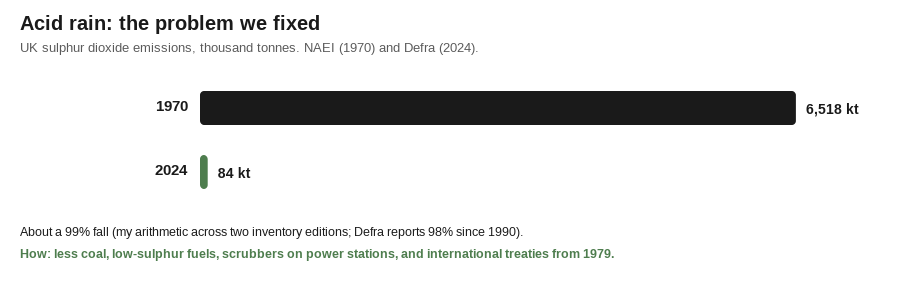
UK sulphur dioxide fell from 6,518 thousand tonnes in 1970 to 84 thousand tonnes in 2024 (Defra reports a 98% fall since 1990). In Sweden, acid deposition had fallen by more than 90% from the early 1970s by 2021.
A local footnote. Kilroot power station, on Belfast Lough near Carrickfergus, a few miles down the coast from Larne, met the European sulphur limits with a seawater scrubber, ordered in 2006, which uses the natural alkalinity of seawater to absorb the sulphur and returns it to the sea as sulphate. Its coal units closed on 30 September 2023. It is a neat bridge between the two halves of this page: the sea has been mopping up our acids for a long time.
Acid seas: the problem we have not
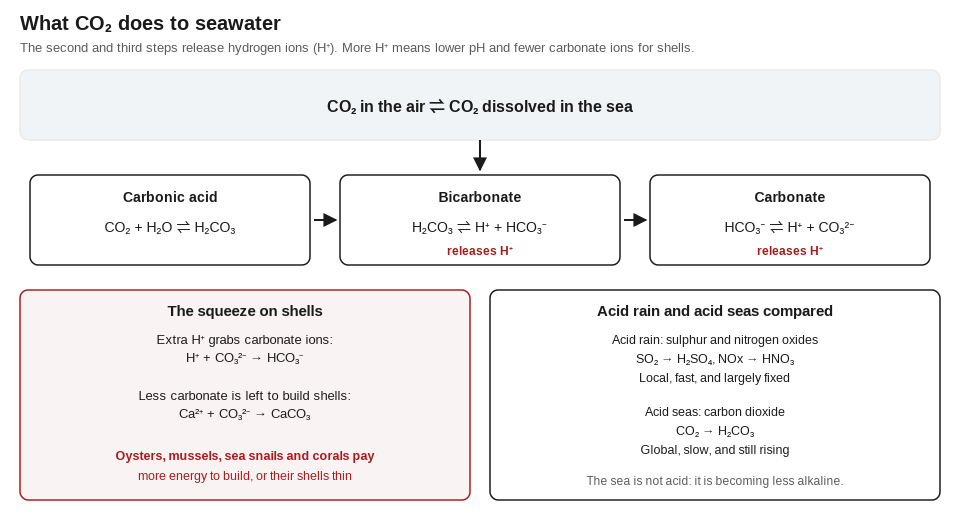
The ocean absorbs about 29% of the CO₂ people emit (Global Carbon Budget 2025). That slows global warming, at a cost. Dissolved CO₂ reacts with water:
CO₂ + H₂O ⇌ H₂CO₃ ⇌ H⁺ + HCO₃⁻ ⇌ 2H⁺ + CO₃²⁻
The extra hydrogen ions lower the pH and grab carbonate ions (H⁺ + CO₃²⁻ → HCO₃⁻), which leaves less carbonate for animals that build shells and skeletons from calcium carbonate (Ca²⁺ + CO₃²⁻ → CaCO₃).
| Measure | Figure | Source |
|---|---|---|
| Fall in surface ocean pH since the Industrial Revolution | About 0.1 units, roughly a 30% rise in acidity | NOAA |
| Rate since the late 1980s (open ocean) | 0.017–0.027 pH units per decade (very likely) | IPCC SROCC, 2019 |
| Projection to 2100 without big cuts | A further fall of about 0.3–0.4 units | NOAA |
| Ocean acidification increasing | Virtually certain | IPCC AR6 |
The sea is not acid: its pH is still above 7. It is becoming less alkaline, and for shell-builders that is what matters. Pteropods, tiny sea snails at the base of polar food webs, are among the most sensitive; in NOAA experiments their shells dissolved over 45 days in water like that projected for 2100. Oyster hatchery failures in the US Pacific Northwest from 2007 have been linked to acidified water in peer-reviewed studies, and hatcheries now monitor and treat their intake water. In the North-East Atlantic, OSPAR’s 2023 assessment found acidification in all its regions, with cold-water corals especially at risk.
Blooms, darker water, less ice and a slower ocean
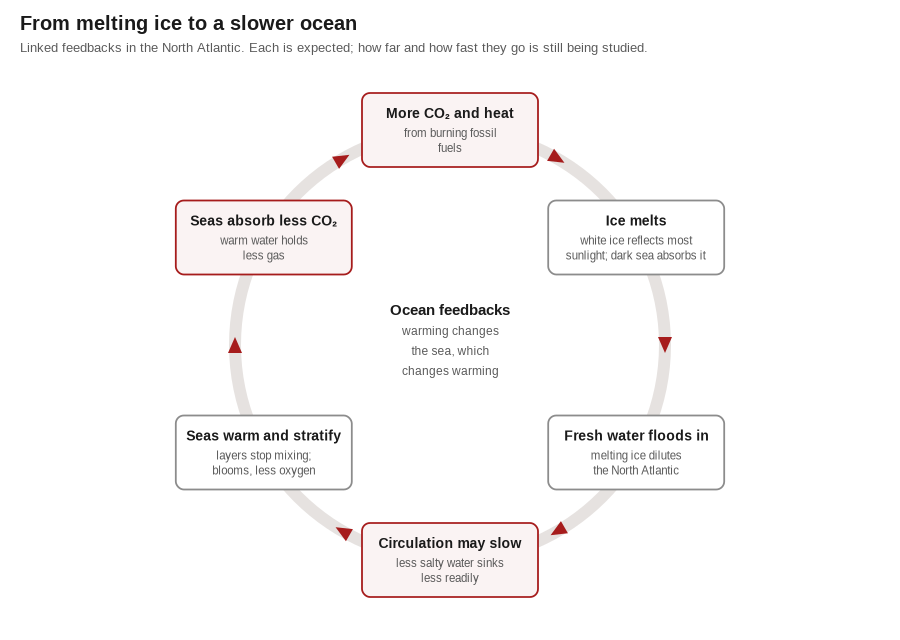
Blooms. The IPCC reports that harmful algal blooms in coastal waters have spread and become more frequent since the 1980s, driven partly by warming, marine heatwaves, oxygen loss and nutrient pollution (high confidence). The upper ocean has also become more layered (stratified), so nutrients and oxygen mix less. Lough Neagh’s blooms are the freshwater cousin of the same problem (see Lough Neagh and cyanobacteria).
Darker water. A study by Thomas Davies and Tim Smyth, published in May 2025, used satellite data to find that 21% of the global ocean darkened between 2003 and 2022, with the depth to which light reaches shrinking by more than 50 m over 9% of the ocean. Less light means less room for the plankton that feed the sea and draw down carbon.
Less ice.
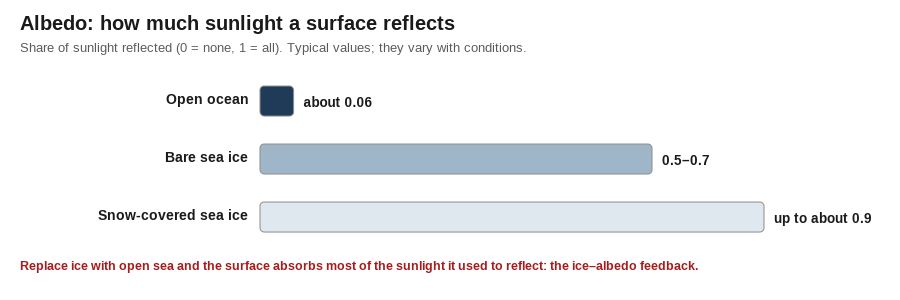
Sea ice reflects half or more of the sunlight that hits it; open ocean reflects about 6%. Each square kilometre of ice lost turns a mirror into an absorber, which warms the water and melts more ice: the ice–albedo feedback. The Arctic’s September sea ice minimum has fallen by about 12% per decade since satellite records began in 1979 (NSIDC), although the minimum has shown no significant trend over the last two decades. The 2025 minimum was 4.60 million km².
Fresh water and salt. The North Atlantic’s overturning circulation (AMOC), of which the Gulf Stream is part, is driven partly by cold, salty water sinking near Greenland. Melting ice and more rain add fresh water, which is lighter and sinks less readily. The IPCC’s assessment, as summarised by the Met Office, is that the AMOC is very likely to weaken this century, with medium confidence that it will not collapse abruptly before 2100. Some recent studies suggest a higher risk; a NOAA review in May 2025 found no significant long-term weakening yet in direct measurements. The science is still unsettled, but even a weakening matters for UK and Irish weather.
The rules
(Checked 17 November 2026.)
| Rule | What it does | Status |
|---|---|---|
| UN Convention on Long-range Transboundary Air Pollution | Framework for cutting air pollution across borders | Signed November 1979; in force 1983 |
| Gothenburg Protocol | Ceilings for sulphur, nitrogen oxides, ammonia, VOCs, and later fine particles | Adopted 1999; in force 17 May 2005; amended 2012 (in force 7 October 2019) |
| UK National Emission Ceilings Regulations 2018 | UK caps for the same pollutants | In force |
| IMO 2020 shipping sulphur cap | Ship fuel sulphur cut from 3.5% to 0.5% | In force 1 January 2020 |
| OSPAR Convention | North-East Atlantic environment, including monitoring acidification | Quality Status Report 2023 |
| Carbon dioxide | No ocean-specific law: the only fix is cutting CO₂ emissions | Climate Change Act 2008; Climate Change Act (NI) 2022 |
A twist. Cleaning up sulphur has a side effect. Sulphur particles help make bright clouds that reflect sunlight. A May 2024 study estimated that the IMO 2020 shipping rules added a warming effect of about +0.2 W/m² over the oceans by removing some of that cooling. Cleaner air is still right; it just unmasks warming that was already there.
Why it matters in Northern Ireland
- Shellfish. Carlingford Lough, Strangford Lough and Belfast Lough support mussel and oyster growing. Hatchery and growing businesses elsewhere have had to monitor water chemistry as the sea changes.
- No local monitoring. AFBI’s coastal monitoring buoys around NI measure temperature, salinity, oxygen, turbidity and chlorophyll, but I have found no routine pH or carbonate monitoring in NI waters; Ireland’s Marine Institute has studied ocean carbon chemistry since 2008.
- Weather. A weaker Atlantic circulation would mean less warming for Ireland and Britain than otherwise but possibly stormier winters, according to the Met Office.
- Upland waters. NI’s upland streams and loughs in the acid waters network have been recovering from acid rain, though recent site-by-site results are not something I have checked, and rising dissolved organic carbon in upland water is partly a side effect of less acid rain (see Peat bogs).
Think of indigestion tablets in a fizzy drink
| Kitchen | Sea |
|---|---|
| A glass of water with indigestion tablets dissolved in it | Seawater, naturally alkaline with carbonate |
| Blowing bubbles into it through a straw | CO₂ from the air dissolving into the sea |
| The tablets fizz and are used up | Carbonate ions are used up neutralising the acid |
| A chalk stick left in the glass starts to soften | Shells and corals struggle to form and may dissolve |
| Stop blowing and it slowly recovers | Cut CO₂ and the sea recovers, but over centuries |
| Pouring vinegar in from the factory next door | Acid rain: fixed by stopping the vinegar |
Examples
Agriculture and food
A shellfish farm on a sea lough
A mussel and oyster business supplies restaurants in Ireland and Britain.
What changes: more acidic water makes young shellfish spend more energy on shells; warmer water raises the risk of harmful algal blooms that close harvesting areas.
What to do: keep records of water temperature and bloom closures, talk to AFBI and the Food Standards Agency about monitoring, and build closures into business plans.
The lesson: the first businesses to feel ocean change are the ones that farm the sea.
Manufacturing
A factory with an old coal or oil boiler
A food or materials plant still burns heavy oil or coal for steam.
What the history shows: sulphur was cut by changing fuel and fitting scrubbers, not by offsets. The same plant switching to electricity or low-carbon heat cuts both sulphur and CO₂ at once.
The lesson: the acid rain story shows that regulation and technology together work. Cutting CO₂ at source is the ocean’s equivalent of the scrubber.
Public sector
A council’s coastal adaptation plan
A coastal council in Antrim or Down is updating its climate adaptation plan.
What to include: marine heatwaves and blooms affecting bathing waters and fisheries; stormier winters if the Atlantic circulation weakens; and links with shellfish growers and harbour users.
The lesson: ocean change is a local issue for every coastal council, not just a global statistic.
Common mistakes
- “The sea is turning to acid.” It is becoming less alkaline; that is enough to harm shell-builders.
- “Acid rain is still the big problem.” In Europe it has largely been fixed; carbon is the problem now.
- “The Gulf Stream is about to stop.” The IPCC expects weakening, not an abrupt collapse this century, though the risk is debated.
- “Cleaner shipping fuel caused global warming.” It removed some cooling that was masking warming; the warming itself comes from greenhouse gases.
- “The ocean soaking up CO₂ is good news.” It slows warming but acidifies the sea.
Previous: Lough Neagh and cyanobacteria · Related: Carbon capture and carbon negative · Permafrost
Sources
Checked 17 November 2026.
- Acid rain history: Swedish Environmental Protection Agency (history of acidification, liming and recovery) · German Environment Agency (UBA) on Waldsterben · Monteith and Evans (eds), UK Acid Waters Monitoring Network: 10 Year Report (March 2000; NI sites) · EU capacity4dev, CLRTAP summary · CEIP, Gothenburg Protocol.
- UK emissions: Defra, emissions of air pollutants in the UK: sulphur dioxide (updated 12 February 2026; 84 kt in 2024, down 98% since 1990) · NAEI, 1970 SO₂ table (6,518 kt). The 1970–2024 percentage is my arithmetic across two inventory editions.
- Kilroot: Alstom, seawater FGD order, 16 January 2006 (company release) · EP Kilroot, closure of the coal units (30 September 2023).
- Ocean acidification: NOAA PMEL, What is ocean acidification? · NOAA Science Council, State of the Science: Ocean Acidification (2022) · IPCC, SROCC Summary for Policymakers (2019) · IPCC, AR6 WG1 ocean fact sheet · CSIRO on the Global Carbon Budget 2025 (29%) · OSPAR, Quality Status Report 2023 (via a summary) · Marine Institute, ocean acidification · AFBI, coastal monitoring.
- Darkening, ice and circulation: University of Plymouth on Davies and Smyth, “Darkening of the global ocean”, Global Change Biology, doi:10.1111/gcb.70227 (27 May 2025) · NSIDC, Arctic Sea Ice News (2025 minimum and trend) · Met Office, The Atlantic Meridional Overturning Circulation in a changing climate (2 May 2024) · NOAA Science Council, State of the Science: AMOC (May 2025).
- Shipping: IMO 2020 sulphur limit; the May 2024 study estimating +0.2 ± 0.11 W/m² (authors not confirmed in my research, so not named).
- Not checked against a primary source: albedo values (from an educational source; typical figures); the sulphur dioxide and scrubber equations (standard chemistry); the 1985 Helsinki Protocol details; absolute pH values; the location of each NI acid-waters site; shellfish growing in specific NI loughs. The examples are illustrative.
Facts and definitions last checked against the standards and official sources on 17 November 2026. General information, not legal, tax or customs advice.