
Fertiliser and the nitrogen cycle
In short
Nitrogen fertiliser is made by pulling nitrogen out of the air with hydrogen from natural gas. Its carbon footprint comes in two halves: CO₂ and nitrous oxide at the factory, and nitrous oxide and ammonia from the field. The carbon border taxes count only the factory half; a farm's footprint must count both.
Nitrogen is the most abundant gas in the air, 78% of every breath, and yet it is the nutrient farmers most often run short of. The reason is a triple bond. Two nitrogen atoms in N₂ are locked together so tightly that plants cannot use them. Before nitrogen can grow grass, it has to be fixed: broken apart and joined to hydrogen or oxygen.
For most of history that was done by bacteria and lightning. Since 1913 it has also been done in factories, by the Haber–Bosch process, which now underpins much of the world’s food supply. In Northern Ireland, where grass is the main crop, nitrogen is at the heart of both farm output and farm emissions.
The cycle, step by step
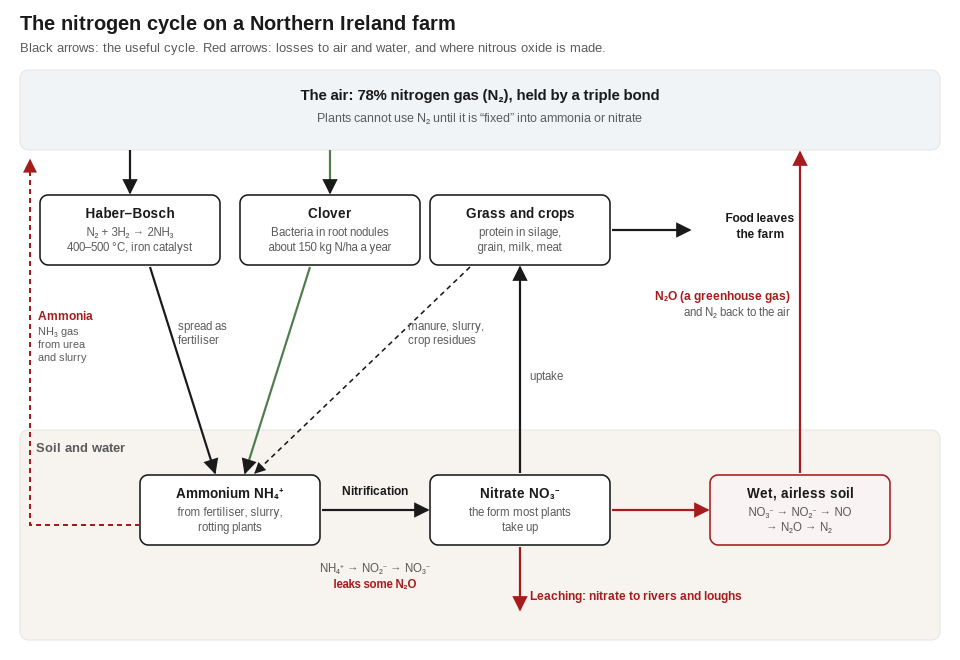
| Stage | What happens | Reaction | Who does it |
|---|---|---|---|
| Fixation (industrial) | Nitrogen and hydrogen joined into ammonia | N₂ + 3H₂ → 2NH₃ | Haber–Bosch plants, 400–500 °C, 150–250 bar, iron catalyst |
| Fixation (biological) | Bacteria in root nodules make ammonia | N₂ + 8H⁺ + 8e⁻ → 2NH₃ + H₂ (enzyme: nitrogenase) | Rhizobium bacteria in clover, peas and beans |
| Fixation (lightning) | Lightning joins nitrogen and oxygen | N₂ + O₂ → 2NO, washed down as nitrate | Thunderstorms |
| Ammonification | Dead plants, dung and slurry break down | Organic N → NH₄⁺ (ammonium) | Soil microbes |
| Nitrification | Ammonium turned into nitrate | NH₄⁺ → NO₂⁻ → NO₃⁻ | Nitrosomonas then Nitrobacter (and others) |
| Uptake | Roots take up nitrate and ammonium | Built into protein | Grass and crops |
| Denitrification | In wet, airless soil, nitrate is stripped back to gas | NO₃⁻ → NO₂⁻ → NO → N₂O → N₂ | Soil bacteria with no oxygen to breathe |
| Volatilisation | Ammonia gas escapes | CO(NH₂)₂ + H₂O → 2NH₃ + CO₂ (urea); slurry NH₄⁺ → NH₃ | Chemistry, helped by the enzyme urease |
| Leaching | Nitrate washes out of the soil | Soluble NO₃⁻ drains away | Rain |
Where nitrous oxide comes from. N₂O is a by-product of nitrification and an unfinished step in denitrification. When soil bacteria run short of oxygen (a wet, compacted, warm field with plenty of nitrate) they use nitrate instead, and if they stop half way, N₂O escapes. Soils are the largest source of N₂O on Earth. Wet conditions favour it, which is why the IPCC gives a higher emission factor for synthetic fertiliser spread in wet climates such as Northern Ireland’s.
Nitrous oxide matters twice over: it traps 265 times as much heat as CO₂ over 100 years (the figure used in UK reporting), and it is now the largest ozone-depleting emission, destroying ozone once it reaches the stratosphere (Ravishankara and colleagues, Science, 2009). See Why is everything counted as “carbon”?.
The life cycle of a bag of fertiliser
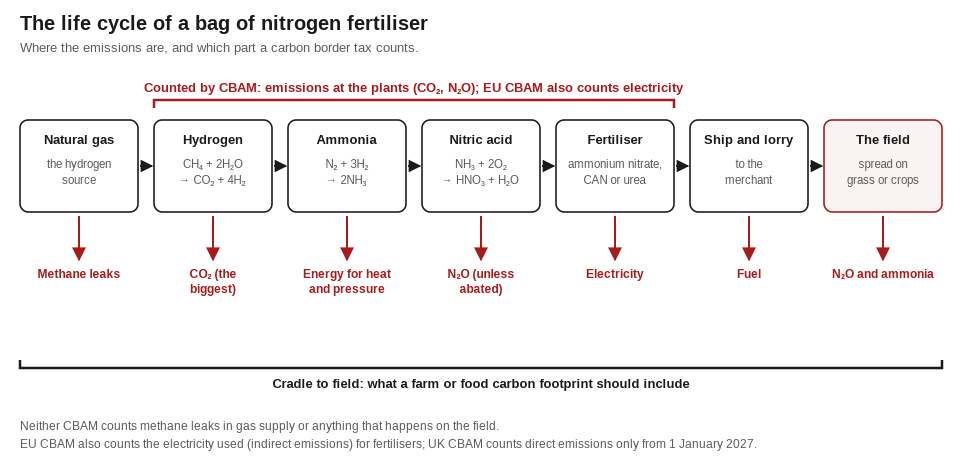
- Gas to hydrogen. Natural gas and steam make hydrogen and CO₂ (see Hydrogen by colour). This is the biggest source of CO₂.
- Hydrogen to ammonia. Haber–Bosch: N₂ + 3H₂ → 2NH₃. The reaction gives off heat, but the plant needs a lot of energy for pressure and gas. Ammonia production uses about 2% of the world’s final energy and emits about 450 million tonnes of CO₂ a year directly; about 70% of ammonia goes into fertiliser.
- Ammonia to nitric acid. Ammonia is burned over a platinum gauze to make nitric acid, and the side reactions make nitrous oxide. Modern European plants destroy most of it; many plants elsewhere do not.
- Into the bag. Nitric acid and ammonia make ammonium nitrate (AN), which is blended into calcium ammonium nitrate (CAN). Urea is made from ammonia and CO₂ instead, which is why urea releases CO₂ on the field.
- To the farm. Shipped and hauled.
- On the field. Some nitrogen becomes nitrous oxide; some escapes as ammonia; some leaches as nitrate. The IPCC’s 2019 refinement gives 1.6% of the nitrogen in synthetic fertiliser spread in a wet climate as emitted directly as N₂O. Its overall default is still 1%, and the UK inventory uses its own country-specific factors.
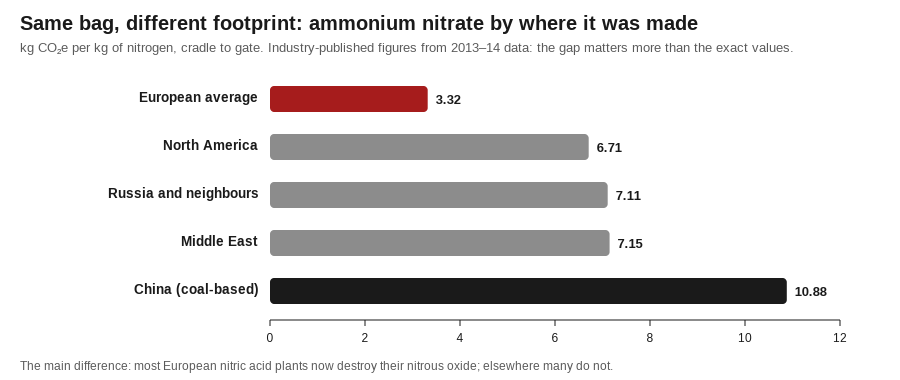
Each kilogram of nitrogen in ammonium nitrate made at an average European plant carried about 3.3 kg of CO₂e to the factory gate. The same product from North America, Russia or the Middle East carried 6.7–7.2 kg, mostly because the nitrous oxide from nitric acid was not destroyed. The data are from 2013–14 and published by the industry, so treat the exact figures with care; the gap is the point.
The rules
(Checked 17 November 2026.)
| Rule | What it covers | Status |
|---|---|---|
| EU CBAM, Regulation (EU) 2023/956 | Ammonia, nitric acid, nitrogen and mixed fertilisers. Counts CO₂ and N₂O, including the emissions from electricity used | Definitive period from 1 January 2026 |
| UK CBAM, Finance Act 2026 | The same fertiliser goods; CO₂ and N₂O; direct emissions only | From 1 January 2027, across the whole UK including NI |
| Nutrients Action Programme (NI) | Limits on manure and chemical nitrogen, spreading periods, slurry storage | The 2019 Regulations (SR 2019/81) are in force; a 2027–2030 programme was consulted on from 29 June to 7 September 2026 |
| Proposed NAP 2027–2030 | Unprotected granular urea only from 1 February to 31 March; protected urea after that; low-emission slurry spreading phased in for farms over 100, 75 and 50 livestock units by February 2028, 2029 and 2030; lower chemical nitrogen limits on grassland | Proposals, not yet law |
| DAERA Ammonia Strategy | Ammonia from farming | Draft consulted on in 2023; environmental report consulted on to 23 May 2025; final strategy not yet published |
Both CBAMs count only the factory half. The field emissions, often as large or larger, fall to the farm’s own inventory and to the Nutrients Action Programme.
Why it matters in Northern Ireland
- Agriculture is NI’s largest emitting sector: 31.4% of the total in 2024, 5.8 million tonnes of CO₂e. Of that, 4.3 Mt was methane, 1.2 Mt nitrous oxide and 0.3 Mt CO₂.
- Fertiliser drove the latest rise. DAERA and NISRA say the increase in farm emissions from 2023 to 2024 was largely driven by manufactured fertilisers, up 16.9%.
- Ammonia: Northern Ireland produces 12% of the UK’s ammonia emissions with 3% of its population and 6% of its land. 97% comes from farming. Farm ammonia was 30.8 thousand tonnes in 2023, 7% higher than in 2005, while UK livestock ammonia fell by about 16% over the same period.
- Fertiliser use is falling. DAERA’s figures show chemical fertiliser nitrogen use down 44% since 2005, though urea use has risen; deliveries in the first half of 2026 were 22% lower than a year earlier.
- Phosphorus and Lough Neagh. Nitrogen’s partner nutrient is phosphorus. The national phosphorus surplus was about 8,729 tonnes in 2024, and about 40% of farmland has more soil phosphorus than crops need. That is the link to the algal blooms in Lough Neagh (a later explainer in this series).
- The CBAM point. I have found no official breakdown of where NI’s fertiliser comes from. Whatever is imported from outside the UK will carry a UK CBAM cost from 2027, based on how it was made.
Think of a leaky bucket
Spreading nitrogen is like carrying water in a bucket with holes in it.
| Bucket | Nitrogen on a field |
|---|---|
| The water you pour in | Fertiliser and slurry spread |
| What reaches the plants | Nitrogen taken up by grass |
| The hole in the side | Ammonia gas escaping from urea and slurry |
| The hole in the bottom | Nitrate leaching to drains and rivers |
| The steam rising off it | Nitrous oxide from wet, airless soil |
| A lid | Protected urea, trailing-shoe slurry spreading, store covers |
| A smaller bucket that fills itself | Clover fixing its own nitrogen |
Every hole is money lost, and every hole is a pollutant.
Examples
Agriculture and food
Switching a dairy farm to protected urea and clover
A 100-hectare grassland farm spreads 20 tonnes of nitrogen a year as granular urea and CAN.
| Change | Effect (from official figures) |
|---|---|
| Protected urea (with a urease inhibitor) instead of plain urea | Cuts ammonia from urea by about 70% (UK inventory and DAERA) |
| Low-emission slurry spreading (trailing shoe or injection) | At least 30% less ammonia than a splash plate; AFBI projects 5–10% off NI farm ammonia overall |
| Covering the slurry store | Up to 80% less ammonia from the store |
| White clover in the sward | About 150 kg of nitrogen per hectare a year, fixed for free (CAFRE) |
The lesson: the cheapest tonne of nitrogen is the one that stays in the field. Fixing it with clover and stopping the losses cuts both the fertiliser bill and the emissions, and the protected-urea and slurry steps are likely to become legal requirements under the next Nutrients Action Programme.
Manufacturing
A feed mill or co-op importing fertiliser
An NI agricultural merchant imports ammonium nitrate from outside the UK.
| Before 2027 | From 1 January 2027 | |
|---|---|---|
| UK CBAM | Not yet in force | Charge on direct embedded CO₂ and N₂O, above the £50,000 annual threshold |
| What the supplier must provide | Optional | Verified emissions data, or default values are used |
| Effect of where it was made | Hidden | A plant without nitrous oxide abatement may carry twice the embedded emissions |
The lesson: ask suppliers now whether their nitric acid plant abates nitrous oxide and for verified emissions per tonne. It will largely decide the CBAM bill and makes a selling point for low-carbon supply.
Public sector
A council’s environmental health team and ammonia
A council receives a planning application for a new poultry or pig unit near a protected bog.
What happens: the application is assessed for ammonia, which falls on nearby habitats as nitrogen and changes what grows there. DAERA’s Operational Protocol sets the thresholds the assessment uses.
What to ask: the expected ammonia emission, the distance to sensitive sites, and the mitigation (scrubbers, covered stores, low-emission spreading). Where the planning, environmental and legal tests sit is a specialist question.
The lesson: the same nitrogen that is a greenhouse gas in one form is a habitat pollutant in another.
Common mistakes
- Counting only the factory. CBAM stops at the gate; for most fertilisers the field emissions are as large or larger.
- Using one factor for everything. The IPCC’s 2019 refinement keeps 1% overall but uses 1.6% for synthetic fertiliser in wet climates like Northern Ireland’s.
- Forgetting ammonia. It is not a greenhouse gas, but it is NI’s biggest air-quality problem from farming, and a small share of it becomes nitrous oxide after it settles on land.
- Assuming all fertiliser is the same. Where and how it was made can double its footprint.
- Assuming the urea rules are settled. A 2025 proposal to ban unprotected granular urea from 2027 was dropped and replaced by the 2027–2030 consultation. Check the final programme before acting.
Previous: Hydrogen by colour · Next: Carbon capture and carbon negative · Related: Embodied carbon or embedded emissions? (the fertiliser example) · Farm Carbon Data Checker
Sources
Checked 17 November 2026.
- Haber–Bosch conditions: University of Wisconsin, Chem 109: The Haber–Bosch process (400–500 °C, 150–250 bar, iron catalyst).
- Ammonia’s energy and CO₂: IEA, Ammonia Technology Roadmap (October 2021).
- Fertiliser footprints by region: Hoxha and Christensen, The carbon footprint of fertiliser production: regional reference values (International Fertiliser Society, industry-published; 2013–14 data).
- Ozone: Ravishankara, Daniel and Portmann, Science 326, 123 (2009).
- Field N₂O factors: Hergoualc’h et al. 2021, Global Change Biology (the work behind the IPCC 2019 Refinement: 1.6% for synthetic fertiliser in wet climates; 1% old default) · Butterbach-Bahl et al. 2013, Phil. Trans. R. Soc. B 368 (soils the dominant N₂O source).
- CBAM: Regulation (EU) 2023/956, Annex I (official copy) · European Commission, CBAM · HMRC, UK CBAM policy summary (updated 2 November 2026).
- Northern Ireland: DAERA and NISRA, NI GHG inventory 1990–2024 (9 June 2026) · DAERA, Ammonia emissions in Northern Ireland · DAERA, NI Environmental Statistics Report 2026 · DAERA, Fertiliser statistics Q2 2026 · DAERA, Nutrients Action Programme and NAP 2027–2030 consultation · DAERA, Ammonia Strategy consultation · NAEI, UK agriculture ammonia emission report 1990–2024 (protected urea 70%) · CAFRE, White clover (about 150 kg N/ha).
- Not checked against a primary source: the textbook reactions for nitrification, denitrification, nitrogenase and lightning; whether the final NAP 2027–2030 rules have been made since the consultation (trade press reports they may come before Christmas 2026). The farm and merchant examples are illustrative.
Facts and definitions last checked against the standards and official sources on 17 November 2026. General information, not legal, tax or customs advice.