
Carbon capture and carbon negative
In short
Carbon capture and storage (CCS) catches CO₂ from a chimney before it escapes, which cuts emissions. Carbon dioxide removal takes CO₂ back out of the air, which can make something “carbon negative”. Nature already removes billions of tonnes a year; engineered removal is under a thousandth of that so far. Neither is a substitute for cutting emissions first.
Two ideas get muddled under the word “capture”.
- Carbon capture and storage (CCS) catches CO₂ from a power station, cement kiln or factory and stores it underground. It stops new CO₂ reaching the air. It reduces emissions; it does not remove any.
- Carbon dioxide removal (CDR) takes CO₂ that is already in the air and locks it away: in trees, soils, rock, the deep ground or the ocean. Only removal can make something genuinely carbon negative.
The IPCC is blunt about both: removal “cannot substitute for immediate and deep emissions reductions”. It is for the emissions that cannot be cut, and later for bringing CO₂ back down.
Capture, use and removal side by side
| Term | What it means | Example | Reduces or removes? |
|---|---|---|---|
| CCS | Capture CO₂ from a source and store it underground | Amine scrubber on a cement kiln | Reduces |
| CCUS | CCS, but some CO₂ is used (in drinks, chemicals, building products) | CO₂ into concrete blocks | Reduces, if the CO₂ stays locked up |
| BECCS | CCS on a plant burning biomass | Wood-fired power station with capture | Removes, if the biomass is regrown and supply chain emissions are low |
| DACCS | Direct air capture with storage | Fans and sorbents pulling CO₂ from air | Removes |
| Biochar | Plant waste heated without air into charcoal, dug into soil | Biochar from sawmill waste | Removes |
| Enhanced rock weathering | Crushed silicate rock spread on fields to react with CO₂ | Basalt dust on farmland | Removes |
| Natural sinks | Trees, soils, peat, seagrass, oceans | New woodland, rewetted bog | Removes, but can be reversed |
| “Carbon negative” | A claim that removals exceed emissions | A product or company label | A claim to test; not an IPCC term |
How capture works: absorb or adsorb
There are two main ways to catch CO₂, and the words differ by one letter.
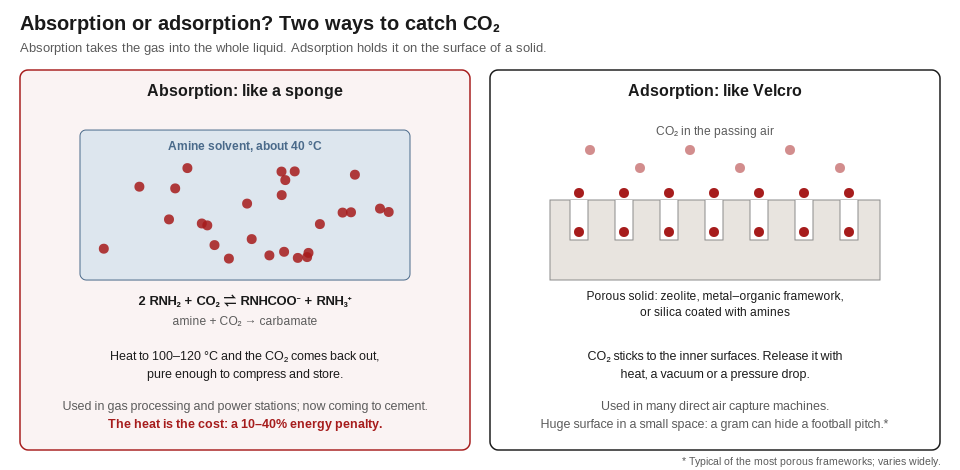
Absorption takes the gas into the bulk of a liquid, like a sponge. The workhorse is amine scrubbing, used to clean CO₂ out of natural gas since the 1930s and now being fitted to power stations and, from the end of this decade, cement kilns. Flue gas at about 40 °C bubbles through a solution of an amine such as monoethanolamine (MEA), and the CO₂ reacts:
2 RNH₂ + CO₂ ⇌ RNHCOO⁻ + RNH₃⁺ (an amine carbamate)
The reaction runs backwards when heated. Steam strips the solvent at 100–120 °C, releasing a stream of nearly pure CO₂ to compress and pipe away, and the regenerated amine goes round again. That reheating is the cost: the IPCC put the energy penalty at 10–40% more energy than the same plant without capture, for capture of 85–95% of the CO₂.
Adsorption holds the gas on a surface, like Velcro. Porous solids such as zeolites, metal–organic frameworks or amine-coated silica have enormous internal surfaces; CO₂ sticks to them and is released by heat, vacuum or a drop in pressure. Many direct air capture machines work this way, because the CO₂ in air is so dilute (about 0.04%) that the sorbent must grab it at the surface.
Turning CO₂ into stone
The most permanent store of all is rock. CO₂ dissolved in water is a weak acid, and it attacks calcium- and magnesium-rich rocks such as basalt and olivine to make carbonate minerals:
Mg₂SiO₄ + 2CO₂ → 2MgCO₃ + SiO₂ (olivine to magnesite and silica)
CaO + CO₂ → CaCO₃ (lime back to limestone)
Nature does this over millions of years. The CarbFix project in Iceland speeds it up by pumping CO₂ dissolved in water into basalt: over 95% had turned into carbonate minerals within two years. It is a little like petrification, where minerals slowly fill a buried log, except here the gas itself becomes the stone.
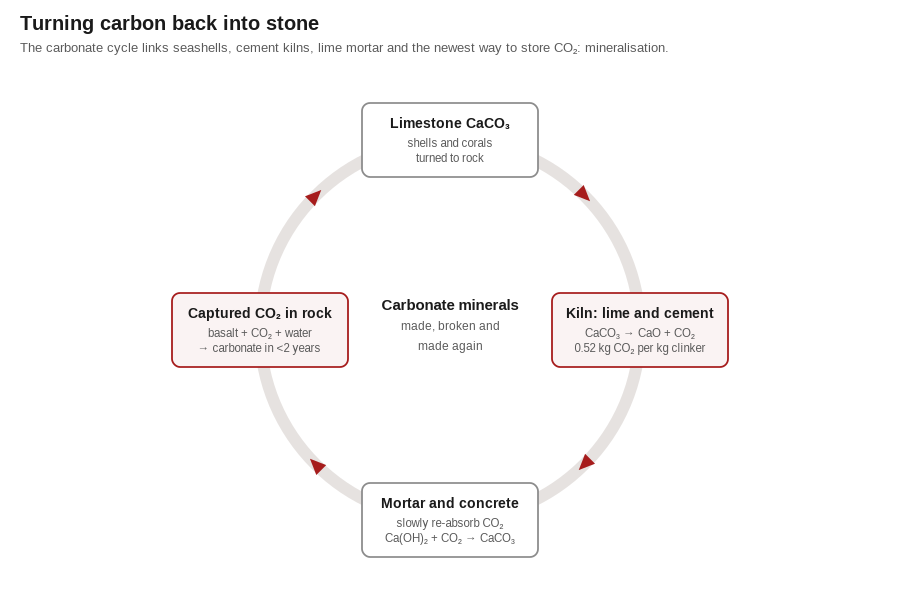
The same chemistry explains why cement is so hard to decarbonise. Heating limestone releases CO₂ from the rock itself, whatever fuel is used: CaCO₃ → CaO + CO₂, about 0.52 kg of CO₂ for every kilogram of clinker before any fuel is burned (more per kilogram of lime, which is nearly pure CaO). Only capture can deal with that part. Mortar and concrete win a little back over the years as their calcium hydroxide re-absorbs CO₂: Ca(OH)₂ + CO₂ → CaCO₃ + H₂O.
Nature’s own capture
| Store | How it captures carbon | Reaction |
|---|---|---|
| Trees and plants | Photosynthesis | 6CO₂ + 6H₂O + light → C₆H₁₂O₆ + 6O₂ |
| Soils | Roots and dead plants become soil organic matter | Slow, and easily lost by ploughing or drainage |
| Peat bogs | Waterlogging stops dead moss rotting | Carbon builds up over thousands of years |
| Seagrass and saltmarsh | Trap carbon-rich sediment | “Blue carbon” |
| Shells and corals | Lock carbon into calcium carbonate; forming it releases some CO₂ locally, so the long-term store is the limestone they leave | Ca²⁺ + 2HCO₃⁻ → CaCO₃ + CO₂ + H₂O |
| The ocean | Dissolves CO₂; plankton sink to the deep | The biological pump |
The scale is striking. In 2024 the oceans took up about 3.4 billion tonnes of carbon and the land about 1.9 billion (Global Carbon Budget), together roughly 19 billion tonnes of CO₂. Deliberate removal of all kinds is about 2 billion tonnes a year (State of CDR, 2024), almost all from planting forests; novel methods such as DACCS, BECCS and biochar removed about 1.3 million tonnes, under a thousandth of that. Scenarios that limit warming to 1.5 °C need roughly 7–9 billion tonnes a year of removal by mid-century.
How long does it stay locked away?
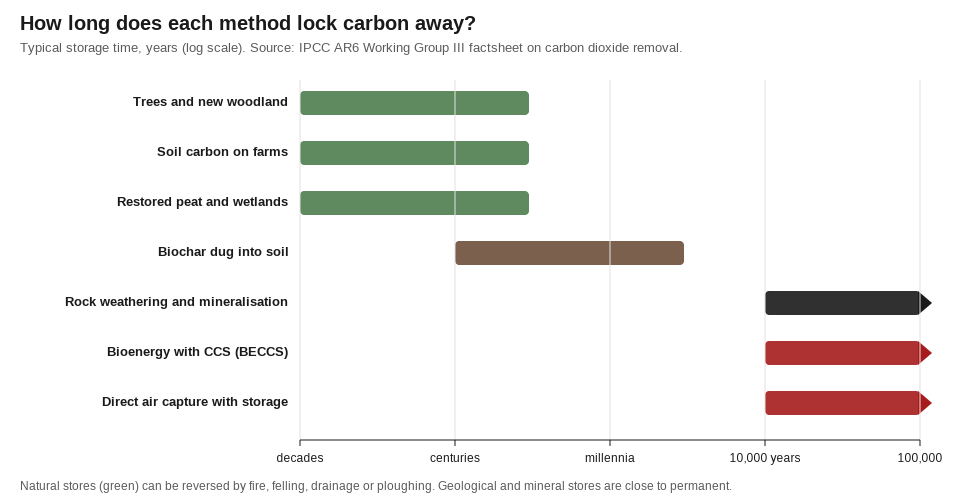
Fossil CO₂ affects the climate for thousands of years. A tree that stores it for 80 years and then burns does not cancel it; it delays it. That is why the UK’s plan to admit removals into the UK Emissions Trading Scheme sets a minimum storage period of 200 years, and why durable removals are treated differently from forestry credits (see Offsets: the good, the ugly and the harmful).
The rules
(Checked 17 November 2026.)
| Rule or programme | What it does | Status |
|---|---|---|
| UK Track-1 clusters | HyNet (North West England and North Wales) and East Coast Cluster (Teesside and Humber); £21.7 billion committed over 25 years on 4 October 2024 | East Coast Cluster financial close 10 December 2024; HyNet storage network 24 April 2025; first injection expected from 2028 |
| UK Track-2 | Acorn (north-east Scotland) and Viking (Humber) | Development funding from the June 2025 Spending Review; no final investment decision found |
| Removals in the UK ETS | Greenhouse gas removals to earn allowances; UK projects only at first; 200-year minimum storage | Government response 21 July 2025: legislation by end of 2028, operational by end of 2029 |
| EU Net-Zero Industry Act, Regulation (EU) 2024/1735 | 50 million tonnes a year of CO₂ injection capacity by 2030, with 44 oil and gas producers obliged to contribute | In force |
| EU carbon removal certification, Regulation (EU) 2024/3012 | Voluntary EU certification of permanent removals, carbon farming and storage in products | In force 26 December 2024; methods for DACCS, BioCCS and biochar adopted by the Commission as a delegated act on 3 February 2026 (entry into force not checked) |
Why it matters in Northern Ireland
- No cluster, no pipeline. Northern Ireland is not in either UK track. The Climate Change Committee said in March 2025 that NI “lacks direct access to suitable storage sites”, assumed CCS would not be available in NI before 2035, and recommended the Executive produce a CCS strategy covering cement, energy from waste and removals. CO₂ would probably have to be shipped to a GB cluster or piped to sites in Irish waters.
- Rocks with potential, not proof. A 2008 assessment for the island of Ireland, co-commissioned by GSNI, identified sandstones that might hold CO₂: about 37 million tonnes in closed structures in the Portpatrick Basin under the North Channel, and a much larger theoretical figure in Permian sandstones under the Lough Neagh Basin. These are paper estimates, not proven stores, and I have found no newer GSNI assessment.
- It has already been tried here. A wind-driven direct air capture trial ran at Larne from September 2023 to March 2025, funded by the UK Government. By the developer’s own report (27 June 2025) it absorbed about 24.9 tonnes of CO₂ and released about 8.4 tonnes as gas, using 4.8 kWh of electricity for each kg released. The gas was bottled, not stored, so this was capture, not removal. The full story is in Larne already has taken carbon out of the atmosphere.
- Removals will be needed. The CCC’s pathway for NI relies on engineered removals, mostly direct air capture, to balance the farm emissions that cannot be cut by 2050.
- Cement and lime. NI’s cement and lime kilns have process emissions that only capture can address. Padeswood in Flintshire, billed by Heidelberg Materials as the UK’s first cement plant with carbon capture (final investment decision 25 September 2025, about 800,000 tonnes a year, commissioning planned for 2029), shows what that looks like.
Think of a bath with the taps running
The atmosphere is a bath. Emissions are the taps; natural sinks and removals are the plughole.
| Bath | Climate |
|---|---|
| Taps running hard | Fossil and land-use emissions, about 42 billion tonnes of CO₂ in 2024 |
| A plughole that drains about half | Oceans and land |
| A teaspoon bailing water out | Novel engineered removal, about 1.3 million tonnes a year |
| Fitting a filter on the tap | CCS on a factory chimney |
| Bailing with a bucket, then pouring it back in | A forest credit that later burns |
Turn the taps down first. Bail only what you cannot turn off.
Examples
Construction
A block maker using recycled CO₂
A concrete products plant is offered blocks cured with captured CO₂ that mineralises inside them.
| Question | Why it matters |
|---|---|
| Where did the CO₂ come from? | Fossil CO₂ from a factory is a reduction at best; biogenic or air-captured CO₂ can be a removal |
| How much is locked in per block? | Usually small next to the cement’s own process CO₂ |
| How long does it stay? | As carbonate, effectively permanently |
| Who verified the figure? | Claims need a third-party check |
The lesson: CO₂-cured concrete can cut the footprint, but it rarely makes the block carbon negative. The cement content is still the bigger lever.
Agriculture and food
A farm spreading basalt or biochar
A farmer is offered payment for spreading crushed basalt (enhanced rock weathering) or biochar, with the removals sold as credits.
What to check: how the removal is measured, not just modelled; who owns the credits; whether the land and soils are suitable; and the transport emissions of moving rock. The IPCC rates both methods as long-lasting (biochar for centuries to millennia, mineral weathering for 10,000 years or more), but measurement in the field is still hard.
The lesson: promising, permanent, and early. Sign nothing that gives away the land’s carbon rights for decades without legal advice.
Public sector
A council’s energy-from-waste plant
A council’s waste is burned for power. Part of the carbon in mixed waste is biogenic (food, paper, wood) and part fossil (mostly plastics); roughly half and half is a common rule of thumb.
What capture would do: capturing the CO₂ would cut the fossil emissions and turn the biogenic half into a removal, which is why the CCC lists energy from waste among NI’s CCS needs. Without a CO₂ network, that is a 2035-or-later option.
The lesson: keep plastic out of the waste stream now; capture may come later.
Common mistakes
- Calling CCS on a gas plant “negative”. It reduces emissions; only removal takes CO₂ out of the air.
- Counting captured as stored. Boundary Dam in Canada has captured 7.3 million tonnes since 2014 (SaskPower), about two-thirds of what a design of roughly 1 million tonnes a year implies; Petra Nova in Texas sent its CO₂ to pump more oil. Judge projects on tonnes stored against design.
- Treating a tree as a permanent store. Forests last decades to centuries and can burn.
- Assuming removal will be cheap and plentiful. Novel removal is about 1.3 million tonnes a year worldwide.
- Mixing up absorb and adsorb. Into the liquid, or onto the surface.
Previous: Fertiliser and the nitrogen cycle · Next: Offsets: the good, the ugly and the harmful · Related: Hydrogen by colour
Sources
Checked 17 November 2026.
- Definitions and permanence: IPCC, AR6 Synthesis Report glossary · IPCC, AR6 WG3 factsheet on carbon dioxide removal (storage times; “cannot substitute”).
- Scale: Smith et al., The State of Carbon Dioxide Removal, 2nd edition (2024) · Global Carbon Project, Global Carbon Budget 2025 (13 November 2025). A newer edition of either may now be out.
- Chemistry: IUPAC Gold Book, adsorption and absorption · Rochelle, Amine scrubbing for CO₂ capture, Science 325 (2009) · IPCC, Special Report on CCS, technical summary (2005: energy penalty, capture rates, mineral carbonation) · Matter et al., CarbFix, Science 352 (2016) · Andrew, Global CO₂ emissions from cement production, ESSD 10 (2018) (0.52 t per tonne of clinker).
- UK: DESNZ, UK carbon capture, usage and storage · DESNZ, contracts signed for Teesside, 10 December 2024 · NSTA, HyNet storage permits, 24 April 2025 · UK ETS Authority, integrating greenhouse gas removals (response 21 July 2025) · Heidelberg Materials, Padeswood final investment decision, 25 September 2025 (company release).
- EU: European Commission, Net-Zero Industry Act injection capacity (22 May 2025) · Regulation (EU) 2024/3012 · European Commission, permanent removal methods adopted, 3 February 2026.
- Project performance: SaskPower, BD3 status update Q4 2025 (cumulative 7,327,868 t; the 1 Mt-a-year design figure is from a third-party compilation, not checked) · Petra Nova’s use of CO₂ for enhanced oil recovery is from trade press citing the US Department of Energy, not checked against the DOE report.
- Northern Ireland: Climate Change Committee, Northern Ireland’s Fourth Carbon Budget (19 March 2025) · CSA Group and BGS for SEI, EPA, GSI and GSNI, assessment of CO₂ storage potential on the island of Ireland (2008; capacity figures theoretical and internally inconsistent).
- Larne trial (added 21 November 2026): CO2CirculAir, SMART-DAC Phase 2 public report (27 June 2025); figures are the developer’s own.
- Not checked against a primary source: the balanced olivine equation and photosynthesis and calcification equations (standard chemistry); the “football pitch per gram” comparison in the diagram (typical of the most porous frameworks); the half-biogenic share of mixed waste (a rule of thumb). The three examples are illustrative.
Facts and definitions last checked against the standards and official sources on 17 November 2026. General information, not legal, tax or customs advice.