
Larne already has taken carbon out of the atmosphere
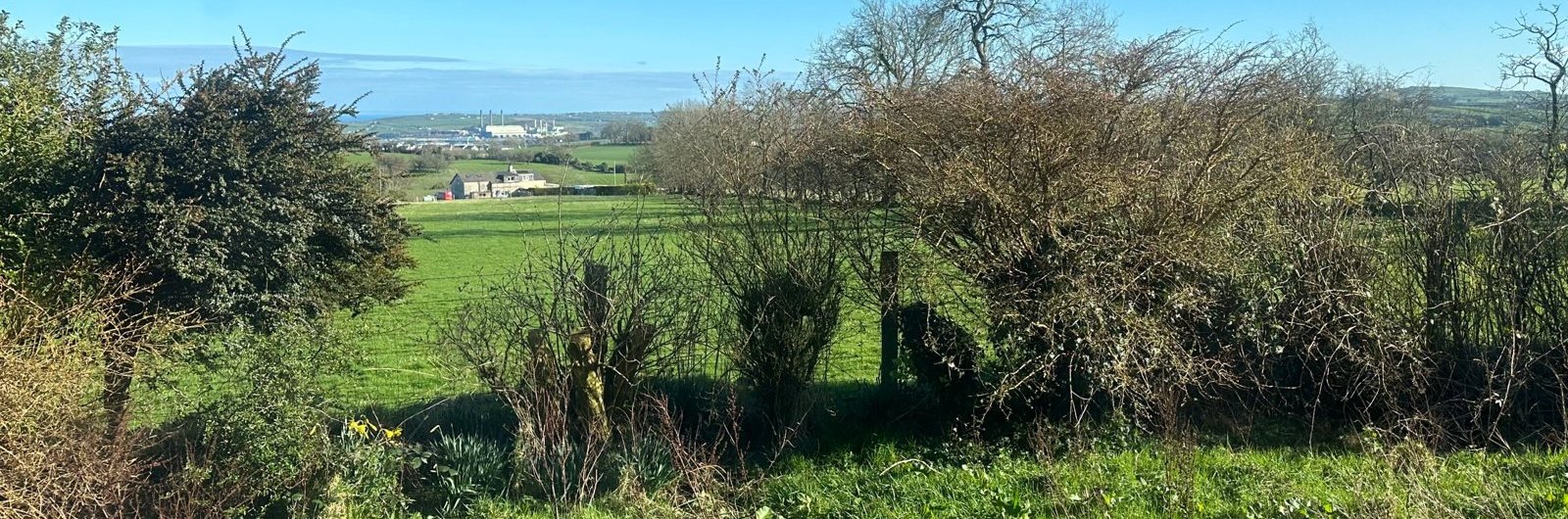
A small trial above the port ran for nineteen months. Here is what it did, what it cost and what it did not do. General information and opinion, not advice.
A trial plant at Larne took carbon dioxide out of the air using the wind, between September 2023 and March 2025. It absorbed about 24.9 tonnes and released about 8.4 tonnes of that as gas. The capture step worked, through two named storms. The release step fell short and used more electricity than the developer hopes for. The developer published all of it. A larger plant is proposed for Northern Ireland; I have found no sign that it is funded.
Download this piece (PDF, 3 pages)
“We don’t just have webbed feet in Larne. We suck the CO₂ out of you all too.”
My Dad is a Master Mariner. When he moved back to the home trade, before he retired, he led the ships from Larne to Fleetwood, so we have a strong connection with the port. If you ever see a ship on the horizon, it is just him sailing by, but he’s always with us.
So it means something to me that this happened here. I came across the trial while researching new environmental technologies, and I think more people in Larne should know that it stood above their own harbour.
What was built
The trial was called SMART-DAC. The technology was designed by CO2CirculAir, a Dutch company set up by membrane engineers. The plant stood at the offices of B9 Energy in Larne, on an exposed site 87 metres above sea level and next to the port. The UK Government paid for it with a grant of £2,941,301 from its Greenhouse Gas Removal Innovation Programme. Catagen of Belfast is named as a partner, and Heriot-Watt University and the Process Design Centre estimated the costs.
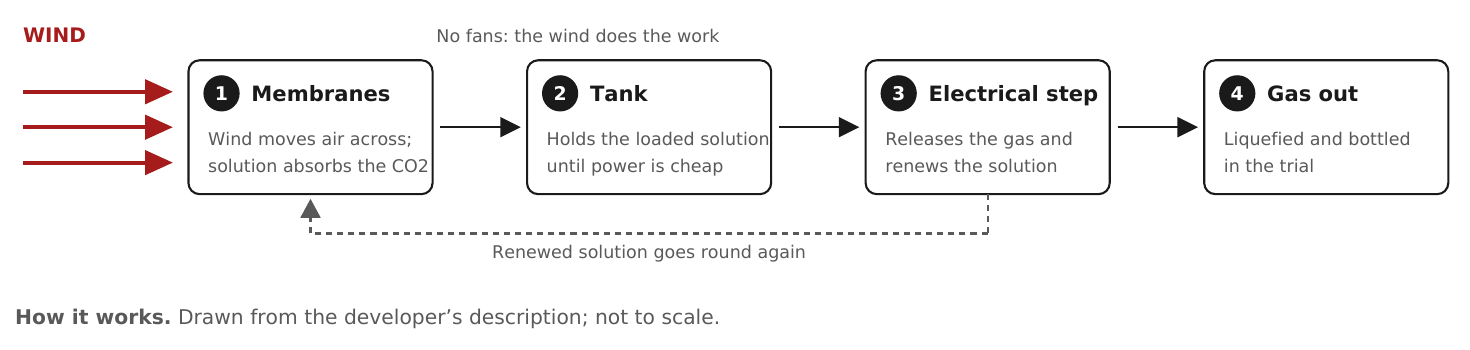
Most plants of this kind use large fans to push air through a filter. This one uses the wind. Air blows across membranes that carry a potassium hydroxide based solution, which absorbs the carbon dioxide. An electrical step then releases the gas and returns the solution for reuse. The loaded solution can be held in a tank, so the electrical step can wait until power is cheap or plentiful.
What it did
These figures are the developer’s own, from its final report to government dated 27 June 2025.
- It first captured carbon dioxide in September 2023 and ran for 467 days to spring 2025, about 80% of the time, with one winter shutdown.
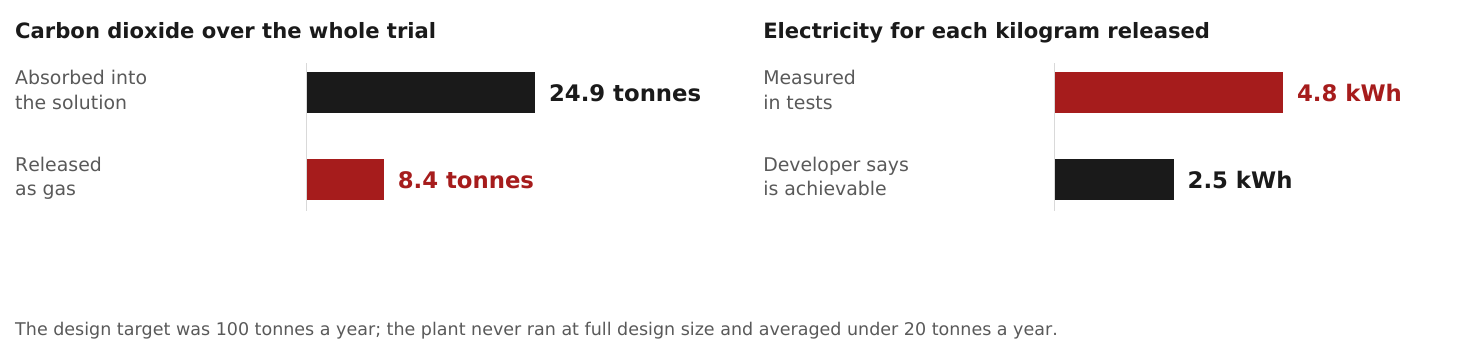
- It absorbed about 24.9 tonnes of carbon dioxide into its solution. The electrical step released about 8.4 tonnes of that as gas, roughly a third. The released gas was 98.5% pure, and some of it was liquefied and bottled.
- The plant was designed to capture 100 tonnes a year. It never ran at its full design size. Over the whole trial it averaged under 20 tonnes a year. The developer’s higher figure of 77 tonnes a year takes the best period and scales it up to the full design.
- Storm Darragh in December 2024 and Storm Éowyn in January 2025 damaged the louvres that guide the air, which cut output. The membranes came through with almost no damage. Frost was not a problem; snow tangled the membranes.
What it cost, in energy and money
In tests, the electrical step used 4.8 kWh of electricity for each kilogram of gas released. The developer says under 2.5 kWh is achievable. That gap is the main thing a next plant has to close.
Electricity matters because making it can release carbon dioxide too. The developer modelled a future plant of 10,000 tonnes a year. Run on wholly renewable power, it would emit 0.12 kg for every kilogram it captures. Run on Northern Ireland’s grid, which the report takes as 45% renewable (the Department for the Economy’s figure for 2024 is 43.5%), it would emit 0.83 kg for every kilogram captured. So this only makes sense on clean power, and best of all on wind power that the grid cannot take at that moment. Where such a plant sits on the network therefore matters.
On money, the report gives three estimates for that future 10,000 tonne plant, none of it built: £390 a tonne from the developer, £435 from the Process Design Centre and £1,325 from Heriot-Watt University. They are not like for like. As for the trial itself, the grant divided by the gas released comes to about £350,000 a tonne. That is the wrong way to judge a trial, whose job is to learn, but it is a sum readers will do, so I have done it first.
What happens next
In June 2025 the developer said the plant was to move to a site in Belfast for more testing. Its stated aim is a plant of at least 1,500 tonnes a year in Northern Ireland, for which it says it needs £5 million to £9 million. The report mentions, once and without detail, a planned “Randallstown deployment” on off-grid or curtailed wind power. It has signed a memorandum of understanding with an unnamed partner on carbon dioxide for e-methanol, a shipping fuel. I have found no public news on any of this since.
What it does not do yet
Capturing carbon dioxide is not the same as removing it. The gas has to go somewhere permanent. Northern Ireland has rules for licensing underground storage, made in 2015, but I know of no store here. The Antrim basalt may one day provide one: two published studies put its capacity at about 10 million tonnes and about 1,400 million tonnes, and no borehole has been tested for the purpose. Until then, carbon dioxide caught from the air here is a raw material, for fuels or for growers. The developer itself presents it that way. The Learn section explains the difference between capture and removal.
We know that wind turbines struggle in the strongest winds: they shut down to protect themselves. This plant has no blades. Its membranes came through two storms, though its louvres did not. I favour energy and climate technology that works with the landscape and the weather we have, and this is a small, honest example of it.
What I respect most is that the developer published the figures that flatter and the figures that do not. That is how a trial should be reported.
A question
Carbon has been taken out of the atmosphere in Larne, in a plant designed in the Netherlands, paid for by the UK Government and hosted by a Northern Irish company. So, a question for the Department for the Economy and Invest NI: now that the results are public, who in Northern Ireland is responsible for deciding what, if anything, comes next?
About this piece
Independence. I have no commercial relationship with CO2CirculAir, B9 Energy, Catagen or any other organisation named, and was not paid or asked to write this. Naming an organisation is not an endorsement.
Figures. Performance, energy and cost figures are the developer’s own and have not been independently verified; the report is the copyright of its author. Statements about plans are as at June 2025. The average under 20 tonnes a year and the £350,000 a tonne are my arithmetic from the report’s totals and the published grant.
Sources. CO2CirculAir, SMART-DAC Phase 2 public report, 27 June 2025 (GOV.UK) · GOV.UK, Greenhouse Gas Removal Innovation Programme, Phase 2 projects · Department for the Economy, renewable electricity in 2024 · Storage of Carbon Dioxide (Licensing etc.) Regulations (NI) 2015 · University of Edinburgh, 18 November 2025 · Andrews, Frontiers in Climate, 2023.
Created with assistive technology including AI and re-checked against the official sources listed.