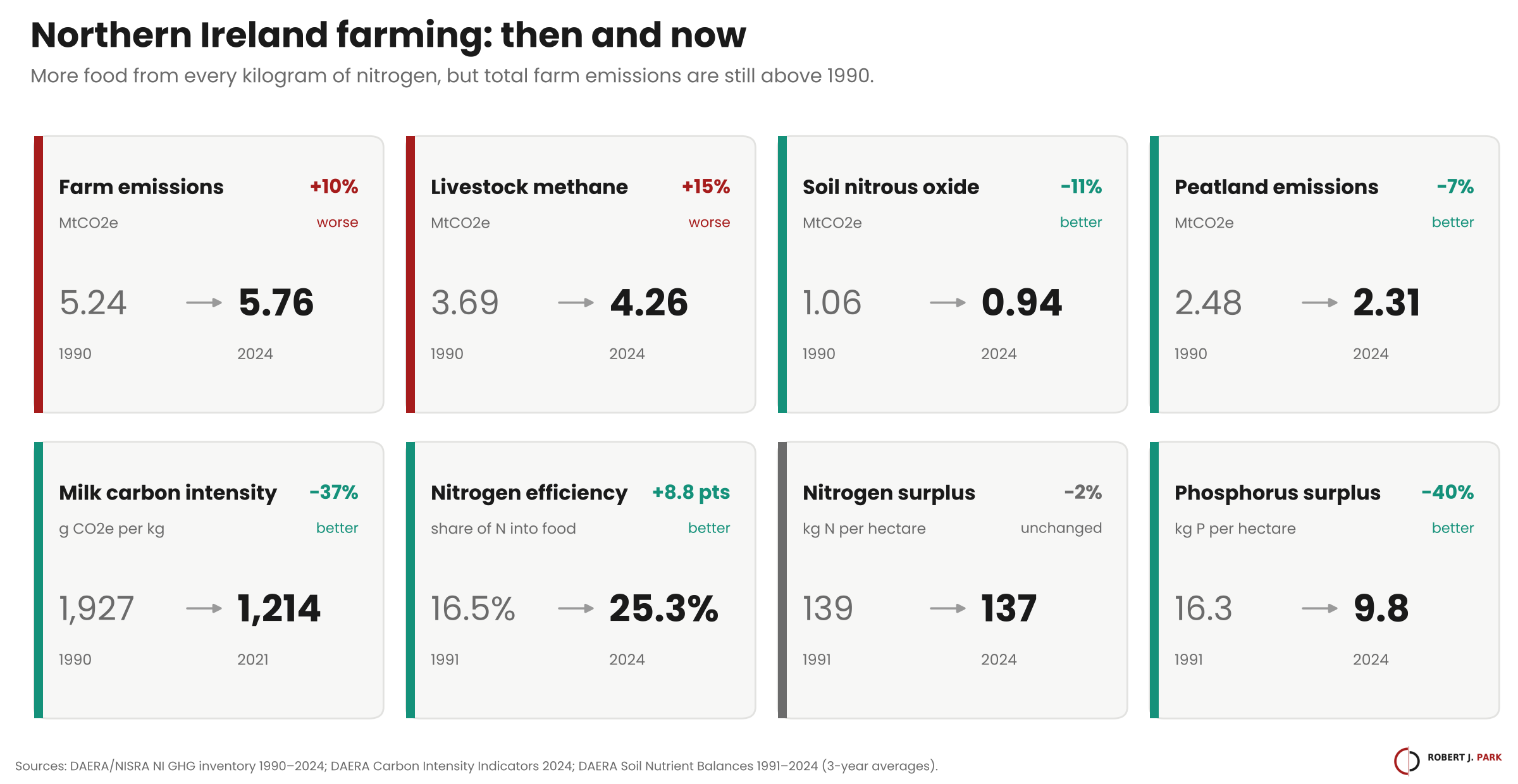
<?xml version="1.0" encoding="utf-8"?><feed xmlns="http://www.w3.org/2005/Atom" ><generator uri="https://jekyllrb.com/" version="3.10.0">Jekyll</generator><link href="https://robertjpark.co.uk/feed.xml" rel="self" type="application/atom+xml" /><link href="https://robertjpark.co.uk/" rel="alternate" type="text/html" /><updated>2026-10-21T01:31:04+01:00</updated><id>https://robertjpark.co.uk/feed.xml</id><title type="html">Robert J. Park</title><subtitle>Independent environmental, carbon and public affairs consultancy for Northern Ireland businesses — CBAM, CSRD, carbon inventories, ESOS and contaminated land.</subtitle><author><name>Robert J. Park</name></author><entry><title type="html">Focus on Agriculture: October 2026</title><link href="https://robertjpark.co.uk/blog/2026/10/focus-on-agriculture-october-2026/" rel="alternate" type="text/html" title="Focus on Agriculture: October 2026" /><published>2026-10-18T00:30:00+01:00</published><updated>2026-10-18T00:30:00+01:00</updated><id>https://robertjpark.co.uk/blog/2026/10/focus-on-agriculture-october-2026</id><content type="html" xml:base="https://robertjpark.co.uk/blog/2026/10/focus-on-agriculture-october-2026/"><![CDATA[<p>Northern Ireland farming now gets far more food from every kilogram of nitrogen, but farm emissions are still 10% above 1990. My October briefing covers livestock methane, fertiliser and nutrient balances, peatland and woodland, new research at Hillsborough, and three things a farm can do this month.</p>

<figure class="page-photo"><img src="/assets/focus-on-agriculture/2026-10/01-then-and-now.png" alt="Eight then-and-now tiles for Northern Ireland farming, comparing 1990 or 1991 with the latest year: emissions and livestock methane are up; soil nitrous oxide, peatland emissions, milk carbon intensity and phosphorus surplus are down; nitrogen efficiency is up; nitrogen surplus is unchanged." loading="lazy" /></figure>

<p><a href="/blog/focus-on-agriculture-october-2026/">Read the full briefing →</a> · <a href="/assets/focus-on-agriculture/2026-10/Focus-on-Agriculture-October-2026.pdf">Download the PDF (7 pages)</a> · <a href="/tools/farm-data-checker/">Try the Farm Carbon Data Checker</a></p>]]></content><author><name>Robert J. Park</name></author><category term="Agriculture" /><category term="Carbon" /><category term="Land" /><category term="Northern Ireland" /><summary type="html"><![CDATA[Northern Ireland farming now gets far more food from every kilogram of nitrogen, but farm emissions are still 10% above 1990. My October briefing covers livestock methane, fertiliser and nutrient balances, peatland and woodland, new research at Hillsborough, and three things a farm can do this month.]]></summary><media:thumbnail xmlns:media="http://search.yahoo.com/mrss/" url="https://robertjpark.co.uk/assets/focus-on-agriculture/2026-10/01-then-and-now.png" /><media:content medium="image" url="https://robertjpark.co.uk/assets/focus-on-agriculture/2026-10/01-then-and-now.png" xmlns:media="http://search.yahoo.com/mrss/" /></entry><entry><title type="html">Offsets are a scam. Here’s what to do instead.</title><link href="https://robertjpark.co.uk/blog/2026/10/offsets-are-a-scam/" rel="alternate" type="text/html" title="Offsets are a scam. Here’s what to do instead." /><published>2026-10-17T00:20:00+01:00</published><updated>2026-10-17T00:20:00+01:00</updated><id>https://robertjpark.co.uk/blog/2026/10/offsets-are-a-scam</id><content type="html" xml:base="https://robertjpark.co.uk/blog/2026/10/offsets-are-a-scam/"><![CDATA[<figure class="page-photo"><img src="/assets/photos/recycle-forest.jpg" alt="Sunlight through a forest canopy" loading="lazy" /><figcaption>A protected forest is a good thing. Paying for it doesn't cancel your boiler.</figcaption></figure>

<p>That’s a strong title, so let me be precise about what I mean. Protecting forests, restoring peat and funding clean cookstoves can all be worthwhile. Some carbon removal projects are genuine. My problem is with the idea at the centre of the offset market: that a business can keep emitting and buy a certificate that makes those emissions disappear, so it can call itself “carbon neutral”.</p>

<p>That idea doesn’t survive contact with the evidence. And from this autumn, in the EU, it doesn’t survive contact with the law either.</p>

<h2 id="the-evidence">The evidence</h2>

<p>Offsets are only worth anything if the reduction is real, wouldn’t have happened anyway, lasts, and isn’t counted twice. Study after study has found that most credits fail at least one of those tests.</p>

<ul>
  <li>In 2024, researchers writing in <em>Nature Communications</em> reviewed studies covering around a fifth of all credits ever issued, across the main project types. They found that <strong>less than 16% of the credits represented real emission reductions</strong> (<a href="https://www.nature.com/articles/s41467-024-53645-z">Probst et al., 2024</a>; <a href="https://tum.de/en/news-and-events/all-news/press-releases/details/carbon-crediting-is-substantially-overestimated">TUM summary</a>).</li>
  <li>Forest-protection projects (REDD+) have been particularly badly affected. A 2023 study in <em>Science</em> found that many projects claimed far more avoided deforestation than actually occurred, because their “what would have happened anyway” baselines were inflated (<a href="https://www.science.org/doi/10.1126/science.ade3535">West et al., 2023</a>).</li>
  <li>Permanence is a further problem. A forest can burn down. Fossil carbon released from your chimney stays in the atmosphere for centuries.</li>
</ul>

<p>None of this means everyone selling credits is acting in bad faith. It means the system is built on estimates of things that didn’t happen, and those estimates are made by people who are paid when they’re generous.</p>

<h2 id="the-law-has-caught-up">The law has caught up</h2>

<p><strong>In the EU,</strong> the Empowering Consumers for the Green Transition Directive (<a href="https://eur-lex.europa.eu/eli/dir/2024/825/oj">Directive (EU) 2024/825</a>) applies from <strong>27 September 2026</strong>. It bans claims, to consumers, that a product has a neutral, reduced or positive impact on the climate because of offsetting. It also bans generic claims such as “eco-friendly” or “climate friendly” unless you can show recognised excellent environmental performance. Northern Ireland firms selling into Ireland or the rest of the EU need to check their packaging, websites and adverts.</p>

<p><strong>In the UK,</strong> the Competition and Markets Authority’s <a href="https://www.gov.uk/government/publications/green-claims-code-making-environmental-claims">Green Claims Code</a> already says claims must be truthful, clear and not omit important information, including whether a claim relies on offsetting. Since April 2025, under the Digital Markets, Competition and Consumers Act 2024, the CMA can fine businesses directly for breaking consumer law, up to 10% of global turnover.</p>

<p><strong>Target-setters</strong> agree. The Science Based Targets initiative doesn’t let carbon credits count towards a company’s emission reduction targets. Credits can sit alongside them, as extra action, but not instead of them.</p>

<h2 id="why-offsets-do-harm-not-just-nothing">Why offsets do harm, not just nothing</h2>

<p>If offsets were simply useless, they’d be a waste of money. The bigger problem is that they delay real action.</p>

<p>A board that believes it is already “carbon neutral” has no reason to fund the heat pump, the better insulation or the conversation with the supplier whose steel makes up half its footprint. The offset buys peace of mind, and peace of mind is the enemy of change. It also exposes the business: to greenwashing complaints, to customers who check, and to staff who notice the gap between the claim and the car park.</p>

<h2 id="what-to-do-instead">What to do instead</h2>

<ol>
  <li><strong>Measure honestly.</strong> Know your Scope 1, 2 and, as far as you can, Scope 3 emissions. My <a href="/tools/carbon-jigsaw.html">Carbon Jigsaw</a> gives a rough start from your bills.</li>
  <li><strong>Cut what you can control.</strong> Energy efficiency, fuel switching, refrigerant management, fleet and travel. These save money as well as carbon. Most are found in the plant room, not the report.</li>
  <li><strong>Work your supply chain.</strong> For most manufacturers, the biggest emissions are in what they buy. Asking suppliers for data, and choosing lower-carbon materials, does more than any certificate.</li>
  <li><strong>Say what you’ve done, not what you’ve bought.</strong> “We’ve cut our emissions by 30% since 2022” is honest, checkable and impressive. “Carbon neutral” isn’t.</li>
  <li><strong>If you fund projects, call it a contribution.</strong> Supporting a high-quality project is fine. Describe it as financing climate action beyond your own footprint, not as cancelling it out. Look for projects that remove carbon durably, or that are rated against recognised quality standards, and be ready to explain your choice.</li>
</ol>

<h2 id="the-bottom-line">The bottom line</h2>

<p>You can’t buy your way to a lower footprint. You have to change what you do. The good news is that the changes usually pay for themselves, and they give you a story you can tell without a lawyer reading it first.</p>

<p>If you’d like help checking your claims or building a reduction plan that will stand up, <a href="/contact/">get in touch</a>.</p>

<p><em>This post is general information, not legal advice.</em></p>]]></content><author><name>Robert J. Park</name></author><category term="Carbon" /><category term="Offsets" /><category term="Greenwashing" /><category term="ESG" /><summary type="html"><![CDATA[A protected forest is a good thing. Paying for it doesn't cancel your boiler.]]></summary><media:thumbnail xmlns:media="http://search.yahoo.com/mrss/" url="https://robertjpark.co.uk/assets/photos/recycle-forest.jpg" /><media:content medium="image" url="https://robertjpark.co.uk/assets/photos/recycle-forest.jpg" xmlns:media="http://search.yahoo.com/mrss/" /></entry><entry><title type="html">Improving the public realm: guardianship, not just maintenance</title><link href="https://robertjpark.co.uk/blog/2026/10/improving-the-public-realm/" rel="alternate" type="text/html" title="Improving the public realm: guardianship, not just maintenance" /><published>2026-10-17T00:10:00+01:00</published><updated>2026-10-17T00:10:00+01:00</updated><id>https://robertjpark.co.uk/blog/2026/10/improving-the-public-realm</id><content type="html" xml:base="https://robertjpark.co.uk/blog/2026/10/improving-the-public-realm/"><![CDATA[<figure class="page-photo"><img src="/assets/photos/bins-collection.jpg" alt="A refuse collection crew emptying wheelie bins on a street" loading="lazy" /><figcaption>The public realm is looked after every day, mostly by people nobody thanks.</figcaption></figure>

<p>The public realm is everything we share and don’t own: streets and pavements, verges and hedgerows, parks, beaches, rivers, car parks, the bins at the end of the lane. We notice it mainly when it goes wrong. Fly-tipping in a lay-by. A river that turns green in July. A town centre that feels tired.</p>

<p>Most of the time we treat these as separate problems, owned by separate departments with separate budgets. I think that’s the root of the trouble.</p>

<h2 id="four-things-that-hold-a-place-together">Four things that hold a place together</h2>

<p>When I look at a place that works, I see four things pulling in the same direction.</p>

<ul>
  <li><strong>Land.</strong> Soil, water and green space that are cared for rather than just cut back. A verge mown once a year instead of six times. Drains that go where they should.</li>
  <li><strong>Waste.</strong> Collection that is reliable, litter that is picked up quickly, and enforcement that makes dumping a bad bet.</li>
  <li><strong>Duty.</strong> Somebody clearly responsible, with the powers and the money to act, and an obligation to keep improving rather than simply not getting worse.</li>
  <li><strong>Civic pride.</strong> People who feel the place is theirs, and who report, volunteer and complain because they care.</li>
</ul>

<p>Take any one away and the others start to slip. Pride fades when nobody seems responsible. Duties go unmet when nobody is watching. Land and waste problems compound each other: litter blocks drains, and neglected corners attract dumping.</p>

<h2 id="the-law-is-part-of-the-problem">The law is part of the problem</h2>

<p>Responsibility for the public realm is spread across dozens of pieces of legislation, written at different times for different purposes. Litter sits in one Act, highways in another, drainage, parks, burial grounds, street trading and dog control in others again. Each has its own duty-holder, its own standard and its own enforcement route. Some duties are absolute, some are “so far as practicable”, and some are only powers that a body may choose to use.</p>

<p>I’ve spent a good deal of time working through this as part of drafting a UK-wide Public Realm Bill. The draft runs to 215 clauses and 26 Schedules. It brings 37 existing enactments into one framework, so that the person on the street can see who is responsible and what they can expect. Two ideas sit at its heart:</p>

<ul>
  <li><strong>A continuous improvement duty.</strong> Public bodies responsible for shared spaces should have to show that those spaces are getting better over time, not just that they’ve been kept at a minimum standard.</li>
  <li><strong>Minimum public realm entitlements.</strong> Every community should be able to expect certain basics: clean streets, safe footways, accessible green space, working drainage, and somewhere to report problems and get an answer.</li>
</ul>

<p>You don’t need new legislation to start acting on either. Councils can adopt them as local standards tomorrow.</p>

<h2 id="what-good-guardianship-looks-like">What good guardianship looks like</h2>

<p>Guardianship is a better word than maintenance. Maintenance is about keeping things as they are. Guardianship is about handing a place on in better shape than you found it. In practice, that tends to mean:</p>

<ul>
  <li><strong>Joining up the budgets.</strong> The cost of a blocked gully, a flooded road and an insurance claim all land in different places. Look at them together and the cheap fix upstream becomes obvious.</li>
  <li><strong>Managing land for nature as well as tidiness.</strong> Fewer cuts, cutting hedges in the right season and at the right height, leaving buffer strips by rivers. These often cost less, not more. My <a href="/tools/land-repair-helix.html">Land Repair Helix</a> pairs common problems with low-cost fixes.</li>
  <li><strong>Making enforcement visible.</strong> Fly-tipping falls when people see that it is investigated and punished. In Northern Ireland, pollution and dumping can be reported to the NIEA on 0800 80 70 60, and councils handle litter and fly-tipping on public land.</li>
  <li><strong>Measuring what residents notice.</strong> Response times, repeat problems, and how people rate their area, not just tonnes collected or miles swept.</li>
  <li><strong>Giving people a way in.</strong> Friends-of groups, adopt-a-spot schemes and community clean-ups work best when the council backs them with equipment, insurance and a named contact.</li>
</ul>

<h2 id="businesses-have-a-part-too">Businesses have a part too</h2>

<p>The public realm isn’t only a council matter. Businesses own land that faces onto it, generate waste that passes through it, and depend on it for their customers and staff. A factory with a scruffy boundary, a car park that floods the road, or packaging that ends up in the hedge is part of the problem. A business that looks after its frontage, its drainage and its waste is part of the answer, and it shows in staff pride and in how the community sees the firm.</p>

<h2 id="where-to-start">Where to start</h2>

<p>If you’re a council officer or an elected member, pick one street, one park or one stretch of river and map who is responsible for every part of it. You’ll quickly find the gaps. If you’re a business, walk your own boundary with fresh eyes and ask what a neighbour would see.</p>

<p>Good places don’t happen by accident. They’re looked after. If you’d like to talk about how to do that well, <a href="/contact/">get in touch</a>.</p>]]></content><author><name>Robert J. Park</name></author><category term="Public realm" /><category term="Land" /><category term="Waste" /><category term="Councils" /><category term="Policy" /><summary type="html"><![CDATA[The public realm is looked after every day, mostly by people nobody thanks.]]></summary><media:thumbnail xmlns:media="http://search.yahoo.com/mrss/" url="https://robertjpark.co.uk/assets/photos/bins-collection.jpg" /><media:content medium="image" url="https://robertjpark.co.uk/assets/photos/bins-collection.jpg" xmlns:media="http://search.yahoo.com/mrss/" /></entry><entry><title type="html">CBAM and CSRD: what Northern Ireland manufacturers actually need to know</title><link href="https://robertjpark.co.uk/blog/2026/10/cbam-and-csrd-for-ni-manufacturers/" rel="alternate" type="text/html" title="CBAM and CSRD: what Northern Ireland manufacturers actually need to know" /><published>2026-10-16T00:05:00+01:00</published><updated>2026-10-16T00:05:00+01:00</updated><id>https://robertjpark.co.uk/blog/2026/10/cbam-and-csrd-for-ni-manufacturers</id><content type="html" xml:base="https://robertjpark.co.uk/blog/2026/10/cbam-and-csrd-for-ni-manufacturers/"><![CDATA[<p>If you make things in Northern Ireland and sell them into Great Britain, the Republic or further into Europe, you’ve probably had an email in the last year asking about your carbon. Sometimes it’s a customer’s procurement team. Sometimes it’s a questionnaire that seems to have been written for a multinational. Either way, the acronyms doing the asking are usually CBAM and CSRD.</p>

<p>Here’s my plain-English take on both, and why they matter more here than almost anywhere else in the UK.</p>

<h2 id="cbam-in-one-paragraph">CBAM in one paragraph</h2>

<p>A Carbon Border Adjustment Mechanism puts a carbon price on certain imported goods, so that products made where carbon is cheap don’t undercut products made where it isn’t. The EU’s version moved into its definitive phase on 1 January 2026. It covers iron and steel, aluminium, cement, fertilisers, hydrogen and electricity. Importers bringing in more than 50 tonnes a year of the covered goods need to be authorised CBAM declarants, buy certificates from February 2027, and file their first annual declaration by 30 September 2027 for goods imported during 2026.</p>

<p>The UK is following with its own CBAM from 1 January 2027. It covers aluminium, cement, fertilisers, hydrogen, and iron and steel, and it bites on importers once the value of covered goods reaches £50,000. The first UK return and payment, for the whole of 2027, is due by 31 May 2028.</p>

<h2 id="why-northern-ireland-is-a-special-case">Why Northern Ireland is a special case</h2>

<p>Northern Ireland sits between the UK and EU systems in a way nowhere else does. The UK Government’s position is that the EU CBAM does not currently apply in Northern Ireland. Bringing it in would need a joint decision under the Windsor Framework, and that hasn’t happened. Meanwhile the UK and EU are negotiating a link between their emissions trading schemes, which is widely expected to lead to mutual exemptions from each other’s CBAM. That deal isn’t done yet.</p>

<p>So the honest answer to “does CBAM apply to me?” is often “not directly, but your customers are going to ask anyway”. If you supply steel components, aluminium extrusions, cement products or fertiliser into the EU, your EU customer is the importer, and it is their declaration that needs your embedded emissions data. If you import covered goods into GB, the UK scheme may hit you from 2027.</p>

<h2 id="csrd-has-shrunk-but-it-hasnt-gone-away">CSRD has shrunk, but it hasn’t gone away</h2>

<p>The Corporate Sustainability Reporting Directive was originally going to pull in tens of thousands of EU companies. The 2025–26 “Omnibus” simplification cut that back hard. Mandatory reporting now applies only to companies with more than 1,000 employees and more than €450 million turnover, plus large non-EU groups with significant EU sales.</p>

<p>That sounds like it lets small and mid-sized NI firms off the hook. Directly, it does. But your large EU customers are still in scope, and they still need value-chain data. The good news is that the Omnibus added a cap: suppliers with up to 1,000 employees can’t be pushed beyond a defined, voluntary-standard level of information. You have the right to say no to requests beyond that.</p>

<h2 id="what-id-do-now">What I’d do now</h2>

<ul>
  <li><strong>Map your exposure.</strong> List the products you sell into the EU and the goods you import. Check which fall into CBAM categories, on either side.</li>
  <li><strong>Talk to your top five customers.</strong> Ask what data they’ll need and when. It’s far better to find out now than in a tender.</li>
  <li><strong>Start a carbon inventory.</strong> Embedded emissions data comes from the same place as a carbon footprint: your energy, your materials, your processes.</li>
  <li><strong>Keep it proportionate.</strong> You don’t need a 200-page sustainability report. You need credible numbers and a clear story behind them.</li>
</ul>

<p>None of this has to be a box-ticking exercise. Done properly, the work of answering these questions tells you a lot about your costs, your suppliers and where your business is exposed. That’s the bit I find most useful, and it’s what the rest of this series is about.</p>

<p><em>This post reflects my understanding of the rules as of October 2026. The UK–EU linking talks in particular could change the picture quickly, so check the current position before making decisions.</em></p>]]></content><author><name>Robert J. Park</name></author><category term="CBAM" /><category term="CSRD" /><category term="Northern Ireland" /><summary type="html"><![CDATA[If you make things in Northern Ireland and sell them into Great Britain, the Republic or further into Europe, you’ve probably had an email in the last year asking about your carbon. Sometimes it’s a customer’s procurement team. Sometimes it’s a questionnaire that seems to have been written for a multinational. Either way, the acronyms doing the asking are usually CBAM and CSRD.]]></summary></entry><entry><title type="html">Carbon inventories without the jargon: scopes, boundaries and why the process matters</title><link href="https://robertjpark.co.uk/blog/2026/10/carbon-inventories-explained/" rel="alternate" type="text/html" title="Carbon inventories without the jargon: scopes, boundaries and why the process matters" /><published>2026-10-16T00:04:00+01:00</published><updated>2026-10-16T00:04:00+01:00</updated><id>https://robertjpark.co.uk/blog/2026/10/carbon-inventories-explained</id><content type="html" xml:base="https://robertjpark.co.uk/blog/2026/10/carbon-inventories-explained/"><![CDATA[<p>A carbon inventory is simply an organised account of the greenhouse gases your business is responsible for. It sounds straightforward. In practice, the decisions you make along the way shape what the number means, and whether anyone should trust it.</p>

<p>Here’s how I explain it to clients who’d rather be running their factory than reading standards.</p>

<h2 id="three-scopes-one-picture">Three scopes, one picture</h2>

<p>Most inventories follow the Greenhouse Gas Protocol, which splits emissions into three “scopes”:</p>

<ul>
  <li><strong>Scope 1</strong> is what you burn yourself: gas in boilers, diesel in vans and forklifts, process emissions from your own equipment, and refrigerant leaks.</li>
  <li><strong>Scope 2</strong> is the electricity (and any purchased heat or steam) you use. It’s usually reported two ways. The <em>location-based</em> figure uses the average grid mix. The <em>market-based</em> figure reflects the contracts you actually hold.</li>
  <li><strong>Scope 3</strong> is everything else in your value chain: the materials you buy, freight, business travel, waste, how customers use and dispose of your products. For most manufacturers, this is the biggest slice by far.</li>
</ul>

<h2 id="boundaries-are-where-the-judgement-lives">Boundaries are where the judgement lives</h2>

<p>Before you count anything, you have to decide what you’re counting. Which sites? Which subsidiaries? Do you take an operational-control approach, or count emissions in line with your ownership share? Which Scope 3 categories are material enough to include?</p>

<p>These aren’t technicalities. Two businesses with the same factory can report very different numbers depending on these choices. A good inventory states them openly so a customer, lender or auditor can follow the logic.</p>

<h2 id="data-quality-beats-false-precision">Data quality beats false precision</h2>

<p>In the first year, you’ll be working with a mix of metered data, invoices, spend-based estimates and industry averages. That’s normal. What matters is being honest about which is which, and improving the weakest data over time.</p>

<p>I’d much rather see a clear baseline with sensible estimates and a plan to firm them up than a number quoted to three decimal places that nobody can explain.</p>

<h2 id="pick-a-base-year-and-stick-to-it">Pick a base year and stick to it</h2>

<p>Your first full inventory usually becomes your base year: the point you measure progress from. If your business changes significantly through an acquisition, a site closure or a better method, you recalculate the base year so you’re comparing like with like.</p>

<h2 id="why-the-process-is-the-point">Why the process is the point</h2>

<p>This is the part people underestimate. To build an inventory, finance has to talk to operations, operations has to talk to procurement, and procurement has to talk to suppliers. Questions get asked that normally don’t. Where is our energy really going? Which suppliers could we not do without? Which customers are going to ask us for this next?</p>

<p>Those conversations often produce more value than the final figure. They expose waste, highlight supply-chain risks and give your board information it doesn’t usually see. I’ve written more about that in <a href="/blog/2026/10/the-report-is-the-by-product/">The report is the by-product</a>.</p>

<h2 id="getting-started">Getting started</h2>

<p>You probably already hold most of what you need: energy bills, fuel cards, purchase ledgers, waste transfer notes. Pull together twelve months of those, agree your boundary, and you have the bones of a first inventory. From there it’s about filling gaps and building a method you can repeat each year.</p>

<p>If you’re facing CBAM or customer questionnaires, the same data does double duty. It’s one piece of work that answers several questions at once.</p>]]></content><author><name>Robert J. Park</name></author><category term="Carbon" /><category term="Carbon inventory" /><summary type="html"><![CDATA[A carbon inventory is simply an organised account of the greenhouse gases your business is responsible for. It sounds straightforward. In practice, the decisions you make along the way shape what the number means, and whether anyone should trust it.]]></summary></entry><entry><title type="html">ESOS Phase 4: making it more than a compliance exercise</title><link href="https://robertjpark.co.uk/blog/2026/10/esos-phase-4-more-than-compliance/" rel="alternate" type="text/html" title="ESOS Phase 4: making it more than a compliance exercise" /><published>2026-10-16T00:03:00+01:00</published><updated>2026-10-16T00:03:00+01:00</updated><id>https://robertjpark.co.uk/blog/2026/10/esos-phase-4-more-than-compliance</id><content type="html" xml:base="https://robertjpark.co.uk/blog/2026/10/esos-phase-4-more-than-compliance/"><![CDATA[<p>The Energy Savings Opportunity Scheme, ESOS, has a reputation as a four-yearly chore. An assessor visits, a report gets written, it goes in a drawer. Phase 4 is a good moment to break that habit, because the rules are moving towards accountability for what you actually do with the findings.</p>

<h2 id="whos-in">Who’s in</h2>

<p>ESOS applies across the UK, including Northern Ireland, where the regulator is the Northern Ireland Environment Agency. You’re a “large undertaking” if your UK business employs 250 or more people, or has turnover above £44 million and a balance sheet above £38 million. If one UK company in a group qualifies, the whole UK group is in.</p>

<h2 id="the-dates-that-matter">The dates that matter</h2>

<ul>
  <li><strong>5 December 2026:</strong> Phase 3 participants must submit an annual progress update on their action plan, signed off by a board-level director.</li>
  <li><strong>31 December 2026:</strong> the qualification date for Phase 4. If you meet the thresholds on that day, you’re in.</li>
  <li><strong>5 December 2027:</strong> the Phase 4 compliance deadline. Notification goes through the government’s online system, MESOS.</li>
</ul>

<h2 id="whats-changed">What’s changed</h2>

<p>Phase 4 tightens things in a few ways that matter for manufacturers:</p>

<ul>
  <li><strong>Action plans now carry weight.</strong> Your assessment has to report progress against previous commitments, and explain where you fell short.</li>
  <li><strong>Fewer shortcuts.</strong> Display Energy Certificates and Green Deal assessments no longer count as alternative routes to compliance.</li>
  <li><strong>A net zero option.</strong> Participants can choose to use PAS 51215 standards to frame a decarbonisation assessment alongside the energy audit.</li>
</ul>

<p>The board-level sign-off on progress updates is the real shift. ESOS is no longer something you can hand to an assessor and forget.</p>

<h2 id="how-i-deliver-it">How I deliver it</h2>

<p>I’m not an ESOS Lead Assessor myself, and I’m upfront about that. The final assessment has to be signed off by an assessor from an approved register, so I work with several experienced Lead Assessors depending on timing and workload.</p>

<p>What I add is the wrapping around it. I think ESOS works best delivered alongside two other pieces of work:</p>

<ul>
  <li><strong>A carbon inventory.</strong> ESOS covers energy. A carbon inventory covers your wider emissions. Gathering the data once for both saves time and money.</li>
  <li><strong>A review of your energy contracts.</strong> The audit tells you where energy is used. The contracts tell you what you’re paying for it and how exposed you are to price swings. Together they make the savings case far easier to put to a board.</li>
</ul>

<h2 id="start-early">Start early</h2>

<p>Twelve months sounds like plenty of time. It isn’t, once you factor in site visits, data gathering across a group and board sign-off. If you think you’ll qualify on 31 December, now is a sensible time to start pulling the data together.</p>

<p>Done well, ESOS gives you a costed list of savings, a clear energy picture and evidence that your board is on top of it. That’s worth having whether or not the regulator asks.</p>]]></content><author><name>Robert J. Park</name></author><category term="ESOS" /><category term="Energy" /><summary type="html"><![CDATA[The Energy Savings Opportunity Scheme, ESOS, has a reputation as a four-yearly chore. An assessor visits, a report gets written, it goes in a drawer. Phase 4 is a good moment to break that habit, because the rules are moving towards accountability for what you actually do with the findings.]]></summary></entry><entry><title type="html">Contaminated land in Northern Ireland: the regime that never started</title><link href="https://robertjpark.co.uk/blog/2026/10/contaminated-land-in-northern-ireland/" rel="alternate" type="text/html" title="Contaminated land in Northern Ireland: the regime that never started" /><published>2026-10-16T00:02:00+01:00</published><updated>2026-10-16T00:02:00+01:00</updated><id>https://robertjpark.co.uk/blog/2026/10/contaminated-land-in-northern-ireland</id><content type="html" xml:base="https://robertjpark.co.uk/blog/2026/10/contaminated-land-in-northern-ireland/"><![CDATA[<p>Here’s something that surprises people from England, Scotland and Wales. Northern Ireland has a law setting up a full contaminated land regime, and it has never been switched on.</p>

<h2 id="the-gap">The gap</h2>

<p>Part III of the Waste and Contaminated Land (Northern Ireland) Order 1997 was designed to mirror the system elsewhere in the UK. District councils would inspect their areas, identify land posing a significant risk of significant harm, and make sure it was cleaned up. Almost three decades later, Part III still hasn’t been commenced.</p>

<p>DAERA’s own update says officials tried to commission a study of the costs and resources needed to introduce the regime, received no tenders, and are still working out next steps. The project may be completed in 2027.</p>

<h2 id="what-happens-instead">What happens instead</h2>

<p>In practice, most contamination is dealt with when land changes hands or gets developed. Planning conditions, lender due diligence and buyers’ solicitors do much of the work a statutory regime would do elsewhere. That works up to a point. But it means sites that aren’t being sold or redeveloped can sit unexamined for years, and responsibility can be unclear when problems surface.</p>

<h2 id="why-it-matters-to-businesses">Why it matters to businesses</h2>

<p>If you own or occupy industrial land in Northern Ireland, or you’re buying it, this matters in a few ways:</p>

<ul>
  <li><strong>Due diligence carries more weight.</strong> Without a public register or inspection programme, a buyer’s own investigation is often the only real check.</li>
  <li><strong>Liability is uncertain.</strong> If Part III is eventually commenced, rules about who pays for clean-up could reach back to past polluters and current owners.</li>
  <li><strong>Lenders and investors are asking.</strong> Environmental risk now shows up in finance and insurance conversations, not just planning ones.</li>
  <li><strong>Remediation can unlock value.</strong> Brownfield land that’s properly understood and treated can often be put back into productive use.</li>
</ul>

<h2 id="how-i-approach-it">How I approach it</h2>

<p>I don’t own testing equipment, and I don’t pretend to. Site investigation, sampling and remediation are specialist jobs, so I bring in established firms to do them. My role is to frame the questions, manage the process and make sense of the results for you: what the findings mean for your plans, your liabilities and your lenders.</p>

<p>My chemistry background helps here. Contaminants behave according to their chemistry and the ground they’re in, and understanding that makes it easier to judge which risks are real and which are theoretical.</p>

<h2 id="the-policy-angle">The policy angle</h2>

<p>There’s also a public policy question here, and with Assembly elections due in May 2027, it’s a good time to raise it. A clear, workable regime would give landowners certainty, protect communities and help bring brownfield sites back into use. I’m preparing a briefing for MLAs and councillors on the case for commencing Part III, and I’d welcome conversations with businesses who have a view.</p>

<p>If you’re dealing with a site now, whether you’re buying, selling, developing or simply unsure what’s under your yard, get in touch. An early conversation is far cheaper than a surprise later.</p>]]></content><author><name>Robert J. Park</name></author><category term="Contaminated land" /><category term="Northern Ireland" /><category term="Policy" /><summary type="html"><![CDATA[Here’s something that surprises people from England, Scotland and Wales. Northern Ireland has a law setting up a full contaminated land regime, and it has never been switched on.]]></summary></entry><entry><title type="html">Public affairs for environmental policy: being heard before the rules are written</title><link href="https://robertjpark.co.uk/blog/2026/10/public-affairs-for-environmental-policy/" rel="alternate" type="text/html" title="Public affairs for environmental policy: being heard before the rules are written" /><published>2026-10-16T00:01:00+01:00</published><updated>2026-10-16T00:01:00+01:00</updated><id>https://robertjpark.co.uk/blog/2026/10/public-affairs-for-environmental-policy</id><content type="html" xml:base="https://robertjpark.co.uk/blog/2026/10/public-affairs-for-environmental-policy/"><![CDATA[<p>Most businesses meet environmental regulation at the end of the process, when the rules are final and the only question is how to comply. By then, the useful conversations are over. Public affairs is about getting into those conversations earlier.</p>

<h2 id="what-public-affairs-actually-is">What public affairs actually is</h2>

<p>It’s not lobbying in the smoke-filled-room sense. In practice it’s mostly quiet, careful work:</p>

<ul>
  <li>understanding how a policy is being developed and who’s shaping it</li>
  <li>responding to consultations with evidence rather than complaints</li>
  <li>explaining to officials and elected representatives how a proposal would work on the ground</li>
  <li>building relationships before you need them</li>
</ul>

<p>I’ve worked in communications and public affairs for over twenty years, including parliamentary work in London. I’m a member of the Chartered Institute of Public Relations, and I work to its code.</p>

<h2 id="why-northern-ireland-needs-it-more">Why Northern Ireland needs it more</h2>

<p>Policy here is shaped by Stormont, Westminster and, through the Windsor Framework, Brussels. Carbon border taxes, emissions trading, waste rules and land regulation can all look different depending on which system applies. That creates gaps and overlaps that officials don’t always see, because they rarely sit inside a business that deals with all of them.</p>

<p>Small and mid-sized firms are often best placed to explain how things work in practice. They’re also the least likely to have anyone whose job it is to say so.</p>

<h2 id="consultations-are-an-opportunity">Consultations are an opportunity</h2>

<p>Government consultations are one of the most underused tools in business. A well-evidenced response, especially one with real numbers and real examples, gets read. A thoughtful response that shows you’ve understood the policy aim gets taken seriously.</p>

<p>A few things make the difference:</p>

<ul>
  <li><strong>Answer the questions asked.</strong> Officials have to summarise responses against their questions. Make it easy for them.</li>
  <li><strong>Bring evidence.</strong> Costs, timelines, practical examples. Anecdote without data is easy to set aside.</li>
  <li><strong>Offer solutions.</strong> Pointing out a problem helps. Proposing a workable alternative helps more.</li>
  <li><strong>Follow up.</strong> A short meeting or briefing note after the deadline keeps your point alive.</li>
</ul>

<h2 id="credibility-over-volume">Credibility over volume</h2>

<p>The same principle applies to environmental communication more broadly. Customers, investors and regulators are increasingly alert to greenwash, and the rules on environmental claims are tightening. The strongest position is to say only what you can back up, and to be open about what you haven’t done yet.</p>

<p>That’s also why I connect public affairs with the technical work. A business that has measured its emissions properly and understands its regulatory exposure has something credible to say. One that hasn’t is just adding to the noise.</p>

<h2 id="a-live-example">A live example</h2>

<p>With Assembly elections due in May 2027, there’s a window to put issues on the agenda for the next Executive. Contaminated land is one I’m working on, because Northern Ireland’s regime has never been switched on. I’ve written about it in <a href="/blog/2026/10/contaminated-land-in-northern-ireland/">Contaminated land in Northern Ireland</a>.</p>

<p>If there’s a policy that’s going to affect your business, the best time to talk about it is before it’s written.</p>]]></content><author><name>Robert J. Park</name></author><category term="Public affairs" /><category term="Policy" /><category term="Communications" /><summary type="html"><![CDATA[Most businesses meet environmental regulation at the end of the process, when the rules are final and the only question is how to comply. By then, the useful conversations are over. Public affairs is about getting into those conversations earlier.]]></summary></entry><entry><title type="html">Board-level insight: turning environmental data into decisions</title><link href="https://robertjpark.co.uk/blog/2026/10/board-level-insight-from-environmental-data/" rel="alternate" type="text/html" title="Board-level insight: turning environmental data into decisions" /><published>2026-10-16T00:00:00+01:00</published><updated>2026-10-16T00:00:00+01:00</updated><id>https://robertjpark.co.uk/blog/2026/10/board-level-insight-from-environmental-data</id><content type="html" xml:base="https://robertjpark.co.uk/blog/2026/10/board-level-insight-from-environmental-data/"><![CDATA[<p>Most boards get excellent financial information and very little else. They see revenue, margin and cash flow in detail every month. They rarely see, in any structured way, how exposed the business is to energy prices, which suppliers it can’t do without, or what customers and regulators will ask of it next year.</p>

<p>That’s the gap environmental data can fill, if it’s presented properly.</p>

<h2 id="non-financial-management-information">Non-financial management information</h2>

<p>Management information doesn’t have to be financial to be useful. Done properly, the data from carbon and energy work gives a board a different lens on the business:</p>

<ul>
  <li><strong>Energy exposure.</strong> How much energy you use, where, and how sensitive your costs are to price movements.</li>
  <li><strong>Supply-chain dependency.</strong> Which materials and suppliers dominate your footprint, and often your risk.</li>
  <li><strong>Regulatory readiness.</strong> Whether you could answer a CBAM data request, a customer questionnaire or an ESOS progress check tomorrow.</li>
  <li><strong>Commercial position.</strong> Whether your carbon credentials help or hinder you in tenders and with key customers.</li>
</ul>

<p>None of that appears in the management accounts. All of it can affect them.</p>

<h2 id="why-boards-should-care-now">Why boards should care now</h2>

<p>Accountability is moving up the organisation. ESOS progress updates now need sign-off from a board-level director. Customers increasingly want named people responsible for sustainability commitments. Lenders and insurers are asking environmental questions as part of normal credit and risk processes.</p>

<p>Directors don’t need to become carbon experts. But they do need enough information to ask good questions and to know whether the answers hold up.</p>

<h2 id="a-sceptical-word-on-esg">A sceptical word on ESG</h2>

<p>I’m openly sceptical of ESG as it’s often sold: glossy reports, ratings and frameworks that generate cost without changing anything. The value isn’t in the report. It’s in the process of gathering the information and the decisions it leads to.</p>

<p>A good board pack on environmental matters is short. It shows a few key measures, how they’ve moved, what’s driving them and what management proposes to do. It’s honest about weak data. And it connects to the business plan rather than sitting in a separate sustainability silo.</p>

<h2 id="what-id-put-in-front-of-a-board">What I’d put in front of a board</h2>

<p>For a small or mid-sized manufacturer, I’d start with one page:</p>

<ol>
  <li><strong>Total emissions and energy use</strong>, against last year and your base year.</li>
  <li><strong>The three biggest sources</strong>, and what’s being done about each.</li>
  <li><strong>Upcoming obligations and customer asks</strong>, with dates.</li>
  <li><strong>Key risks</strong>, such as energy price exposure, single-source suppliers or regulatory change.</li>
  <li><strong>Decisions needed</strong> from the board.</li>
</ol>

<p>Reviewed quarterly, that’s enough to keep environmental issues in the same conversation as everything else, which is where they belong.</p>

<h2 id="bringing-it-together">Bringing it together</h2>

<p>Each post in this series has touched on the same idea from a different direction. <a href="/blog/2026/10/cbam-and-csrd-for-ni-manufacturers/">CBAM and CSRD</a> create demands for data. <a href="/blog/2026/10/carbon-inventories-explained/">A carbon inventory</a> and <a href="/blog/2026/10/esos-phase-4-more-than-compliance/">ESOS</a> produce it. <a href="/blog/2026/10/contaminated-land-in-northern-ireland/">Contaminated land</a> and <a href="/blog/2026/10/public-affairs-for-environmental-policy/">public affairs</a> shape the risks and rules around it. Board-level insight is where it all becomes useful.</p>

<p>If your board isn’t seeing this kind of information yet, that’s a good place to start the conversation.</p>]]></content><author><name>Robert J. Park</name></author><category term="Governance" /><category term="ESG" /><category term="Board" /><summary type="html"><![CDATA[Most boards get excellent financial information and very little else. They see revenue, margin and cash flow in detail every month. They rarely see, in any structured way, how exposed the business is to energy prices, which suppliers it can’t do without, or what customers and regulators will ask of it next year.]]></summary></entry><entry><title type="html">The report is the by-product: what a carbon inventory is really for</title><link href="https://robertjpark.co.uk/blog/2026/10/the-report-is-the-by-product/" rel="alternate" type="text/html" title="The report is the by-product: what a carbon inventory is really for" /><published>2026-10-15T00:00:00+01:00</published><updated>2026-10-15T00:00:00+01:00</updated><id>https://robertjpark.co.uk/blog/2026/10/the-report-is-the-by-product</id><content type="html" xml:base="https://robertjpark.co.uk/blog/2026/10/the-report-is-the-by-product/"><![CDATA[<p>Ask most businesses why they’re measuring their carbon footprint and you’ll hear one of three answers: a customer asked for it, a tender required it, or a regulation is coming. All fair reasons. But if the only thing you get out of the exercise is a number in a report, you’ve paid for the least valuable part.</p>

<h2 id="the-process-does-the-work">The process does the work</h2>

<p>To build a carbon inventory you have to ask questions that rarely get asked. Where does our energy actually go? What do we know about the materials we buy, and the people who make them? Which of our customers are going to need this data from us — and when?</p>

<p>Those questions cut across finance, operations, procurement and sales. Answering them means people who don’t normally talk to each other start comparing notes. Suppliers get a different kind of conversation from the usual one about price and delivery. That is where the commercial value tends to show up.</p>

<h2 id="information-the-board-doesnt-have-yet">Information the board doesn’t have yet</h2>

<p>Most boards are well served with financial information and poorly served with everything else. A carbon inventory, done properly, produces non-financial management information: exposure to energy prices, dependence on particular suppliers, readiness for customer and regulatory demands.</p>

<p>None of that appears in the management accounts. All of it matters.</p>

<h2 id="why-this-matters-more-in-northern-ireland">Why this matters more in Northern Ireland</h2>

<p>Manufacturers here often sell into both the UK and EU markets, which means keeping an eye on two sets of carbon rules rather than one. That makes good, well-understood data more valuable — and a box-ticking approach more risky.</p>

<h2 id="where-to-start">Where to start</h2>

<p>You don’t need to begin with a full-scale reporting framework. Start by understanding where your emissions are likely to sit, which customers or rules will ask about them first, and what data you already hold. The report will follow. The understanding is the point.</p>]]></content><author><name>Robert J. Park</name></author><category term="Carbon" /><category term="ESG" /><summary type="html"><![CDATA[Ask most businesses why they’re measuring their carbon footprint and you’ll hear one of three answers: a customer asked for it, a tender required it, or a regulation is coming. All fair reasons. But if the only thing you get out of the exercise is a number in a report, you’ve paid for the least valuable part.]]></summary></entry></feed>