
Peat bogs: carbon stores that leak
In short
Peat is half-rotted moss and plants, preserved for thousands of years because a waterlogged bog keeps oxygen out. Wet, it slowly stores carbon. Drained, dug or burned, it rots and breathes the carbon back out as CO₂. In Northern Ireland peat emitted about 2.3 million tonnes of CO₂e in 2024, about an eighth of the total. Rewetting is the cure.
Walk across the Garron Plateau, the Sperrins or the Mournes and you are walking on a carbon store built over ten thousand years since the last ice age. Peat bogs cover only 3–4% of the world’s land but hold up to a third of all soil carbon, about twice as much as all the world’s forests (UNEP, 2022).
They hold it only as long as they stay wet. That one fact explains why bogs matter for climate, why so many are leaking, and why blocking a drain on a hillside can be one of the most effective things a landowner does for carbon.
How peat forms
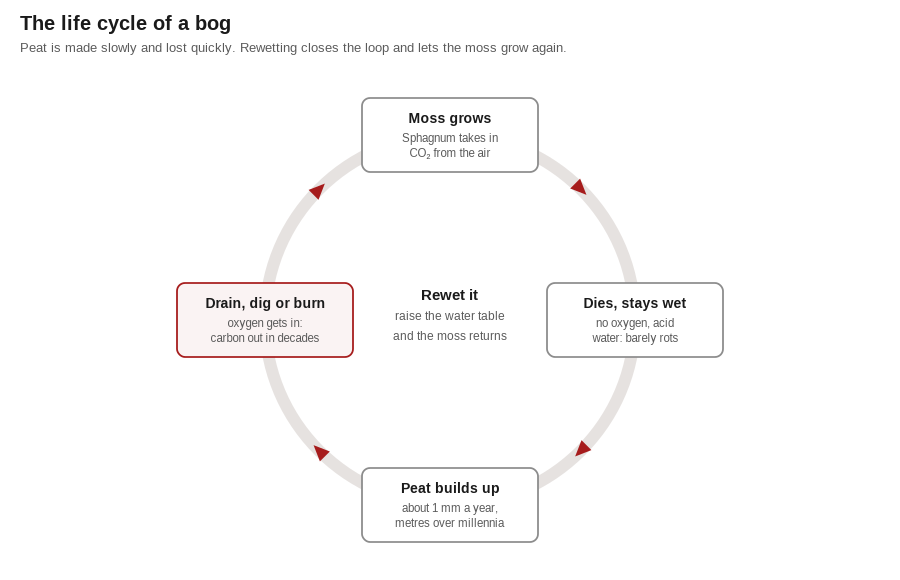
- Moss grows. Sphagnum mosses, the bog builders, take in CO₂ by photosynthesis and hold many times their own weight in water.
- It dies but does not rot. Below the water table there is almost no oxygen. Sphagnum also makes its surroundings acid and contains sphagnan, a pectin-like sugar thought to tie up nutrients and slow the microbes that would break it down.
- Peat builds up. DAERA puts the rate at about 1 cm every 10 years, about a millimetre a year. Lowland raised bogs in Northern Ireland can be over 12 metres deep: a long time in the making.
- It holds carbon. Dry peat is roughly half carbon by weight.
| Type | Fed by | Where in NI |
|---|---|---|
| Blanket bog | Rain only; covers whole hillsides on slopes up to 30° | Antrim Plateau (Garron), Sperrins, Mournes, Cuilcagh |
| Raised bog | Rain only; domes in valleys and river plains | Lowland Armagh, Tyrone, Fermanagh; Peatlands Park |
| Fen | Rain plus groundwater from mineral soil; less acid, richer in nutrients | Around loughs and river margins |
The chemistry: wet against drained
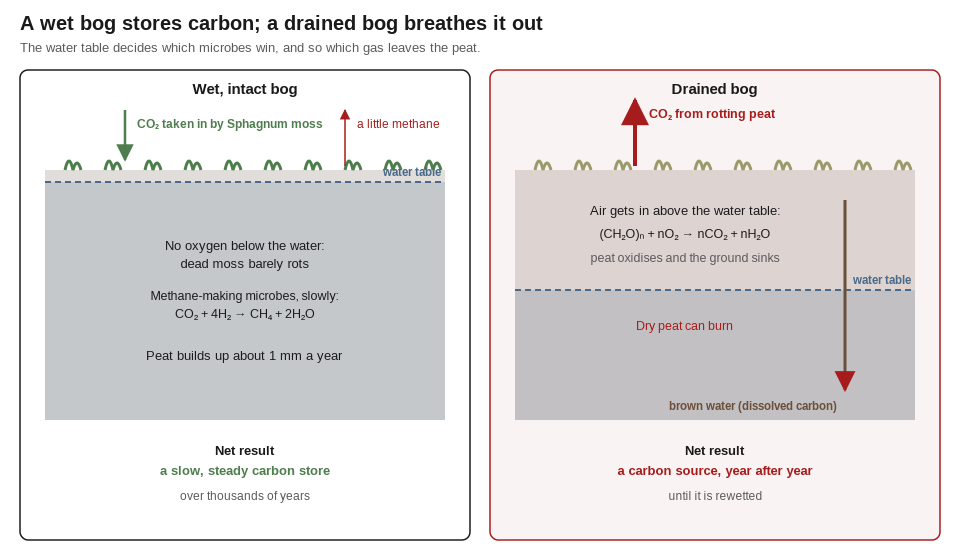
Drained peat rots. Lower the water table and air gets into the peat. Ordinary aerobic microbes go to work, and stored carbon becomes CO₂:
(CH₂O)ₙ + nO₂ → nCO₂ + nH₂O (carbohydrate in the peat, oxidised; simplified)
The peat shrinks and the ground sinks. Some carbon also dissolves and washes out as dissolved organic carbon, the tea-coloured “brown water” in upland streams, which water companies must remove before it reaches the tap.
Wet peat makes a little methane. With no oxygen, methane-making microbes (methanogens) do the work instead, by two main routes:
CO₂ + 4H₂ → CH₄ + 2H₂O (usually the main route in northern bogs)
CH₃COOH → CH₄ + CO₂ (from acetate; more important in richer fens)
So a healthy bog is a small methane source but a long-term carbon store. Methane is the price of keeping the peat wet, and studies show it is worth paying: Günther and colleagues (2020) found that rewetting stops the CO₂ losses and that the methane from rewetted peat does not outweigh that benefit; delaying rewetting increases long-term warming.
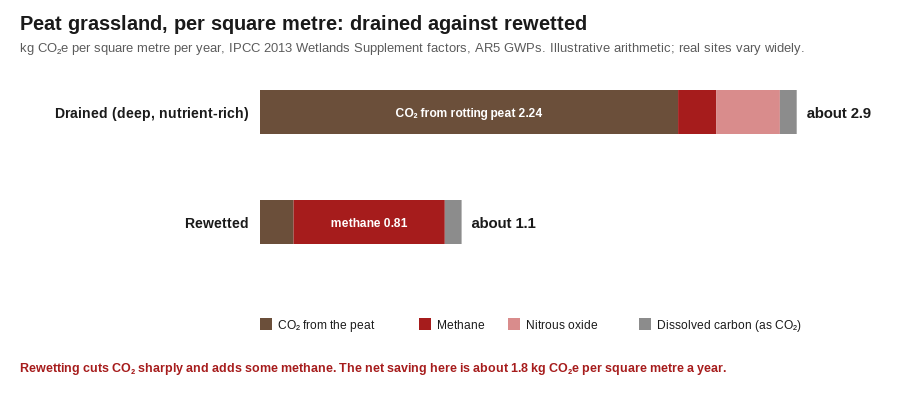
Using the IPCC’s default factors for temperate peat, every square metre of deep-drained, fertile peat grassland emits roughly 2.9 kg of CO₂e a year; rewetted, about 1.1 kg. Across a hectare (10,000 m²) that is about 29,000 kg against 11,000 kg. These are illustrative sums from international defaults; real sites vary widely.
Dry peat burns. A drained bog in a dry spring is fuel. In April 2025 there were nearly 150 wildfires in the Mournes over a single weekend, and the Fire and Rescue Service declared a major incident; DAERA says such fires are almost always started deliberately.
The rules
(Checked 17 November 2026.)
| Rule or plan | What it does | Status |
|---|---|---|
| NI Peatland Strategy to 2040 (DAERA) | All semi-natural peatlands protected and restored to functioning ecosystems by 2040; 150,000 ha of degraded peat restored by 2050 | Launched 17–18 September 2025 |
| First Delivery Plan (April 2026 to December 2027) | About 4,500 ha “on the road to recovery” by December 2027; a peatland asset register; work with growers to phase out peat in horticulture by 2030 | Published 22 April 2026 |
| Retail peat sales | The Delivery Plan promised an NI consultation by August 2026; DAERA has since said ministers prefer a single UK-wide law | No NI consultation found as at 17 November 2026 |
| England peat sales ban | Announced August 2022 for 2024 | Not yet legislated; Defra says it will legislate “when Parliamentary time allows” |
| Peatland Code | Voluntary standard for selling peat restoration carbon; 30-year minimum, 20% buffer, claims only after verification | Version 2.1; see Offsets |
| Peat in the UK inventory | Emissions from drained and degraded peat have been counted since the 1990–2019 statistics, adding about 3.5% to UK emissions | Reported February 2021 |
| EU Nature Restoration Regulation, (EU) 2024/1991 | Restore at least 30% of drained farmed peat by 2030 | In force 18 August 2024 in the EU; probably does not apply in NI (not confirmed) |
Why it matters in Northern Ireland
- A big store. Peat soils cover about 242,600 hectares, an estimated 18% of NI’s land; peatland habitats (bog and fen) about 12%. DAERA says peat holds 53% of NI’s soil carbon.
- Mostly in poor shape. DAERA’s November 2025 environmental report says only 15% of NI peatland is in good condition. The Climate Change Committee (March 2025) counts over 200,000 hectares degraded.
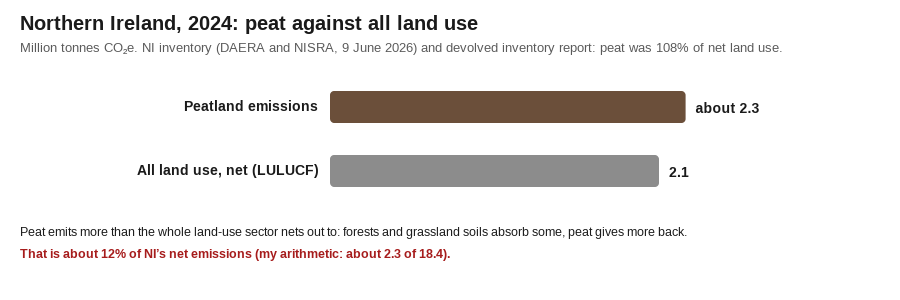
- A big source. NI peatlands emitted about 2.3 million tonnes of CO₂e in 2024, 108% of the whole land-use sector’s net 2.1 million tonnes, so more than the sector nets out to (2.31 million tonnes in the revised 2023 figure). That is about 12% of NI’s net emissions (my arithmetic). The main culprits are intensive grassland on drained lowland peat and, in the uplands, old domestic turf cutting; ONS figures show 87,500 hectares affected by domestic fuel-peat extraction.
- Restoration is under way. NI Water owns over 2,000 hectares of the Garron Plateau, has blocked drains with thousands of small dams since 2013, and in July 2023 the area hosted the first Peatland Code project registered in Northern Ireland.
- The carbon budget needs it. The CCC’s pathway for NI raises the share of peat under restoration management from 18% to 63% by 2040.
Think of a fridge with the door open
| Fridge | Peat bog |
|---|---|
| Food kept cold so it does not go off | Plants kept wet so they do not rot |
| Door seal | The water table |
| Door left open | Drains cut through the bog |
| Food goes off and smells | Peat oxidises into CO₂ |
| A little ice builds up on the coils | A wet bog makes a little methane |
| Close the door and it keeps working | Block the drains and the bog recovers |
| Throw the fridge in a skip | Dig the peat out and sell it as compost |
Examples
Agriculture and food
A farm with drained peat fields
A lowland farm grazes cattle on drained peat soils that grow good grass but keep sinking.
| Drained grassland | Rewetted or water table raised | |
|---|---|---|
| Emissions (IPCC defaults, illustrative) | About 2.9 kg CO₂e per m² a year (29,000 kg per hectare) | About 1.1 kg CO₂e per m² a year (11,000 kg per hectare) |
| Grass and stocking | Higher | Lower, or a different use (wetter grazing, paludiculture) |
| Income options | Grazing | Grazing plus restoration funding or carbon credits |
The lesson: a few hectares of drained peat can outweigh a whole herd’s fuel use. Raising the water table even partly cuts the loss, but it changes how the land can be farmed, so it needs a plan and, if credits are involved, independent advice.
Public sector
A water utility or council with upland catchments
A body owning upland bog above a reservoir faces rising water colour and wildfire risk.
What the evidence says: rewetting helps the bog and cuts carbon loss, but a 2023 review (Williamson and colleagues) found the effect on brown water at catchment scale is mixed. NI Water reports only modest falls in water colour at Garron so far.
The lesson: restore bogs for carbon, habitat and fire risk; do not promise cheaper water treatment on the strength of it.
Retail and the home
A garden centre still selling peat compost
A garden centre stocks bagged compost, some of it peat-based.
What is happening: about 70% of peat sold in the UK went into retail bags (Defra, 2022); a ban is promised UK-wide but not yet law, and DAERA aims to work with growers to phase peat out of horticulture by 2030. Peat-free alternatives include composted bark, wood fibre, coir and green compost, each with trade-offs (RHS).
The lesson: switch stock to peat-free before the law forces it, and label it clearly. Bagged peat is someone else’s bog, drained.
Common mistakes
- “Peat is just soil.” It is a carbon store built over millennia and lost in decades.
- “Rewetting is bad because it makes methane.” It makes some; the CO₂ it saves is far larger.
- “Planting trees on peat helps.” Draining peat to plant trees usually releases more carbon than the trees take up; forestry on peat is a source in the UK inventory.
- “The peat compost ban is already law.” Not yet, in England or NI.
- “Restoring the bog will fix the brown water.” The evidence is mixed.
Previous: Offsets · Next: Permafrost: worse than the ice caps? · Related: Lough Neagh and cyanobacteria
Sources
Checked 17 November 2026.
- Global picture: UNEP, Global Peatlands Assessment 2022 (3–4% of land; up to a third of soil carbon).
- Formation and types: DAERA, What is peat? (1 cm per 10 years; bog types; depths) · Natural Resources Wales, Peatland information note (carbon content; drained peat oxidises) · IPCC 2013 Wetlands Supplement, glossary.
- Chemistry and rewetting: Heffernan et al. 2022, Biogeosciences 19, 3051 (methane pathways; water table) · Günther et al. 2020, Nature Communications 11, doi:10.1038/s41467-020-15499-z · IPCC 2013 Wetlands Supplement, chapter 3, rewetted organic soils. The drained-soil factors were read from the final draft of chapter 2, as the published chapter could not be reached; the per-hectare totals are my arithmetic.
- Water: Williamson et al. 2023, Biogeosciences 20, 3751 · NI Water, Peatland restoration.
- Northern Ireland: DAERA and NISRA, NI GHG inventory 1990–2024 (9 June 2026; peatland 2.31 Mt revised for 2023) · Ricardo for DESNZ, GHG inventories for England, Scotland, Wales and NI 1990–2024 (peatland 108% of NI net land-use emissions in 2024) · DAERA, NI Peatland Strategy 2040 and first Delivery Plan (22 April 2026) · DAERA, NI Peatland Strategy consultation (8 August 2022; 18% and 12% of land, 53% of soil carbon) · Peatland Strategy Delivery Plan SEA environmental report (November 2025; 15% in good condition) · ONS, UK natural capital: peatlands (2019) · Climate Change Committee, Northern Ireland’s Fourth Carbon Budget (19 March 2025) · DAERA, wildfires news release (7 April 2025).
- UK inventory: Evans et al. 2017, Implementation of an emissions inventory for UK peatlands · IUCN UK Peatland Programme, peat added to the UK inventory (4 February 2021).
- Peat sales: Defra, horticultural peat to be banned (27 August 2022) · Lords written answer HL16277 (UK-wide approach; via Parallel Parliament) · DAERA replies to information requests of 22 July 2026 and 7 August 2026 · RHS guidance on peat-free growing media.
- EU: Regulation (EU) 2024/1991, Article 11 (as summarised by Ireland’s Climate Change Advisory Council); its application in NI is not confirmed.
- Not checked against a primary source: the oxidation and methanogenesis equations (standard chemistry); the role of sphagnan, which the research describes as partly supported; that drained forestry on peat is a net source (consistent with the UK peat inventory, which lists forestry on peat as a source). The examples are illustrative.
Facts and definitions last checked against the standards and official sources on 17 November 2026. General information, not legal, tax or customs advice.