
Hydrogen by colour: grey, blue, green and the rest
In short
Every colour of hydrogen is the same molecule, H₂. The colour describes how it was made, and so how much greenhouse gas came with it: from about 22–26 kg of CO₂e per kilogram for coal-based “brown” hydrogen to near zero for “green” hydrogen made with renewable power. The rules ignore the colours and set a number instead: 2.4 kg per kg in the UK.
Hydrogen is sold as the clean fuel of the future, and when it burns or runs a fuel cell the only product is water. But under 1% of the world’s hydrogen is made by low-emission routes. According to the IEA, about two-thirds comes from natural gas and about a fifth from coal, and for the same useful energy, making hydrogen from gas releases more CO₂ than simply burning the gas. So “is hydrogen green?” is the wrong question. The right one is: how was this hydrogen made, and how much carbon came with each kilogram?
The colours are a shorthand for that. They are informal, they are not used in the UK or EU hydrogen standards, and the International Energy Agency has warned that they hide big differences. But you will meet them everywhere, so here is what they mean.
Seven colours, side by side
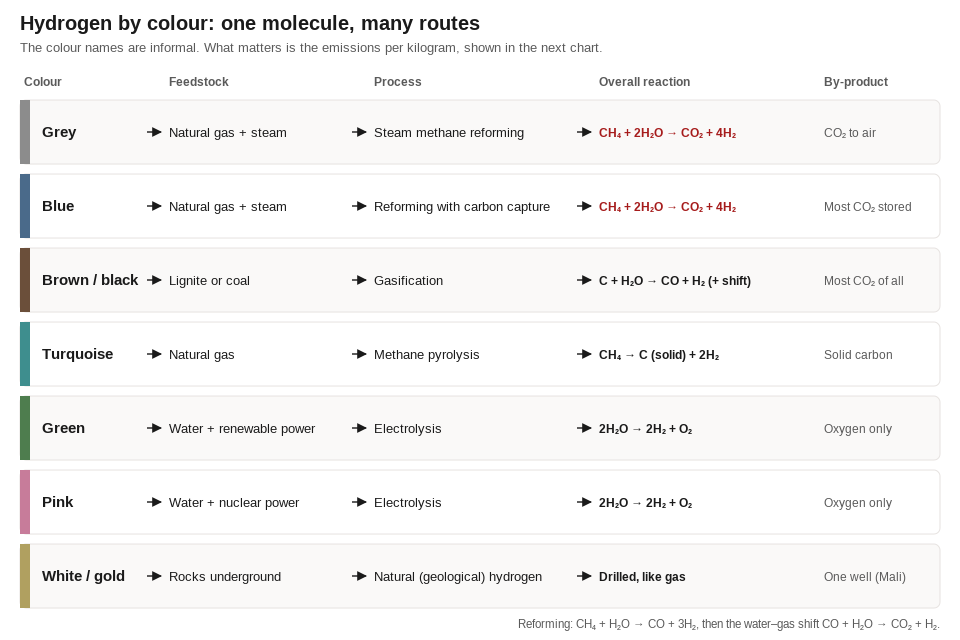
| Colour | How it is made | Main reaction | What comes with it |
|---|---|---|---|
| Grey | Steam methane reforming of natural gas | CH₄ + 2H₂O → CO₂ + 4H₂ | CO₂ released to air, plus methane leaks upstream |
| Blue | The same, with carbon capture and storage | As grey | Less CO₂, depending on how much is captured and on methane leaks |
| Brown / black | Gasifying lignite (brown) or coal (black) | C + H₂O → CO + H₂, then shifted | The most CO₂ of any route |
| Turquoise | Methane pyrolysis: cracking gas without air | CH₄ → C (solid) + 2H₂ | Solid carbon (soot or graphite), not CO₂, if it stays solid |
| Green | Electrolysis of water with renewable electricity | 2H₂O → 2H₂ + O₂ | Oxygen; emissions only from building the wind or solar kit |
| Pink | Electrolysis with nuclear electricity | 2H₂O → 2H₂ + O₂ | Oxygen; low emissions |
| White / gold | Natural hydrogen drilled from rocks | None needed | Unknown at scale; one producing well, in Mali |
“Yellow” is used for both solar-powered and grid-powered electrolysis, which shows the problem with colours: two people can mean different things by the same word.
The chemistry of grey and blue
Reforming happens in two steps. First, methane and steam meet over a nickel catalyst at high temperature:
CH₄ + H₂O → CO + 3H₂ (reforming; needs a lot of heat)
Then the carbon monoxide reacts with more steam:
CO + H₂O → CO₂ + H₂ (the water–gas shift)
Add them up and every molecule of methane gives four of hydrogen and one of carbon dioxide. Half the hydrogen came from the water, not the gas. The CO₂ is unavoidable: it is the carbon from the methane with nowhere else to go. In blue hydrogen that CO₂ is captured from the process stream and piped to storage, but the gas burned to heat the reformer, and any methane leaked on the way to the plant, still count.
The chemistry of green
Electrolysis is the reverse of burning hydrogen. Pass a current through water and it splits:
2H₂O → 2H₂ + O₂
It takes a lot of electricity. The IEA’s 2023 global average electrolyser efficiency of 66% works out at roughly 50 kWh of electricity for every kilogram of hydrogen. That kilogram holds about 33 kWh of energy, so a third is lost before the hydrogen is even used. Electrolysis on the grid only beats unabated grey hydrogen if the grid emits less than about 200–240 g of CO₂ per kWh.
Emissions per kilogram
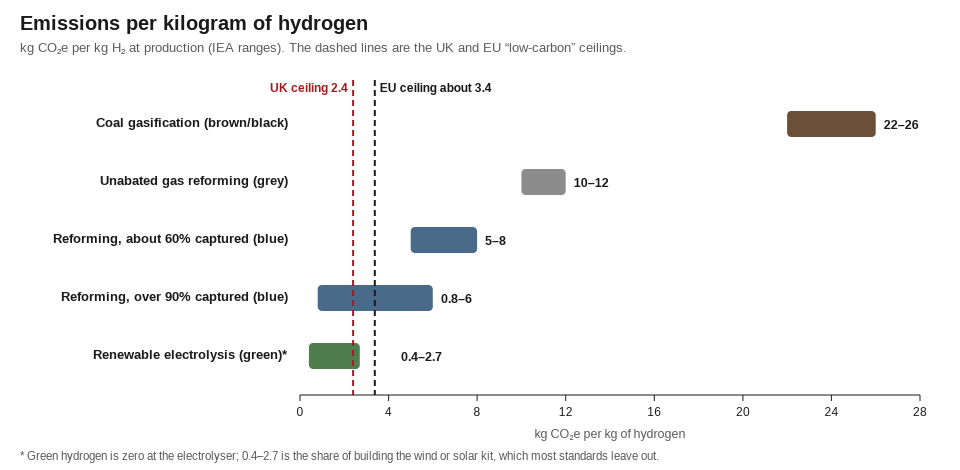
| Route | kg CO₂e per kg H₂ (IEA) |
|---|---|
| Coal gasification | 22–26 |
| Unabated gas reforming (grey) | 10–12 (other IEA work: 10–14) |
| Reforming with about 60% capture (blue, retrofitted) | 5–8 |
| Reforming with over 90% capture (blue, advanced) | 0.8–6 |
| Renewable electrolysis (green) | 0 at the plant; 0.4–2.7 from making the equipment |
The spread for blue hydrogen is the important line. A well-run plant with high capture and tight methane control can beat the thresholds below; a retrofitted plant capturing 60% cannot. The colour “blue” covers both.
The rules: numbers, not colours
Regulators have dropped the colours and set limits on emissions per unit of energy. (Checked 17 November 2026.)
| Rule | Limit | In kg CO₂e per kg H₂ | Status |
|---|---|---|---|
| UK Low Carbon Hydrogen Standard | 20 g CO₂e per MJ | about 2.4 | Version 4 published 19 January 2026; the test for UK subsidy |
| EU renewable hydrogen (RFNBO), Delegated Regulation (EU) 2023/1185 | 70% below a fossil comparator of 94 g per MJ, so 28.2 g per MJ | about 3.4 | In force 10 July 2023 |
| EU low-carbon hydrogen, Delegated Regulation (EU) 2025/2359 | Same 70% saving | about 3.4 | In force 11 December 2025 |
The UK line is stricter than the EU’s. The UK standard has also added routes such as gas splitting with the solid carbon used in asphalt, so turquoise-type hydrogen can qualify if the numbers work. The EU low-carbon rules count upstream methane and do not treat nuclear power as zero-emission.
Carbon border taxes. Hydrogen (commodity code 2804 10 00) is a CBAM good under both regimes. The EU CBAM, in its definitive period from 1 January 2026, lists hydrogen in Annex II, so only direct emissions count. The UK CBAM covers hydrogen from 1 January 2027, charged on direct emissions. An importer of hydrogen into Northern Ireland may need to look at both; get customs advice on which applies to a given movement.
Hydrogen’s own warming effect
Hydrogen is not a greenhouse gas: it does not absorb infrared. But it is a tiny, slippery molecule that leaks easily, and once in the air it reacts with the hydroxyl radical (OH), the same “detergent” that breaks down methane.
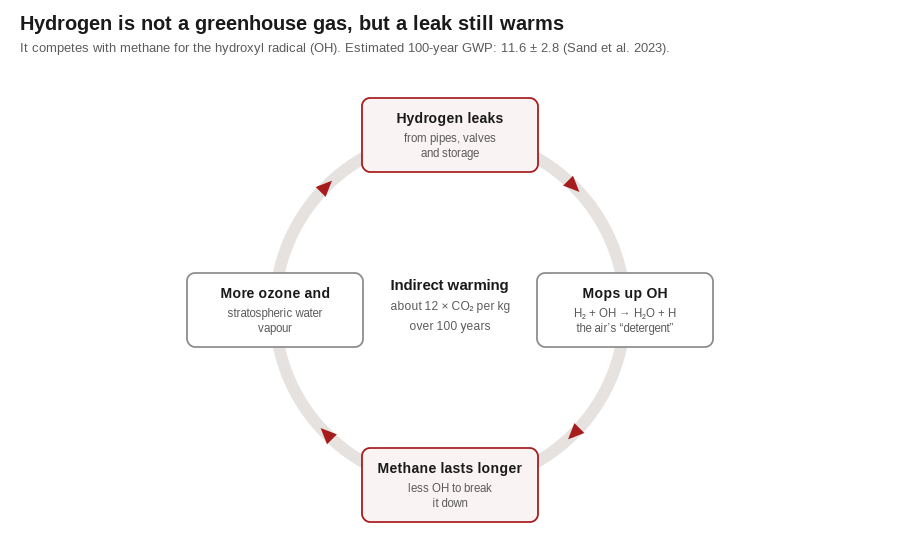
H₂ + OH → H₂O + H
Every OH radical used up by hydrogen is one not available to destroy methane, so methane lasts longer. The same chemistry adds ozone and water vapour high up. A 2023 multi-model study by Sand and colleagues put hydrogen’s 100-year GWP at 11.6 ± 2.8: each tonne leaked warms like about 12 tonnes of CO₂. Neither the UK nor the EU thresholds above count hydrogen leaks as emissions, so a hydrogen system with high leakage can look cleaner on paper than it is. The UK standard does at least require producers to plan against leaks and report them each year.
Why it matters in Northern Ireland
Policy. The Department for the Economy consulted on a hydrogen policy from 25 September to 18 December 2025 and published its response on 27 May 2026; a hydrogen action plan is to follow. A law firm’s summary of the response reports no targets for now, alignment with the UK standard and a preference for green hydrogen; I have not been able to check that against the department’s own document. None of the UK’s subsidised hydrogen projects is in Northern Ireland: 11 projects won the first allocation round in December 2023, ten had signed contracts by July 2025, and none of the 27 shortlisted for the second round, announced in April 2025, is in NI.
Buses. Belfast was early. Three hydrogen fuel-cell double-deckers, built by Wrightbus in Ballymena, arrived for Translink’s Metro fleet in December 2020, to run on hydrogen made by electrolysis at a North Antrim wind farm using wind power that would otherwise have been curtailed.
Storage under Larne Lough. The salt beds around Larne and Carrickfergus are, according to the Geological Survey of Northern Ireland, the only thick salt on the island of Ireland, which is why caverns there have been proposed for gas storage. The Islandmagee project was for natural gas, not hydrogen: seven caverns holding about 500 million cubic metres. DAERA granted its licences in November 2021; the Court of Appeal allowed a challenge on 17 June 2024; and DAERA’s register now lists the marine licence application as withdrawn. GSNI notes the salt is thinner and less pure than elsewhere, which would also matter for any hydrogen storage idea. (Facts only; not legal advice.)
Fertiliser. About half of the world’s hydrogen goes into ammonia and methanol. Every bag of nitrogen fertiliser spread in Northern Ireland started as hydrogen, almost all of it grey. See Fertiliser and the nitrogen cycle.
Think of electricity tariffs, then add a meter
Buying hydrogen by colour is like buying a “green” electricity tariff without seeing the meter readings.
| Electricity | Hydrogen |
|---|---|
| A tariff called “green” | A colour called “green” or “blue” |
| The supplier’s actual fuel mix | The plant’s actual route and capture rate |
| Grams of CO₂ per kWh on your bill | kg of CO₂e per kg of hydrogen on the certificate |
| Matching renewable certificates to when you use power | EU rules matching electrolysis to renewable generation in time and place |
| A leaking meter nobody bills you for | Hydrogen leaks the UK standard asks producers to report, but no threshold counts |
Ask for the number, the method and who checked it, not the colour.
Examples
Manufacturing
A food factory replacing its gas boiler
A County Antrim food processor is offered hydrogen-ready boilers and asks whether to switch from gas to hydrogen for process heat.
| Natural gas | Grey hydrogen | Green hydrogen | |
|---|---|---|---|
| Energy delivered | 1 MWh | 1 MWh (30 kg H₂) | 1 MWh (30 kg H₂) |
| Emissions (illustrative) | about 180 kg CO₂ burned (about 210 kg with gas supply) | about 300–360 kg CO₂e | about 80 kg CO₂e or less |
| Electricity to make it | none | none | about 1.5 MWh |
The numbers are rounded and illustrative (30 kg of hydrogen at 10–12 kg CO₂e each for grey; up to 2.7 for green). The lesson: grey hydrogen is worse than the gas it replaces. Green hydrogen cuts emissions but needs one and a half times as much electricity as the energy in the hydrogen, and more once boiler losses are counted; a heat pump or direct electric heating usually needs far less.
Public sector
A council choosing between hydrogen and battery buses
A council-backed transport scheme is offered both. The questions to ask: where will the hydrogen come from, what is its carbon intensity per kilogram, and is there a refuelling station within reach?
What to check: the supplier’s certificate against the UK standard (2.4 kg per kg or less); whether the electrolysers run on surplus wind or on grid power; and the whole cost per kilometre. Translink’s early buses ran on curtailed wind, which is the best case.
The lesson: a hydrogen bus is only as clean as the hydrogen in its tank.
Agriculture and food
A merchant importing ammonia-based fertiliser
An NI merchant imports ammonium nitrate made from grey hydrogen. From 1 January 2027 the UK CBAM applies to fertilisers, and the EU CBAM already covers fertiliser entering the EU.
What happens: the embedded emissions of the fertiliser start with the hydrogen. A supplier who switches to green or high-capture blue hydrogen for ammonia can lower the CBAM charge on every tonne, provided it supplies verified actual emissions data; otherwise default values apply. Ask suppliers which hydrogen route they use and for their verified emissions data.
The lesson: hydrogen’s colour shows up on the farm invoice before it shows up in a fuel tank.
Common mistakes
- Calling all hydrogen clean. Under 1% is made by low-emission routes; most is grey or brown, and grey hydrogen emits more than burning the gas it was made from.
- Trusting the colour. “Blue” covers both 0.8 and 8 kg of CO₂e per kg. Ask for the number.
- Forgetting the electricity. Green hydrogen needs about 50 kWh per kg; using the power directly is often better.
- Ignoring leaks. Hydrogen warms indirectly, about 12 times CO₂ over 100 years. Neither the UK nor the EU threshold counts it, though the UK standard requires leaks to be reported.
- Assuming Islandmagee was a hydrogen project. It was for natural gas.
Previous: Was it the Sun? · Next: Fertiliser and the nitrogen cycle · Related: Carbon capture and carbon negative
Sources
Checked 17 November 2026.
- Emissions by route and efficiency: IEA, Global Hydrogen Review 2024: GHG emissions of hydrogen (grey 10–12, coal 22–26, renewable kit 0.4–2.7, grid break-even 200–240 g/kWh) · IEA, Towards hydrogen definitions based on emissions intensity (2023) (blue 5–8 and 0.8–6; warning on colour labels; under 1% low-emission) · IEA, GHR 2024 assumptions annex (66% electrolyser efficiency) · IEA, Global Hydrogen Review 2026 (natural hydrogen; ammonia and methanol about half of use).
- Thresholds: DESNZ, UK Low Carbon Hydrogen Standard, version 4 (19 January 2026) · Delegated Regulation (EU) 2023/1185 · Delegated Regulation (EU) 2025/2359. Conversions to kg per kg are mine, using 120 MJ per kg.
- Hydrogen’s GWP: Sand et al. 2023, Communications Earth & Environment 4, 203.
- CBAM: HMRC, UK CBAM policy summary (updated 2 November 2026) · Regulation (EU) 2023/956, Annexes I and II (from an official copy; EUR-Lex not reachable today, and later amendments to Annex II not re-checked).
- UK allocation rounds: DESNZ, HAR1 successful projects · contracts signed, 23 July 2025 · HAR2 shortlist, 7 April 2025.
- Northern Ireland: Department for the Economy, hydrogen consultation and response (content of the response from a law-firm summary, not yet checked against the department’s document) · DfI, first hydrogen buses, 16 December 2020 · Judiciary NI, Court of Appeal summary, No Gas Caverns Ltd, 17 June 2024 · DAERA, marine licence ML 28_12 (listed as withdrawn) · GSNI, Energy storage.
- Not checked against a primary source: the reforming and electrolysis equations (standard chemistry); the food factory and bus figures are illustrative.
Facts and definitions last checked against the standards and official sources on 17 November 2026. General information, not legal, tax or customs advice.