
Contrails and “chemtrails”: is it true?
In short
The white lines behind planes are contrails: ice clouds made from the water vapour in jet exhaust. They are not harmless to the climate. Spreading contrails warm the planet more than all the CO₂ aviation has ever emitted, though the figure is far less certain. There is no evidence that planes are secretly spraying chemicals. Solar geoengineering is real as research, with a few small, public experiments, but it is not being deployed.
Look up over Northern Ireland on a clear day and you will often see the sky criss-crossed with white lines. Some fade within seconds. Others spread into a haze that lasts all afternoon. Many people ask why, and some believe the lasting trails are something else: chemicals sprayed on purpose, the so-called chemtrails.
It is a fair question to ask, and it deserves a straight answer with the evidence. The surprising part is that the real story, about contrails, is a genuine climate problem that gets far less attention than it should.
In short
| Short-lived contrail | Persistent contrail (contrail cirrus) | “Chemtrail” claim | |
|---|---|---|---|
| What it is | Ice cloud from engine exhaust | The same ice, in moist air, spreading into cloud | Said to be chemicals sprayed on purpose |
| How long | Seconds to minutes | Hours | Said to linger and spread |
| Why | Air too dry for ice to survive | Air already saturated with respect to ice | |
| Climate effect | Small | Net warming, especially at night | |
| Evidence | Physics and observation | Physics, satellites, models | None found |
How a contrail forms
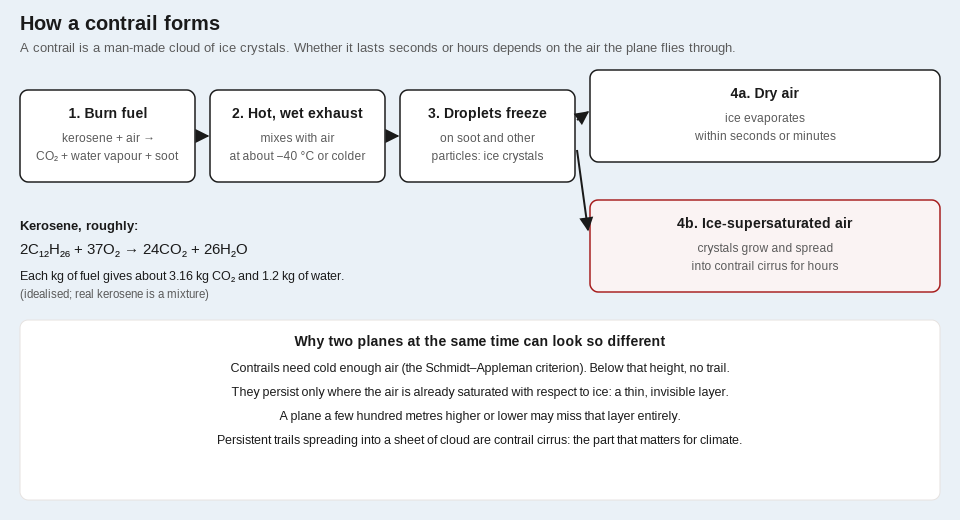
Jet fuel is kerosene, a mixture of hydrocarbons. Burned in air, it gives carbon dioxide and water. In idealised form:
2C₁₂H₂₆ + 37O₂ → 24CO₂ + 26H₂O
Each kilogram of jet fuel gives about 3.16 kg of CO₂ and about 1.2 kg of water (standard aviation factors; the idealised equation gives slightly different figures because real fuel is a mixture). The water leaves the engine as hot vapour, along with tiny soot particles.
The Met Office explains the rest: at the cold heights where airliners cruise, above about 20,000 feet, the water vapour freezes into ice crystals around particles from the engine. What happens next depends on the air:
- Dry air: the ice turns straight back into vapour and the trail disappears within seconds or minutes.
- Humid air, saturated with respect to ice: the crystals survive, grow and can spread for hours into sheets of cirrus-like cloud, called contrail cirrus.
Those moist layers are often thin and invisible. That is why two planes a few minutes apart can leave very different trails: one passes through the moist layer, the other flies a little above or below it.
Do contrails warm the climate?
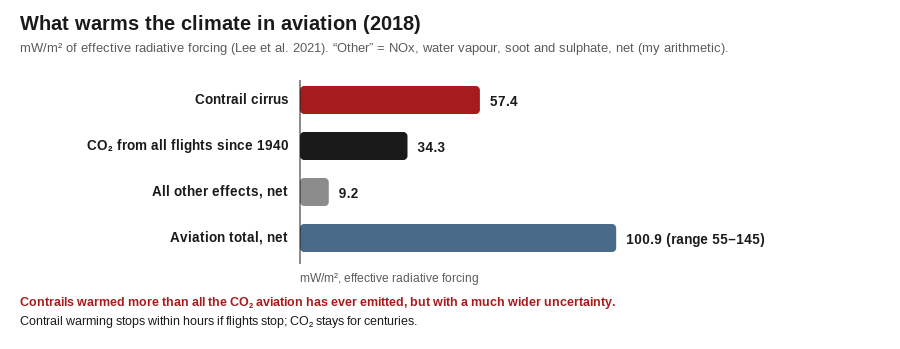
Yes. The most-cited assessment, by Lee and colleagues (Atmospheric Environment, 2021), put aviation’s total warming effect in 2018 at 100.9 milliwatts per square metre (range 55–145). Of that, contrail cirrus was 57.4 and the CO₂ from all the flights since 1940 was 34.3. Effects other than CO₂ made up about two-thirds of aviation’s total.
Two caveats matter. The contrail number is much less certain than the CO₂ number. And it behaves differently over time: contrails vanish within hours, so if flights stopped the contrail warming would stop almost at once, while aviation’s CO₂ stays in the air for centuries. Comparing the two needs care, which is why the same questions about time horizons come up as for methane (see CO₂e and global warming potential).
By day and by night
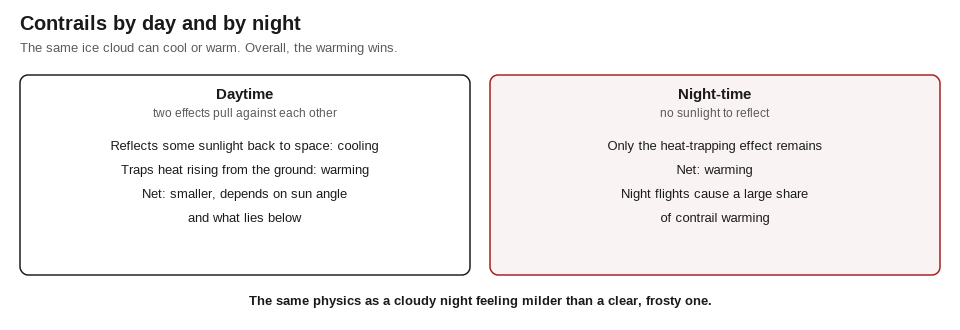
A contrail is a thin cloud, and clouds do two things: they reflect sunlight (cooling) and trap heat rising from the ground (warming). By day the two partly cancel. At night only the warming is left. A 2024 global study by Teoh and colleagues found the strongly warming contrails formed mostly between 4 pm and 3 am.
A few flights do most of the damage
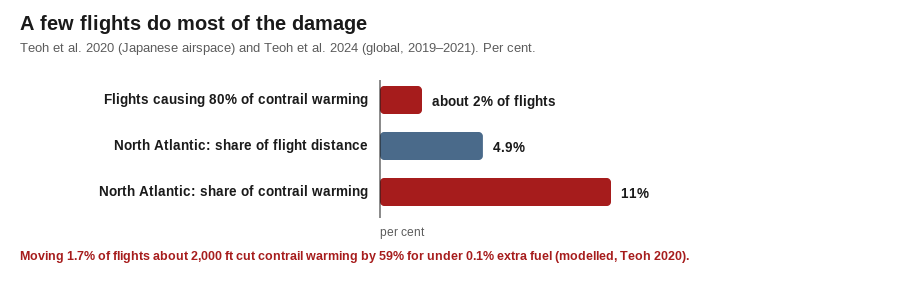
Because lasting contrails need those thin moist layers, a small number of flights cause most of the effect. Teoh and colleagues (2020) found about 2% of flights caused 80% of contrail warming in Japanese airspace, and that moving 1.7% of flights by about 2,000 feet could cut it by 59% for under 0.1% extra fuel (a model result). In 2023 Google and American Airlines reported a trial of 70 flights with 54% fewer contrails for 2% more fuel on those flights (a company report, not peer reviewed).
The open question is whether forecasts of the moist layers are good enough to do this routinely, and how to weigh a certain extra tonne of CO₂ against an uncertain contrail saved.
The rules
(Checked 17 November 2026.)
| Rule | What it does | Applies to | Status |
|---|---|---|---|
| EU ETS Directive amendment (EU) 2023/958 | Airlines must monitor and report their non-CO₂ effects, including contrails | Flights within the EEA and departures to the UK and Switzerland (2025–26); all flights to and from the EEA from 2027 | Reporting from 1 January 2025; the Commission reports by 31 December 2027 and may propose extending the ETS to them |
| UK ETS | Covers aviation CO₂ | UK domestic flights and flights to the EEA | No non-CO₂ charge (not checked against the latest UK ETS changes) |
| UK Government view on solar radiation modification | States there is no deliberate spraying of chemicals in UK skies for climate modification, and that it does not support deploying solar geoengineering | UK | Published 29 September 2026 |
| ARIA climate-cooling programme | £56.8 million of research, including five small, time-limited outdoor experiments; no deployment | UK research | Running |
| US state laws | Tennessee (April 2024) and Florida (SB 56, from 1 July 2025) ban releasing chemicals into the air to affect weather or climate | Those states | Florida: state Senate bill page; Tennessee: news reports |
“Chemtrails”: what is claimed and what the evidence shows
The claim, in its usual form: that lasting white trails are not ice but chemicals sprayed deliberately from aircraft, by governments or others, for purposes such as changing the weather or the climate, and that the trails are kept secret.
What the evidence shows:
- The trails behave as ice physics predicts. They form at cruising heights, last where the air is moist and vanish where it is dry. Weather balloons, satellites and forecast models detect those moist layers, though not yet precisely enough to predict every trail.
- Scientists looked and found nothing. Shearer and colleagues (Environmental Research Letters, 2016) asked 77 atmospheric scientists and geochemists to assess the evidence put forward for secret spraying. 76 of the 77 had found no evidence of a secret large-scale programme; the remaining one reported unusually high levels of atmospheric barium in a remote area with low barium in the soil; the authors did not discuss that observation separately. Many said the samples could be explained by ordinary contrails, normal pollution and poor sampling.
- The government says so on the record. The UK Government’s statement of 29 September 2026 says there is no deliberate spraying of chemicals in the skies over the UK for climate modification. In March 2026 DAERA told a member of the public who asked about aircraft spraying over NI that it held no such information.
- The ice explanation needs nothing extra. An airliner already makes about 1.2 kg of water for every kg of fuel it burns.
What is real: solar geoengineering research
The idea behind the claim is not invented. Solar radiation modification, cooling the Earth by reflecting a little sunlight back to space, is a genuine field of research, and the debate about it is open and public:
- Stratospheric aerosol injection would release reflective particles high in the atmosphere, copying the cooling after big volcanic eruptions. Harvard’s planned SCoPEx test balloon was cancelled in March 2024 without ever flying.
- The UK’s Advanced Research and Invention Agency (ARIA) is funding £56.8 million of research, including five small, time-limited outdoor experiments. Its stratospheric project releases no material.
- A US start-up, Make Sunsets, has released small balloons of sulphur dioxide; in April 2025 the US EPA sent it a formal demand for information under the Clean Air Act.
- Cloud seeding, spreading particles such as silver iodide to encourage rain or snow, is real and used in some countries. It is local, aimed at existing clouds, and does not make long white lines across the sky.
So the honest answer is: research yes, small public experiments yes, secret spraying from airliners no.
A story people often mention: Lynmouth, 1952
The Lynmouth flood in Devon in August 1952 killed 34 people (the BBC’s report gives 35). On 30 August 2001 a BBC report raised claims that cloud-seeding experiments had taken place in the area around that time; the Ministry of Defence said it had no knowledge of such experiments at the time of the flood. The claim remains disputed and unproven, and there is no evidence that seeding could cause a storm of that size.
Why it matters in Northern Ireland
- Under the North Atlantic flight paths. Much of the traffic between Europe and North America passes over or near Ireland. Teoh and colleagues (2024) found the North Atlantic carries 4.9% of the world’s flight distance but causes 11% of contrail warming, helped by its night-time eastbound flights. The lines over Larne or Enniskillen are part of that.
- EU reporting. Airlines flying within the EEA, or from the EEA to the UK, must report their non-CO₂ effects from 1 January 2025; flights into the EEA from the UK are added from 2027 (European Commission).
- Council and business travel footprints. DESNZ’s greenhouse gas conversion factors offer flight factors with and without an allowance for these non-CO₂ effects (not checked for this page). Which one an organisation uses can change the flight part of its footprint a lot, so say which you chose.
- Trust. Questions about chemtrails reach councillors and MLAs. A clear, evidence-based answer, without mockery, keeps the conversation on the real issue: contrails, which can be cut.
Think of breath on a cold morning
| Your breath | A jet engine |
|---|---|
| Warm, wet air from your lungs | Hot exhaust full of water vapour |
| A cold, dry morning: a puff that vanishes | Dry air at altitude: a short trail |
| A cold, damp morning: mist that hangs about | Ice-saturated air: a trail that spreads for hours |
| Dust in the air helps fog form | Soot from the engine helps ice form |
| You cannot see the damp in the air, only the result | The moist layers are invisible until a plane crosses them |
| Nobody thinks your breath is a secret spray | A trail is ice unless there is evidence otherwise |
Examples
Public sector
A councillor asked about chemtrails
A constituent sends a councillor photographs of criss-crossing trails over the Glens and asks what is being sprayed.
A good reply: take the question seriously; explain that the trails are ice from engine exhaust and why some last; point to the UK Government’s statement of September 2026 and the 2016 survey of scientists; and acknowledge the real issue, that lasting contrails do warm the climate and can be reduced.
The lesson: respect the question, give the evidence, and move to what can actually be done.
Manufacturing
An exporter reporting business travel
An NI engineering firm’s staff fly to North America for trade shows and it is preparing its first carbon footprint.
What to decide: whether to count flights with or without the non-CO₂ allowance. With it, the flights count for considerably more. The non-CO₂ number is uncertain, but leaving it out understates the real effect, and an increasing number of customers ask which method was used.
The lesson: pick a method, state it, and use it every year. Fewer, longer trips and daytime flights where possible are sensible ways to cut both.
Education
A school science lesson
A teacher wants a lesson that turns a question pupils see online into real science.
What works: breathe on a cold window and compare with a warm day; look up the day’s upper-air humidity forecast and predict whether trails will last; then check the sky. Pupils test the claim themselves.
The lesson: the best answer to a contested claim is a test anyone can run.
So, are chemtrails true?
| Claim | Verdict |
|---|---|
| Contrails are made of ice from the water in jet exhaust | True |
| Some contrails last for hours and spread into cloud | True: in air saturated with respect to ice |
| Contrails warm the climate | True: aviation’s largest single warming effect, but uncertain in size |
| Contrails are “just water vapour”, so harmless | Misleading: they are ice clouds that trap heat, especially at night |
| Planes are secretly spraying chemicals | No evidence found; denied on the record by the UK Government |
| Governments are researching solar geoengineering | True: research and a few small, public experiments, not deployment |
| Cloud seeding exists | True, locally, and it does not make trails across the sky |
Common mistakes
- “A trail that lasts must be chemicals.” It means the air is moist at that height.
- “Contrails are only water, so they do not matter.” They are one of aviation’s biggest warming effects.
- “Contrails cool the planet because they block the sun.” By day partly; at night they only warm, and overall they warm.
- “Geoengineering is a conspiracy theory.” The research is real and public; secret spraying from airliners is the unsupported part.
- Counting flights on CO₂ alone without saying so. State whether non-CO₂ effects are included.
Previous: Fracking: what is burned and what leaks · Related: Was it the Sun? · CO₂e and global warming potential
Sources
Checked 17 November 2026.
- Formation: Met Office, Contrails.
- Climate effect: Lee et al. 2021, The contribution of global aviation to anthropogenic climate forcing for 2000 to 2018, Atmospheric Environment 244 · Imperial College London, small altitude changes could cut contrail impact (Teoh et al. 2020, Environmental Science & Technology) · Teoh et al. 2024, Global aviation contrail climate effects from 2019 to 2021, Atmospheric Chemistry and Physics 24 · Google, AI and airlines on contrails (8 August 2023; company report).
- Rules: European Commission, reducing emissions from aviation (non-CO₂ reporting scope) · Directive (EU) 2023/958 (10 May 2023) · UK Government, view on solar radiation modification (29 September 2026) · ARIA, Exploring climate cooling: FAQs.
- Chemtrail evidence: Shearer et al. 2016, Quantifying expert consensus against the existence of a secret, large-scale atmospheric spraying program, Environmental Research Letters 11 · BBC, Lynmouth cloud-seeding claims (30 August 2001; mirror of the BBC page) · DAERA, environmental information response 26-125 (20 March 2026; not linked, as the published file names the requester).
- Geoengineering research: E&E News, Harvard shuts down geoengineering experiment (March 2024) · US EPA, demand to Make Sunsets (April 2025) and geoengineering: government action and contrail resources (9 July 2025).
- Not checked against a primary source: the 3.16 kg CO₂ and 1.2 kg water per kg of fuel (standard aviation factors) and the kerosene equation (idealised); the Tennessee law (news reports); the Lynmouth claims; the UK ETS position on non-CO₂ effects; the DESNZ non-CO₂ flight factors; the North Atlantic flight paths over NI. The examples are illustrative.
Facts and definitions last checked against the standards and official sources on 17 November 2026. General information, not legal, tax or customs advice.