
Lough Neagh and cyanobacteria
In short
Cyanobacteria, often called blue-green algae, are ancient bacteria that made the oxygen we breathe. Fed too much phosphorus, in warm, still, clear water, they bloom, and some make toxins. Lough Neagh, which supplies about 40% of Northern Ireland's drinking water, had serious blooms in 2023, 2024 and 2025. The main cure is less phosphorus from farms and sewage, but the lough will take years to recover.
In the summer of 2023 Lough Neagh turned green. Thick scums of blue-green algae washed onto its shores and down the Lower Bann to the north coast, and they returned in 2024 and 2025 (no end-of-season report for 2026 had been published when this was checked). For a lough that supplies about 40% of Northern Ireland’s drinking water, supports Europe’s largest wild eel fishery and covers 392 km², it became the country’s most visible environmental problem.
The organisms behind it are not really algae. They are cyanobacteria, and their story goes back three billion years.
Cyanobacteria: the good and the bad
| The good | The bad |
|---|---|
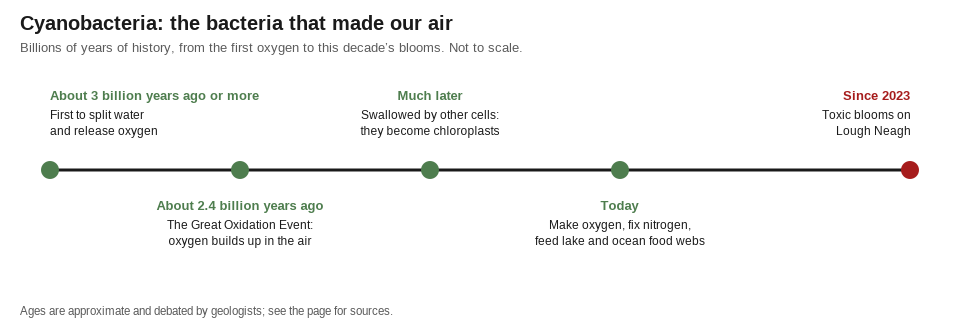
| Invented oxygen-making photosynthesis, about 3 billion years ago or more, and filled the air with oxygen from about 2.4 billion years ago | In blooms, shade out other plants and form thick scums |
| Their descendants live on as chloroplasts inside every green plant | Some make microcystins, liver toxins harmful to people and highly toxic to animals |
| Some fix nitrogen from the air, using special cells called heterocysts | Rotting blooms use up oxygen in the water, stressing fish |
| Feed lake and ocean food webs | Make geosmin, the earthy taste some people notice in tap water in summer (harmless) |
Lough Neagh’s 2023 bloom was caused mainly by Microcystis aeruginosa, which made up over a third of the DNA in water samples, according to a 2024 study led by Neil Reid. The same study found ten different microcystins and, in algal mats, toxin levels far above the World Health Organization’s guideline for recreational water. AFBI says blue-green algae of this kind had not been abundant in the lough since the mid-1970s.
Photosynthesis, carbon, nitrogen and warmth
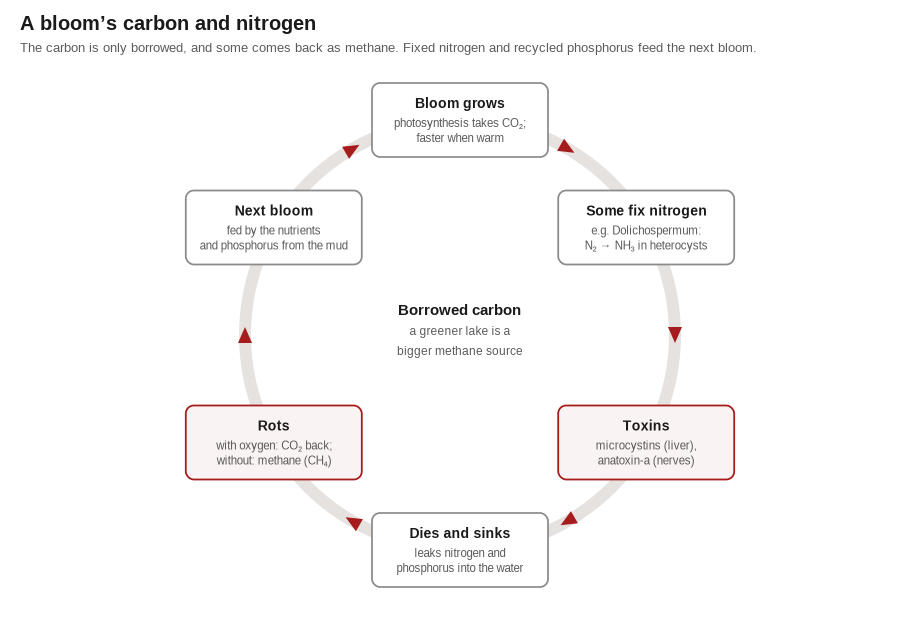
Cyanobacteria photosynthesise, like plants. DAERA notes they need sunlight, nutrients and carbon dioxide to grow. In outline:
6CO₂ + 6H₂O → C₆H₁₂O₆ + 6O₂ (light energy in; sugar and oxygen out)
A dense bloom pulls CO₂ out of the water, and then out of the air. It uses up the dissolved CO₂ faster than it can be replaced, so the surface water holds less CO₂ than the air above it and more flows in. Visser and colleagues (Harmful Algae, 2016) point out that as CO₂ in the air rises, that gradient gets steeper, and surface blooms can catch the extra CO₂, which can intensify blooms in nutrient-rich lakes. Using up the CO₂ also pushes the water’s pH up (the carbonate chemistry on Acid rain to acid seas, run in reverse).
But the carbon is only borrowed. When the bloom dies and sinks, bacteria rot it back to CO₂, and in the oxygen-free mud other microbes turn some of it into methane, about 28 times as warming as CO₂ per kilogram over 100 years (see CO₂e and GWP). Beaulieu and colleagues (Nature Communications, March 2019) estimated that greener, more nutrient-rich lakes will raise methane emissions from lakes and reservoirs by 30–90% this century. A bloom is not a carbon sink; a greener lake is a bigger greenhouse source.
Some add nitrogen to the water. Species such as Dolichospermum (formerly Anabaena) and Aphanizomenon fix nitrogen gas from the air in their heterocysts, using the same enzyme as clover root nodules (nitrogenase; see Fertiliser and the nitrogen cycle):
N₂ + 8H⁺ + 8e⁻ + 16ATP → 2NH₃ + H₂ + 16ADP + 16Pᵢ
When their cells break down, that fixed nitrogen leaks into the water and feeds other algae. Microcystis, the main species in Lough Neagh’s 2023 bloom, cannot fix nitrogen; it is very good at taking up ammonium and urea, and can benefit from nitrogen leaked by the species that do. That is one reason lake scientists argue for cutting both nitrogen and phosphorus where non-nitrogen-fixing blooms dominate.
Warmth speeds them up. Photosynthesis and growth speed up with temperature up to an optimum, then fall. Many bloom-forming cyanobacteria have optima above 25 °C, higher than diatoms and other algae, and respond more strongly to warming than other algae; higher temperatures can also stimulate nitrogen fixation (Visser and colleagues, 2016). Warm, calm weather also stops the water mixing, which favours cyanobacteria that can float to the light (Jöhnk and colleagues, Global Change Biology, 2008, after the 2003 European heatwave). So a warmer climate with more CO₂ suits them. But nutrients still matter most: in one 2018 experiment, warming from 20 to 25 °C raised cyanobacteria only slightly, while a pulse of nutrients raised them about ninefold.
Why blooms happen: the phosphorus cycle
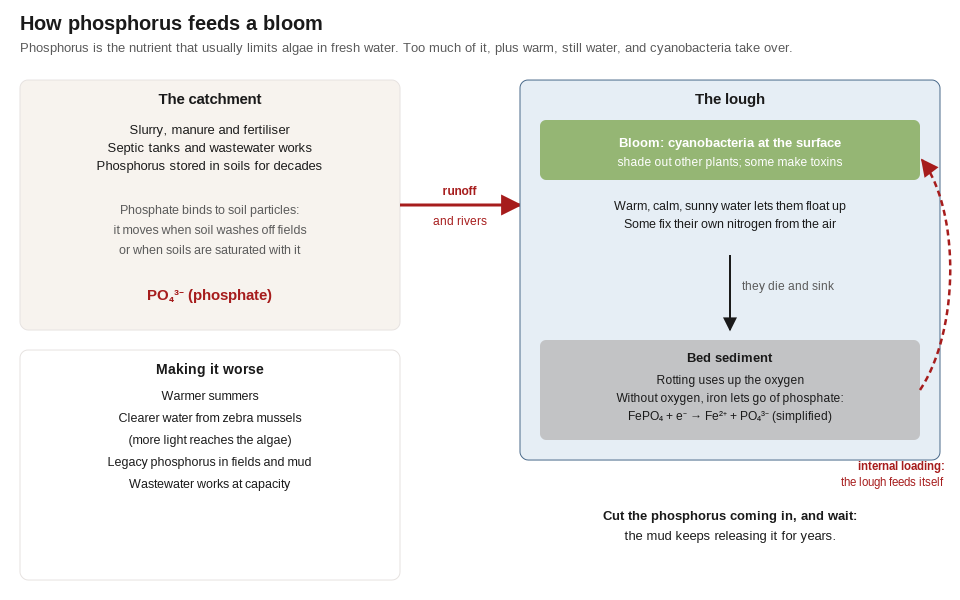
Plants and algae need nitrogen and phosphorus. In most fresh water, phosphorus is the one in short supply, so it sets the limit on growth. Add more and you get more algae. That is eutrophication:
- Phosphorus comes in as phosphate (PO₄³⁻) from slurry, manure, fertiliser, animal feed, sewage and septic tanks. It sticks to soil particles, so it travels when soil washes off fields, and builds up in soils that have had more than crops need.
- Warm, still, sunny water lets cyanobacteria float to the surface, where they outcompete other algae. Some can fix their own nitrogen, so they keep growing when nitrogen runs low.
- They die and sink. Bacteria rotting them use up the oxygen near the bed.
- The mud gives it back. Without oxygen, iron in the sediment changes form and lets go of the phosphate it was holding, which rises back into the water. Lake scientists call this internal loading. A 2021 study estimated it would take about 41 years for the lough bed’s store of loosely held phosphorus to fall by three-quarters.
What made 2023 so bad
- Warmth. AFBI recorded a surface temperature of 21 °C in June 2023, against a typical June average of about 15 °C.
- Clearer water. Invasive zebra mussels, first found in the lough in November 2005 and spreading fast since about 2017, filter the water. Clearer water lets light reach deeper, which helps algae. NIEA now says they play a significant role in blooms.
- Decades of phosphorus. About 40% of NI farmland has more soil phosphorus than crops need, and phosphorus concentrations in NI rivers rose 38% from 2012 (Office for Environmental Protection, 2025).
Where the phosphorus comes from
| Source | Share of phosphorus reaching Lough Neagh (provisional, 2024) |
|---|---|
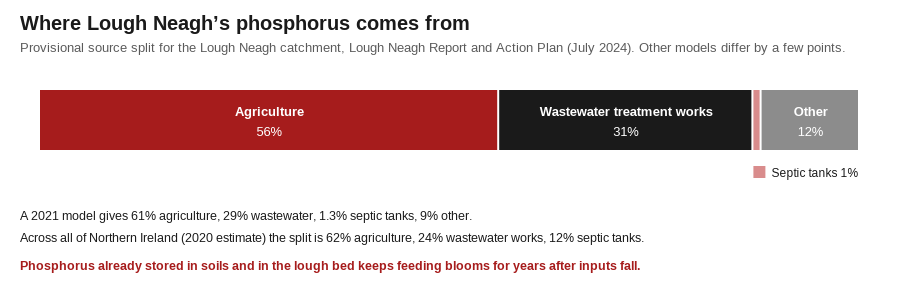
| Agriculture | 56% |
| Wastewater treatment works | 31% |
| Septic tanks | 1% |
| Other (forestry, urban) | 12% |
Estimates differ a little by model, and NI Water said in February 2026 that an earlier “70% from agriculture” figure it had given should not have been presented as definitive, and that it fully owns its own share of the load. The picture is consistent, though: farming first, sewage second. The farm phosphorus comes mostly from imported feed: the OEP estimates Northern Ireland imports about 18,300 tonnes of phosphorus a year, 11,700 tonnes of it in feed, leaving a surplus of about 10,300 tonnes. (The Nutrients Action Programme proposals use a different 2024 baseline of 8,729 tonnes; estimates differ by year and method.)
The rules and the response
(Checked 17 November 2026. Facts and dates only; not legal advice.)
| Measure | What it does | Status |
|---|---|---|
| Lough Neagh Report and Action Plan | 37 actions across education, incentives, regulation and enforcement | Executive approved 18 July 2024; 23 delivered and 14 in progress (DAERA, updated 16 November 2026) |
| Water Framework Directive classification | Lough Neagh’s ecological status: Poor, with phosphorus among the failing elements | 2024 data; only 29% of NI surface waters were good or better |
| Nutrients Action Programme 2027–2030 (proposed) | 30% cut in NI’s phosphorus surplus from 8,729 tonnes; chemical phosphorus on grassland only with a soil test and nutrient plan; low-emission slurry spreading phased in | Consulted on 29 June to 7 September 2026; not yet adopted |
| Lough Neagh catchment programme | £49.3 million (€56.7 million) for 2027–2031, £31.5 million from NI, for on-farm measures such as fencing, riverside buffers and advice | Announced 23 June 2026 |
| Farming with Nature Transition Scheme | Payments for measures including riverside buffers | Year 1: £2.7 million to 489 farms, over 35 km of buffers |
| Inter-agency algae protocol | Amber and red warnings for bathing waters based on algae and toxin levels | In place since May 2024 |
| Bathing water at Rea’s Wood | Rated Poor in 2025; advice against bathing for the whole 2026 season | DAERA, 2025–2026 |
| Wastewater capacity | NI Water reports 66 treatment works with no spare capacity, limiting new connections | NI Water capacity information, 2025–2026 |
Ownership. The bed and soil of the lough belong to the Earl of Shaftesbury’s estate. The Minister has said he wants them transferred to public ownership at no charge; news reports in August and September 2026 describe talks and options. No transfer had been completed as of 17 November 2026.
Is the water safe? NI Water says its treatment works use several barriers, including activated carbon, and are designed to deal with algae so that water is safe at the tap. The advice for the lough itself is different: the Public Health Agency says to assume any bloom is harmful, not to swim, swallow or touch it, and DAERA warns that dogs can become ill within 15 minutes. If in doubt, stay out.
Dogs
Dogs are most at risk: they swim, drink the water and lick scum off their fur afterwards. The two main toxins work in different ways:
- Microcystins attack the liver; signs can take hours.
- Anatoxin-a attacks the nerves and can kill within an hour or two. In a US review of dog poisonings from the 1920s to 2012, anatoxin was linked to more of the deaths with a known cause than microcystin (Toxins, 2013).
DAERA’s advice (updated 21 April 2026): keep dogs out of water that looks discoloured or has scum; do not let them drink lough water, eat algae or lick it off their fur; rinse them with tap water if they have been in. Signs include drooling, vomiting, diarrhoea, increased thirst, seizures and breathing difficulties. Contact a vet immediately: dogs can become unwell in as little as 15 minutes, and there is no antidote.
Not every death is algae. In June 2023 four dogs died after visits to Lough Melvin on the Fermanagh–Leitrim border, and a local vet warned owners about blue-green algae (RTÉ). In May 2023 a dog died after being in Lough Neagh near Antrim, but NIEA’s tests found no evidence of a bloom, and the council also warned about hemlock water dropwort, a highly poisonous waterside plant (UTV).
Why it matters in Northern Ireland
- Drinking water. Three treatment works draw on the lough for about 40% of the population.
- Planning. Wastewater works at capacity can mean negative planning responses for new homes and factories.
- Farming. The next Nutrients Action Programme is likely to tighten phosphorus rules, especially on grassland.
- Food and fishing. The eel fishery holds protected (PGI) status; algae and toxins put pressure on it and on the lough’s wider reputation.
- Time. Even if inputs fell tomorrow, studies of lakes with stored phosphorus suggest recovery takes from about 8 to 20 years.
Think of a fish tank fed by everyone
| Fish tank | Lough Neagh |
|---|---|
| Too much fish food | Too much phosphorus from farms and sewage |
| A warm room and a sunny window | Warm summers and clear water |
| Green slime on the glass | A cyanobacteria bloom |
| Uneaten food rotting in the gravel | Phosphorus stored in the lough bed |
| Cutting the feeding does not clear it overnight | The mud keeps releasing phosphorus for years |
| A filter snail that cleans the glass but lets more light in | Zebra mussels |
| Thirty people each adding a pinch | Thousands of farms, homes and works across 4,860 km² |
Examples
Agriculture and food
A dairy farm in the Blackwater catchment
A dairy farm with high soil phosphorus indices still buys compound fertiliser containing phosphorus.
| Step | Why |
|---|---|
| Soil test every field (the Soil Nutrient Health Scheme) | Many fields already hold more phosphorus than grass needs |
| Stop chemical phosphorus where indices are high | Under the NAP proposals, chemical phosphorus on grassland would need a soil test and a nutrient plan |
| Fence watercourses and keep a riverside buffer | Stops soil and dung reaching the water; catchment funding available from 2027 |
| Review feed phosphorus | Most farm phosphorus arrives in feed |
The lesson: the cheapest phosphorus to remove from the lough is the phosphorus you do not buy.
Public sector
A council approving a housing scheme
A council receives an application for new homes in a town where the wastewater works has no capacity.
What happens: NI Water may respond negatively, and the scheme may need a developer-funded solution or a wait for investment. Treated sewage is the lough’s second-largest phosphorus source.
The lesson: water quality and housing supply are now the same conversation. Where the planning and legal tests sit is a specialist question.
Manufacturing
A food factory discharging to sewer
A meat or dairy processor discharges trade effluent rich in phosphorus to a works that drains to the lough.
What to check: the phosphorus limits in its trade effluent consent, cleaning chemicals containing phosphates, and whether on-site treatment would cut both the load and the charges.
The lesson: a factory’s phosphorus counts twice: once on the effluent bill and once in the lough.
Common mistakes
- “It’s algae.” They are bacteria, cyanobacteria, and some make toxins.
- “It’s all the farmers’ fault” or “it’s all NI Water’s.” Both are major sources; estimates put farming first and sewage second.
- “Cut the phosphorus and it will clear next year.” The lough bed will keep releasing phosphorus for years.
- “Clear water means clean water.” Zebra mussels make it clearer and help blooms.
- “The tap water is affected.” NI Water says treatment makes it safe at the tap; the risk is in the lough itself.
- “Blooms soak up CO₂, so they help the climate.” The carbon goes back when they rot, partly as methane.
- “No scum, no risk to the dog.” DAERA says to keep pets out of any water that looks discoloured, too.
Previous: Permafrost · Next: Acid rain to acid seas · Related: Fertiliser and the nitrogen cycle
Sources
Checked 17 November 2026.
- The lough and the plan: DAERA, DfI and NI Water, Lough Neagh Report and Action Plan (July 2024: area, catchment, phosphorus sources) · DAERA, 20 actions, 2 July 2024 and Executive approval, 18 July 2024 · DAERA, Action being taken (updated 16 November 2026).
- Cyanobacteria: DAERA, Blue-green algae · Olson, Reinhard and Lyons 2016, Frontiers in Microbiology 7:1526 (age of oxygenic photosynthesis; Great Oxidation Event; heterocysts) · Reid et al. 2024, Environment International 190:108934 (the 2023 bloom) · WHO, Microcystins background document (2020) · AFBI, Why has Lough Neagh been going green? (28 June 2023).
- Causes: Office for Environmental Protection, phosphorus and NI water quality (October 2025) and advice on the NAP proposals (7 September 2026) · McLean et al. 2010, Biology and Environment 110B (first zebra mussels, November 2005) · NIEA, Significant Water Management Issues consultation (December 2025) · Rippey et al. 2021, Water Research 200 (sediment phosphorus, 41 years) and Rippey et al. 2022 (recovery 8–20 years) · NI Water, statement on phosphorus sources (27 February 2026).
- Rules and funding: DAERA, NAP 2027–2030 consultation · DAERA, Shared Island investment in Lough Neagh (23 June 2026) · DAERA, Farming with Nature Transition Scheme payments (23 June 2026) · NIEA, Lakes failing elements 2024 · DAERA, Inter-agency blue-green algae protocol · DAERA, bathing water results · NI Water, capacity information.
- Eels: AFBI, Experts visit Europe’s largest eel fishery (10 August 2016).
- Health and drinking water: Public Health Agency, blue-green algae · NI Water, blue-green algae · DAERA, bathing water advice (22 August 2025).
- Ownership: Irish News, 1 August 2024 and 7 September 2026 (news reports; not checked against Hansard).
- Photosynthesis, carbon, nitrogen and warmth: Visser et al. 2016, How rising CO₂ and global warming may stimulate harmful cyanobacterial blooms, Harmful Algae 54 · Beaulieu, DelSontro and Downing 2019, Eutrophication will increase methane emissions from lakes and impoundments, Nature Communications 10:1375 · Jöhnk et al. 2008, Summer heatwaves promote blooms of harmful cyanobacteria, Global Change Biology 14 · Warming and nutrient pulses, Frontiers in Microbiology (2018) · Paerl et al. 2019, non-nitrogen-fixing blooms and dual nutrient reduction, Hydrobiologia · Lake Erie, nitrogen fixation by Dolichospermum and Aphanizomenon in Microcystis blooms (NOAA) · DAERA, What is blue-green algae? (9 July 2025; CO₂, sunlight, nutrients).
- Dogs: DAERA, Blue-green algae frequently asked questions (21 April 2026) · Backer et al. 2013, Canine cyanotoxin poisonings in the United States, Toxins 5 · Cornell University College of Veterinary Medicine, freshwater harmful algal blooms (signs by toxin) · RTÉ, four dogs die after Lough Melvin (2 June 2023; news) · UTV, dog owners warned at Lough Neagh (26 May 2023; news).
- Not checked against a primary source: the photosynthesis and nitrogenase equations (standard biochemistry); the general rise and fall of photosynthesis with temperature; whether the Lough Melvin deaths were confirmed as algae poisoning; the iron-bound phosphorus release chemistry (standard lake science); geosmin as the cause of the earthy taste (NI Water); whether a 2026 end-of-season bloom report has been published. The examples are illustrative.
Facts and definitions last checked against the standards and official sources on 17 November 2026. General information, not legal, tax or customs advice.