
Permafrost: worse than the ice caps?
In short
Permafrost is ground that stays frozen for at least two years, and the soils of the permafrost region hold up to almost twice as much carbon as the whole atmosphere. As it thaws, that old plant matter rots into CO₂ and methane, adding to warming. Melting ice sheets raise the sea; thawing permafrost raises the carbon in the air. On carbon, permafrost is the bigger worry.
Across the far north, from Alaska to Siberia, the ground a short way below the surface never thaws. That frozen ground, permafrost, has been locking away dead plants and soil for tens of thousands of years, like a freezer full of food that has never been allowed to go off.
The freezer is warming. As permafrost thaws, microbes get to work on the old carbon, and it comes out as carbon dioxide and methane. That is why scientists worry about it more than headlines about melting ice caps would suggest. The two problems are real, but they do different damage.
What permafrost is
The US National Snow and Ice Data Center defines permafrost as soil, sand, sediment or rock that stays at or below 0 °C for at least two years in a row. The top layer above it, which thaws each summer and refreezes each winter, is the active layer.
| Measure | Figure | Source |
|---|---|---|
| Ground actually underlain by permafrost in the Northern Hemisphere | About 14 million km², 15% of the land | Obu (2021), via the Global Tipping Points Report 2023 |
| The wider permafrost region | About 23 million km², about a quarter of exposed land | NSIDC |
| Carbon in permafrost-region soils | About 1,300–1,600 billion tonnes | Hugelius et al. (2014); NOAA Arctic Report Card 2024 |
| Of which permanently frozen | About 800 billion tonnes | Hugelius et al. (2014) |
| Carbon in the whole atmosphere | About 900 billion tonnes (2024) | Global Carbon Budget 2025 (my arithmetic from 422.8 ppm) |
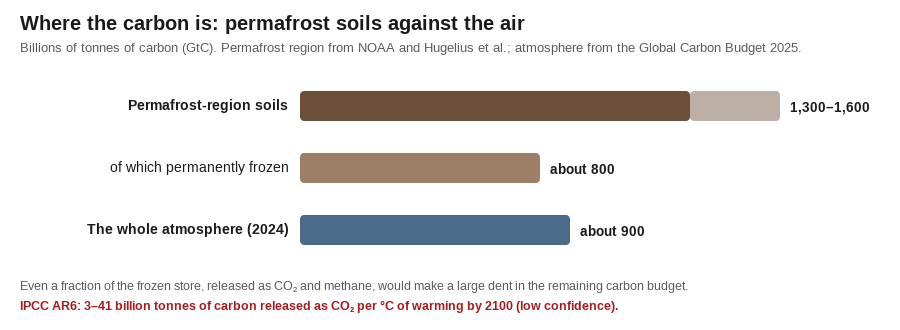
The IPCC puts it as about twice as much carbon as is currently in the atmosphere. That compares the whole permafrost-region soil store with the air; the part that is permanently frozen today, about 800 billion tonnes, is a little less than the atmosphere’s.
How thaw becomes greenhouse gas
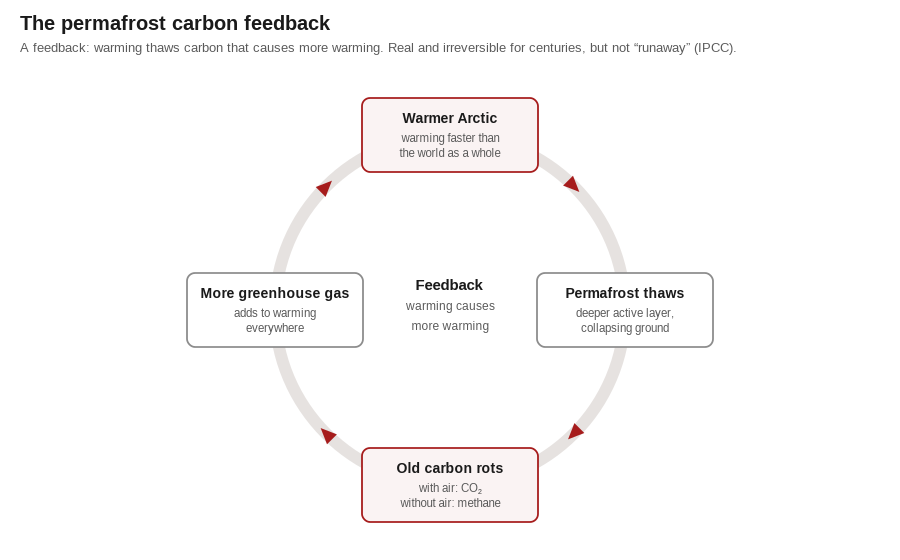
Once the ice in the soil melts, microbes wake up and eat the old plant remains. What comes out depends on oxygen, exactly as in a peat bog (see Peat bogs):
| Conditions | Microbes | Main gas | Simplified reaction |
|---|---|---|---|
| Dry, airy soil | Aerobic decomposers | Carbon dioxide | (CH₂O)ₙ + nO₂ → nCO₂ + nH₂O |
| Waterlogged soil, thaw lakes, wetlands | Methanogens | Methane (and some CO₂) | CH₃COOH → CH₄ + CO₂; CO₂ + 4H₂ → CH₄ + 2H₂O |
Most of the extra carbon is expected to come out as CO₂; methane is a smaller share of the carbon but a much stronger greenhouse gas per tonne. The IPCC also reports emerging evidence of more nitrous oxide where thaw collapses the ground.
Slow thaw and sudden collapse
Gradual thaw deepens the active layer a little each year. Abrupt thaw is faster: where the ground holds a lot of ice, the surface slumps, lakes form and drain, and hillsides slide. A 2020 study led by Merritt Turetsky estimated that abrupt thaw will probably affect under 20% of the permafrost zone but could affect half of its carbon, and that models with only gradual thaw substantially underestimate emissions.
Other signs are already visible:
- The tundra has tipped. NOAA’s Arctic Report Card 2024 found that, once wildfires are included, the Arctic tundra has shifted from a carbon sink to a small source of CO₂.
- Winter leaks. A 2019 study estimated the permafrost region loses about 1.7 billion tonnes of carbon each winter, more than plants take up in an average summer.
- Craters. Explosive gas-emission craters on the Yamal and Gydan peninsulas in Siberia form when gas builds up under frozen ground and blows out.
- Rusting rivers. NOAA reported in 2025 that iron released by thaw has turned streams orange in more than 200 Arctic Alaska watersheds.
What about frozen methane under the sea?
Methane hydrates, ice-like cages of methane in seabed sediments, are often cited as a doomsday trigger. The IPCC’s assessment (AR6, 2021) is that only a small fraction could be destabilised this century, that most methane released would be oxidised in the ocean, and that the release to the air would be under 2% of current human methane emissions. Real, but not the catastrophe of the headlines.
Ice caps or permafrost: which is worse?
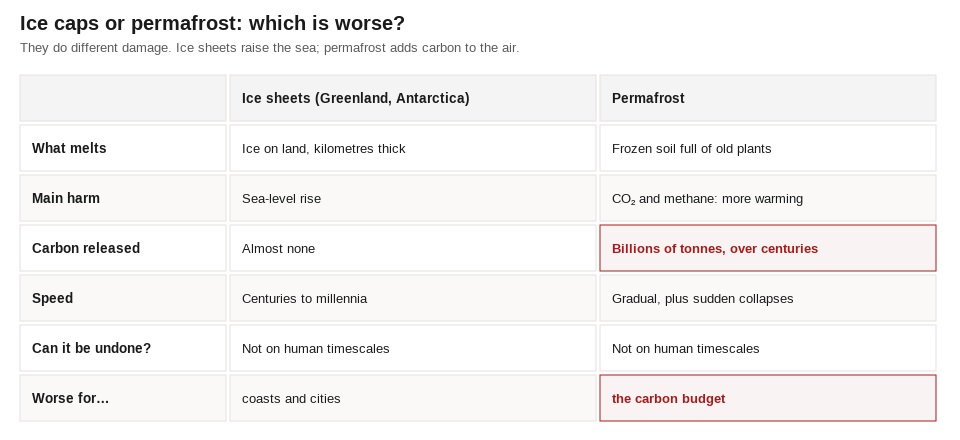
| Ice sheets | Permafrost | |
|---|---|---|
| Biggest risk | Sea-level rise: Greenland holds about 7.4 m of sea level, Antarctica about 58 m (NSIDC) | Extra CO₂ and methane: 3–41 billion tonnes of carbon as CO₂ per °C of warming by 2100 (IPCC, low confidence) |
| Effect on warming | Darker land and sea absorb more sunlight | Adds greenhouse gas: a carbon feedback |
| Reversible? | Not on human timescales | “Irreversible at centennial time scales” (IPCC, high confidence) |
| Runaway? | No | No: the IPCC says the extra warming is “not enough to lead to a runaway warming situation” |
So the honest answer is: worse for carbon, not for sea level. The ice sheets threaten coasts and cities; permafrost threatens the carbon budget.
The rules and the budget
There are no permafrost regulations in the UK; the link is through carbon budgets.
| Figure | Value | Status |
|---|---|---|
| IPCC remaining budget for a 50% chance of 1.5 °C | 500 billion tonnes of CO₂ from 1 January 2020 | AR6, August 2021 |
| Latest update (Forster et al.) | 130 billion tonnes of CO₂ from the start of 2026: a little over three years at 2025 emissions | Published 11 June 2026 |
| Allowance in that budget for feedbacks such as permafrost | 7 billion tonnes of CO₂ | Forster et al., June 2026 |
| Human-caused warming in 2025 | 1.37 °C above 1850–1900 | Forster et al., June 2026 |
| IPCC: loss of frozen ground per °C | About 25% of the volume in the top 3 m, per degree up to 4 °C | AR6, medium confidence |
The IPCC says permafrost carbon is weaker than fossil fuel emissions but strong enough that it must be included in carbon budgets. Every tonne released by thaw is a tonne less that people can emit for the same temperature.
Why it matters in Northern Ireland
- No permafrost here. There is none in Ireland or Britain today; even on Scotland’s highest summits, frozen ground is seasonal only (Ballantyne, 2018).
- Our own frozen-freezer equivalent is peat. DAERA’s 2022 peatland strategy consultation said peat covers about 12% of NI’s land but holds 53% of its soil carbon, and that most of it is degraded to some degree. Peat and permafrost store carbon for the same reason, cold or waterlogged ground slowing decay, and lose it the same way, when air gets in.
- Carbon budgets. NI’s targets under the Climate Change Act (Northern Ireland) 2022 sit inside a global budget that permafrost is quietly drawing down.
- Supply chains. Thawing ground damages Arctic pipelines, mines and roads. A 2022 study estimated that up to 70% of Arctic infrastructure lies in areas at risk by mid-century, with repair costs of about €30 billion by 2060. NI firms buying metals, fuels or fish from the far north are exposed.
Think of a chest freezer during a power cut
| Freezer | Permafrost |
|---|---|
| Food frozen solid for years | Plant remains frozen for millennia |
| The power goes off slowly | The Arctic warms faster than the world as a whole |
| The top layer thaws first | The active layer deepens |
| Food starts to rot and smell | Microbes release CO₂ and methane |
| A sealed bag goes off without air | Waterlogged thaw makes methane |
| You cannot refreeze rotten food | Thaw is irreversible for centuries |
| An ice block melts and floods the floor | Ice sheets melt and raise the sea |
Examples
Manufacturing
A firm reporting climate risk for its board
A mid-sized NI manufacturer buying nickel, aluminium or fuel is preparing its first climate risk statement.
What permafrost means here: physical risk in the supply chain. The 2020 Norilsk spill, when a fuel tank at a Siberian metals plant failed and released about 21,000 tonnes of diesel, was linked by the operator to thawing ground. Mines, pipelines and ports across the Arctic sit on permafrost.
The lesson: map where critical raw materials come from, and treat Arctic sources as a physical risk to supply and price.
Public sector
A council setting its climate targets
A district council asks whether it can rely on global action to stay within 1.5 °C.
What the numbers say: the latest update puts the remaining budget for a 50% chance at 130 billion tonnes of CO₂ from the start of 2026, a little over three years of current emissions, and it already sets aside 7 billion tonnes for feedbacks such as permafrost.
The lesson: plan for adaptation as well as cutting emissions. Permafrost is one reason the budget is tight and the feedbacks are not fully in the models.
Agriculture and food
A hill farmer with drained peat
A County Antrim hill farm has old drains cut through blanket peat.
The link: the same chemistry as permafrost. Drained peat lets air in and rots; rewetted peat stops rotting. Unlike permafrost, a bog can be rewetted by blocking drains, and there are schemes and carbon codes that pay for it (see Offsets and Peat bogs).
The lesson: we cannot refreeze the Arctic, but we can rewet our own carbon stores.
Common mistakes
- “Permafrost is ice.” It is frozen ground, mostly soil and rock, with ice in it.
- “Melting ice caps release carbon.” Ice sheets matter for sea level; the carbon is in permafrost.
- “It will cause runaway warming.” The IPCC says no, but it is irreversible on human timescales and must be in carbon budgets.
- “The methane bomb is about to go off.” Seabed hydrates are expected to add under 2% of current human methane emissions.
- “It’s too far away to matter here.” It is drawing down the same global budget NI’s targets depend on.
Previous: Peat bogs · Next: Lough Neagh and cyanobacteria · Related: Why is everything counted as “carbon”?
Sources
Checked 17 November 2026.
- Definitions and area: NSIDC, Frozen ground and permafrost · Global Tipping Points Report 2023, section 1.2.2.4 (Obu 2021 area, secondary).
- Carbon stocks: Hugelius et al. 2014, Biogeosciences 11, 6573 · NOAA, Arctic Report Card 2024: terrestrial carbon cycling (1.4–1.6 trillion tonnes; tundra a small CO₂ source including fire) · Global Carbon Budget 2025, ESSD 18, 3211 (422.8 ppm; 2.124 GtC per ppm; 900 GtC is my arithmetic).
- IPCC: AR6 WG1 Summary Volume (3–41 PgC per °C; 25% per °C; irreversibility; must be in budgets; SPM Table 2 budget) · AR6 WG1 FAQ 5.2 (twice the atmosphere; not runaway; hydrates under 2%) · IPCC, SROCC Summary for Policymakers (2019) (abrupt thaw, methane share).
- Thaw studies: Turetsky et al. 2020, Nature Geoscience 13, doi:10.1038/s41561-019-0526-0 · Natali et al. 2019, Nature Climate Change 9 (1,662 TgC each winter) · Schurmeier, Brouwer and Fagents 2024, Permafrost and Periglacial Processes 35 (Yamal craters) · NOAA, Arctic Report Card 2025 (rusting rivers).
- Ice sheets: NSIDC, Ice sheet quick facts.
- Budget: Forster et al. 2026, Indicators of Global Climate Change 2025, ESSD 18, 3889 (11 June 2026).
- Infrastructure: Hjort et al. 2022, Nature Reviews Earth & Environment, doi:10.1038/s43017-021-00247-8 (via University of Oulu) · IChemE, The Chemical Engineer, 4 June 2020 (Norilsk; trade press reporting the operator).
- UK and NI: Ballantyne 2018, Earth and Environmental Science Transactions of the Royal Society of Edinburgh · DAERA, NI Peatland Strategy consultation (8 August 2022) (12% of land, 53% of soil carbon; check against the final 2025 strategy).
- Not checked against a primary source: the decomposition and methanogenesis reactions (standard chemistry); that the Arctic is warming faster than the global average is widely reported but I have not quoted a specific multiple. The examples are illustrative.
Facts and definitions last checked against the standards and official sources on 17 November 2026. General information, not legal, tax or customs advice.