
Why is everything counted as “carbon”?
In short
“Carbon” is shorthand. Carbon accounts cover seven greenhouse gases, several of which contain no carbon at all, such as nitrous oxide, sulphur hexafluoride and nitrogen trifluoride. Each is converted into the amount of carbon dioxide that would trap the same heat over 100 years, so they can be added up in one currency: tonnes of CO₂ equivalent (CO₂e).
Ask why sulphur hexafluoride (SF₆) counts towards a “carbon footprint” and you have a fair point: there is not a carbon atom in it. Nor in nitrous oxide (N₂O), nitrogen trifluoride (NF₃) or water. Yet a switchgear supplier, a fertiliser maker and a chip fab can all be told to report their “carbon”.
The answer is that “carbon” has become shorthand for “greenhouse gases, measured in carbon dioxide terms”. The more useful question is what makes a gas a greenhouse gas at all, and why some of them count thousands of times more than CO₂. That is chemistry, and it is worth getting right.
Carbon is the currency, not the content
Carbon accounts convert every greenhouse gas into carbon dioxide equivalent (CO₂e) using its global warming potential (GWP): how much heat one tonne of the gas traps over a set period, usually 100 years, compared with one tonne of CO₂.
So one tonne of SF₆ is reported as about 24,300 tonnes of CO₂e. It does not mean the gas contains carbon. It means it does the same warming damage as that much CO₂ would.
International reporting has covered a fixed “basket” of gases since the Kyoto Protocol. Nitrogen trifluoride joined it for 2013–2020 under the Doha Amendment, making seven:
| Gas | Contains carbon? | Where it comes from |
|---|---|---|
| Carbon dioxide (CO₂) | Yes | Burning fuel, cement, land clearing |
| Methane (CH₄) | Yes | Livestock, landfill, gas leaks, rice, wetlands |
| Nitrous oxide (N₂O) | No | Fertiliser and manure on soil, nitric and adipic acid plants |
| Hydrofluorocarbons (HFCs) | Yes | Fridges, air conditioning, heat pumps, aerosols |
| Perfluorocarbons (PFCs) | Yes | Aluminium smelting, electronics |
| Sulphur hexafluoride (SF₆) | No | Electrical switchgear, magnesium casting |
| Nitrogen trifluoride (NF₃) | No | Making semiconductors and flat screens |
Water vapour is not on the list. More on why below.
How much each one counts
The figures below are from the IPCC’s latest assessment (AR6, 2021). The UK still reports on the previous set (AR5, 2014): the UK greenhouse gas inventory, the Northern Ireland inventory published on 9 June 2026, and the DESNZ conversion factors for 2025 and 2026 all use AR5, because the UN rules have not yet moved on. Check which set your figures use before comparing them.
| Gas | Lifetime in the air | GWP over 20 years (AR6) | GWP over 100 years (AR6) | GWP over 100 years (AR5, used in UK reporting) |
|---|---|---|---|---|
| Carbon dioxide | Centuries to millennia (no single figure) | 1 | 1 | 1 |
| Methane | 11.8 years | 81.2 | 27.9 | 28 |
| Nitrous oxide | 109 years | 273 | 273 | 265 |
| HFC-32 | 5.4 years | 2,690 | 771 | 677 |
| HFC-134a | 14 years | 4,140 | 1,530 | 1,300 |
| CF₄ (a PFC) | 50,000 years | 5,300 | 7,380 | 6,630 |
| C₂F₆ (a PFC) | 10,000 years | 8,940 | 12,400 | 11,100 |
| NF₃ | 569 years | 13,400 | 17,400 | 16,100 |
| SF₆ | 1,000 years | 18,200 | 24,300 | 23,500 |
| Water vapour | About 9 days | Not given | Not given | Not given |
Two things jump out. Short-lived gases look worse over 20 years: methane traps about 81 times as much heat as CO₂ in its first 20 years, but it is mostly gone after a few decades, so the 100-year figure is 28. Long-lived gases look the same or worse over 100 years, because they are still there doing damage long after the methane has gone. Choosing 20 or 100 years is a policy choice, not a scientific fact; most rules use 100.
AR6 also cut SF₆’s lifetime from 3,200 years to 1,000 after new measurements of how it is destroyed in the upper atmosphere. Studies since put it somewhere between about 850 and 1,300 years. Still a very long time.
What makes a gas a greenhouse gas
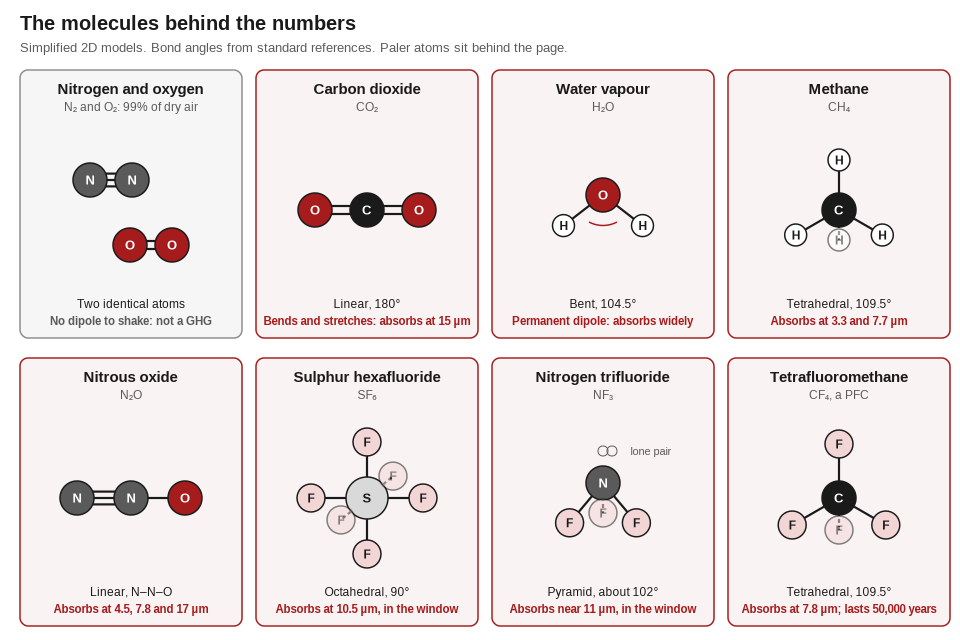
The Earth is warmed by sunlight and cools by glowing in the infrared, mostly at wavelengths between about 5 and 30 micrometres (µm), peaking near 10 µm. A greenhouse gas is one that absorbs some of that glow on the way out.
A molecule can only absorb infrared if one of its vibrations changes its electrical balance, its dipole. That is the whole rule.
- Nitrogen and oxygen make up 99% of dry air but are two identical atoms joined together. However they stretch, they stay balanced, so they ignore the Earth’s glow. They are not greenhouse gases.
- Water is bent, with its hydrogens at 104.5°, so it has a dipole all the time. It absorbs across a wide range.
- Carbon dioxide is straight and balanced at rest, but when it bends or stretches unevenly it becomes lopsided for a moment, and that is enough.
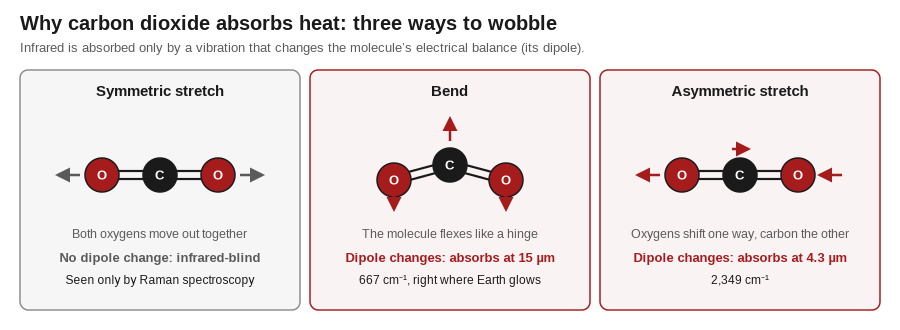
The other molecules follow the same rule. Their shapes decide which vibrations they have, and the vibrations decide which wavelengths they catch.
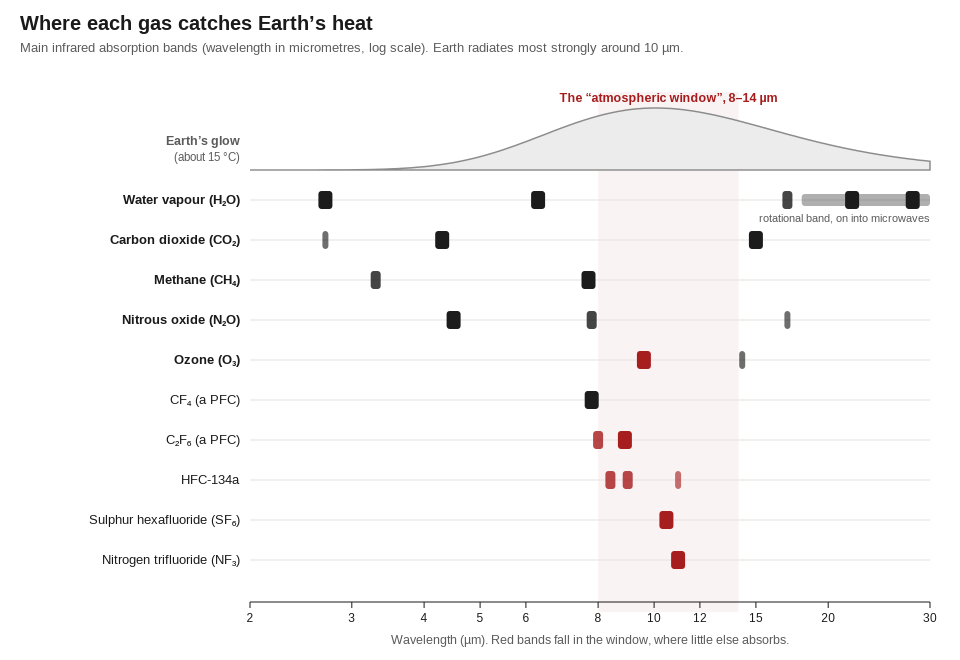
Where each gas catches the heat
Every bond vibrates at its own frequency, so each gas absorbs at its own set of wavelengths. A molecule emits at the same wavelengths it absorbs, which matters later.
| Gas | Main absorption bands | What is vibrating |
|---|---|---|
| Water vapour | 2.7 µm and 6.3 µm, plus a broad rotational band from about 18 µm out into the microwave | O–H stretches and the H–O–H bend; at long wavelengths the whole molecule spinning |
| Carbon dioxide | 15 µm (667 cm⁻¹) and 4.3 µm (2,349 cm⁻¹) | The bend, and the uneven stretch |
| Methane | 3.3 µm and 7.7 µm | C–H stretches and bends |
| Nitrous oxide | 4.5, 7.8 and 17 µm | N–N and N–O stretches, and the bend |
| Ozone | 9.6 µm | The O–O–O stretch |
| CF₄ and C₂F₆ (PFCs) | About 7.8–9.4 µm | C–F stretches |
| SF₆ | 10.5 µm (948 cm⁻¹) | S–F stretch |
| NF₃ | About 10.4–11.9 µm | N–F stretches |
This is why the fluorinated gases are so potent. Water vapour and CO₂ between them already absorb most of the Earth’s glow at their own wavelengths, so adding a little more of either closes a gap that is already mostly shut. But between about 8 and 14 µm there is a gap, the atmospheric window, where heat escapes to space almost freely. Carbon–fluorine, sulphur–fluorine and nitrogen–fluorine bonds absorb strongly right in that window. A few molecules of SF₆ block heat that nothing else was blocking.
Add a lifetime of hundreds or thousands of years, and you get GWPs in the thousands.
Absorb, shake, pass it on
What happens after a molecule absorbs? It is set vibrating: an excited state, in chemist’s terms, but not ionised or broken. In the lower atmosphere it almost always bumps into a nitrogen or oxygen molecule within a fraction of a second and hands the energy over as motion, which is heat. That is how a gas making up 0.04% of the air warms the other 99.96%.
The reverse also happens: collisions set greenhouse molecules vibrating, and they emit infrared in all directions, some back down. High up, where the air is thin and cold, they emit less, so less heat leaves. Adding gas pushes the level from which heat escapes higher and colder, and the surface warms until the books balance again.
Water and microwaves
Water does absorb microwaves, but not quite in the way the kitchen myth says. Water vapour has rotational lines at 22.235 GHz and 183.31 GHz, and weather satellites listen at those frequencies to measure humidity through cloud. A microwave oven works at 2.45 GHz, which is not a water resonance. It heats food by dielectric heating: the electric field keeps twisting liquid water molecules back and forth, and the jostling becomes heat. The 2.45 GHz frequency was chosen because it was free to use, not because water likes it.
Where each gas meets its end
Every gas is eventually destroyed or removed. Where and how decides its lifetime, and so its GWP.
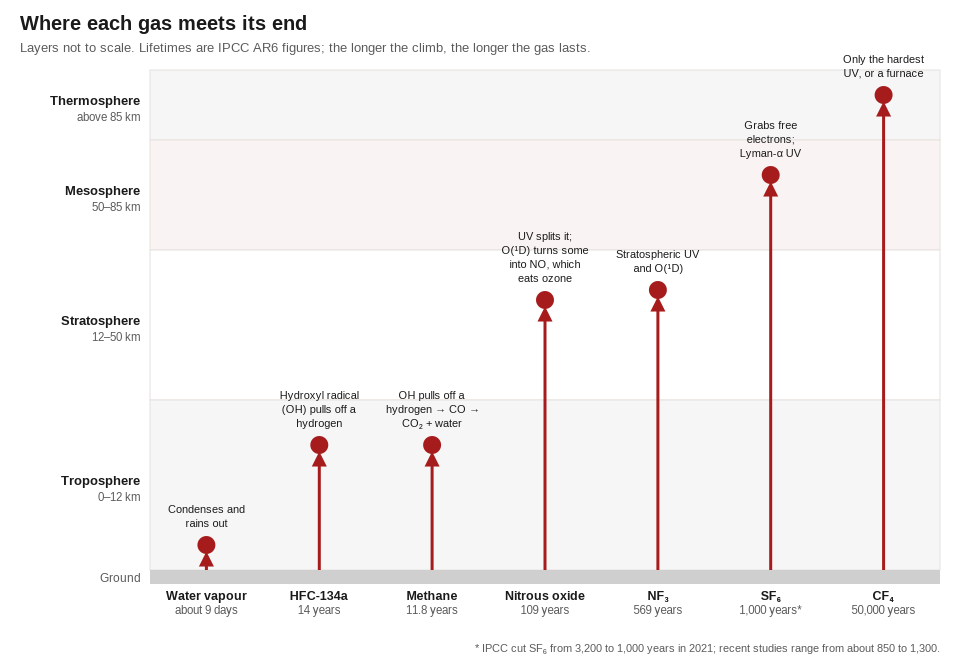
Water vapour: rained out. A water molecule spends about nine days in the air on average before it condenses and falls. Nothing chemical needed.
Methane and HFCs: the atmosphere’s detergent. In the lower atmosphere, sunlight makes small amounts of the hydroxyl radical, OH. It does not add hydrogen to methane (that would be hydrogenation); it does the opposite and pulls a hydrogen atom off, leaving water and a methyl radical. That sets off a chain through formaldehyde and carbon monoxide that ends as CO₂ and water. So fossil methane, once it is gone, leaves its carbon behind as CO₂. HFCs were designed with hydrogen in them for the same reason: it gives OH something to grab, so they break down in years, not millennia.
Nitrous oxide: up to the ozone layer. N₂O is too stable for OH. It drifts up into the stratosphere, where about 90% is split by ultraviolet light into nitrogen and an excited oxygen atom. Most of the rest reacts with those excited oxygen atoms, and some of that makes nitric oxide (NO), which destroys ozone in a catalytic cycle. Since the CFCs were phased out, N₂O has been the single biggest ozone-depleting emission. It is both a greenhouse gas and an ozone-layer problem, and farming is the main human source.
NF₃: stratospheric ultraviolet. Similar route to N₂O, slower: split by ultraviolet and excited oxygen in the stratosphere, over centuries.
SF₆: the mesosphere. Almost nothing in the lower atmosphere touches it. It is destroyed above about 50 km, mainly when it captures a free electron to become a negative ion (SF₆⁻), which then falls apart, and by the hardest ultraviolet (Lyman-alpha). This is the one gas on the list where ionisation really is the exit route, and it is why its lifetime was so hard to pin down.
PFCs: almost forever. CF₄ is among the most stable molecules made by people. It survives everything below the thermosphere; the main way to destroy it is in a furnace hot enough to break carbon–fluorine bonds. With a 50,000-year lifetime, about two-thirds of the CF₄ released from an aluminium smelter today will still be in the air 20,000 years from now.
Carbon dioxide: no single exit. CO₂ is not destroyed in the air at all. It is swapped into the oceans, plants and soils over years to centuries, and the last part is removed by rock weathering over many thousands of years. That is why it has no single lifetime in the table.
Why water vapour is not counted
Water vapour is the biggest greenhouse gas by effect. It is left out of carbon accounts because people do not control how much is in the air; temperature does. Warm air holds more vapour (about 7% more per degree Celsius), and any extra we add rains out within days.
So water vapour is a feedback, not a driver. When CO₂ warms the air, the air holds more water, which traps more heat. NASA describes increased water vapour as a consequence of warming, not a cause; the Met Office says it is not a driver of today’s warming. It amplifies roughly whatever the other gases start.
The exceptions are where water is put somewhere it would not otherwise be, such as aircraft vapour trails high up, or methane breaking down into water in the stratosphere. Those effects are studied separately.
Why it matters in Northern Ireland
Northern Ireland’s greenhouse gas profile is unusual for the UK. In 2024 its emissions were 22.2 million tonnes of CO₂e, or 18.4 million net of what land and forests absorbed. Agriculture was the largest sector at 31.4%, ahead of transport at 21.3%. By gas, methane made up 29.5% and nitrous oxide 8.0%: almost two-fifths of the total, most of it from cattle, slurry and fertiliser. F-gases were under 1%. Like the rest of the UK, the inventory uses AR5 100-year GWPs.
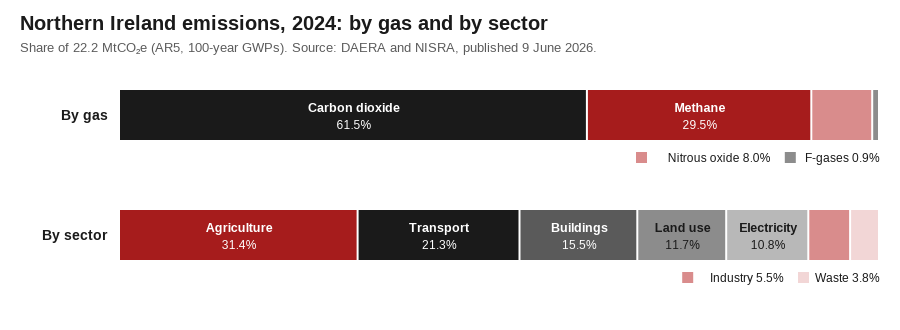
That has two consequences. First, the choice of GWP matters more here than in most of the UK: put Northern Ireland’s methane on a 20-year basis and it nearly triples. Second, any claim that “carbon” means CO₂ misses most of what NI farming emits.
F-gases also split across the Irish Sea. Northern Ireland follows the EU F-gas Regulation, (EU) 2024/573, which entered into force on 11 March 2024 and applies in NI under the Windsor Framework; Great Britain runs its own F-gas regime. A refrigeration contractor or switchgear supplier working on both sides needs to check which rules apply on each job. (Checked 17 November 2026.)
The carbon border taxes add a third consequence. Both CBAMs count nitrous oxide in nitric acid and PFCs in aluminium, so a non-CO₂ gas can turn up on an import bill for fertiliser or aluminium coming into Northern Ireland.
Think of currency, then exchange it
CO₂e works like converting a pile of foreign cash into sterling. You hold euros (methane), dollars (nitrous oxide) and a few very valuable coins (SF₆). To add them up you need an exchange rate for each: that is the GWP. Two things follow, as they do with money:
| Currency idea | Greenhouse gas equivalent |
|---|---|
| The exchange rate | The GWP: 28 for methane, 265 for nitrous oxide, 23,500 for SF₆ (AR5, used in UK reporting) |
| Which day’s rate you use | Which IPCC report: AR5 and AR6 give slightly different rates |
| Spot rate or long-term average | A 20-year or 100-year GWP. Methane is worth far more “today” than averaged over a century |
| Mixing rates in one total | Adding an AR5 figure to an AR6 figure: the total is wrong |
| The coins are not sterling | Converting to CO₂e does not mean the gas contains carbon |
Examples
Manufacturing
A leaking switchgear panel
A factory’s medium-voltage switchgear holds a few kilograms of SF₆ as insulation. A seal fails and 3 kg leaks before anyone notices.
| Figure | |
|---|---|
| Gas lost | 3 kg SF₆ |
| GWP (AR5, 100 years) | 23,500 |
| Reported emission | 3 × 23,500 = 70,500 kg, about 70 tonnes CO₂e |
| Equivalent in fuel | Roughly what the factory might emit from tens of thousands of litres of diesel |
The numbers are illustrative. The lesson: a small, invisible leak can outweigh a year of fuel savings. The F-gas rules require regular leak checks on most equipment above set size thresholds; doing them properly is one of the easiest carbon wins many sites have.
Agriculture and food
A dairy herd on a 20-year view
A dairy farm’s footprint is mostly methane from the cows and slurry, and nitrous oxide from fertiliser and manure. Suppose (illustratively) the farm emits 100 tonnes of methane and 4 tonnes of nitrous oxide a year.
| 100-year GWP (AR5) | 20-year GWP (AR6) | |
|---|---|---|
| Methane, 100 t | 2,800 t CO₂e | 8,120 t CO₂e |
| Nitrous oxide, 4 t | 1,060 t CO₂e | 1,092 t CO₂e |
| Total | 3,860 t CO₂e | 9,212 t CO₂e |
Same farm, same cows, more than double the number. The lesson: always say which GWP you used. Cutting methane pays off quickly in warming terms because methane is short-lived; that is the argument for acting on it first.
Public sector and retail
A council leisure centre’s chillers
A council leisure centre runs air conditioning and a chiller on HFC-134a. The annual service finds the system has lost 10 kg of refrigerant.
| Figure | |
|---|---|
| Gas lost | 10 kg HFC-134a |
| GWP (AR5, 100 years) | 1,300 |
| Reported emission | 10 × 1,300 = 13,000 kg, about 13 tonnes CO₂e, in Scope 1 |
| Where it shows up | The council’s own carbon report |
The lesson: refrigerant top-ups on a maintenance invoice are emissions. Ask the contractor for the kilograms, not just the cost, and plan the switch to lower-GWP refrigerants when equipment is replaced.
Common mistakes
- “Carbon” means CO₂ only. In most footprints it means all seven gases in CO₂e. Ask.
- Mixing GWP sets. An AR6 figure for one supplier and an AR5 figure for another will not add up.
- Treating water vapour as an emission to cut. It is a feedback; cut the gases that drive it.
- Forgetting what methane becomes. It breaks down into CO₂; fossil methane leaves extra CO₂ behind.
- Thinking microwave ovens prove water’s resonance. Satellites use water vapour’s lines; ovens use dielectric heating.
Previous: What is a carbon life cycle? · Next: Was it the Sun? · Related: Embodied carbon or embedded emissions?
Sources
Checked 17 November 2026.
- GWPs and lifetimes: IPCC, AR6 WG1 Chapter 7 Supplementary Material, Table 7.SM.7 (2021), including the SF₆ lifetime of 1,000 years. AR5 values as tabulated by the GHG Protocol, Global Warming Potential Values (August 2024) (secondary). AR6 also gives separate fossil (29.8) and non-fossil (27.0) methane GWPs in Table 7.15; I have seen those only via the GHG Protocol table, so they are not used above.
- SF₆ lifetime studies: Ray et al. 2017, JGR Atmospheres 122 (about 850 years, range 580–1,400) · Kovács et al. 2017, ACP 17, 883–898 (1,278 years; electron attachment and photolysis in the mesosphere).
- NF₃: Totterdill et al. 2016, ACP 16, 11451 (photolysis and O(¹D) loss; absorption in the atmospheric window) · Bristol Chemistry, Molecule of the Month: NF₃ (bond angle 101.9°).
- UK and NI reporting basis: DESNZ, GHG conversion factors 2026: methodology (AR5; CH₄ 28, N₂O 265) and the 2025 methodology · UK GHG inventory 1990–2022 (AR5, seven gases) · DAERA and NISRA, Northern Ireland GHG inventory 1990–2024, 9 June 2026 (AR5, seven gases) · UNFCCC, Doha Amendment (NF₃ added for 2013–2020).
- Water vapour: NASA, Steamy relationships (about nine days; a consequence of warming, not a cause) · Met Office, Greenhouse gases.
- Removal chemistry: Saunois et al. 2025, Global Methane Budget 2000–2020 · NIWA, Detergent of the atmosphere (the methane oxidation chain) · IPCC TAR, WG1 4.2.1.2 (N₂O sinks: photolysis about 90%, O(¹D)) · Ravishankara, Daniel and Portmann, Science 326, 123 (2009) (N₂O the largest ozone-depleting emission).
- Spectroscopy and shapes: HITRAN, Vibrational modes (band centres; µm values converted by me) · HITRAN 2012 IR cross-section notes (CF₄ and C₂F₆ band ranges) · Colorado State University, Greenhouse gas handout (why N₂ and O₂ do not absorb) · LibreTexts, Molecular geometry.
- Microwaves: JPL, IPN Progress Report 42-48 (22.235 GHz line) · Brogniez et al. 2016, AMT 9, 2207 (183.31 GHz in satellite use) · C. S. Baird, West Texas A&M University, Why are microwave ovens tuned to water? (they are not).
- Northern Ireland: DAERA and NISRA, NI GHG inventory 1990–2024 (sector and gas shares) · NI Assembly, Windsor Framework Democratic Scrutiny Committee: Regulation (EU) 2024/573 and DAERA’s assessment of the F-gas replacement act (NI remains subject to EU F-gas law; GB has its own regime) · European Commission, F-gas Regulation (EU) 2024/573 (in force 11 March 2024).
- The three examples use illustrative quantities, not measured data.
- CBAM gases: HMRC, UK CBAM System Boundaries Document (draft), Table 1 (PFCs for aluminium, N₂O for nitric acid) · EU CBAM Regulation (EU) 2023/956, Annex I (same gases; EUR-Lex not reachable today, so not re-checked).
- Not checked against a primary source: the exact 8–14 µm limits of the atmospheric window (a conventional range); the ozone bond angle of 117° is from Bristol Chemistry rather than NIST.
Facts and definitions last checked against the standards and official sources on 17 November 2026. General information, not legal, tax or customs advice.