
Embodied carbon or embedded emissions: what is the difference?
In short
Embodied carbon is the building world's term for all the carbon in making, building, maintaining and disposing of something, except the energy used to run it. Embedded emissions is the EU carbon border tax's term for a much narrower, legally defined slice: the emissions from producing a good. And the UK's own carbon border tax calls that narrow slice "embodied".
Two words that sound the same, and are often used as if they were, mean different things depending on who is asking. A construction client, an EU customer and HMRC can each ask you for the “embodied” or “embedded” carbon in the same steel beam and expect three different numbers. All three can be right. The trouble starts when you send one of them the wrong one.
Four meanings, side by side
| Term | Who uses it | What it covers | Set by |
|---|---|---|---|
| Embodied carbon | Architects, engineers, surveyors, construction clients | Everything in the life of a building or product except the energy and water used to run it: materials, manufacture, transport, construction, maintenance, replacement, demolition and disposal | RICS whole life carbon standard (2nd edition, in force from 1 July 2024), following BS EN 15978:2026 |
| Embedded emissions | The EU carbon border adjustment mechanism (CBAM) | Direct emissions from producing a good, plus emissions from the electricity used to make it, plus emissions in listed inputs (“precursors”). For iron and steel, aluminium, hydrogen and electricity, direct emissions only | Regulation (EU) 2023/956, Article 3(22) and Article 7, as amended by Regulation (EU) 2025/2083 |
| Embodied emissions | The UK CBAM, for goods imported on or after 1 January 2027 | In the Act, emissions “attributable to the production of a CBAM good”. The regulations and HMRC narrow this to direct emissions from producing the good plus those in precursor goods. No electricity for any sector until 2029 at the earliest | Finance Act 2026, Part 5, sections 148 and 158; CBAM (Emissions and Verification) Regulations 2026, SI 2026/995 |
| Embedded (or embodied) emissions in trade | Statisticians, Defra | Emissions released abroad to make the goods and services a country imports | Defra, Carbon footprint for the UK and England to 2023 |
The last row is why the words get muddled. Defra’s carbon footprint statistics (published 30 June 2026) say “embedded”: in 2023, emissions from imports were 371 million tonnes of CO₂e, 53% of the UK’s 699 million tonne footprint. The methods note for the same statistics says “embodied”. Government uses both words for the same idea; the law and the standards do not.
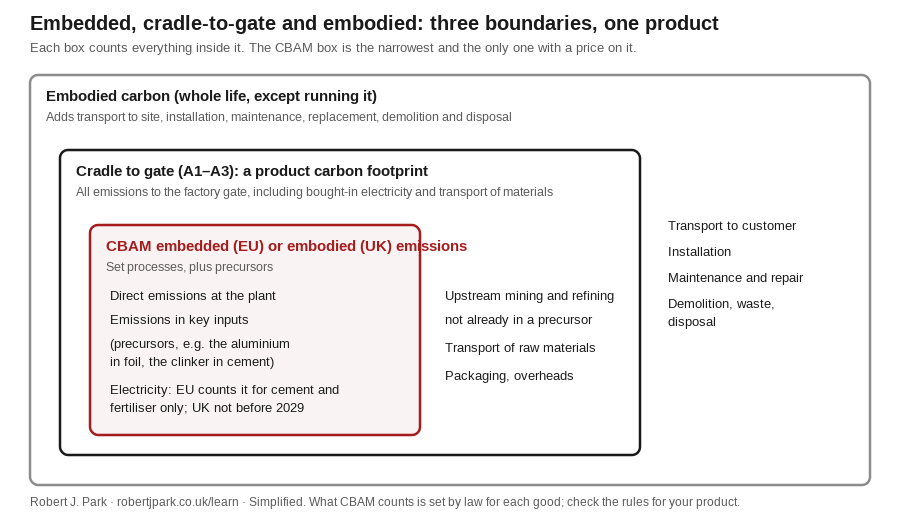
What the carbon border taxes actually count
The two CBAMs look alike but draw the line in different places. As at 17 November 2026:
- Direct emissions are those from the production processes themselves. Under the EU rules this includes heat and cooling used in production even if you buy it in from someone else (Article 3(21)). That is different from ordinary company carbon reporting, where bought-in heat is Scope 2.
- Electricity. The EU counts the emissions from electricity used in production only for cement and fertilisers. For iron and steel, aluminium, hydrogen and electricity it counts direct emissions only (Annex II). The UK CBAM counts no electricity emissions for any sector; HMRC says indirect emissions are “delayed until 2029 at the earliest”.
- Where the UK line is drawn. The Finance Act 2026 itself is wide: section 148(1) defines “emissions embodied in a CBAM good” as emissions “attributable to the production of a CBAM good”, and section 148(3) lets the Treasury cover activities connected with producing the good or the materials used to make it. The narrower direct-only rule sits in the regulations (SI 2026/995) and the System Boundaries Document, so the Treasury can widen it later without new primary legislation.
- Precursors. Both count the emissions already in key inputs: the crude steel in a steel beam, the unwrought aluminium in foil, the clinker in cement. Since the 2025 amendments, the EU counts only precursors listed in its Annex I and made outside the EU.
- Transport to the customer is not counted by either. The EU Regulation only asks the Commission to consider adding it.
So the same bag of fertiliser carries two different figures: the EU counts the electricity used to make it and the UK does not.
Why it matters in Northern Ireland
- UK CBAM applies across the whole UK, including Northern Ireland, from 1 January 2027, once covered imports pass, or are expected to pass, £50,000 (HMRC, updated 2 November 2026). Your supplier’s figure must follow the UK system boundaries, not an EU one or a product footprint.
- Goods from Ireland or the EU into Northern Ireland are caught by the UK CBAM, not the EU one. Section 144(5)(a) of the Finance Act 2026 treats “a Union good that is imported into the United Kingdom as a result of its entry into Northern Ireland” as an import, and section 146(4) makes the importer “the person on whose behalf the good is imported”, usually the NI buyer. HMRC’s guidance does not yet cover this case in detail, so take customs advice on your own supply routes.
- Goods made in Northern Ireland and sold into the EU are outside the EU CBAM: the European Commission’s CBAM Q&A (question 7.14, updated 15 October 2026, as quoted on my CBAM Desk page) says goods produced or released for free circulation in NI are not subject to it. EU customers may still ask for EU-style embedded emissions for their own reporting, and EU customers of GB firms need them to avoid the EU’s default values.
- Carbon already paid abroad can reduce the UK charge. Section 150 allows relief where tax or emissions trading costs are payable on the same emissions, but leaves the calculation to regulations, and section 149 already reduces the UK rate for free allocation. Free EU allowances count as no price paid, so goods from plants that get most of their allowances free may earn little relief. Do not assume EU goods carry no UK CBAM cost.
- Construction clients increasingly ask for embodied carbon, usually through an Environmental Product Declaration (EPD) made to BS EN 15804. That is a cradle-to-gate figure or more, and it is not a CBAM figure.
- Building rules do not yet require it, in Northern Ireland or England. Northern Ireland’s building regulations cover operational energy and carbon only (Technical Booklets F1 and F2, uplifted from 30 June 2022). In 2023 the Department of Finance said it had “no resource” to develop its own approach to embodied carbon and would follow the other administrations. England’s new Approved Document L, published on 24 March 2026, comes into force on 24 March 2027 and also deals with running a building, not making it. “Part Z”, an industry proposal to add embodied carbon to the Building Regulations, has not been adopted.
- Some English planning authorities ask for it anyway. London Plan Policy SI 2 requires every application referred to the Mayor to submit a whole life-cycle carbon assessment, and Bath and North East Somerset’s Policy SCR8 (adopted January 2023) requires an embodied carbon assessment for new developments of 50 or more homes or 5,000 m² or more of commercial floor space. Westminster, the City of London and Bristol have similar policies (as listed in Essex County Council’s 2024 evidence study). Nothing similar applies in Northern Ireland’s planning system that I could find.
- Voluntary standards fill the gap. The UK Net Zero Carbon Buildings Standard, an industry-led and voluntary standard, published Version 1 on 10 March 2026, with limits on embodied as well as operational carbon. RICS members must follow the RICS whole life carbon standard whenever they carry out an assessment.
Think of VAT, then reverse it
Northern Ireland already lives with two rulebooks, and VAT shows how. For goods, NI follows EU VAT rules under the Windsor Framework: a delivery from Dundalk to Larne is an intra-EU “acquisition”, not an import, and the NI buyer quotes a VAT number starting XI instead of GB, so the Irish supplier can zero-rate it. For services, NI follows UK VAT rules and uses the GB number.
The UK CBAM runs the other way. For VAT, steel from Dundalk is an EU movement within the single market for goods. For the UK CBAM, the same steel is an import into the UK (Finance Act 2026, section 144(5)(a)). There is no customs declaration at the border to hang the charge on, which is why the Act names the importer as the person the goods were brought in for.
The useful part: your VAT records already list the EU goods arriving in NI. NI businesses report them on the VAT return: the value in Box 9 and the acquisition VAT in Box 2 (HMRC VAT Notice 700/12). The invoices behind those boxes, showing the supplier’s EU VAT number, are the starting point for the UK CBAM £50,000 test and records.
| Purchase (all names and numbers invented) | VAT in NI | Where it shows | UK CBAM? |
|---|---|---|---|
| 4 tonnes of steel angle (7216) from a Dublin stockholder, VAT no. IE 9999999ZZ, invoiced to your XI 999 9999 99 | Intra-EU acquisition: supplier zero-rates, you account for the VAT yourself | Boxes 2 and 9 | Yes. A Union good entering NI is a UK import; it counts towards £50,000. Origin is where the steel was made, so check the mill certificate |
| Aluminium foil (7607) from a supplier in Liverpool | GB to NI movement: ordinary UK VAT | Box 4 | No new charge. It is already in the UK; any UK CBAM fell due when it first came into Great Britain |
| Bolts (7318) from a wholesaler in Belfast | Ordinary UK VAT at 20% | Box 4 | Not for you. The wholesaler was the importer if they came from outside the UK |
| Cement (2523) from a works in County Monaghan | Intra-EU acquisition, with your XI number | Boxes 2 and 9 | Yes, as for the steel. Cement is a UK CBAM good |
| Consultancy from a Dublin firm, invoiced to your GB number | Services: reverse charge under UK rules | Boxes 1 and 4 | No. Services are not CBAM goods |
Three cautions. Box 9 is a total that includes freight and other related costs, so use the invoices behind it, not the box. The supplier’s country is not the origin: steel bought in Dublin may have been made in Türkiye or China. And this is a way to find your CBAM purchases, not a ruling on them: an accountant or customs adviser should confirm how your VAT records can be used as CBAM evidence.
Examples
Manufacturing
A roll of aluminium foil
A converter in Northern Ireland imports aluminium foil (commodity code 7607) to make food trays.
| Question | What is counted |
|---|---|
| UK CBAM (from 2027) | Direct emissions from rolling the foil and from producing the unwrought aluminium it was rolled from (the precursor). No electricity. |
| EU CBAM (for an EU customer) | The same, because aluminium is in Annex II: direct emissions only. |
| Product carbon footprint, cradle to gate (ISO 14067) | All of the above, plus the electricity used to smelt and roll the aluminium, mining and refining the bauxite and alumina, and transport to the factory. |
| Embodied carbon of the finished tray | The footprint above, plus making the tray, delivering it, and what happens to it at the end of its life. |
For aluminium made from ore, the electricity used to smelt it is usually a large part of its footprint, and how large depends on how that electricity is generated. Both carbon border taxes leave it out. A supplier who sends you its product footprint as its “CBAM figure” will overstate it; one who sends a CBAM figure as its product footprint will understate it badly.
The lesson: always ask which boundary a number was calculated to.
Construction
A steel beam in a new warehouse
A contractor in Antrim builds a warehouse with imported structural steel.
- The importer reports UK CBAM embodied emissions from 2027: direct emissions from making the section and the crude steel it came from.
- The steel maker’s EPD gives a cradle-to-gate figure (modules A1 to A3), which also counts the electricity used in its furnaces.
- The design team’s whole life carbon assessment adds delivery to site (A4), erection (A5), any repainting or replacement over the building’s life (B2 to B4) and demolition and disposal (C1 to C4). The benefit of recycling the steel afterwards goes in module D, reported separately, not netted off.
The lesson: three numbers, all correct, for one beam. Only the first has a tax bill attached.
Agriculture and food
A bag of fertiliser on a dairy farm
A merchant imports ammonium nitrate fertiliser and sells it to farms in County Antrim.
- EU CBAM counts direct emissions from making the ammonia and nitric acid and the electricity used to make them, because fertilisers are not in Annex II.
- UK CBAM counts direct emissions only, for every sector, until at least 2029. Same bag, smaller number.
- Neither counts what happens after the bag is spread: the nitrous oxide released from the soil. That appears in the farm’s own emissions and in the carbon footprint of its milk, which is what a processor or supermarket will ask the farmer for.
The lesson: a carbon border tax measures the carbon in the bag, not the carbon from using it.
Common mistakes
- Sending a product footprint as a CBAM figure, or the other way round.
- Assuming the EU and UK CBAM figures are the same. For cement and fertiliser they are not, until the UK adds electricity.
- Treating “embodied” as one thing. In a building assessment it covers the whole life except operation; in UK CBAM law it covers production only.
- Netting off recycling credits. Module D is reported separately in building assessments, not deducted from the total.
- Forgetting bought-in heat. CBAM counts heat and cooling used in production as direct emissions, wherever they were made.
Next: What is a carbon life cycle? · Related: Is my part or chemical a CBAM good? · CBAM Desk
Sources
Checked 17 November 2026.
- EU CBAM: Regulation (EU) 2023/956, Articles 3, 7 and 30 and Annexes I, II and IV, read from the Council of the EU’s adopted text and a Maltese Government copy of the Annexes (EUR-Lex could not be opened) · Regulation (EU) 2025/2083, Council text and EUR-Lex record · Implementing Regulation (EU) 2025/2547, EUR-Lex record · European Commission, CBAM
- UK CBAM: Finance Act 2026, Part 5 (sections 142 to 150 and 158) · European Commission, CBAM Questions and Answers, question 7.14 (updated 15 October 2026; not re-opened on 17 November) · SI 2026/995 · HMRC, CBAM factsheet and policy summary, updated 2 November 2026
- Buildings: RICS, Whole life carbon assessment for the built environment, 2nd edition and in full effect from 1 July 2024 · BSI, BS EN 15978:2026 and BS EN 15804:2012+A2:2019 · MHCLG, Consideration of embodied carbon in new buildings, July 2025 · Department of Finance (NI), improved energy performance standards, 2022 and Building Regulations discussion document, July 2023
- VAT in Northern Ireland: GOV.UK, Selling or moving goods between Northern Ireland and the EU (XI prefix) · HMRC, VAT Notice 700/12: filling in your VAT return and VAT Northern Ireland and the EU manual, VATNIEU7200 (Boxes 2, 8 and 9)
- England and planning: MHCLG, Building Circular 01/2026, 24 March 2026 · Greater London Authority, Whole Life-Cycle Carbon Assessments, London Plan Guidance, March 2022 · Bath and North East Somerset Council, Sustainable Construction Checklist SPD (Policy SCR8) · Essex County Council, Embodied carbon policy study, June 2024 · IStructE, UK Net Zero Carbon Buildings Standard Version 1, 10 March 2026 (professional body)
- Products and statistics: ISO, ISO 14067:2018 · Defra, Carbon footprint for the UK and England to 2023 and summary of methods 2026 · DESNZ, Low carbon industrial products: government response
Facts and definitions last checked against the standards and official sources on 17 November 2026. General information, not legal, tax or customs advice.