
Offsets: the good, the ugly and the harmful
In short
A carbon offset is a credit for one tonne of CO₂e cut or removed somewhere else, bought to balance your own emissions. The best are real, extra, measured and lasting; many are not. Cut your own emissions first, then use only verified, durable credits, and describe them honestly: in the EU, product claims of being “carbon neutral” through offsetting have been banned since 27 September 2026.
Offsetting is the most argued-about idea in carbon accounting. The theory is simple: if you cannot yet avoid emitting a tonne of CO₂, pay for a tonne to be cut or taken out of the air somewhere else. In practice, the tonne you paid for may never have existed, may have happened anyway, or may be undone by the next forest fire.
None of that makes all offsets bad. It makes them a product that needs checking like any other. This page explains what you are buying, the evidence on quality, and the rules on what you can say about it.
What a credit is, and the words that matter
A carbon credit is a tradable certificate, issued by a crediting programme, for one tonne (1,000 kg) of CO₂e reduced or removed. Using it to balance your own emissions is offsetting.
| Term | What it means | Why it matters |
|---|---|---|
| Avoidance (reduction) credit | Paying to stop emissions happening: protecting a forest, cleaner cookstoves, renewable power | The tonne is measured against a guess about what would otherwise have happened |
| Removal credit | Paying to take CO₂ out of the air and store it: trees, peat, biochar, direct air capture | The tonne is physically stored, but for how long varies |
| Additionality | The cut would not have happened without the credit money | Without it, you paid for something that was happening anyway |
| Permanence | The carbon stays out of the air | A tree that burns in 20 years gives the carbon back |
| Leakage | The activity just moves elsewhere | Protecting one forest while loggers fell the next |
| Buffer pool | A share of credits held back to cover losses | 20% under the UK Woodland Carbon Code and Peatland Code |
| Double counting | The same tonne claimed twice | By the buyer and by the host country, for example |
| Insetting | Funding cuts within your own supply chain | No official definition; counted in your own inventory, not bought as credits |
| Contribution claim | Funding climate projects without claiming they cancel your emissions | Increasingly the recommended way to describe credit purchases |
The life cycle of a credit
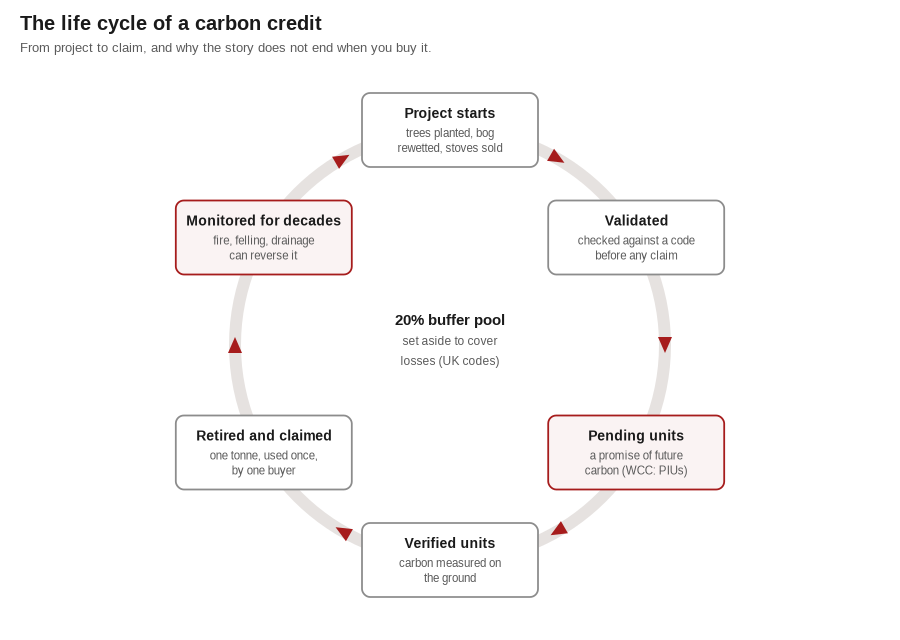
The step people miss is the difference between a promise and a delivery. Under the UK Woodland Carbon Code, a newly planted wood sells Pending Issuance Units: a promise of carbon the trees are expected to absorb as they grow. They cannot be used to report against UK emissions. Only when the wood is measured, at least every ten years, do they become Woodland Carbon Units, which can.
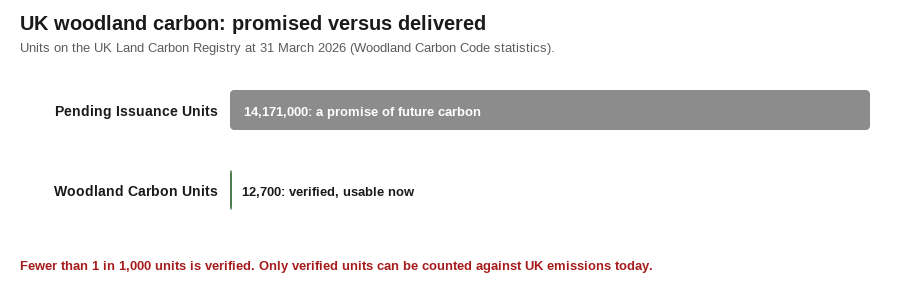
At 31 March 2026 there were 14.2 million pending units on the UK Land Carbon Registry and 12,700 verified ones. The Peatland Code works the same way: a minimum 30-year project, 20% into the buffer, and no claims until the reductions have happened and been verified.
The good, the ugly and the harmful
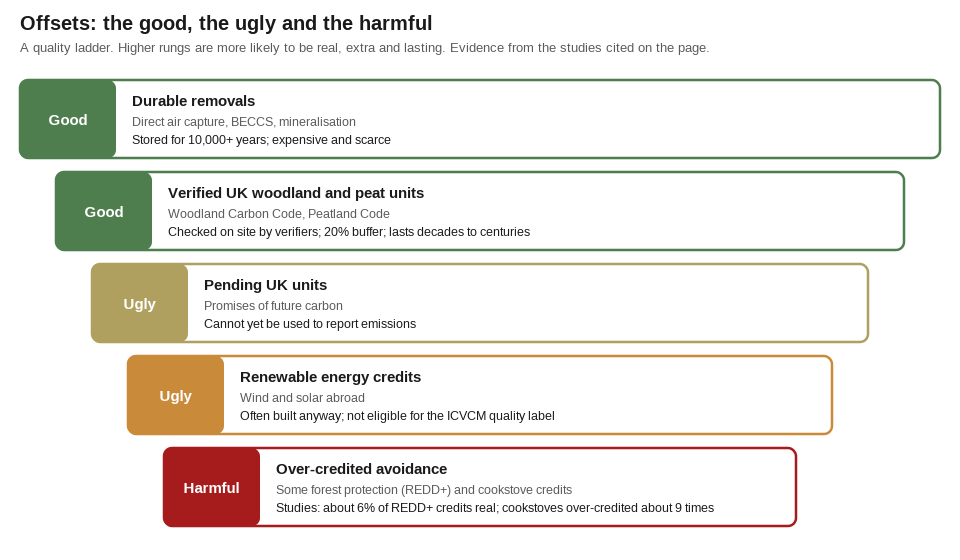
The harmful. The evidence on some of the largest credit types is damning:
- Forest protection (REDD+). A 2023 study in Science by West and colleagues found that of about 89 million credits from the projects examined, only about 6% were linked to real additional reductions.
- Cookstoves. A 2024 study in Nature Sustainability found the cookstove credits it examined were over-credited about 9.2 times.
- Fire. A 2022 study of California’s forest offset programme found wildfires had used up at least 95% of the buffer meant to cover 100 years of fire risk in about ten years.
A credit that represents no real tonne does harm twice: the buyer keeps emitting, and believes the problem is solved.
The ugly. Renewable energy credits from large wind and solar projects abroad are often for projects that would have been built anyway. The Integrity Council for the Voluntary Carbon Market (ICVCM) has refused its quality label to eight renewable energy methods for that reason. Pending units are not bad, but they are promises: buy them as support for a project, not as tonnes to count today.
The good. Credits that meet all four tests: real (measured, not modelled), additional, lasting, and counted once. The ICVCM’s Core Carbon Principles label is the main international benchmark. In the UK, verified Woodland Carbon Units and Peatland Carbon Units are checked on site by independent verifiers (woodland by measuring the trees; peat by surveying the condition of the bog). At the top are durable removals, such as direct air capture with geological storage, biochar and mineralisation, which store carbon for centuries to tens of thousands of years but are scarce and expensive (see Carbon capture and carbon negative).
Prices
The Woodland Carbon Code’s registry reports average prices for pending woodland units of £28.32 a tonne in 2025, up from £11.01 in 2020, and £39.57 for pending Peatland Code units (a small sample). There are too few sales of verified units to give a price. The global voluntary market average was about $6.37 a tonne in 2024 (Ecosystem Marketplace, quoted by the Woodland Carbon Code). A very cheap credit is a warning sign.
The rules
(Checked 17 November 2026. Not legal advice; wording of claims to consumers should be checked by a consumer-law specialist.)
| Rule | What it says | Status |
|---|---|---|
| UK government principles for voluntary carbon and nature markets | Use credits in addition to cutting your own emissions; use high-integrity credits; disclose; make accurate claims | Published 15 November 2024 |
| UK government response on raising integrity | ICVCM principles and the Paris Agreement crediting mechanism are the key benchmarks; supports durable removals for residual emissions at net zero; no new UK claims standard; guidance on using credits due spring 2027; a regulators’ forum (not a regulator) from 2027 | Published 12 November 2026 |
| CMA Green Claims Code | Claims must be truthful, clear, complete, fair, consider the full life cycle and be substantiated; say whether you are cutting or offsetting, and name the scheme | In force; since April 2025 the CMA can fine up to 10% of global turnover for consumer law breaches under the Digital Markets, Competition and Consumers Act 2024 |
| ASA and CAP guidance | Make clear whether a “carbon neutral” or “net zero” claim relies on offsetting; future goals need a verifiable strategy | Updated 2023; rulings against “carbon negative” and “100% carbon neutral” claims |
| EU Directive (EU) 2024/825 (empowering consumers) | Bans claiming a product has a neutral, reduced or positive impact based on offsetting. Company-level claims and transparent contribution claims are not banned but must not mislead | Applies from 27 September 2026 |
| EU Green Claims Directive | Would have set detailed rules for substantiating claims | Commission said on 20 June 2025 it intended to withdraw it; no formal withdrawal found as at 17 November 2026 (last dated step: listed as pending, 21 October 2025) |
| SBTi Corporate Net-Zero Standard V2.0 | Credits sit outside progress against targets; removals needed to neutralise residual emissions at net zero | Final standard published 11 June 2026 |
| Climate Change Act (Northern Ireland) 2022, s.11 | Carbon units can count towards NI’s own targets, but the net reduction from them must not exceed 25% of net emissions for the period | In operation since 7 June 2022; regulations under it not checked |
Does the EU ban apply in Northern Ireland? As far as I can establish, no, not to sales to NI consumers. The Windsor Framework applies EU goods rules in NI, listed in its Annex 2; consumer marketing law is a transferred matter, and the UK’s own unfair commercial practices rules in the Digital Markets, Competition and Consumers Act 2024 extend to the whole UK, including NI. So an NI business selling to NI or GB consumers follows UK law: the CMA Green Claims Code and ASA rules, under which an offset-based “carbon neutral” claim is not banned outright but must be explained, backed by evidence and not misleading. This is my reading, not a published ruling.
The EU ban bites on where the consumer is, not on which customs lane the goods travel by. An NI business selling to consumers in the Republic of Ireland or elsewhere in the EU, in shops or online, must comply: Ireland brought the ban into its law by S.I. No. 124/2026, in operation from 27 September 2026. Because many NI food and drink producers print one pack for the whole island, the practical answer for them is the same: do not rely on offsetting for a neutral claim on pack. Get the wording checked by a consumer-law specialist.
Why it matters in Northern Ireland
- The NI Act caps offsets. Section 11 of the Climate Change Act (Northern Ireland) 2022 limits how far Northern Ireland can rely on carbon units to meet its own targets and carbon budgets: no more than 25% of net emissions. Northern Ireland is told to cut first; buying can cover at most a quarter.
- NI projects exist, but are young. At 31 March 2026 there were 115 Woodland Carbon Code projects in NI covering 1,117 hectares, 20 of them validated or verified. The first NI Peatland Code project was registered on the Garron Plateau in County Antrim in July 2023; by October 2026 there were six NI peatland projects, none yet validated.
- Planting is behind target. DAERA’s Forests for our Future programme aims for 9,000 hectares of new woodland by 2030. The Woodland Trust reported in June 2025 that about 2,016 hectares had been created; I have not checked that figure against official planting statistics.
- Peat is the bigger prize. The NI Peatland Strategy, launched on 18 September 2025, aims for all semi-natural peatlands to be protected and restored to functioning ecosystems by 2040; its first delivery plan (22 April 2026) targets 4,500 hectares on the road to recovery by December 2027. Rewetting a bog that is drying out stops a loss that is already happening, which is why peat restoration attracts buyers; the savings are estimated from the condition of the site rather than weighed directly.
- Councils’ own trees. The Belfast Christmas tree argument (see Deck the halls, check the rules) is an offset argument in miniature: a carbon store counts only while it stands.
Think of a gym membership
Buying an offset is like paying for someone else’s gym membership to cancel out your own takeaway.
| Gym | Offset |
|---|---|
| They were going anyway | Not additional |
| They never actually go | The tonne was never real (over-crediting) |
| They go for a month, then stop | Not permanent: the forest is felled or burns |
| Two of you both claim the same sessions | Double counting |
| A gym that checks they turned up | Verified units, checked on site |
| Going yourself | Cutting your own emissions |
The membership is worth having if they really go, keep going, and nobody else claims it. It does not make the takeaway healthy.
Examples
Manufacturing
A food producer printing “carbon neutral” on its packs
An NI food business sells into supermarkets in Great Britain, Northern Ireland and the Republic of Ireland. Its packs say “carbon neutral”, backed by cookstove credits.
| Market | The risk |
|---|---|
| Republic of Ireland (EU) | Since 27 September 2026, a product claim of carbon neutrality based on offsetting is banned (Irish S.I. No. 124/2026) |
| Great Britain and NI | The CMA and ASA expect the claim to explain that it relies on offsetting and name the scheme; misleading claims can now be fined |
| Any market | The credit type is one studies have found heavily over-credited |
The safer course: drop the neutral claim. Report the cuts you have made, and if you keep funding projects, describe it as a contribution: “we fund verified peatland restoration in County Antrim”. Get the wording checked by a consumer-law specialist.
Public sector
A council planting trees to reach net zero
A district council plans to plant woodland on its own land and count the carbon towards its net zero target.
What to check: the trees take decades to absorb most of their carbon, so a 2030 target will see little of it; the wood must be kept, managed and protected from fire and felling; and if the council registers it with the Woodland Carbon Code and sells the units, it cannot also count the carbon itself.
The lesson: plant the trees for every good reason, but count only what has been measured, and never twice.
Agriculture and food
A farmer offered money for peatland on the hill
A hill farmer in the Antrim Plateau is approached to rewet degraded peat and sell the credits under the Peatland Code.
What to know: projects run for at least 30 years; 20% of the credits go into the buffer; credits can only be claimed after verification; and the land’s carbon rights may be tied up for the life of the project. NI peatland projects are still at an early stage.
The lesson: a good project for the bog and potentially for the farm, but a long contract. Take independent legal and land advice before signing.
Common mistakes
- Offsetting before cutting. Every standard and government principle puts reductions first.
- Counting pending units as tonnes. They are promises until verified.
- Buying on price. Very cheap credits are cheap for a reason.
- Claiming a product is “carbon neutral”. Banned in the EU since 27 September 2026 where it rests on offsetting, and risky in the UK.
- Forgetting permanence. A forest credit is a loan of decades, not a tonne gone for good.
Previous: Carbon capture and carbon negative · Related: Why is everything counted as “carbon”? · Deck the halls, check the rules
Sources
Checked 17 November 2026.
- Definitions and quality principles: ICVCM, Core Carbon Principles and CCP guide, module 1 (19 June 2026) · University of Oxford, Oxford Offsetting Principles, revised 2024 · UN-REDD, glossary: leakage · ICVCM, decision on renewable energy methods.
- UK codes and prices: Woodland Carbon Code, What you can buy, statistics (to 31 March 2026) and UK carbon prices · IUCN UK Peatland Programme, Peatland Code V2.1, first NI registration and project statistics (14 October 2026).
- Evidence on quality: West et al. 2023, Science, doi:10.1126/science.ade3535 (via University of Cambridge) · Gill-Wiehl, Kammen and Haya 2024, Nature Sustainability · Badgley et al. 2022, Frontiers in Forests and Global Change, doi:10.3389/ffgc.2022.930426 (via Frontiers) · IPCC, AR6 WG3 CDR factsheet (storage times).
- UK rules: DESNZ and Defra, principles for voluntary carbon and nature market integrity (15 November 2024) and government response (12 November 2026) · CMA, Green Claims Code · CMA, new consumer protection regime (7 April 2025) · ASA, Carbon neutral and net zero claims: where are we now? (21 March 2024).
- EU rules: Irish Statute Book, S.I. No. 124/2026 · European Commission, FAQ on Directive (EU) 2024/825 (preliminary, not an official position) · European Parliament, Legislative train: Green Claims Directive · SBTi, Corporate Net-Zero Standard V2.0 (11 June 2026).
- Northern Ireland: Climate Change Act (Northern Ireland) 2022, s.11 (enacted text; later amendments not checked) · IUCN UK Peatland Programme reports of the NI Peatland Strategy launch and delivery plan · Woodland Trust, Forests for our Future progress (24 June 2025; NGO figure, not checked against official statistics).
- Northern Ireland position: legislation.gov.uk, DMCC Act 2024 explanatory notes: territorial extent (extends to the whole UK; consumer protection transferred in NI) · NI Assembly, legislative consent memorandum on the DMCC Act. That Directive (EU) 2024/825 does not apply to NI consumer sales is my inference from these and from the Windsor Framework’s scope (goods rules in Annex 2); I have not found an official statement either way. The three examples are illustrative.
Facts and definitions last checked against the standards and official sources on 17 November 2026. General information, not legal, tax or customs advice.