
Deck the halls, check the rules: Christmas decorations from Nuremberg tinsel to the carbon tax on your turkey foil
Update, 21 November 2026: the food and farm-goods (SPS) agreement was concluded at the UK–EU summit on 20 November and is aimed at 1 March 2028, not 2027. It is not yet law. See what the summit agreed.

Updated 21 November 2026 after the UK–EU summit: the food and farm-goods (SPS) agreement, concluded on 20 November and aimed at 1 March 2028, would end most plant certificates and the Plant Health Label for trees moving from Great Britain to Northern Ireland, but nothing changes this Christmas or next. The UK says it intends to exempt EU-made goods, foil and steel included, from its carbon border charge from 1 January 2027; that is not yet law. The EU Forced Labour Regulation was confirmed for Northern Ireland on 10 November. Changes are in the tree-movement section, the CBAM and forced-labour paragraphs and carol verses 5 and 6. Sources: Joint Statement and explainers (Cabinet Office, 20 November 2026) and carbon-market linking explainer (DESNZ, 20 November 2026).
Status as at 16 November 2026, with the summit update of 21 November. Every regulatory claim carries a date and a source, listed at the end. Where I could not check something against an official source, or where a good story turned out to be a legend, I say so. Not legal, tax or customs advice.
Nollaig Shona daoibh. A happy Christmas to you all, in the Irish of Ulster, where Nollaig is said “NUL-ik”. There is a short glossary further down, and a few old sayings along the way, starting with the one that sums up this whole piece: Bíonn blas ar an bheagán. A little tastes sweet.
Most of what hangs on a British or Irish Christmas tree was invented in Germany, popularised by a royal household, mass-produced in the United States and is now made in China. Almost none of it was designed with fire, carbon, recycling or a border down the Irish Sea in mind. Northern Ireland now sits under two rulebooks at once, so some decorations face a different law in Larne than in Stranraer, and a different one again in Dundalk.
This is a then-and-now of the decorations in our homes, shops, pubs and public spaces: where they came from, who fought over them, what the rules say today and where the rules contradict each other. I have tried to interrogate everything, including some of my own assumptions, three of which did not survive. It ends with twelve practical ways to make Christmas better, and a carol for the regulators.
Download the briefing (PDF) · Open the dashboard
Father Christmas, and the Christmases that were banned
He is older than you think, and he did not bring presents
Father Christmas is English, and he is not St Nicholas. English Heritage traces him to a 15th-century carol that greets “Sir Christëmas”, attributed by the Library of Congress’s folklife blog to Richard Smart, a Devon rector. Ben Jonson put “old Christmas” on the court stage in 1616, an old man with a long thin beard who insists he is as good a Protestant as anyone in his parish. By the 1640s and 1650s he was a figure in political pamphlets, put on trial for his life and, in Josiah King’s 1658 pamphlet, acquitted by the jury.
He stood for feasting, games and hospitality. The historian Ronald Hutton’s verdict is that he had no connection with presents. The gift-bringer came from elsewhere: St Nicholas of Myra, the Dutch Sinterklaas, and two New York poems, of 1821 and 1823, that gave him the reindeer and the sleigh. The American figure reached England in the 1860s, and by the 1880s the two had merged. In Irish he is Daidí na Nollag, literally “Daddy of Christmas”.
The Coca-Cola myth. The company did not invent him or his red coat. English Heritage calls that a myth: the red coat is in print from 1821, and Coca-Cola did not use him in advertising until the 1930s.
1647: Parliament cancels Christmas
Decorations have been political before. In 1644 Christmas Day fell on a monthly fast day and Parliament kept the fast. In January 1645 the Directory for Public Worship dropped the feast, and on 8 June 1647 an ordinance abolished Christmas, Easter and Whitsun in England and Wales. That December officers pulled the holly, ivy and bay down from London churches. In Canterbury a crowd played football in the streets, knocked down the mayor, set holly bushes at their doors and forced open shops to close. The riots, later nicknamed the Plum Pudding Riots, fed the Kent rising of 1648. The laws fell at the Restoration in 1660. It was Parliament’s doing, not Oliver Cromwell’s alone: he did not become Lord Protector until 1653.
Scotland went further and for longer. The General Assembly abolished “Yule day” in 1575, and Christmas Day became a public holiday there only in 1958 (the National Records of Scotland says 1971). Massachusetts fined anyone found keeping Christmas five shillings from 1659 to 1681.
Ulster is often said to have inherited some of that. I could not find a solid source for how long Ulster Presbyterians held out against keeping Christmas, so I make no claim. What is documented is the reverse: a Presbyterian minister in Strabane, Alexander Porter Goudy, is thought to have had one of the first Christmas trees in Ulster, around 1857. And the old calendar hung on: in 1863 Ulster people still spoke of “Oul’ Chrissimis Day”, 6 January, as “more luckier nor the new one”.
1973: the year outdoor Christmas lights were illegal
In the energy emergency of 1973, the Government restricted electricity for display. Hansard records the minister confirming on 19 December 1973 that lights inside the home were allowed, but any external display was prohibited, including a tree in a window or a porch. A general licence allowed outdoor Christmas trees to be lit on 22 to 25 December and on one earlier day for a switch-on ceremony. In the blackout of 1939 no lit tree could stand in a front window at all. In the 2022 energy crisis, Oxford Street cut its lights from 24 hours to eight a day and some councils dropped their switch-on events.
Signs of the times at Belfast City Hall
Christmas greetings are contested here too. On 1 December 2011 Belfast City Council agreed a lit “Merry Christmas” sign for City Hall and to explore a donated Irish-language sign; An Cultúrlann supplied “Nollaig Shona Duit” free, and it went up over the east entrance that year. In August 2017 a committee backed festive signage in English, Irish and Ulster-Scots. In February 2026 a Mid Ulster committee voted 11 to 4 for a report on Irish-language Christmas greetings in Dungannon and other towns. In December 2003 the village tree in Burnfoot, County Londonderry, was cut down overnight after a row over who switched on its lights. Ní neart go cur le chéile: there is no strength without unity.
A few words of Ulster Irish for the season
Is fearr Gaeilge bhriste ná Béarla cliste: broken Irish is better than clever English. The pronunciations are rough guides to the Ulster sound. I am not a fluent speaker, so check them with one before you paint them on a shop window.
| Irish | Roughly said | Meaning |
|---|---|---|
| Nollaig Shona duit / daoibh | NUL-ik HUN-uh ditch / deev | Happy Christmas to you (one person / several) |
| Gurb é duit féin | GUR-ub ay ditch hayn | The same to you |
| Bíodh Nollaig mhaith agaibh | BEE-oo NUL-ik wy UG-iv | Have a good Christmas |
| Daidí na Nollag | DAJ-ee nuh NUL-ug | Father Christmas |
| crann Nollag | cran NUL-ug | Christmas tree |
| cuileann, drualus, coinneal | KWIL-un, DROO-uh-lus, KUN-yul | holly, mistletoe, candle |
| Nollaig na mBan | NUL-ik nuh MON | Women’s Christmas, 6 January |
| Bliain Úr faoi mhaise daoibh | BLEE-in OOR fwee WASH-uh deev | A happy New Year to you all |
| Cad é mar atá tú? | kuh-JAY mar uh-TAA too | How are you? (the Ulster greeting) |
| Go raibh maith agat | guh ruh MY UG-ut | Thank you |
| Sláinte! | SLAAN-chuh | Health! |
Two notes. In the north and west, Nollaig Bheag, “Little Christmas”, means New Year’s Day, not Epiphany as in the south. And I found no confirmed Ulster-Scots Christmas greeting from an official source, so I have not invented one.
The decorations, then and now
Tinsel: from silver to PVC
Then. Tinsel is traditionally dated to Nuremberg around 1610, made from strands of real silver that tarnished in candlelight. The date rests on weak secondary sources, so treat it as tradition. By the 20th century much tinsel was lead foil. According to contemporary press reports, in August 1971 the US Food and Drug Administration concluded that lead tinsel was an unnecessary risk to children, and makers agreed to stop voluntarily from 1 January 1972. It was never a formal ban.
Now. Most tinsel is PVC or polyester film with a thin metallic coat. It cannot be recycled at the kerbside, sheds fibres, and lasts for decades if you keep it. The greenest tinsel is the tinsel already in the loft.
Baubles: a glassblower’s legend and a Chinese city
Then. The glassmaking town of Lauscha in Thuringia had a ducal licence for its glassworks from 1597. The Corning Museum of Glass tells the story of Hans Greiner blowing glass fruit and nuts for his tree in 1847, when the real thing was scarce, but calls it a legend. Insides were silvered with silver nitrate and sugar. F. W. Woolworth was importing European glass ornaments by the 1890s, and at their peak European imports made up 99% of the 50 to 80 million ornaments sold each year in the US (The Henry Ford).
Now. Most baubles are plastic “shatterproof” sets, and most come from one country. Christmas decorations are not toys in law: the toy safety rules list “decorative objects for festivities and celebrations” as not toys (my reading; check before relying on it), so they fall under general product safety law, which has differed between Northern Ireland and Great Britain since 13 December 2024.
Who makes our Christmas? The HMRC figures
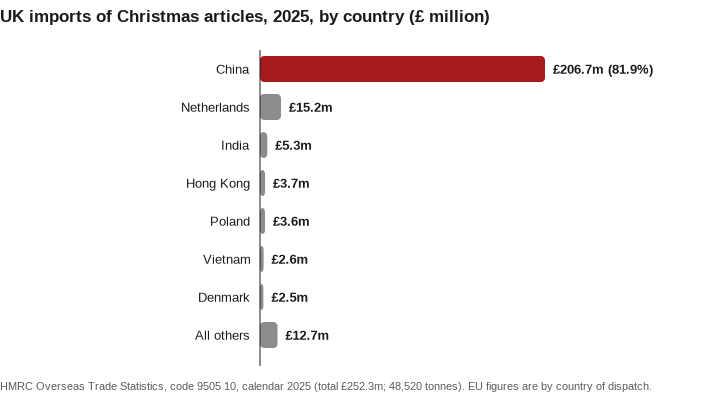
HMRC’s Overseas Trade Statistics give the answer. In 2025 the UK imported £252.3 million of Christmas articles (commodity code 9505 10, which excludes lights, candles and natural trees), weighing about 48,500 tonnes. China supplied 81.9% by value and 91.3% by weight. The true share is probably higher, because goods arriving through Dutch, Belgian and Polish distribution hubs are likely to be counted against those countries (HMRC records EU imports by country of dispatch).
- Christmas lights: £63.3 million of lighting strings in 2025, 90.7% from China by value.
- Glass ornaments: £17.5 million, 61% from China and 21% through the Netherlands. Lauscha’s trade has moved east.
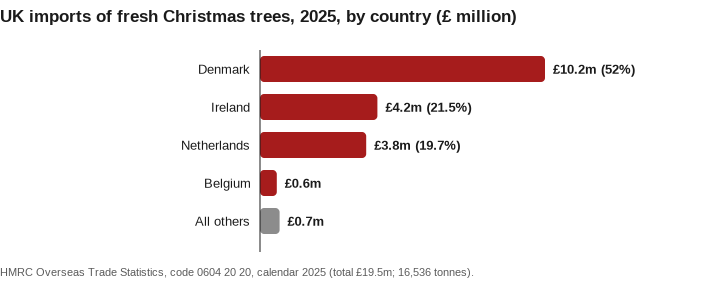
- Fresh Christmas trees: £19.5 million, about 16,500 tonnes: Denmark 52%, Ireland 21.5%, the Netherlands 19.7%.
- Northern Ireland: there is no official figure. HMRC’s regional trade statistics stop well short of this level of detail.
The human side is harder to see. A 2014 Guardian report from Yiwu, in Zhejiang, described some 600 factories said to make over 60% of the world’s Christmas decorations, with migrant workers on 12-hour days. The 60% figure came from Chinese state media and is twelve years old. In December 2019 a schoolgirl in London found a message inside a Tesco charity card saying foreign prisoners in Shanghai were being forced to work. Tesco halted production, withdrew the cards and suspended the supplier, and said an audit a month earlier had found no breach of its ban on prison labour. The EU’s Forced Labour Regulation, (EU) 2024/3015, applies from 14 December 2027. On 10 November 2026 the Withdrawal Agreement Joint Committee adopted Decision No 4/2026, adding it to the Windsor Framework, so it is due to apply in Northern Ireland from that date (joint statement, 10 November 2026). From then, goods made with forced labour cannot be placed on the market in Northern Ireland, or exported from it. The summit on 20 November did not change this. Great Britain is promised a separate regime.
Even the real tree has a supply chain. Much of Europe’s Nordmann fir seed is picked by hand in the mountains of Georgia, by climbers who in 2017 were going more than 30 metres up, many of them without ropes, for about 21 US cents a pound of cones (National Geographic). Is glas iad na cnoic i bhfad uainn: faraway hills are green.
The tree: from a royal yew to a PVC import
Then. The Royal Collection Trust credits Queen Charlotte, George III’s German consort, with bringing the custom to Britain in the late 18th century, using a yew. Coleridge described a candle-lit German tree in 1798. The Illustrated London News engraving of Victoria, Albert and their children around a decorated tree in 1848 made it a national habit; historians call the idea that Albert “introduced” it a persistent myth. The V&A dates the first advertisements for tree ornaments to 1853. In Ireland most homes made do with holly, ivy and laurel, and the tree became general only in the mid-20th century (National Museum of Ireland). Germany made goose-feather artificial trees from the 1880s (secondary sources). The story that the Addis brush company made bristle trees from toilet-brush machinery around 1930 is often told and contested. Aluminium trees arrived in 1958 and faded after the mid-1960s (secondary sources).
Now. Most artificial trees are PVC on steel frames, and most are made in China (secondary sources). The British Christmas Tree Growers Association, a trade body, says over 8 million real trees were sold in the UK in 2021 and almost 5 million were “obtained” for 2023. The two figures cannot both describe the same thing, so I do not chart them as a trend.
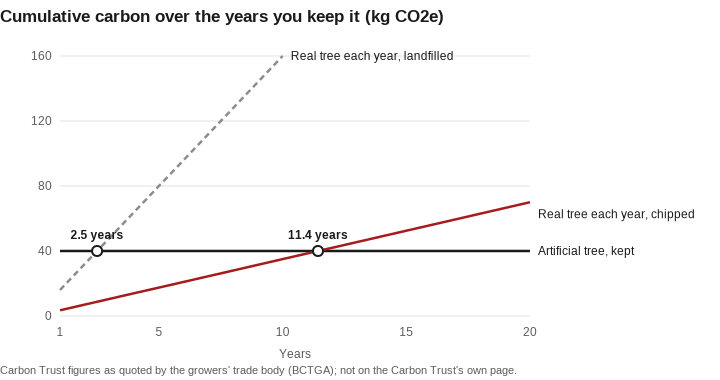
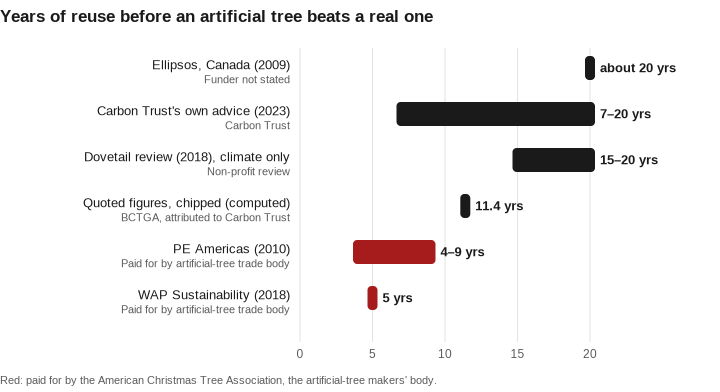
Real or fake? Interrogate the evidence. The most quoted numbers are 40 kg CO2e for a 2 m artificial tree, 16 kg for a real tree sent to landfill and 3.5 kg for one that is chipped. They are attributed to the Carbon Trust, but they are not on the Carbon Trust’s own page. They reach us through the growers’ trade body, and even the press disagree on whether 3.5 kg means chipped or burned. The Carbon Trust’s own advice (29 November 2023) is that chipping cuts a real tree’s footprint by up to 80%, and that an artificial tree used for 7 to 20 years generally beats buying a new real tree each year.
Who paid for the study matters too. The two studies that say an artificial tree “wins” after four to nine years (PE Americas, 2010) or five years (WAP Sustainability, 2018) were both paid for by the American Christmas Tree Association, which represents artificial-tree makers. A 2009 Canadian study by Ellipsos put the break-even at about 20 years, and a 2018 review by the non-profit Dovetail Partners at 15 to 20 years on climate alone.
The honest answer: keep the artificial tree you already own for as long as it lasts; if you buy real, buy local and get it chipped; never landfill it. If you buy a potted tree, note that peat compost is still lawful: no retail ban has been legislated in England, and DAERA’s April 2026 peatland plan only promises to consult on one.
Belfast’s £77,500 question
Which brings us to City Hall. After decades of real trees, Belfast City Council has put up an artificial tree this year: 16.6 metres tall according to the Irish News, bought for £77,500 from AJC Group Limited including delivery and this year’s installation, with a stated life of ten years (council working group minutes, 18 November 2025; Irish News, 14 November 2026). I had it down as Belfast’s first ever artificial tree; the sources only support “after decades of real ones”.
Why? The minutes record an officer saying that “the structure of the real Christmas trees had been weaker due to changes in the climate” and that an artificial tree “would be more sustainable”. A council spokesperson cited difficulty in recent years sourcing a suitable real tree. The council chose to buy outright because local suppliers were limited, and will store the tree at Duncrue. The council says the tree is made entirely from recycled materials, is fully recyclable at the end of its life, and compares favourably on cost with buying, moving and installing real trees each year. It has not published the figures behind either claim. Critics have not been kind: the TaxPayers’ Alliance called it an “eye-watering expense”, and Belfast’s night czar, Michael Stewart, said in a personal capacity that an artificial tree “isn’t sustainable” and will most likely end up in landfill.
Does it stack up? Three questions the council should answer in public:
- Where is the life-cycle assessment? “More sustainable” is the kind of statement that, on a retailer’s label, the Green Claims Code would expect evidence for. It was an officer’s remark in a minuted meeting, not an advertisement, but a council should be able to show the same working. The Carbon Trust’s range for an artificial tree to beat real ones is 7 to 20 years of use; this tree’s stated life is ten. That range is for a household tree, so it is a prompt for the question, not an answer.
- What did the real tree cost? I could not find what Belfast paid for its real trees or where they came from. £77,500 over ten years is £7,750 a year before storage, installation in later years and repairs. The Irish News puts the supply and delivery of a large real tree to UK councils at “over £10,000”. On cost, the artificial tree may well win, as the council says. I could not find the figures, or any carbon assessment, in its published papers.
- Was a local tree ever on the table? Half an hour up the road above Larne, the Forest Service’s Ballyboley Forest covers about 689 hectares, first planted in 1957. Why not take the city’s tree from a public forest like Ballyboley, and then give it a second life at the council’s own zoo? To be fair to the council, this is a question, not a finding. I could not confirm which species grow at Ballyboley, plantation trees grown tight for timber rarely have the shape of a specimen tree, and the Forest Service cut back its direct Christmas tree sales in 2003. But of 85 civic trees listed across Northern Ireland last year, 50 were still real (Irish News), and Newry, Mourne and Down is planting living Nordmann firs at seven sites to grow on. It can be done.
An offset by another name. I have argued before that offsets don’t cancel your emissions. The artificial tree runs on the same logic. Its carbon is spent on day one: the steel, the plastic and the shipping are emitted in 2026. The benefit is a promise, ten Christmases of real trees not cut. That is a carbon debt repaid by instalments, and like a forest sold as a carbon sink it is only as good as its permanence. A sink is finite: once the forest has grown, there is no more offset to sell. And a sink can burn. A 2022 study of California’s forest offset scheme found that wildfires had used up nearly a fifth of a buffer meant to insure the credits for a hundred years, in under a decade. The tree’s “sink” is ten winters of avoided felling. If a storm, a vandal, a fire in the store, a change of fashion or a change of council retires it in year four, the saving never arrives and the emissions are already in the air. And the thing it replaces was never the problem: on the Carbon Trust’s own advice, a real tree chipped afterwards is already the low-carbon choice.
A bigger footprint to shrink a footprint. A 16.6-metre tree has to be stored, moved, inspected, repaired and rebuilt every year. For about 46 weeks in 52 it is a large object taking up space at Duncrue. Meanwhile the public sector here is shrinking its estate to cut cost and carbon. The Department of Finance told the Assembly’s Finance Committee on 10 December 2025 that it is cutting Civil Service office accommodation by about 40% by 2028, has already let 17 properties go, and expects lower energy use as a result. I have not found Belfast’s own estate figures, though its capital programme includes a staff accommodation project at Duncrue (committee minutes, 18 September 2026). So one public policy shrinks the physical footprint, and another adds a warehouse-sized object to it in the name of sustainability. Nobody has netted the two.
My verdict. Without published sums, “more sustainable” is an article of faith, and an expensive one. I use the word duplicity in its plain sense of two faces: one says shrink the footprint, the other says store the tree. To my eye it verges on greenwash in style: virtue signalled rather than shown. The council can prove me wrong with three numbers: the tree’s life-cycle carbon, the yearly cost of storing and rebuilding it, and what both look like if it lasts five years instead of ten.
And the zoo? Belfast Zoo, which the council owns, already runs a “treecycle” each January: households drop off real trees, which go to the meerkats and Barbary lions as enrichment, with the rest chipped for enclosures and mulch. It is enrichment and woodchip, not dinner, and it takes private donations only. Other zoos are stricter: Tierpark Berlin takes only unsold, untreated trees from partner vendors and no private donations, so that it can be sure the trees are safe for the animals. The obvious worry with a tree from a living room, though the zoo does not spell it out, is leftover hooks, tinsel and spray. A civic tree strung with lights for six weeks would need the same care. But a real City Hall tree, stripped and chipped for the zoo and the parks, is to my mind a better ending than ten years in a store at Duncrue, even if the artificial tree is recycled afterwards as the council says it will be. An rud is annamh is iontach: what is rare is wonderful.
Moving a Christmas tree across the Irish Sea
Ireland supplies a fifth of the UK’s imported trees by value, and trees move in every direction across these islands. The paperwork depends on whether the tree has roots.
Then (2016). The Forestry Commission’s guide was short. Trees under 3 m moved freely within the UK and from most of the EU. Trees over 3 m needed a plant passport to enter protected zones, including Northern Ireland and the Republic, to keep out spruce bark beetles.
Now (November 2026), and what the summit plans for 2028.
| Movement | Cut tree, no roots: now | Potted or rooted tree: now | Planned from 1 March 2028, if ratified |
|---|---|---|---|
| Great Britain to NI | Not eligible for the NI Plant Health Label. Can move under the NI Retail Movement Scheme if packed for final consumers. Otherwise, on my reading of DAERA’s March 2026 import guide, a phytosanitary certificate and advance notification | NI Plant Health Label; the receiving business notifies DAERA. Growing medium must meet NI requirements. Some “high-risk” species still cannot move at all | Most plants: no phytosanitary certificate, no Plant Health Label and no routine checks. The summit papers do not mention Christmas trees or the high-risk species by name |
| A private person, GB to NI | DAERA says individuals cannot legally bring plants from GB, because certificates are issued only to professional growers. Whether that catches a cut tree on a roof rack is not stated | Not allowed | Not stated. If certificates go, the reason for the bar goes with them (my inference) |
| NI to Great Britain | Moves as before 2021 | Moves with an EU plant passport | No change expected. EU plant passports replace UK ones in GB |
| Ireland or the EU to NI | Treated as movement within the EU (over 3 m, protected-zone rules may apply: ask DAERA) | EU plant passport; protected-zone rules; some tree species notified to DAERA | No change: NI already follows EU plant health law |
| EU (including Ireland) to GB | Phytosanitary certificate and pre-notification; trees over 3 m also notified to the Forestry Commission (trade body guidance) | Phytosanitary certificate, pre-notification and border checks | Import checks stop. Some post-import checks, and notification of high-risk plants, remain |
| Great Britain to Ireland or the EU | Phytosanitary certificate, through a border control post | The same | Most certificates and border checks go |
Wreaths and cut foliage, like cut trees, cannot use the Plant Health Label; I could not confirm how the retail scheme treats them, or the position for holly and mistletoe, and the summit papers do not mention them. Northern Ireland and the Republic both hold protected-zone status against the eight-toothed spruce bark beetle (Ips typographus), found breeding in Kent in late 2018, so there is a reason behind the forms. This table is my reading of published guidance, not customs or plant-health advice. The 2028 column is from the government’s summit explainer on the SPS agreement and its horticulture guidance; the treaty text is not published.
Next. At the UK–EU summit on 20 November 2026 the two sides concluded the food and farm-goods (SPS) agreement. It is aimed at 1 March 2028, not mid-2027 as earlier GOV.UK guidance said, and it is not yet signed, ratified or in UK law. When it applies, Great Britain follows EU plant health rules, and most plants moving from Great Britain to Northern Ireland need no certificate, no Plant Health Label and no routine checks; the Retail Movement Scheme falls away for most goods. Until then, the rules in the table stand for Christmas 2026 and Christmas 2027, and on 10 November the UK and EU agreed to tighten enforcement of the current rules, not relax it. Earlier GOV.UK guidance said “the final restrictions on the movement of certain tree species will disappear”; the summit papers do not repeat that for trees, so I would not count on it until the text is out. Ask DAERA Plant Health before you ship a load. More in the SPS deal: what Northern Ireland gains.
Lights: from candles and Edison to LEDs
Then. Trees were lit with candles. Edward H. Johnson, an associate of Thomas Edison, hand-wired 80 red, white and blue bulbs around his tree in New York in 1882. In 1900 a 16-bulb string cost $12. In Christmas week 1959, Hansard recorded 14 fires involving decorations in England and Wales: five from naked lights, four from electrical faults, four where decorations fell on fires, and one from soot. Old sets had other hazards: “bubble lights”, sold from 1946, held a vial of methylene chloride, and a 2008 Cornell study found lead in the PVC cords of every US light set it tested.
Now. LED strings use around 92% less energy than incandescent ones, according to the US EPA’s Energy Star programme. In Northern Ireland that matters more, because there is no Ofgem-style price cap (Power NI’s tariff is regulated by the Utility Regulator): its standard rate has been 34.15p per kWh including VAT since 1 July 2026, against the GB cap of 26.32p for October to December 2026. That is about 30% more per unit. Part of the gap is VAT: GB domestic electricity is zero-rated from 1 October 2026 to 31 March 2027, but Northern Ireland stays at 5%.
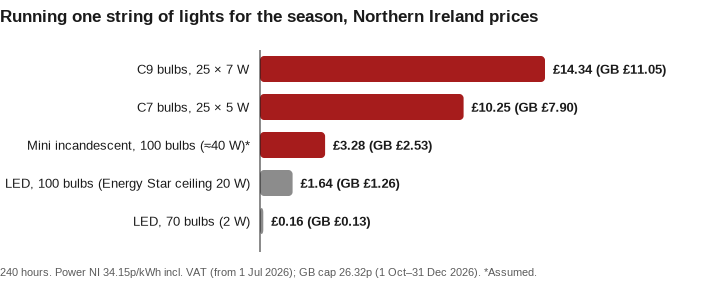
The catch is safety. Cheap LED strings bought online feature in product recalls. Trading Standards recently recalled rainbow pom-pom fairy lights, bought between September and December 2025, as a serious fire risk because they came with the wrong USB cable. Fairy lights fall under the Electrical Equipment (Safety) Regulations 2016. In Northern Ireland the EU Low Voltage Directive still applies under the Windsor Framework, so lights sold here must carry the CE mark and cannot be UKCA marked (GOV.UK, updated 27 October 2026). Great Britain accepts either.
One more cost is rarely counted. The Natural History Museum reports UK moth numbers down by about a third since the late 1960s and artificial light as one cause. It says nothing about Christmas lights in particular; the link is my inference. A timer that switches the garden off at midnight costs nothing.
Spray snow, fake leaves and other poisons
Then. Victorian artificial foliage was coloured with arsenic. Scheele’s green, invented in 1775, was dusted onto fake leaves by flower-makers; one of them, 19-year-old Matilda Scheurer, died in London in 1861 with arsenic in her organs. In the 1930s, fake snow for American homes, churches, schools and film sets was made from asbestos, until the Second World War, when asbestos was needed for US Navy ships (Moffitt Cancer Center). Some frosted vintage decorations still contain it: if a family heirloom sheds white fibres, do not handle it. It is widely said that asbestos snow fell on the cast of The Wizard of Oz; nobody has shown it from studio records. Aerosols later used chlorofluorocarbons until the US banned CFC propellants in 1978 and the Montreal Protocol was signed in 1987 (US EPA). I found no source confirming that CFC snow sprays were sold in the UK.
Now. Spray snow and flock are aerosols and adhesives. Read the can: many aerosol propellants are flammable, so never spray near lit candles, fires or hot bulbs, and ventilate the room. Fake snow on windows washes into drains, and flock makes paper and trees harder to recycle.
And two myths. Poinsettias are not deadly: a review of 22,793 US poison-centre cases found no deaths, and the plant’s reputation rests on one unconfirmed report from 1919. Holly berries will make a child sick but have killed no one on record. Keep them out of reach and stop worrying.
Crackers
Tom Smith, a Clerkenwell confectioner, patented his first cracker in 1847 and perfected the bang in the 1860s (V&A). The snap is a trace of silver fulminate, a genuine explosive, on a strip of card. The plastic toy inside is the modern problem; Morrisons made its own-brand crackers plastic-free in 2020 (press reports).
Glitter: restricted in Larne, legal in Stranraer
Then. The New Jersey machinist Henry Ruschmann is credited with cutting plastic film into glitter before 1934, and his firm turned to plastic glitter in the war when glass glitter dried up (local history sources).
Now. Commission Regulation (EU) 2023/2055 restricts intentionally added synthetic polymer microparticles, including loose plastic glitter, from 17 October 2023. Defra’s own explanatory memorandum (12 October 2024) confirms it applies in Northern Ireland. Great Britain has no equivalent: the UK REACH work programme for 2025 to 2026 started no new restrictions, and a Defra answer of 16 March 2026 announced no decision. So a tube of craft glitter that cannot be placed on the market in Larne can still be sold in Stranraer.
There are two further twists. The restriction does not cover glitter bonded to baubles, cards or wrapping paper, which is most festive glitter, and is what spoils paper recycling. And “biodegradable” glitter is not the answer it seems: a 2020 Anglia Ruskin University study found that cellulose glitter harmed freshwater plants about as much as plastic glitter.
Candles: light, heat and carbon monoxide
Then. Candles lit the tree until electricity replaced them. In Ireland the candle belonged in the window: the National Folklore Collection records a lit candle, sometimes three-branched, set there on Christmas Eve to guide the Holy Family and kept through the twelve days. (The story that it was a secret signal to priests in penal times is a legend.) Johann Wichern lit the first Advent wreath in Hamburg in 1839, a cartwheel of candles. The Moravian Church’s Christingle dates to 1747, and the Children’s Society brought it to British churches in 1968 (secondary sources). St Francis’s crib at Greccio in 1223 had hay, an ox and an ass, and no figures at all. The older end of the season was Candlemas on 2 February. English Heritage notes that the rule that decorations must come down by Twelfth Night is a modern invention.
Now: the Home Office figures. A Home Office review counted 9,371 fires started by candles in England in the nine years to March 2019, a little over a thousand a year. Of those, 94 were fatal and 204 were severe-casualty fires. Candles had the highest severe-casualty rate of any source of ignition: 21.8 per 1,000 fires. In nearly three-quarters of the severe cases the first thing to catch was fabric or furnishings, and in over half, something had been left too close to the flame. I could not open the Home Office’s latest annual table (FIRE0602), so I have no official figure after 2019; an insurer’s analysis of Home Office data put candle fires at 940 in 2021/22, the highest in a decade, which I have not verified. The National Fire Chiefs Council says accidental house fires in England run about 10% higher in December and 53% higher on Christmas Day. I found no published Northern Ireland figures; that is a question for the Fire and Rescue Service.
Candle labels follow BS EN 15494, with standards for sooting (BS EN 15426) and outdoor candles (BS EN 17616). The NI Direct and Fire and Rescue Service advice (11 December 2025) is simple: never place candles near the tree, decorations, wrapping paper or furnishings, and never leave them burning unattended.
Carbon monoxide is the hidden Christmas risk. Candles make little CO. The danger is a fire or stove lit for the first time in months with an unswept chimney, a gas appliance working harder for a full house, or a barbecue or generator brought indoors. Northern Ireland has been ahead here:
- 31 October 2012: NI Building Regulations require a CO alarm wherever a combustion appliance is installed or replaced in a home.
- 1 September 2024 (new tenancies) and 1 December 2024 (existing tenancies): NI private landlords must fit smoke alarms, a heat alarm in every kitchen and a CO alarm wherever there is a fixed combustion appliance (other than one used solely for cooking) or a flue (SR 2024/123).
- 1 October 2022: England’s equivalent covers CO alarms for fixed combustion appliances other than gas cookers, but no kitchen heat alarm.
The tax on the church candle
I set out to write that Ireland’s Revenue zero-rates Catholic candles for VAT and taxes everyone else’s. That was true, in a way, for about 43 years. It is not true now, and it was never quite what the law said.
Then. From 1 July 1978, Ireland zero-rated “wax candles and night-lights which are white and cylindrical”, excluding any that were “decorated, spiralled, tapered or perfumed” (S.I. No. 146 of 1978). The law never mentioned a church. It did not need to: the plain white candle was the church candle, and the red, scented or twisted one was the Christmas candle, taxed in full. I found no official explanation of why the relief was given.
The dispute. A church-candle maker sold a candle shaped as a truncated cone, with only a 3 mm cylindrical section at its base, as part of a patented burning system. Revenue said that made it “tapered”. The Tax Appeals Commission agreed (determination 119TACD2020) and upheld VAT assessments of €394,802 for 2013 to 2016. Shape alone, not use, decided the tax: a candle made for the altar was taxed like one made for the mantelpiece.
Now. The Minister for Finance removed the relief in Finance Bill 2020, on the ground that a historic zero rate could not be extended, and after representations it ended on 1 January 2022. Revenue’s guidance is plain: white and cylindrical candles are now at the standard rate. The Irish Catholic newspaper was reported to have likened it to a tax on prayer (Irish Mail on Sunday, January 2021). So today a white altar candle and a red Christmas candle are both taxed at 23% in Dundalk and 20% in Newry. The Border still sets the price of a candle, just not the way I thought.
Wrapping paper: not packaging, depending on who wraps it
Then. People wrapped gifts in brown paper, newspaper or fabric until, the story goes, a Kansas City shop ran out of tissue in 1917 and sold decorative envelope linings instead. That shop became Hallmark. The first commercial Christmas card, in 1843, sold at a shilling and flopped; the robin arrived on cards soon after, a nod to the red-coated postmen nicknamed “robins”.
Now. The often-repeated claim that the UK uses 227,000 miles of wrapping paper a year is repeated by Defra (13 December 2024), but it traces back to a packaging company’s web page with no published method. Treat it as an industry estimate.
The legal position is odd. The EU list of packaging examples, which UK law mirrors, treats wrapping paper sold separately as not packaging, while aluminium foil used to wrap goods at the point of sale is packaging. So a roll of glittered paper sold in a supermarket is outside UK packaging producer responsibility (in force 1 January 2025, including NI) and outside the EU Packaging and Packaging Waste Regulation, which has applied in Northern Ireland since 12 August 2026. The same paper used by a shop to gift-wrap your purchase at the till is probably packaging. The rule depends on who does the wrapping. Use the scrunch test: if the paper stays scrunched, it can usually go in the recycling; if it springs back, it is plastic or foil and cannot.
Your turkey foil is a carbon border good
Aluminium foil (commodity code 7607) is in the EU carbon border adjustment mechanism (CBAM), which entered its definitive phase on 1 January 2026. EU importers bringing in under 50 tonnes a year are exempt (Regulation (EU) 2025/2083 of 8 October 2025, in force 20 October 2025). Foil is also in scope of the UK CBAM from 1 January 2027, which applies across the whole UK, including Northern Ireland, once covered imports pass, or are expected to pass, £50,000 (over the past 12 months or the next 30 days) (HMRC, updated 2 November 2026).
After the summit (21 November 2026). The UK and EU concluded talks on 20 November to link their carbon markets, aiming for 1 January 2028. The government says it “intends to exempt goods originating in the EU”, the wider European Economic Area and Switzerland from the UK CBAM from 1 January 2027 (DESNZ explainer, 20 November 2026). That would cover EU-made foil and EU-made steel goods alike, because the exemption follows origin, not the product. It is an intention, not law: the regulations are not yet made. The EU is expected to exempt UK goods from its CBAM once the link applies, from 2028, which needs EU legislation. Foil and tree stands made in China are untouched: they stay in whichever CBAM they enter. For a Northern Ireland importer the question becomes where the foil was made, not where it was bought. More in the carbon deal: what changes, and when.
The steel in a tree stand is less clear. For now, the EU CBAM covers “other articles of iron or steel” (7326) but not household articles (7323); a Commission proposal of December 2025 would extend it to downstream steel and aluminium goods from 2028 (not yet checked against EUR-Lex). Two near-identical stands can sit on either side of that line, depending on how they are classified. The summit did not change where that line falls; if the planned exemption is made, it matters only for stands made outside the EU. That is a question for a customs specialist, not a blog.
Greenwashing: who is checking the “eco” Christmas?
Nobody much. I searched the Advertising Standards Authority’s published list of environmental rulings (2021 to 2024) and the Competition and Markets Authority’s green-claims cases and found none on a Christmas product: no glitter, no “plastic-free” cracker, no “recyclable” wrap, no “sustainable” tree. That is an absence of enforcement, not proof of honest labels.
- The glitter “bans” of 2020 were narrower than the headlines. Morrisons, Waitrose and John Lewis removed glitter from own-brand Christmas ranges such as cards and wrap. None stopped selling branded glitter, and Sainsbury’s only reduced it on decorations (press reports).
- “Biodegradable” and “eco” glitter did about as much harm in the Anglia Ruskin study as the plastic kind. The ASA’s guidance since 2023 says a “biodegradable” claim must say where, how fast and into what.
- The law has teeth it has not used here. Since 6 April 2025 the CMA can decide for itself that a firm has broken consumer law and fine it up to 10% of global turnover. In the Republic, generic claims such as “eco-friendly” without proof have been banned since 27 September 2026 under Directive (EU) 2024/825 (reported as transposed by S.I. No. 124 of 2026). I could not confirm whether that Directive applies in Northern Ireland; as far as I can tell it does not. The EU’s separate Green Claims Directive is reported withdrawn.
- Public bodies make environmental statements too, and should be ready to show the evidence. Belfast’s “more sustainable” tree is one example. I am not saying it is false; I am saying it is unevidenced in public, and until the evidence appears it reads to me as virtue signalling. The same goes for any council statement that a booking system will improve recycling: in Ards and North Down, recycling collected at the centres fell 15% in the first two months.
Pay now, promise later: the offset pattern
Belfast’s tree is not a one-off. Read this piece again and the same shape keeps appearing: a cost paid today, in carbon or cash, against a green benefit promised for later and guaranteed by nobody.
- The household artificial tree. About 40 kg of carbon up front on the quoted figures, repaid only if you keep it 7 to 20 years. The claim depends on a promise the buyer makes to themselves.
- “Fully recyclable at the end of its life.” The council’s tree, and a great many decorations, carry this claim. It is a promise about 2036, about a composite of plastic and metal, to be kept by someone not yet named.
- The real tree as a carbon store. Growers are right that a tree absorbs carbon as it grows. It is a temporary sink: the quoted figures run from 3.5 kg if it is chipped to 16 kg if it is landfilled. The benefit lives or dies in January, at the recycling centre gate.
- “Living” and potted trees. A rooted tree is a sink only if it survives. Newry, Mourne and Down’s planted firs are a fair experiment; the test is how many are alive in five years.
- “Biodegradable” glitter. The label promises a harmless ending. The one study that tested it found harm much like plastic.
- LED lights. The saving per hour is real. A cheap string that fails, or is recalled, after one season has spent its manufacturing carbon for nothing, and cheap light invites more of it (that last point is my inference).
- Recycling-centre booking. Sold as protecting ratepayers and recycling. In Ards and North Down, waste through the centres fell by 652 tonnes in early 2024, but about half reappeared at the kerbside and the recycling rate slipped. The footprint moved; it did not vanish.
- Retailers’ glitter “bans”. A headline today, covering own-brand lines only.
- Zero VAT on electricity in Great Britain. A winter price cut, alongside a policy of using less.
None of these is a fraud. Each is an offset in miniature: the emission is certain and the saving is conditional. The honest version of every one comes with a number, a date and a name. Is glas iad na cnoic i bhfad uainn.
Retail, hospitality, leisure and the public realm
Decorations are a business, and a public-realm job.
- Markets and events. Belfast City Council reports over a million visitors to the 2024 Christmas market, with over 100 stalls, 40% of them local. The 2024 lights switch-on drew over 10,500 people and an estimated £195,585 in direct spend. This year’s market and switch-on were both on Saturday 14 November. A temporary street trading licence in Belfast now costs £244 to apply, plus £54 to £95 a day (fees from 1 June 2026).
- Fire safety in premises. Pubs, shops, halls and churches open to the public need a fire risk assessment under the Fire and Rescue Services (NI) Order 2006 and the Fire Safety Regulations (NI) 2010 (in operation 15 November 2010). The GOV.UK guide for places of assembly (written for England and Wales, but a useful reference) lists decorations as a fuel and asks for fire-retardant display materials. That sets safety against recycling: retardant treatments make decorations harder to recycle.
- Working at height. Bury Council was fined £200,000 on 2 April 2025 after a man fell while putting up the town’s Christmas tree (HSE). HSE says heavy festive displays need secure anchor points, and lights across highways need extra checks.
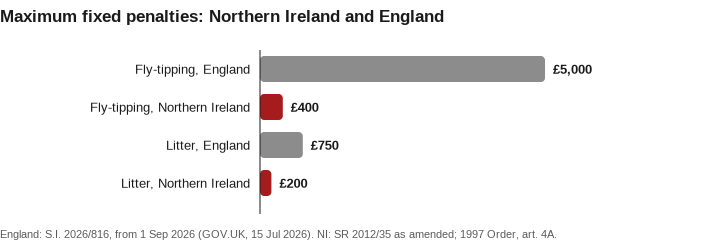
- Litter. A council in Northern Ireland can set a fixed penalty of up to £200 for dropping litter under the Litter (NI) Order 1994 (SR 2022/302, from 30 December 2022). In England the maximum went to £500 on 31 July 2023 and to £750 on 1 September 2026 (S.I. 2026/816, announced 15 July 2026).
- Sky lanterns are left to individual councils: Armagh City, Banbridge and Craigavon has consulted on a ban, and I found no NI-wide position. The case against them is not theoretical. A single lantern started the 2013 Smethwick recycling plant fire, the largest the West Midlands Fire Service had fought, and lanterns released at New Year 2020 burned down the ape house at Krefeld Zoo in Germany, killing more than 30 animals.
The January problem: barriers, bookings and the back road
Every decoration in this article ends up somewhere in January, and the tree is the awkward one. I could not find 2026/27 tree-disposal guidance from either Belfast or Mid and East Antrim, or a statement from either on whether a cut-up tree can go in the brown bin. Last year Belfast’s answer was a recycling centre or the zoo.
Getting into a recycling centre has become harder. I expected to report a height barrier at Redlands in Larne. The council’s own page says otherwise, and the facts are these:
- Since 19 October 2026, Mid and East Antrim’s three main sites (Redlands in Larne, Sullatober in Carrickfergus and Waveney Road in Ballymena) require a permit and a booked slot for vans, for cars with double-axle trailers, and for businesses, charities, community groups and landlords. Permits are free, for ratepayers only, with proof of address and vehicle. Van households get 12 visits a year, with more considered case by case.
- A car, with or without a small trailer, needs neither.
- Height barriers of 1.95 m are in place at the council’s other, smaller centres.
- Redlands has no Sunday opening, shuts at 2pm on Christmas Eve and is closed on 25 and 28 December and 1 January. A motion to restore Sunday opening failed.
The council’s reasons are real: commercial waste dumped at ratepayers’ expense, and “waste tourism” from neighbouring districts. Belfast books vans in ten-minute slots. Ards and North Down has required every visit to be booked since 4 September 2023.
Will it raise fly-tipping? My instinct says yes: make the legal route harder and some people will take the back road. The evidence is less tidy than my instinct, and I should say so.
- For: in the first two months of booking in Ards and North Down, fly-tipping incidents rose to 103 from 58 a year earlier, while recycling collected at the centres fell 15%. Officials said nothing proved the booking system was the cause.
- Against: a 2022 study commissioned by Defra found no evidence linking booking systems to fly-tipping, though it called its own evidence thin. Antrim and Newtownabbey told councillors in 2025 that fly-tipping had not risen after it began booking vans.
- The real gap: Northern Ireland publishes no consistent count of fly-tipping incidents, so no one can test it. England counted 1.26 million incidents in 2024/25. Here we have fragments: the Northern Ireland Environment Agency’s crime unit investigated 339 larger illegal sites in 2025/26, 27 of them in Mid and East Antrim, and the Audit Office puts the cost of waste crime at about £34 million a year.
The penalties do not help. The maximum fixed penalty for fly-tipping in Northern Ireland is £400. England’s went to £1,000 in July 2023 and to £5,000 on 1 September 2026. A van driver without a permit will be turned away at Redlands, and there is no Sunday to come back. If he dumps the load instead, the most a council here can offer as a fixed penalty is £400, though a court can impose far more. None of that excuses fly-tipping; it does mean the deterrent is weaker here. Mid and East Antrim has promised to review its scheme after six months and to keep watching fly-tipping. It should publish the numbers, month by month, starting with January.
One decoration, three rulebooks
This is where duplication becomes contradiction. The same product can be lawful, restricted or unregulated depending on which side of the Irish Sea or the border it is sold.
| Issue | Northern Ireland | Great Britain | Republic of Ireland / EU |
|---|---|---|---|
| Loose plastic glitter | Restricted since 17 Oct 2023 (EU 2023/2055) | Legal; no restriction decided (16 Mar 2026) | Restricted since 17 Oct 2023 |
| General product safety | EU GPSR 2023/988 since 13 Dec 2024 | GPSR 2005; new framework consulted on, Mar–Jun 2026 | EU GPSR since 13 Dec 2024 |
| Fairy lights marking | CE only, not UKCA | UKCA or CE | CE |
| Packaging design and labels | EU PPWR from 12 Aug 2026, plus UK packaging EPR | UK packaging EPR | EU PPWR from 12 Aug 2026 |
| Generic “eco” claims | Case by case, DMCC Act (from 6 Apr 2025) | Case by case, DMCC Act | Banned unless proven from 27 Sep 2026 (Directive 2024/825)* |
| Cut Christmas tree from GB | Retail scheme, or certificate and notification (most certificates to go from 1 Mar 2028, if ratified) | Within GB: none under 3 m; UK plant passport over 3 m | Phytosanitary certificate (most to go from 1 Mar 2028, if ratified) |
| VAT on a candle | 20% | 20% | 23% (white church candles were 0% from 1978 to 2021) |
| Maximum litter fixed penalty | £200 (since 30 Dec 2022) | £750 in England (since 1 Sep 2026) | Not checked |
| Maximum fly-tipping fixed penalty | £400 | £5,000 in England (since 1 Sep 2026) | Not checked |
| Aluminium foil (CBAM) | UK CBAM from 1 Jan 2027; UK intends to exempt EU-made foil (not yet law) | UK CBAM from 1 Jan 2027; same intended exemption | EU CBAM, definitive since 1 Jan 2026; UK-made foil expected to be exempt from 2028 |
| Electricity price | Power NI 34.15p/kWh incl. 5% VAT (regulated tariff) | Ofgem cap 26.32p/kWh, VAT zero-rated to 31 Mar 2027 | Not compared |
*I could not find an official statement on whether Directive 2024/825 applies in Northern Ireland. As far as I can tell, the underlying consumer directives are not in Annex 2 of the Windsor Framework, so it does not. Confirm before relying on it.
Where the ESG pillars collide
ESG is usually sold as if environmental, social and governance goals line up. At Christmas, they visibly don’t.
- LEDs save energy and money (E), but cheap imported strings are the ones being recalled for fire risk (S).
- Fire-retardant decorations protect people in pubs and halls (S), but the treatments make them harder to recycle (E).
- Real trees support local growers and jobs (S) and store carbon while growing, but they are farmed with inputs and need careful disposal (E). Artificial trees avoid pests and annual felling but are PVC and steel shipped from China.
- A reusable civic tree is sold as sustainable (E), but adds a large object to store and maintain while the public estate is being cut to save cost and carbon (G).
- Recycling-centre controls protect ratepayers from paying for traders’ waste (G), and may push some of it into the hedgerows (E).
- Plant health rules protect our forests from beetles (E) and make it harder for a small grower to send a load of trees across the Irish Sea (S).
- The glitter rule bans the loose craft tube but exempts the glitter bonded to cards and wrap, which does the most damage to recycling.
- Treat the evidence with care. The two studies paid for by the artificial-tree industry give the shortest break-even times; the figures repeated by the real-tree industry could not be traced to the source they name. Funding is a declared interest, not proof of error, but anyone selling a “green” Christmas should show their working. That is where duplication can shade into duplicity: a “biodegradable” glitter that harms rivers like plastic, or an “eco” label with nothing behind it.
Twelve ways to make Christmas better
Tagged by who gains: £ pocket, J jobs, E energy, Env environment, C Christianity. Tús maith leath na hoibre: a good start is half the work.
- Switch to LEDs and put them on a timer (£, E). A small LED string costs pennies a season; an old C9 string costs over £14 at NI prices.
- Keep the tree you have. If it is artificial, use it until it falls apart. If you buy real, buy Northern Ireland-grown and have it chipped, or take it to Belfast Zoo’s treecycle if it runs again in January (Env, J).
- Pass the scrunch test. Choose plain paper, brown paper or fabric wraps; skip foil and glitter (Env, £).
- Buy decorations from local makers and markets, not anonymous online sellers (J). Four pounds in five of the Christmas decorations we import come from China; Belfast’s market is 40% local traders.
- Check before you plug in. Buy lights from retailers you can find again, look for the CE mark in NI, check the GOV.UK product recalls database, and unplug at night (£, safety).
- Test your alarms and sweep the chimney before the first fire of the season. Fit a CO alarm wherever there is a fire, stove or boiler (safety).
- Treat candles with respect. In the Home Office’s review, candle fires were more likely to cause a severe injury than fires from any other source. Keep them a clear distance from fabric and greenery, never leave them, and put an LED candle in the window (safety, C).
- Councils: plan the after-party. Publish tree disposal dates before Christmas, take trees at the kerb or in the brown bin, open the recycling centre on the first Sundays of January, ban lantern and balloon releases on council land, and publish monthly fly-tipping figures (Env, public realm).
- Councils: show your working. If an artificial civic tree is “more sustainable”, publish the assessment, including the cost of storing it and what happens if it does not last. If a real one is possible, source it from a local forest and give it a second life as woodchip or zoo enrichment (Env, J, governance).
- Hospitality and retail: update the fire risk assessment for the decorations, keep exits clear, and make only the green claims you can prove (J, safety, governance).
- Keep the twelve days, and the meaning. Christmas starts on 25 December and runs to Twelfth Night, with Epiphany and Nollaig na mBan on 6 January, when by Irish custom the men cook and the women rest. Go to a carol service, light a candle safely, support a church food bank or a Christingle, and leave the greenery up until Twelfth Night, or Candlemas if you are a traditionalist (C, J).
- Buy less, buy better. One glass bauble that lasts fifty years beats a plastic set a season. Mend lights, reuse tins and boxes, and give experiences (£, Env). Bíonn blas ar an bheagán.
The twelve days of regulation
To the tune of “The Twelve Days of Christmas”, first printed in Mirth Without Mischief in 1780. Each verse names a rule, my verdict, and a tip.
- On the first day of Christmas, the EU gave to me: a ban on loose plastic glitter. Good, but half done. It applies in NI from 17 October 2023 but not in GB, and bonded glitter is exempt. Tip: skip glitter; “biodegradable” glitter isn’t harmless either.
- On the second day of Christmas, Stormont gave to me: two alarms and a heat one. Good. NI tenancies need smoke, heat and CO alarms (from 1 December 2024 for existing tenancies). Tip: press the test button before the guests arrive.
- On the third day of Christmas, Westminster gave to me: two marks for fairy lights. Bad: duplication. Lights sold in NI must be CE marked and cannot be UKCA marked; in GB either will do, so a GB seller shipping to Larne can get it wrong. Tip: in NI, look for CE, and check the recalls database.
- On the fourth day of Christmas, my council gave to me: a permit for the van. Understandable, but risky. Since 19 October 2026 a van needs a permit and a booked slot at Redlands, with twelve visits a year and no Sundays. Tip: book early for January; councils, publish the fly-tipping figures.
- On the fifth day of Christmas, HMRC gave to me: a carbon tax on foil. Good in principle, odd in practice. UK CBAM covers aluminium foil from 1 January 2027 above £50,000 of imports; after the summit the UK intends to exempt EU-made foil, but has not yet legislated. Tip: importers, ask every supplier where the foil was made and track your 12-month total now; households, wash and ball foil for recycling.
- On the sixth day of Christmas, DAERA gave to me: a certificate for a tree. Good aim, heavy paperwork. A cut tree from GB needs the retail scheme or a phytosanitary certificate; a potted one needs a plant health label. The summit’s SPS agreement would end most of that from 1 March 2028, if ratified, so it stays for this Christmas and next. Tip: buy an NI-grown tree, and do not plan a 2027 load on the new rules.
- On the seventh day of Christmas, the CMA gave to me: fines for fibbing. Good, but unused. Fines of up to 10% of global turnover since 6 April 2025, and not one Christmas case. Tip: if you sell “eco” decorations, hold the evidence before you print the label.
- On the eighth day of Christmas, Belfast gave to me: a seventy-seven-thousand-pound tree. Unproven: an offset by another name. Carbon spent now, savings promised over ten years; “more sustainable” and “fully recyclable”, says the council, but the assessment is not published. Tip: publish the sums, and next time ask the Forest Service and the zoo.
- On the ninth day of Christmas, Brussels gave to me: a packaging rule with a gift-wrap hole. Bad: loophole. Wrapping paper sold on a roll is not packaging. Tip: scrunch test; wrap in brown paper or fabric.
- On the tenth day of Christmas, Dublin gave to me: full VAT on altar candles. Fair, if joyless. Ireland’s zero rate for plain white candles lasted from 1978 to 2021. A tapered church candle never qualified. Tip: a candle is 23% in Dundalk and 20% in Newry, whatever its colour or creed.
- On the eleventh day of Christmas, the market gave to me: 34p a unit and no GB cap. Bad: NI pays about 30% more than GB, partly because GB’s VAT on electricity is zero until March. Tip: LEDs on a timer can cut lighting costs by 90% or more against old bulbs.
- On the twelfth day of Christmas, nobody gave to me: a ban on sky lanterns. Bad: a gap. There is no NI-wide rule; it is left to councils. Tip: never release lanterns or balloons; ask Krefeld Zoo why.
What I’d change
Five fixes would remove most of the duplication. First, the UK should decide on loose glitter, so Larne and Stranraer follow the same rule. Second, gift wrap and seasonal decorations should come into producer responsibility on recyclability, or at least carry the scrunch test on the label. Third, Northern Ireland’s councils should agree one festive public-realm standard: published tree collection and chipping, Sunday opening in January, and a lantern and balloon ban. Fourth, DAERA should publish consistent fly-tipping statistics, as England does, so that recycling-centre controls can be judged on evidence, and DAERA and the Assembly should look again at fixed-penalty ceilings that now trail England’s by a wide margin. Fifth, any public body that calls a purchase “sustainable” should publish the assessment behind it.
None of this needs a no-fun Christmas. Father Christmas survived Parliament, the Puritans and the 1973 energy emergency; he will survive a booking system. It needs rules that say the same thing on both sides of the Irish Sea, and decorations made to last.
Go raibh maith agaibh, agus Nollaig Shona daoibh. Thank you, and a happy Christmas to you all.
Robert J. Park is an environment, carbon and public affairs consultant based in Larne, Northern Ireland. Download the briefing, *Deck the halls, check the rules* (PDF), or explore the dashboard. Retailers, venues and councils that want a festive compliance check can email robert@robertjpark.co.uk.
Sources
Checked 16 November 2026; summit sources added 21 November 2026. Secondary, press or trade-body sources are marked.
-
UK–EU summit, 20 November 2026: Cabinet Office, UK/EU Summit 2026: key documents, including the Joint Statement and the SPS explainer · Defra, SPS agreement: horticulture industry, preparing your business · DESNZ, UK-EU linking agreement: explainer · UK Government and European Commission, joint statement of the Withdrawal Agreement Joint Committee, 10 November 2026 · Joint Committee Decision No 4/2026 (Forced Labour Regulation)
- Father Christmas and the bans: English Heritage, The history of Father Christmas · Library of Congress, Old Father Christmas · Institute of Advanced Legal Studies, 25 December 1647 · History Today, Christmas under the Puritans · National Records of Scotland, Christmas banned in Scotland · National Trust for Scotland, Scottish Christmas traditions · Mass Moments, Christmas celebration outlawed · Ulster-Scots Academy, Old Christmas · thejournal.ie, Christmas in Ireland (historian, press) · Hansard, 12 Dec 1973 and 19 Dec 1973 · ITV News, councils and Christmas lights, 27 Oct 2022 (press) · Belfast City Council, committee minutes, 7 Sept 2012 · Irish Times, Burnfoot tree, 10 Dec 2003 (press) · Irish News, Mid Ulster greetings vote, 13 Feb 2026 (press)
- Irish language and custom: Irish News, An Irish-language guide to Christmas, 23 Dec 2024 · Royal Irish Academy, A history of Ireland in 100 words: Christmas · National Museum of Ireland, How Christmas was celebrated · Dúchas.ie, Christmas in the National Folklore Collection
- History of decorations: Royal Collection Trust, A royal Christmas · V&A, Victorian Christmas traditions, The first Christmas card and The Christmas cracker · OUP blog, German Christmas traditions · Corning Museum of Glass, Lauscha · The Henry Ford, From light bulbs to Christmas baubles · Smithsonian, history of Christmas lights and the Twelve Days · English Heritage, Leave your decorations up · Moffitt Cancer Center, asbestos snow · Environmental History Now, poisonous colours in the artificial flower industry · Paris Review, Scheele’s green (secondary) · Cornell Chronicle, lead in light cords, 2008 · Evens and Stellpflug, Holiday plants with toxic misconceptions, 2012 · US EPA, regulatory history of CFCs · Hansard, Christmas decorations (fires), 8 Dec 1960 · Hamburg, the Advent wreath · Church Times, Greccio, 22 Dec 2023 · University of St Andrews, robins on cards · Wikipedia, Tinsel, Christingle, Bubble light and 2013 Smethwick fire (secondary) · Smithsonian, Krefeld Zoo fire · KCUR, Hallmark and wrapping paper · Natural History Museum, light pollution
- Trade and supply chains: HMRC, Overseas Trade Statistics custom tables (commodity codes 95051010, 95051090, 94053100, 94053900 and 06042020, calendar 2025, retrieved 16 Nov 2026) · Guardian, report from Yiwu, 19 Dec 2014 (press) · Al Jazeera, Tesco suspends supplier, 22 Dec 2019 (press) · UK Government, Explanatory memorandum on Regulation (EU) 2024/3015, 4 Nov 2026 · National Geographic, Georgia’s cone pickers, 2017 · DAERA, Peatland Strategy Delivery Plan, 22 Apr 2026
- Offsets and the public estate: Badgley and others, California’s forest carbon offsets buffer pool is severely undercapitalized, Frontiers in Forests and Global Change, 2022 · NI Assembly, Committee for Finance, 10 Dec 2025 · Belfast City Council, Strategic Policy and Resources Committee, 18 Sept 2026 · County Down Spectator, booking system, 1 Aug 2024 (press)
- Tree carbon: Carbon Trust, Tips for a more sustainable Christmas, 29 Nov 2023 · BCTGA, Real Christmas trees are truly green (trade body) · Purdue Extension, real or artificial? · Dovetail Partners, Christmas trees review, 2018 · ACTA, 2018 life cycle assessment (trade body)
- Belfast’s tree, Ballyboley and the zoo: Belfast City Council, Installations Working Group minutes, 18 Nov 2025 and lights switch-on 2026 · Irish News, £77,500 artificial tree, 14 Nov 2026 and night czar, 20 Dec 2025 (press) · NI Direct, Ballyboley Forest · Woodland Trust, Ballyboley Forest · 4ni, Forest Service Christmas tree sales, 25 Nov 2003 (press) · Newry, Mourne and Down, sustainable Christmas tree pilot · Belfast Zoo, Recycle your Christmas tree · Tierpark Berlin, Every year again
- Moving trees: Forestry Commission, Christmas tree import guide, 2016 · Defra, NI Plant Health Label FAQ and NI Retail Movement Scheme · DAERA, Import and export of plants and Ips typographus · GOV.UK, Move plants from GB to NI, Import plants from the EU and SPS agreement: preparing your business · Defra, Regulation of conifer plants, 19 Nov 2024 · Fresh Produce Consortium, certificates for trees under 3 m (trade body) · DAFM, Importing plants from the UK
- Candles, fire and alarms: Home Office, In-depth review of fire-related fatalities and severe casualties in England, 2010/11 to 2018/19 · Zurich, candle fires, 11 Oct 2022 (insurer, unverified) · NFCC, 19 Dec 2025 · NI Direct, Fire safety over Christmas, 11 Dec 2025 · DfC, Smoke, heat and CO alarms for private tenancies (NI) 2024 · SR 2024/123, reg 3 · SI 2022/707 · HSENI, Carbon monoxide alarms · Fire Safety Regulations (NI) 2010 · GOV.UK, Fire risk assessment: places of assembly
- Irish VAT on candles: S.I. No. 146 of 1978 · Tax Appeals Commission, 119TACD2020 · Oireachtas, answer of 10 Dec 2020 and 13 Jan 2021 · Revenue, Candles (white and cylindrical) and current VAT rates · GOV.UK, VAT rates
- Product safety, glitter and green claims: GOV.UK, GPSR in Northern Ireland · Electrical Equipment (Safety) Regulations 2016: NI · Product recall, pom-pom fairy lights · UK product safety framework consultation · European Commission, Regulation (EU) 2023/2055 on microplastics · Defra, Explanatory memorandum, 12 Oct 2024 · DAERA, REACH · GOV.UK, UK REACH work programme 2025 to 2026 · Anglia Ruskin University, Glitter study, 14 Oct 2020 · BusinessGreen, retailers and glitter, Oct 2020 (press) · ASA, rulings on environmental issues and green disposal claims guidance · CMA, Green Claims Code, misleading environmental claims cases and new consumer regime, 7 Apr 2025 · Department of Enterprise (Ireland), Empowering consumers for the green transition · Matheson, Irish transposition (law firm)
- Packaging and CBAM: SI 2024/1332, packaging EPR · Directive 2013/2/EU annex · DAERA, Packaging and packaging waste · Defra, Sustainable festivities, 13 Dec 2024 · Recycle Now, Wrapping paper · European Commission, CBAM and simplifications, 20 Oct 2025 · HMRC, UK CBAM policy summary and aluminium goods in scope
- Energy: Power NI, unit rates · Utility Regulator, Power NI tariff review, July 2026 · Ofgem, Price cap 1 Oct to 31 Dec 2026 · HMRC, Temporary zero rate of VAT for domestic electricity in GB · US EPA, Energy Star decorative light strings · Yukon Government, Holiday lighting
- Public realm, recycling centres and fly-tipping: Mid and East Antrim Borough Council, recycling centre booking system and household recycling centres · Love Ballymena, permits and booking, 13 Oct 2026 and van curbs, 18 Feb 2026 (press) · Belfast City Council, booking for vans, Christmas programme 2024 and street trading licence · County Down Spectator, booking system results, 29 Feb 2024 (press) · Air and Space Evidence for Defra, booking systems and fly-tipping, 2022 (copy hosted by a parish council) · GOV.UK, Fly-tipping statistics for England 2024 to 2025, bigger fines, 7 Jul 2023 and new fines for fly-tippers and litter, 15 Jul 2026 · S.I. 2026/816 (read on a mirror; in-force date to be confirmed) · NI Audit Office, Waste crime in Northern Ireland, 3 Jul 2025 · Irish News, illegal dumping sites, 11 May 2026 (press) · Waste and Contaminated Land (NI) Order 1997, arts 4 and 4A · SR 2012/35, reg 3 and SR 2022/302 · SI 2023/770 · ABC Council, balloon and lantern release consultation · HSE, local government FAQ and Bury council fined, 2 Apr 2025