
The SPS deal: what Northern Ireland gains, what it gives away
Status as at 21 November 2026. General information, not legal advice. The treaty text is not published and nothing has changed in law yet.
The short version
- On 20 November 2026 the UK and the European Union (EU) concluded a sanitary and phytosanitary (SPS) agreement, covering food safety, animal health and plant health. Great Britain (GB) will follow EU rules as they change, in return for dropping most certificates and border checks. It is due to apply from 1 March 2028.
- GB to Northern Ireland (NI) gets easier. Most food, plants and used farm machinery moving from GB to NI will need no certificates and no routine checks. “Not for EU” labels largely go.
- NI’s edge narrows. NI is the only part of the UK with frictionless agri-food access to the EU. From 2028 GB processors lose most of the food checks too, though they still face customs.
- GB takes EU rules without a vote, with the EU Court as the final word on EU law in disputes. In food and carbon trading, GB becomes a rule-taker. NI has been one since 2021, though its Assembly has a limited brake that GB will not have.
Terms used
CBAM: carbon border adjustment mechanism, a charge on the carbon in imported goods. CO2e: carbon dioxide equivalent; kt is kilotonnes. CPTPP: the Comprehensive and Progressive Agreement for Trans-Pacific Partnership. DAERA: Department of Agriculture, Environment and Rural Affairs. EU Court: the Court of Justice of the European Union. GB: Great Britain. GDP: gross domestic product. NAEI: National Atmospheric Emissions Inventory. NI: Northern Ireland. SPS: sanitary and phytosanitary, meaning food safety, animal health and plant health. TCA: the UK–EU Trade and Cooperation Agreement.
Open the dashboard for every figure and chart, with the data to download. Download the full briefing (PDF) covers the detail: fisheries, pork and the GB land bridge, the EU Court, the carbon market exit clause, the carbon border adjustment mechanism (CBAM), and the Trans-Pacific trade bloc (CPTPP), the US and Mercosur.
What NI makes, and where it goes
This is the part of the economy the deal governs, and the official figures show why it matters more here than anywhere else in the UK. Farming is about 2.0% of NI’s economy, against 0.6% across the UK; food and drink processing adds 2.2%, against 1.5%. Together that is about twice the UK share.
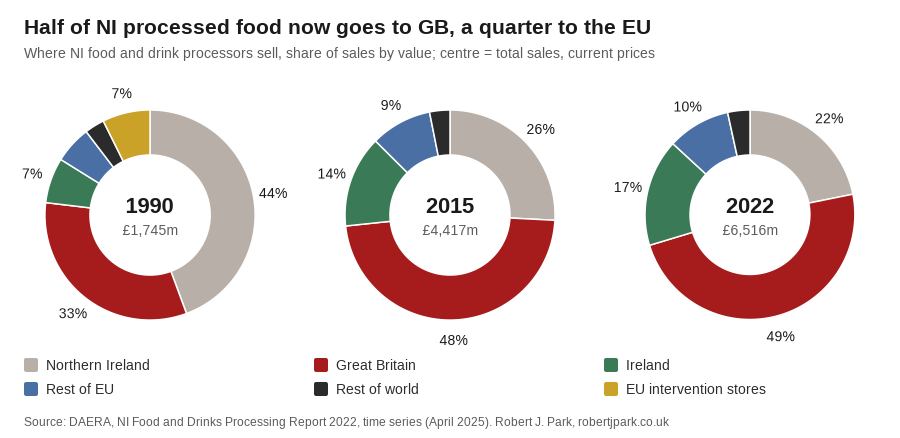
In 1990 NI processors sold 44% of their output at home and a third to GB. By 2022 GB took £3.16 billion (49%), Ireland £1.08 billion and the rest of the EU £631 million: about £1.71 billion, or 26%, went to the EU.
What were “EU intervention stores”?
Under the old Common Agricultural Policy, when market prices fell below a set floor, each member state’s intervention agency had to buy beef, butter, skimmed milk powder and cereals at a guaranteed price. The produce went into cold store until prices recovered, then was sold off, often for export, for processing or through free food schemes. In the UK the buyer was the Intervention Board for Agricultural Produce, with the Department of Agriculture for Northern Ireland, and from August 1990 the Livestock Marketing Commission for Northern Ireland, supervising work here as its agents (Hansard, 6 June 1991).
Northern Ireland in 1990. NI processors sold £128 million to intervention that year. That was 7% of their sales, more than they sold to Ireland (£122 million) or to the rest of the EU (£100 million). Beef was the main product. In March 1990 a Northern Ireland minister told the Commons that the government had “sought to optimise beef intervention in Northern Ireland” to lift prices for winter-finished cattle (Hansard, 16 March 1990). DAERA’s series does not split the £128 million by product. Some of the stock came back as free food: the UK gave about 3,000 tonnes of intervention beef to people in need in 1990 (Hansard, 3 April 1996), and 50 organisations handed out beef and butter in NI (Hansard, 22 October 1990).
Who else held it. Every member state had an intervention agency, run nationally and funded by the Community (the EU did not exist until 1993). Commission regulations in 1990 put up for sale beef held by the UK, Irish, German, French and Spanish agencies (Regulation (EEC) No 1166/90; No 2722/90). By June 1991 the Community held about 760,000 tonnes of beef, 235,000 tonnes of it in Ireland (Dáil Éireann, 4 July 1991). In February 1985 beef stocks were 606,000 tonnes across the ten member states: France 188,000, Italy 153,000, Ireland 85,000, Germany 79,000 and the UK 50,000 (Hansard, 26 April 1985). Intervention mattered on both sides of the border: 7% of NI processors’ sales in 1990, and almost a third of Community beef stocks held in Ireland in 1991.
Why it is zero now. The 1992 MacSharry reforms and later changes cut support prices and limited what could be sold into intervention. Public intervention survives in EU law as a safety net, mainly for butter and skimmed milk powder; the EU bought large amounts of milk powder this way in 2016–17. By 2015 DAERA records no NI processing sales to it.
The trade runs both ways. NI processors bought £886 million of inputs from GB in 2022 and £969 million from Ireland and the rest of the EU. Beef and sheepmeat are the clearest case: £426 million of inputs from GB and £128 million from the EU, and £1.1 billion of product sold to GB.
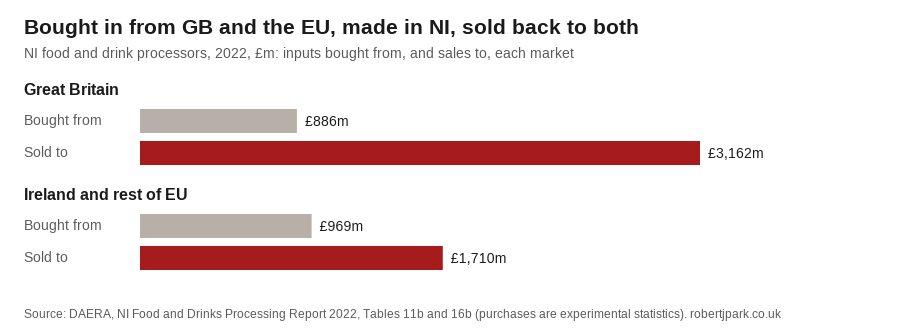
Today the GB inputs that are animals, meat, plants or seeds cross the Irish Sea under EU controls, which is what lets the finished product go on into the EU. From 2028 most of those controls fall away, so GB inputs get cheaper. Live animals from GB are still checked, so beef and sheepmeat gain less than the headline suggests. The same change removes most SPS checks on GB processors selling into the EU, though, unlike NI firms, they still face customs declarations and rules-of-origin paperwork.
What NI farms produce, and what they emit
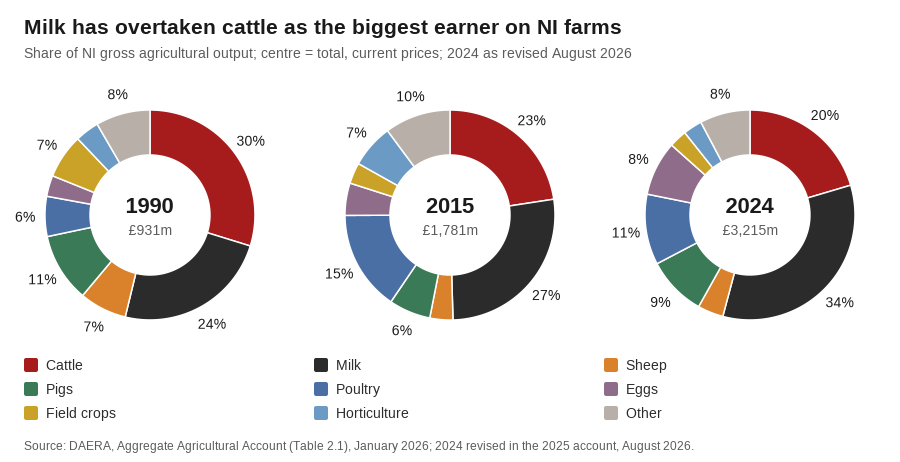
Milk’s share of farm output rose from 24% in 1990 to 34% in 2024; poultry and eggs from 9% to 19%. Cattle fell from 30% to 20%, and sheep from 7% to 4%. In 2025, on provisional figures, cattle output rose 37% on higher prices.
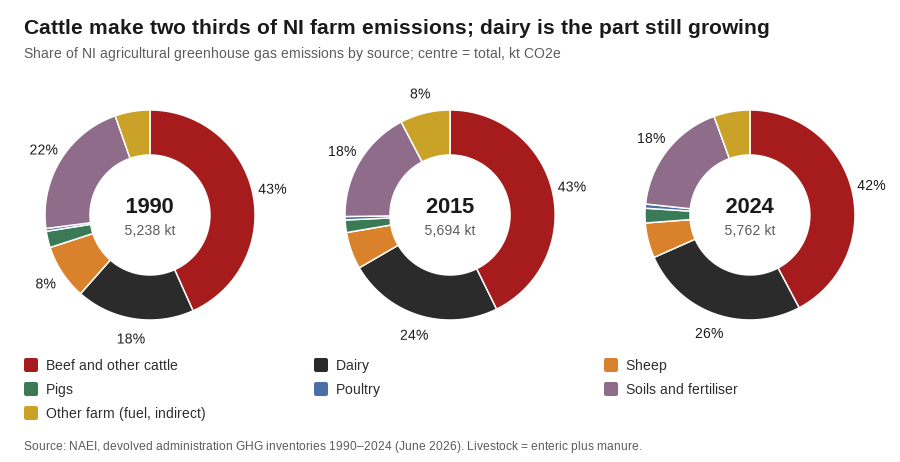
Farm emissions rose 10% between 1990 and 2024 while output more than tripled in cash terms, mostly through inflation. Cattle make about two thirds of them, and dairy is the part still growing.
| Industry | Direct emissions 2024 (kt CO2e) | kg CO2e per £ of output, 2024 |
|---|---|---|
| Beef and other cattle | 2,435 | 3.71 (2.71 on 2025 prices) |
| Sheep | 312 | 2.45 |
| Dairy | 1,505 | 1.39 (1.25 on 2025 prices) |
| Pigs | 129 | 0.44 |
| Poultry, meat and eggs | 37 | 0.06 |
Emissions from the animals and their manure, divided by farm-gate output in current prices (DAERA’s 2024 figures as revised in August 2026); soils, fertiliser and fuel are shared and not split. “Beef and other cattle” includes dairy replacement heifers, and cattle output includes dairy culls and calves, so the beef and dairy split is approximate and leans against beef. The per-£ figures move with prices: beef falls to about 2.7 on 2025 prices because cattle prices rose, not because emissions fell. Pigs and poultry look low mainly because they are not ruminants and produce little methane; their imported feed is also counted where it is grown. Sources: NAEI and DAERA; the division is mine.
Where the trend points
If processing kept its 2015 to 2022 real growth, NI food processing would reach about £6.9–7.2 billion by 2030 and £8.0–8.7 billion by 2035 in 2015 prices, against £5.4 billion in 2022. Treat that as a trend, not a forecast, and probably an overstatement. 2022 was a milk price spike, and the gross domestic product (GDP) deflator lagged food prices that year. From 2028 GB processors lose most SPS checks into the EU, which bears hardest on beef and dairy, NI’s largest sellers there. And NI’s carbon budgets point to fewer cattle, not more.
Who gains and who loses in NI
Gains
- Shops and wholesalers: one supply chain from GB depots, fewer labels and certificates
- Farms, growers and nurseries: cheaper GB seed, plants and used machinery
- Hauliers: fewer documents and checks at Belfast, Larne and Warrenpoint
- Processors buying GB inputs (less so for live animals, which are still checked)
Losses and risks
- Exporters to Ireland and the EU: GB rivals lose most SPS checks from 2028, though they still face customs
- Beef and dairy processors most of all
- Stricter enforcement of the current rules until 2028
- A long tail of transitions, some to 2031
The case for, as the government makes it: up to £5.1 billion a year for the UK by 2040, an end to most Irish Sea food checks without moving NI out of the EU’s food rules, and shared biosecurity. The case against: GB takes EU rules it cannot vote on, with the EU Court as the final word on EU law in disputes; there is less room for agricultural deals with the US and others; and the £5.1 billion rests on an unpublished study that leaves the costs out. No one has published an NI figure.
What NI businesses can do now
- Keep to current rules. Nothing changes before 1 March 2028, and enforcement is tightening in the meantime.
- Map your GB supply. List what you bring from GB under the Retail Movement Scheme, plant health labels or certificates. That is where savings will show.
- Check for GB-only inputs. Pesticides, biocides, feed additives or novel ingredients approved only in GB will be phased out. Ask suppliers now.
- Watch the competition. If you sell into Ireland or the EU, plan for GB rivals with lower costs from 2028.
- Price the carbon side too. The food deal and the carbon market link come into force together. See The carbon deal: who pays, who gains, and what Northern Ireland loses.
Download the full briefing (PDF) Open the dashboard Talk to me about your supply chain
The wider summit package is in The second UK–EU summit: what was agreed and what it will take. I’ll update this piece when the treaty text is published.
Created with assistive technology including AI and re-checked against the official sources listed.
Sources
- Cabinet Office, UK-EU Summit 2026 Joint Statement and Explainer: SPS, 20 November 2026
- Defra, what farmers and growers need to know, and the Food Standards Agency, what the agreement means for food businesses, 20 November 2026
- UK-EU Summit Common Understanding, May 2025, paragraphs 28–32 and 43
- Department for Business and Trade, methodology note on the SPS growth impact, 2025
- DAERA, Statistical Review of NI Agriculture 2024, November 2025; Aggregate Agricultural Account (Table 2.1), January 2026; 2025 account summary, 19 August 2026
- DAERA, NI Food and Drinks Processing Report 2022, with the 1989–2022 time series, April 2025
- Department for Energy Security and Net Zero, National Atmospheric Emissions Inventory, devolved administration greenhouse gas inventories 1990–2024, June 2026