
The carbon deal: who pays, who gains, and what Northern Ireland loses
Status as at 20 November 2026. General information, not legal, tax or customs advice. The summit papers are political statements and a government guide, not law; take advice on your own goods and routes before you act.
The short version
- From 1 January 2027 the UK intends not to charge carbon on steel, cement and fertiliser made in the EU. Not law yet.
- From 2028 the UK and EU carbon markets are due to link, and Great Britain’s goods are expected to escape the EU’s border charge.
- Northern Ireland gains on what it buys in, loses its edge over GB on what it sells, and pays more for carbon without cheaper power.
- What decides your bill: where the goods were made, not where you bought them.
 Is it a CBAM good?Check your part, chemical or commodity code
UK CBAM CountdownDays to 1 January 2027, and what to record
CBAM Exposure TrackerWho pays, from when, at what price
CBAM data checklistWhat to ask every supplier
On 20 November 2026 the UK and the EU concluded talks to link their carbon markets, aiming for 1 January 2028. Nothing changed in law on the day. But one line in the papers matters a great deal here. The UK government says it “intends to exempt goods originating in the EU”, the wider European Economic Area and Switzerland from the UK’s new carbon border charge from 1 January 2027 (DESNZ explainer). If that is legislated, Northern Ireland firms buying steel, cement or fertiliser of EU origin are spared the charge from day one. Great Britain’s exporters wait a year longer for the EU to return the favour.
What happens when
- January 2026The EU's carbon border charge starts charging importers into the EU.
- 1 July 2026Ships of 5,000 gross tonnage and above join the UK ETS.
- 20 November 2026UK–EU summit: linking talks concluded.
- 15 December 2026Stormont's biomethane strategy consultation closes at 5pm.
- 1 January 2027UK carbon border charge starts, across the whole UK. Your records start here.
- 1 January 2027UK intends to exempt goods of EU, EEA and Swiss origin. Not law yet.
- April 2027Electricity levy relief for GB industry. Northern Ireland is not covered.
- 1 January 2028UK CBAM registration opens.
- 1 January 2028The carbon markets link, if ratified. The EU is expected to exempt UK goods.
- 31 January 2028Deadline to register for 2027 imports.
- 1 March 2028Aim for the food and farm-goods (SPS) agreement.
- 31 May 2028First UK CBAM return and payment, for 2027 goods.
Filled dot: a fixed date. Hollow dot: an aim or intention, not yet law. Every date is checked on the NI Regulatory Horizon.
Two charges, one island
- An emissions trading scheme (ETS) charges producers at home for the carbon they emit. The UK has run its own since leaving the EU’s in 2021.
- A carbon border adjustment mechanism (CBAM) charges importers for the carbon in goods made abroad: iron and steel, aluminium, cement, fertiliser and hydrogen. The EU’s has charged since January 2026. The UK’s starts on 1 January 2027, across the whole UK.
Northern Ireland sits in both worlds. Its power stations stay in the EU ETS because they sell into the all-island electricity market. Its larger industrial sites, those with 20MW or more of combustion plant, are in the UK ETS. The EU CBAM does not apply in respect of NI, so goods made here and moved direct into the EU are outside it. Goods from Great Britain or elsewhere that only pass through NI do not qualify. Not sure which rules reach you? Try Which EU rules apply to me?
| Then (2021–25) | Now (2026) | 2027 | From 2028 | |
|---|---|---|---|---|
| Carbon markets | Separate. Prices diverge | UK near £60 a tonne, EU near €82 (Reuters) | Laws due on both sides; none laid yet. Prices likely to converge | Linked, if ratified. One price in practice. The UK follows EU rules, with a say but no vote |
| EU-origin goods into NI or GB (EEA and Swiss too) | No charge | No charge | UK says it intends to exempt them. Not law yet | Exempt, if regulations are made |
| GB-made goods into the EU | Reporting only | EU importers owe the EU CBAM | EU importers still owe it | Exempt, expected, once the EU legislates |
| NI-made goods moved direct into the EU | Outside the EU CBAM | Outside | Outside | Outside. The edge over GB ends |
| Goods from anywhere else | No charge | EU CBAM, if imported into the EU | Charged by whichever system they enter: UK CBAM into the UK, EU CBAM into the EU. Goods cleared in the EU and then moved into NI can meet both | Same |
The Joint Statement says “from 2028”; 1 January 2028 is the aim given in the government’s explainer. Both are political documents, not law, and the treaty text is not yet published.
Made where, not bought where
Turkish rebar bought from a stockholder in Dublin or Liverpool is still Turkish rebar.
The charge follows origin, and origin has a legal meaning. HMRC uses the UK’s non-preferential rules of origin: broadly, where the goods were wholly produced or last substantially processed. That is not always where the metal was first melted. Steel rolled in an EU mill from imported slab may well count as EU-origin; steel that was only cut or stocked in the EU will not. Fertiliser blended or bagged in Ireland may or may not count as EU-origin, and HMRC has not said. The regulations that would create the exemption are not published and may set their own test.
A written statement of origin, line by line, with the mill certificate behind it, is now worth money. The CBAM data checklist sets out what to ask for.
What it costs, per tonne
What it means for your business
Steel fabricators
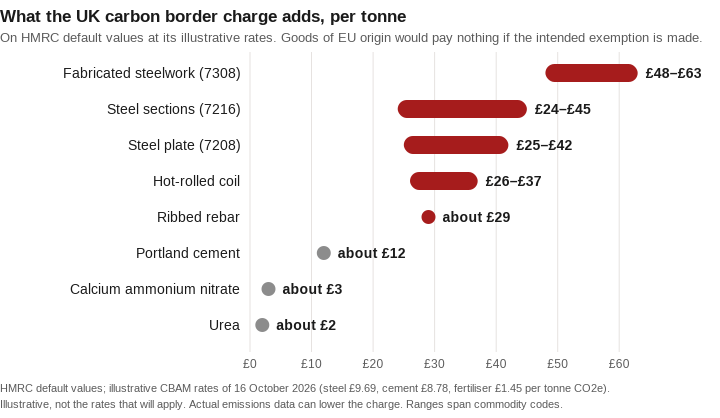
At HMRC’s illustrative steel rate of £9.69 per tonne of CO2e, chargeable steel carries roughly £24 to £45 a tonne on HMRC’s default values, depending on the commodity code: about £24 to £45 for sections, £25 to £42 for plate and £26 to £37 for hot-rolled coil. Bought-in fabricated steelwork is a CBAM good too, at about £48 to £63 a tonne.
Buy from a GB stockholder’s cleared stock and they are the importer; you see a surcharge. Buy goods across the border from Ireland and you may well be the importer yourself, with no customs declaration behind you: your invoices and delivery notes are the record. If a GB merchant has goods delivered to you direct from Ireland or the EU, ask who the importer is. For 2027 the return and payment are due by 31 May 2028, with three more quarterly payments by 30 November 2028.
Engineering and machinery makers
Finished machines are not CBAM goods. Fabricated steelwork, tanks, tubes and fasteners are. NI makers of those keep an edge over GB rivals into the EU until 2028. After that the selling point is your carbon data, which customers will keep asking for.
Builders' merchants
Cement, rebar, sections, tube and some steel fixings are on the list; check each line by commodity code, because plenty of what a merchant sells is not. On default values and illustrative rates, chargeable Portland cement carries about £12 a tonne (roughly 30p on a 25kg bag) and ribbed rebar about £29 a tonne.
Goods count when they arrive, not when they were ordered. Bringing them from Ireland can reach the £50,000 registration test quickly. A firm that expects to reach it within 30 days is registrable from the first load, and until regulations are made Irish cement counts towards it. EU-origin lines should then drop out; Turkish rebar bought through an Irish wholesaler will not.
Farms and farm merchants
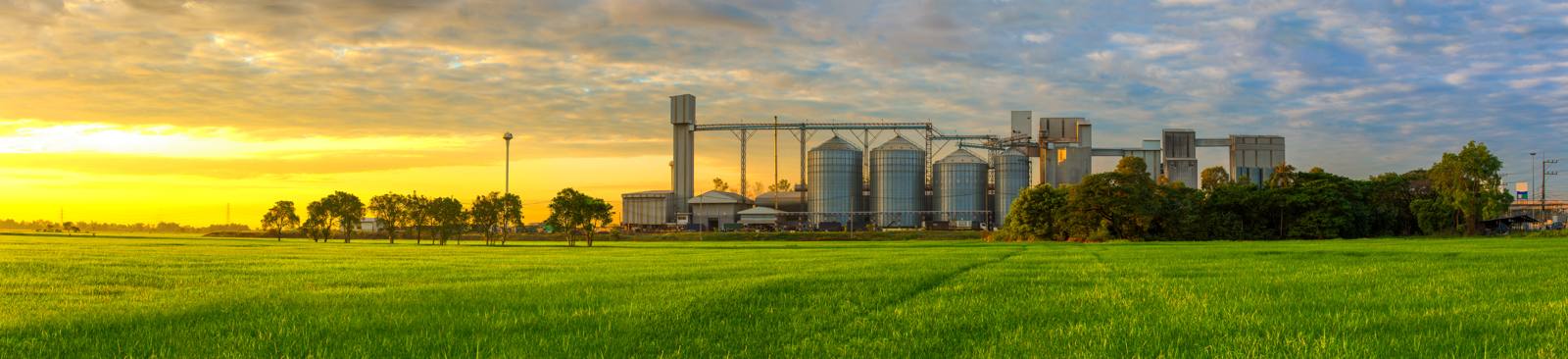
Farming is in neither ETS and food is not a CBAM good. Fertiliser is. At HMRC’s illustrative rate the charge on chargeable CAN is about £3 a tonne and on urea about £2, paid by the importer. It will rise as free allowances for producers are withdrawn. A farmer who buys fertiliser, or a steel-framed shed, direct from across the border can be the importer.
Nothing in the deal puts a carbon price on imported food, so the farming unions’ leakage argument is untouched. The separate food and farm-goods (SPS) agreement, aimed at 1 March 2028, would ease the food paperwork GB firms now face on sales into the EU, narrowing an advantage NI has today.
Food and drink processors
Some empty steel and aluminium packaging, such as cans, drums and foil, is on the CBAM list; check the commodity code, and note that the charge falls on whoever imports it, which is usually your supplier. Sites with a full UK ETS permit should plan on the linked price and on free allocations moving to EU benchmarks from 2028. Small-emitter and ultra-small-emitter statuses already granted are protected to 2030.
Chemicals, glass, ceramics and pharmaceuticals
None is a CBAM sector on either side, apart from hydrogen and the fertiliser chain (ammonia and nitric acid included). The UK dropped glass and ceramics from its CBAM before it starts, and the EU never listed them. Organic chemicals and polymers are named in EU law as the next candidates, but no proposal has been made. Medicines are on no list.
For these sectors the deal works through the ETS, not the border: furnaces, kilns and chemical plants above the 20MW line face the linked carbon price and EU benchmarks from 2028. Smaller sites feel it in energy prices and customers’ data requests. Any of them can still be an importer of CBAM goods through steel drums, foil or tanks bought in their own name.
GB exporters
Your EU importers owe the EU CBAM on 2026 and 2027 goods, unless they bring in under 50 tonnes a year in total. If you sell delivered duty paid, the liability can come back to you through your EU customs representative. Keep supplying the data.
Tool: Incoterms Chooser: who carries the duty and the carbon charge on your terms of sale
Hauliers and anyone paying Irish Sea freight
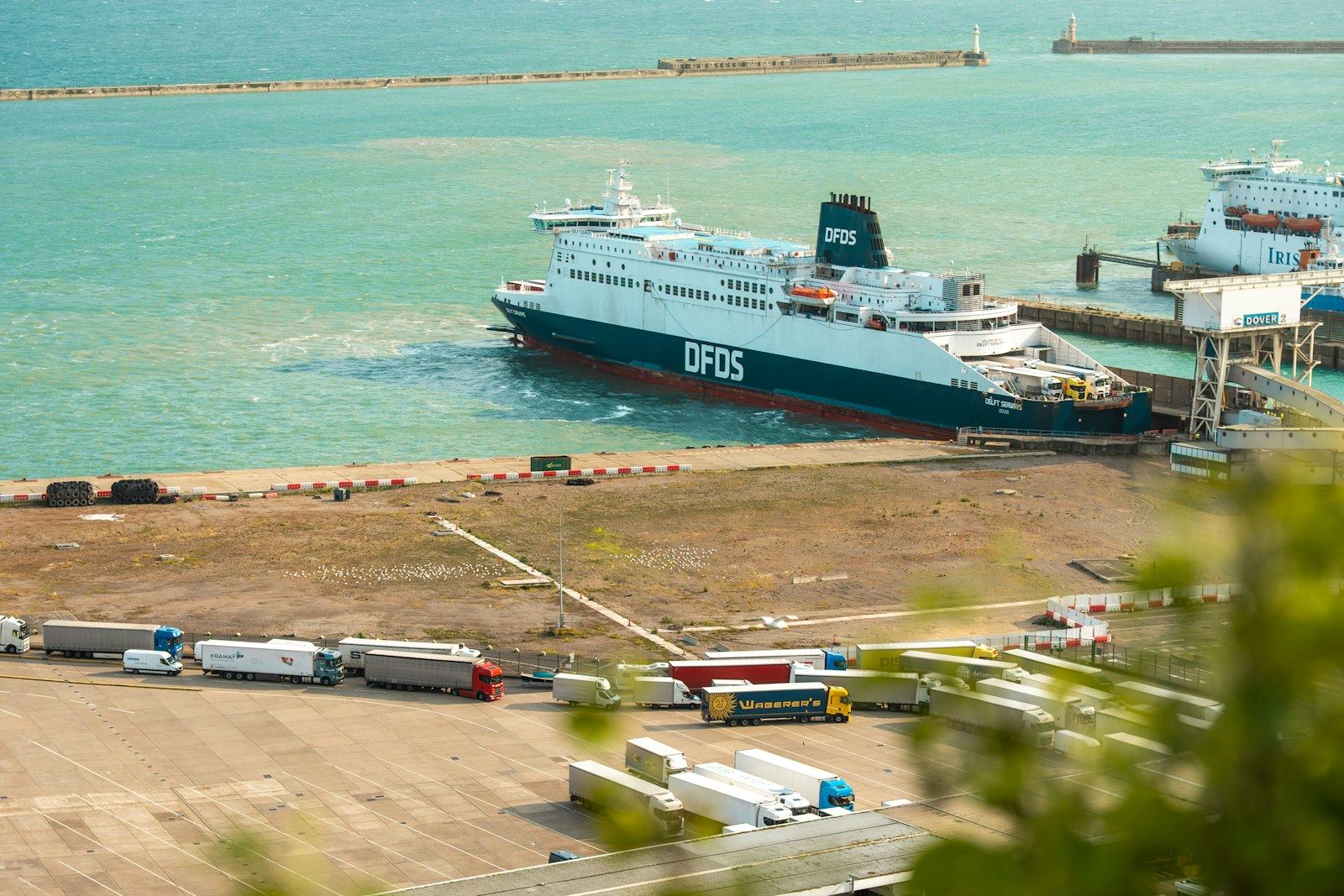
Ships of 5,000 gross tonnage and above have been in the UK ETS since 1 July 2026. Under the linking terms the temporary 50% reduction for voyages between NI and GB is removed, so operators’ carbon costs on those crossings rise, at the linked price. There is no official costing yet; expect it in surcharges. Road fuel is not in either ETS and the deal does not change that. A carrier is not the importer for CBAM unless it makes the customs declaration in its own name.
Electricity: the EU charges it, the UK does not
Electricity is on the EU’s CBAM list and not on the UK’s. Power sent from Great Britain to Northern Ireland is not affected: the government’s position is that the EU CBAM does not apply here (written answer HL12132, 3 December 2025). Power moves between NI and Ireland inside the all-island market with no border charge, which is why NI’s power stations stay in the EU ETS.
Power sent from Great Britain to Ireland is an import into the EU and has been inside the EU CBAM since January 2026. NI wholesale prices are set in the all-island market, so any cost on that flow reaches bills here too. The summit papers do not deal with electricity separately; as a listed good it should fall within the EU’s expected 2028 exemption, but that is not confirmed. Separate talks on electricity trading are due to conclude in 2027.
Biomethane: not unlocked yet
Northern Ireland is consulting on a biomethane strategy until 15 December 2026, and many gas-using manufacturers are being offered certified “green gas”. The deal does not yet make it count. The government’s explainer says the UK ETS will go on recognising biomethane that a site produces and uses directly, but biomethane injected into the gas grid cannot yet generate claimed reductions. That waits for a system to prevent double counting, introduced in accordance with EU law. From 2028 even gas made on site needs evidence that it meets the EU’s sustainability criteria. The EU ETS already has such a system, with conditions: sustainability evidence, no double counting, and buyer and producer on the same gas grid. From 2028 the UK is to follow those EU monitoring rules, so the route is visible, but no date is set.
Biomethane is not itself a CBAM good. It matters as the fuel behind one: the EU CBAM counts biogas as zero only with sustainability evidence, and HMRC’s draft guidance for the UK CBAM is silent on gas taken from the grid. So a site in the UK ETS should not pay a premium for certified grid biomethane expecting a lower carbon bill until the rule exists.
Stormont’s proposal is a limited support scheme for biomethane used in industrial heat, aimed at 2028 to 2035: a preferred position, not an approved scheme. For digester operators, today’s income is the renewables obligation for electricity; income from biomethane depends on that scheme. A farmer asked to supply slurry should ask who takes the digestate back, and on what terms.
What I have said to Stormont about it
My response to DfE’s request for information on the biomethane business case, sent on 19 November 2026, argues that demand will follow recognition, not only price. A manufacturer will sign a long contract for certified gas only if the gas counts where the firm reports. On 19 November it counted partly in company energy and carbon reports, not at all in the UK ETS, and was unsettled in customers’ Scope 3 requests. The summit papers confirm that gap and show how it would close.
It asks for one certificate per supported kWh that works with Ireland’s scheme and EU proof of sustainability; a UK ETS decision on grid biomethane; NI injection data in the greenhouse gas inventory; measured methane leakage; and support that never exceeds the gap with natural gas, the lesson of the Renewable Heat Incentive. About £13m a year buys roughly 260 to 433 GWh, at 5p to 3p a kWh (my arithmetic).
I will respond to the strategy consultation by 15 December. My position is support, with conditions. Biomethane is strongest where it does two things at once: replaces fossil gas in heat that is hard to electrify, and takes nutrients out of overloaded catchments such as Lough Neagh. Those aims can conflict, because the cheapest gas comes from crops and the strongest nutrient case from slurry. The strategy should say which wins. Open consultations and their closing dates are on the NI Consultations Monitor.
What is bad for Northern Ireland
The deal is presented as a gain for Northern Ireland, and on inputs it is. These are the costs.
- Dearer carbon, same power bill. NI’s larger industrial sites are in the UK ETS. If the UK price rises to the EU level, they would pay about £9 a tonne of CO2 more at 20 November prices (UK about £60, EU about €82, at £0.84 to the euro). The linked price could settle between the two. NI power stations already pay the EU price, so there is no matching fall in electricity costs.
- The edge over Great Britain goes. NI is the one part of the UK whose goods are outside the EU’s border charge. From 2028 GB goods are due to join them.
- The food advantage narrows too. The food and farm-goods agreement would give GB producers much of the access to the EU that NI has now.
- Freight costs rise. The 50% carbon reduction on sailings between NI and GB is removed, in a region that ships almost everything.
- A year of charge and paperwork first. Until regulations are made, NI firms buying across the border are importers for UK CBAM, with no customs declaration behind them. Goods of non-EU origin bought through Irish stockholders stay charged, and can meet both charges.
- Rules without a vote. The UK follows EU carbon-market rules as they change. Stormont co-owns the UK ETS through DAERA, the Assembly has had to approve past changes, and this one falls in an election year.
- GB gets help that NI does not. The GB electricity levy relief from April 2027 does not cover NI. The Executive is funded to design its own and has not yet done so. That comes from the Budget, not the deal, but it lands at the same time.
- Left unsolved. Steel supply to NI is still to be negotiated. Biomethane from the grid still does not count. Farming, 31.4% of NI’s emissions, is untouched, so the carbon budget gap stays.
How the rest of the EU law that applies here reaches NI firms is on the EU Law and the Windsor Framework dashboard.
The case for and against
For
A larger, more liquid carbon market. No border charge or data burden on UK–EU trade once both exemptions apply. For NI, the oddity of a UK tax on goods from across the border should go, and NI power and NI industry face the same carbon price.
Against
The UK follows EU carbon-market rules without a vote and gives up its own price floor. If the UK price rises to the EU level, UK sites in the ETS pay about £9 a tonne of CO2 more at 20 November prices, more if sterling weakens. NI industry pays more for carbon with no matching fall in power costs, because NI generators already pay the EU price. And NI loses its niche as the one part of the UK outside the EU CBAM.
It is also contested. Labour would keep the UK ETS and CBAM. The Conservatives pledged on 1 April 2026 to abolish the UK carbon market, Carbon Price Support and the UK CBAM (press reports). Reform UK would abolish the UK ETS and stop the UK CBAM (press reports, 26 October 2026). The government is itself ending Carbon Price Support from April 2028 (written statement HCWS1519, 16 April 2026). Ending the UK ETS would lift a cost from every UK site, and would also put GB-made goods back into the EU’s border charge. Firms should plan for either outcome.
It will not fix Northern Ireland’s carbon budget
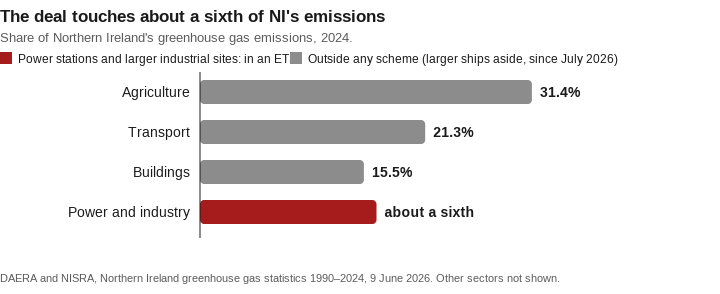
Agriculture is 31.4% of NI emissions and 10% above its 1990 level. Transport is 21.3% and buildings 15.5%. Apart from larger ships since July 2026, none is in an ETS. Power and industry, the sectors the deal touches, are about a sixth. The 2028–32 budget asks for an average cut of 48%, and the Climate Action Plan is still not laid. This agreement does not change that sum.
What to do now
- Map your suppliers. List every supplier of steel, aluminium, cement or fertiliser and mark each as GB, Irish or other.
- Ask for code and origin. Ask each one, for every invoice line, the 8-digit commodity code and the country of origin under the non-preferential origin rules. For steel, ask for the country of melt and pour as well; it is a different test and the two can differ. The CBAM data checklist has the questions.
- Run the £50,000 test. If these goods cross the border from Ireland to you, add up what you expect to buy that way in 2027, at customs value. The test is £50,000 over the past 12 months, counting only from 1 January 2027, or expected in the next 30 days. Once you pass it, register with HMRC by 31 January 2028; registration opens on 1 January 2028 and an agent cannot do it for you. Goods imported before you passed the test are not charged (Finance Act 2026, section 147).
- Keep records from 1 January 2027. Code, date, value, weight, origin and evidence for any exemption. HMRC requires them of anyone importing these goods, liable or not, for six years, and there are penalties for failing to register, file, pay or keep records. The UK CBAM Countdown lists what to record.
- Treat the EU-origin exemption as likely, not as law. HMRC’s policy summary, last updated on 2 November before the summit, still said when read on 20 November that no country is exempt.
- Think before using default values. A return made on defaults cannot later be amended with actual emissions data.
Open the CBAM Exposure Tracker Ask the CBAM Desk
The summit’s wider package, from youth mobility to fishing, is in The second UK–EU summit: what was agreed and what it will take. I’ll update this piece when the regulations and the treaty text are published.
Correction, 21 November 2026: an earlier version gave the carbon price gap as £9 to £11 a tonne; at the 20 November exchange rate it is about £9. The party positions now give dates and sources.
Created with assistive technology including AI and re-checked against the official sources listed.
Sources
- Cabinet Office, UK/EU Summit 2026: Key documents, 20 November 2026
- DESNZ, UK-EU linking agreement: explainer, 20 November 2026
- HMRC, CBAM policy summary, updated 2 November 2026; illustrative rates, 16 October 2026; default values for iron and steel, cement and fertilisers; record-keeping
- Finance Act 2026, Part 5
- DAERA and NISRA, statistical bulletin and news release, Northern Ireland greenhouse gas statistics 1990–2024, 9 June 2026
- Scope: HM Treasury and HMRC, response to the UK CBAM consultation, October 2024; European Commission, CBAM review report COM(2025) 783 and proposal COM(2025) 989, December 2025
- Electricity: DESNZ written answer HL12132, 3 December 2025; Regulation (EU) 2023/956, Annex IV; Joint Statement, paragraph 52
- Biomethane: Implementing Regulation (EU) 2018/2066, Article 39, as amended; Implementing Regulation (EU) 2025/2547, Annex II; DfE and DAERA, Biomethane Strategy and Policy Framework consultation, October 2026
- Carbon prices: Reuters, 20 November 2026; exchange rate: ECB reference rate, 20 November 2026 (£0.83735 to the euro). Carbon Price Support: HM Treasury written statement HCWS1519, 16 April 2026. Party positions: press reports (Conservatives: LBC, 1 April 2026).