
The circular economy is a life cycle too
In short
A circular economy keeps products and materials in use for as long as possible, in loops: repair, reuse, refurbish, remanufacture, and only then recycle. Recycling is the outermost loop, not the first, because it throws away the energy and work already put into the product. In 2024/25 Northern Ireland's councils recycled about half the waste they collected, the same as the year before; the law asks for 70% of waste to be recycled by 2030.
Most of the things we buy follow a straight line: dig it up, make it, sell it, use it, bin it. The circular economy is the idea of bending that line into loops, so products and materials keep their value for longer.
It is often reduced to “recycle more”. That misses the point. A product carries the energy, labour and carbon that went into making it, and the tighter the loop, the more of that is kept. Recycling melts or shreds the product and keeps only the material. It is the last loop, not the first.
This page treats the circular economy as a life cycle: the same cradle-to-grave thinking used for carbon footprints, with the grave turned back into a cradle.
In short
| Linear economy | Recycling economy | Circular economy | |
|---|---|---|---|
| Idea | Take, make, use, bin | Take, make, use, then recover the material | Keep the product in use, then the parts, then the material |
| What is kept | Nothing | The material, often of lower quality | The product, its parts and its embodied energy |
| Carbon | All embodied carbon lost at the end | Some saved by avoiding new raw material | Most saved by avoiding new products |
| Business model | Sell more units | Sell units, pay for collection | Sell use, service, repair and take-back |
The loops
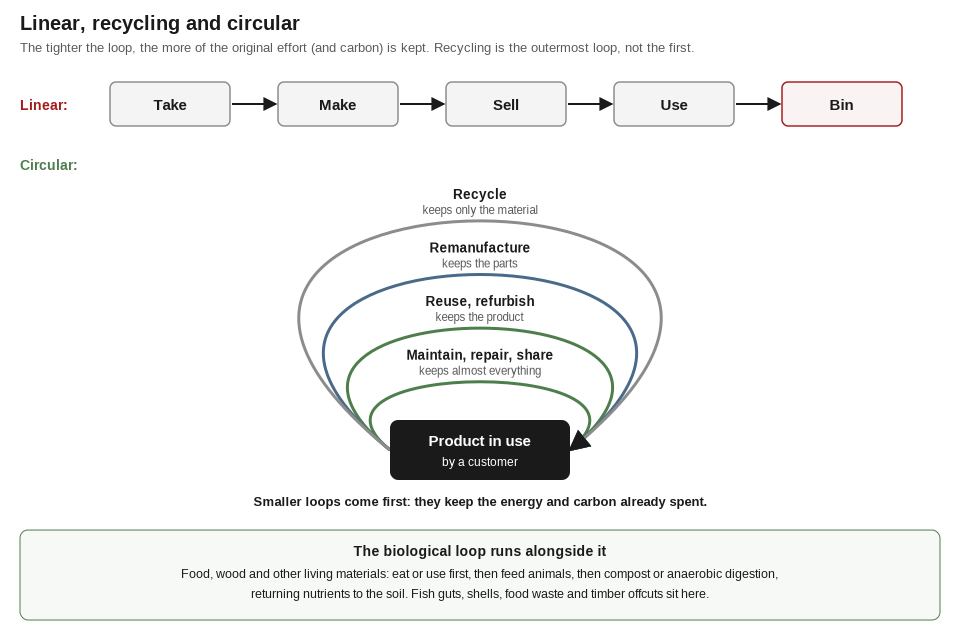
The Ellen MacArthur Foundation’s “butterfly” diagram, the best-known picture of the idea, has two wings:
- The technical cycle, for things that do not rot: metals, plastics, glass, machines. Its loops run from maintain and share, through reuse, refurbish and remanufacture, to recycle. The Foundation says recycling loses the most embedded labour, energy and material.
- The biological cycle, for things that can safely go back to nature: food, wood, cotton. Materials cascade through uses of falling value (the Foundation’s example: jeans become furniture stuffing, then insulation, then compost), and finally return nutrients to the soil through composting or anaerobic digestion. Fish guts and shells belong here: see Fish guts and seashells.
Dutch researchers at PBL (Potting and colleagues, January 2017) set out a longer ladder, the R-ladder: Refuse, Rethink, Reduce, Reuse, Repair, Refurbish, Remanufacture, Repurpose, Recycle and Recover (energy). The higher up the ladder, the more circular.
The waste hierarchy is the law
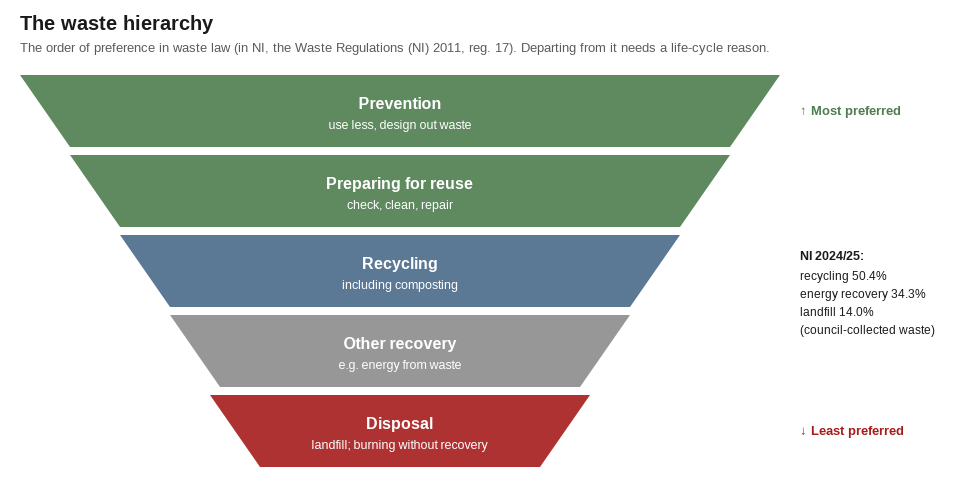
In Northern Ireland the waste hierarchy is a legal duty: regulation 17 of the Waste Regulations (Northern Ireland) 2011, which implemented the EU Waste Framework Directive. Anyone producing or handling waste must take reasonable measures to apply it. A business can depart from the order only where a life-cycle view shows a better overall result.
That duty sits in NI’s own law. The Waste Framework Directive itself is not on the NI Assembly’s list of EU laws that still apply under the Windsor Framework (list as at 5 September 2025), but some newer EU product and packaging rules are (below).
Recycling and carbon
The UN International Resource Panel’s Global Resources Outlook 2024 found that extracting and processing natural resources causes over 60% of planet-warming emissions, and that extraction has tripled in fifty years. That is why the circular economy is a climate issue and not only a waste issue.
Recycling saves most where making the material from scratch is most energy-hungry:
- Aluminium: recycling uses about 95% less energy than making primary metal (International Aluminium Institute, an industry body).
- Steel: each kilogram of scrap used avoids about 1.5 kg of CO₂ (worldsteel, an industry body). The world average for steel in 2024 was 2.18 kg CO₂e per kg.
The world is getting less circular, not more. Circle Economy’s Circularity Gap Report (May 2025) put the share of materials entering the global economy that come from recycled sources at 6.9%, down from 7.2%, even as recycling grew, because extraction grew faster. A 2022 report for the Department for the Economy put Northern Ireland at 7.9%, with a material footprint of about 16,600 kg of material per person a year.
The rules
(Checked 17 November 2026.)
| Rule | What it does | In NI? | Status |
|---|---|---|---|
| Waste hierarchy duty, Waste Regulations (NI) 2011, reg. 17 | Prevention, reuse, recycling, recovery, disposal, in that order | Yes | In force since 8 October 2011 |
| Climate Change Act (NI) 2022, s.18 | At least 70% of waste recycled by 2030 | Yes | In force; DAERA says the target still needs defining (page updated 14 April 2026) |
| EU Circular Economy Package targets | 65% municipal recycling and under 10% landfill by 2035 | Yes, transposed into NI law in 2020 | In force |
| UK packaging EPR (SI 2024/1332) | Packaging producers pay the cost of collecting and recycling it | Yes, UK-wide | First invoices October 2025; fees for poorly recyclable (“red”) packaging rise 1.2× in 2026/27, 1.6× in 2027/28 and 2.0× in 2028/29 |
| Deposit return scheme (SI 2025/67) | Deposit on plastic bottles and metal cans, 150 ml to 3 litres; glass excluded | Yes (England and NI) | Starts 1 October 2027 |
| EU Packaging and Packaging Waste Regulation (EU) 2025/40 | Packaging design, recyclability, PFAS limits in food packaging | In part | Applies from 12 August 2026; in NI most product rules apply; the reuse targets do not (DAERA FAQ, August 2026) |
| EU Ecodesign for Sustainable Products Regulation (EU) 2024/1781 | Durability, repairability, digital product passports; ban on destroying unsold clothes and shoes (large firms from 19 July 2026) | Case by case, as each detailed rule is made | In force 18 July 2024; whether the clothing destruction ban applies in NI is not confirmed |
| EU Right to Repair Directive (EU) 2024/1799 | Manufacturers must offer repair of certain products | Probably not: not on the Assembly’s Windsor Framework list | Applies in the EU from 31 July 2026 |
| UK repair rules 2021 (SI 2021/745) | Spare parts for some appliances | GB only; NI follows the EU ecodesign rules (SI 2021/924) | In force 1 July 2021 |
Why it matters in Northern Ireland
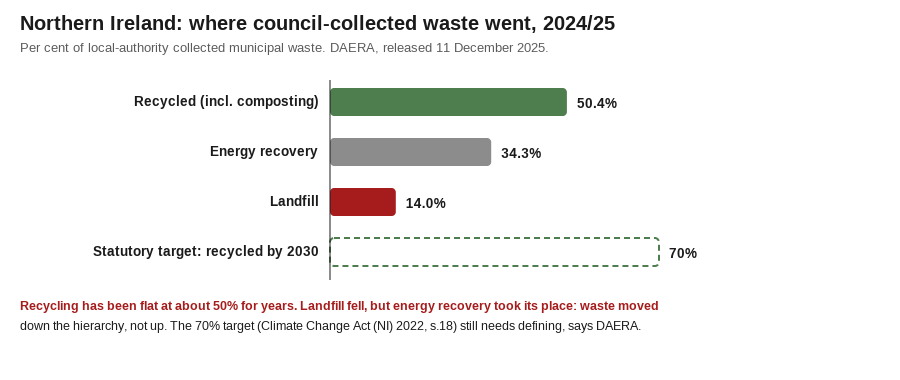
- Recycling has stalled. DAERA’s figures for 2024/25 (released 11 December 2025): household recycling 51.0%, all council-collected waste 50.4%, the council-collected rate about the same as the year before. Landfill fell from 18.4% to 14.0%, but energy recovery rose from 29.7% to 34.3%. Waste moved down the hierarchy, not up.
- The 2030 target is about 20 points away, with just over four years to go, and DAERA has not yet defined how it will be measured.
- Two sets of rules. NI businesses selling packaged goods deal with UK packaging EPR and, from October 2027, the deposit return scheme, while also meeting parts of the EU’s packaging and ecodesign rules under the Windsor Framework. A firm selling into both GB and the EU needs to know which rules apply to which product.
- A new strategy is coming. DAERA consulted on a draft resources and waste strategy, Rethinking Our Resources, from 15 January to 6 May 2026, with 10 targets and 63 actions. The final version had not been found as at 17 November 2026.
Think of a car
| A car | The circular economy |
|---|---|
| Servicing it every year | Maintain: the tightest loop |
| Lending it to a neighbour | Share: more use from the same product |
| Selling it second-hand | Reuse |
| Fitting a reconditioned engine | Remanufacture: the parts live on |
| Crushing it for scrap steel | Recycle: only the metal is kept |
| Leaving it in a field | Linear: everything is lost |
| Buying a new car every two years | The rebound: more products, faster |
Examples
Retail
A shop deciding what bags to sell
A County Antrim retailer wants to drop single-use carrier bags and asks which alternative is greenest.
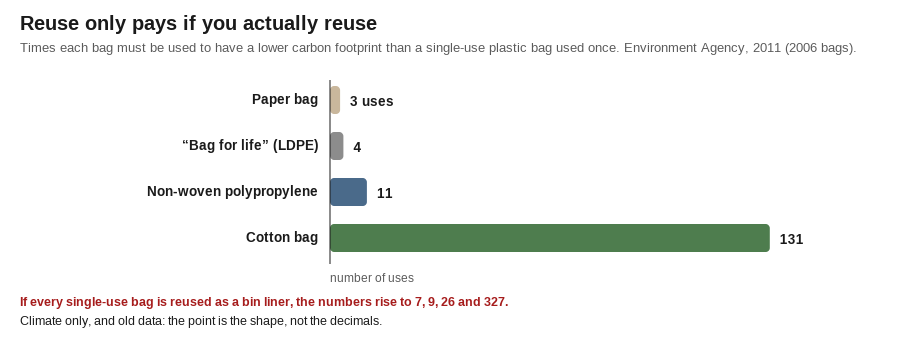
What the evidence says: the Environment Agency (2011) found a cotton bag must be used 131 times to beat a single-use plastic bag on climate impact; a bag for life, 4 times. The data are old and cover climate only, but the lesson holds.
The lesson: sell a durable bag people will actually keep using, and price it so they do. A cotton tote given away free is a linear product with a green label.
Manufacturing
A food producer and its packaging bill
A food producer places 200 tonnes of packaging on the UK market each year and has started receiving packaging EPR invoices.
What to do: find which packaging is rated red for recyclability, because its fee rises to twice the base rate by 2028/29. Redesigning to a single material, or to a format that is collected for recycling everywhere, cuts both the fee and the carbon. Check the EU PPWR rules too if the product is also sold in Ireland or the EU.
The lesson: packaging EPR turns the waste hierarchy into a line on the invoice. Prevention is the cheapest packaging.
Public sector
A council’s recycling plan
A council recycles below the NI average and sends much of the rest to energy from waste.
What to know: energy recovery counts as recovery, not recycling, and sits lower in the hierarchy. Council rates in 2024/25 ranged from about 42% to 59% (trade press reporting of DAERA data; check DAERA’s tables).
The lesson: better separate collections (food waste above all) move tonnes up the hierarchy. Reuse shops at recycling centres move them higher still, and count towards prevention.
Common mistakes
- “Circular means recycling.” Recycling is the last loop; repair and reuse come first.
- “Recyclable means recycled.” Only if it is collected, sorted and made into something.
- “Energy from waste is recycling.” It is recovery, one step above landfill.
- “Reusable is always greener.” Only after enough uses; see the bag chart.
- “Biodegradable plastic is circular.” Only if it reaches the right composting or digestion process.
- Ignoring the rebound. Cheaper, faster recycling can fuel more consumption, and the circularity rate can fall while recycling grows.
Previous: Block, lime, brick or prefab? · Next: Fish guts and seashells · Related: The carbon life cycle
Sources
Checked 17 November 2026.
- Ideas and frameworks: Ellen MacArthur Foundation, The circular economy in detail · Potting et al., Circular economy: measuring innovation in the product chain, PBL (27 January 2017).
- Carbon and materials: International Resource Panel, Global Resources Outlook 2024 (1 March 2024) · International Aluminium Institute, recycling saves 95% (industry body) · worldsteel, climate change policy paper (industry body; updated 7 November 2025) · Circle Economy, global circularity rate fell to 6.9% (May 2025) · Department for the Economy, Circularity Gap Report Northern Ireland (22 June 2022).
- NI law and data: Waste Regulations (Northern Ireland) 2011, reg. 17 · Climate Change Act (Northern Ireland) 2022, s.18 · DAERA, recycling net zero targets and Circular Economy Package targets (both updated 14 April 2026) · DAERA, LAC municipal waste statistics 2024/25 (11 December 2025) · DAERA, draft waste strategy consultation · NI Assembly, EU acts applying under the Windsor Framework (September 2025).
- Packaging and deposits: Packaging EPR Regulations 2024 · GOV.UK, year 1 invoicing and fee modulation statement (updated 17 February 2026) · DAERA, PPWR frequently asked questions (August 2026) · Deposit Scheme Regulations 2025 · GOV.UK, deposit return update.
- Products and repair: NI Assembly, ESPR scrutiny tracker · CMS, unsold textiles destruction ban (law firm) · Department of Enterprise, Ireland, Ecodesign for sustainable products (in force 18 July 2024; ban dates) · European Parliament, Right to Repair Directive summary · SI 2021/745 and SI 2021/924.
- Bags: Environment Agency, Life cycle assessment of supermarket carrier bags (February 2011).
- Not checked against a primary source: the R-ladder step “Repurpose”; whether the Right to Repair Directive and the clothing ban apply in NI (confirm with DAERA or the Department for Business and Trade); the council range 42–59%; the example business figures, which are illustrative.
Facts and definitions last checked against the standards and official sources on 17 November 2026. General information, not legal, tax or customs advice.