
The slurry vote: 56 to 14, and what it means for Lough Neagh
Stormont has voted, by four to one, to ask for more give in the slurry rules. The Minister has said no. Each side is partly right. The Assembly is right that a criminal defence is a poor substitute for a rule. The Minister is right that a dry day in November is not a growing day. Our neighbours have built something between the two, and Northern Ireland has not.
Focus on Agriculture briefing, as at 26 November 2026. General information, not legal advice. The full briefing has every chart and source: download the full briefing (PDF, 10 pages). This page is the accessible version.
| 56 to 14 | 15.5 weeks | 22 weeks | 61% |
|---|---|---|---|
| Assembly division on the Ulster Unionist motion, 24 November 2026 | Closed period for slurry, 15 October to 31 January | Minimum slurry storage in law; 26 for pigs and poultry | Share of Lough Neagh’s phosphorus load from agriculture |
What the Assembly asked for, and what it was told
The motion was moved by Diana Armstrong, Ulster Unionist deputy leader and chair of the Assembly’s agriculture committee. It accepts that the closed period protects water. It then argues that fixed dates cannot account for the weather, and that the lack of published criteria for the reasonable excuse defence leaves farmers without certainty. It makes three requests of the Minister, Andrew Muir. He refused the first two in the chamber.
| The motion calls on the Minister to | His answer in the debate |
|---|---|
| Publish clear criteria for when the reasonable excuse defence may be relied on | No. It is a defence assessed case by case after the event, not permission in advance. He said prescriptive criteria could be mistaken for permission to breach the rules. He did describe how a claim is assessed: what happened, whether it could have been anticipated, what steps were taken and whether there was a reasonable alternative. |
| Establish a time-limited extension or deferral where exceptional weather is verified | No. He will keep the current dates and will not introduce weather-based flexibility. He listed what any mechanism would have to weigh, including soil temperature, nutrient uptake, later rainfall, a legal basis and monitoring. |
| Report to the Assembly before the next closed period | No undertaking given. He said farmers will need timely and practical guidance once the 2027 to 2030 programme is settled. |

Both party statements simplify the result. The Ulster Unionists say one party did not back the motion. Alliance says every party bar Alliance voted for it. In fact People Before Profit’s Gerry Carroll also voted against. He did not speak, and I found no statement from his party.
The law itself is short. Regulation 7 of the Nutrient Action Programme Regulations (Northern Ireland) 2019 bans slurry spreading from 15 October to 31 January. Regulation 32 makes a breach an offence unless there is a reasonable excuse. There is no general power to waive or move the dates, so any change needs amending regulations.
The farming case
The case for flexibility has three strong strands, and each was made in the debate.
- Deadlines change behaviour. Ms Armstrong said farmers talk of having to beat the ban, spreading in marginal conditions because a date is near. Sinn Féin’s Declan McAleer argued that flexibility would not create more slurry, only better timing.
- Farmers cannot know where they stand. The only relief is a criminal defence tested afterwards. The SDLP’s Cara Hunter called clarity on that defence the most important part of the motion.
- Storage is blocked. The DUP’s Tom Buchanan said planning restrictions stop farmers building the capacity they are told to build. Mr McAleer raised the ammonia protocol as a further barrier.
‘That is not good regulation, it is bureaucracy.’ Diana Armstrong MLA, Ulster Unionist Party statement, 24 November 2026
Supporters also set limits. John Stewart, winding up for the Ulster Unionists, accepted that a dry day in winter is not automatically a suitable one. Ms Hunter said exemptions should not be granted routinely. Mr McAleer said any farmer who pollutes should face the penalties.
Outside the chamber, Farmers For Action and Countryside Alliance Ireland welcomed the vote. By 26 November I could find no statement from the Ulster Farmers’ Union, from any environmental body or from the Office for Environmental Protection.
What the evidence says
The Minister’s objection is agronomic. Ground that will carry a tanker is not ground that will use the nutrients. Short days and cool soil hold grass growth back whatever the weather, and what the crop does not take up is exposed to the next heavy rain. In March he said there was ‘no scientific, agronomic or economic evidence’ for change.
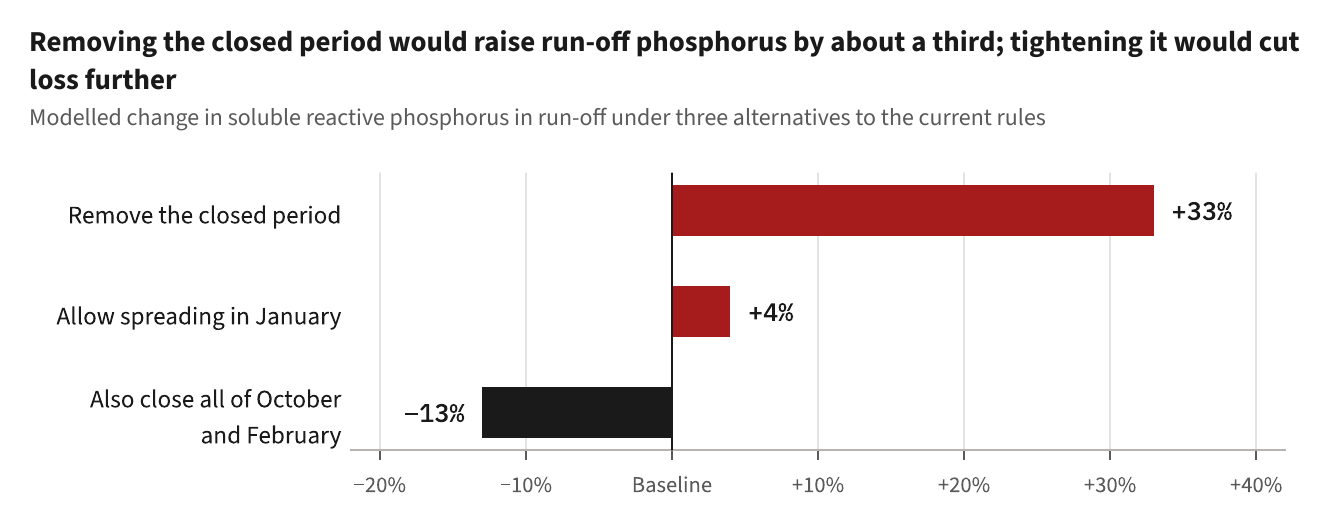
Other findings point the same way, with one exception that matters:
- Winter ground is rarely fit. Nine years of Hillsborough records found January conditions suitable for spreading 3% of the time (Irish Farmers Journal, August 2021).
- The closed months carry the loss. Across five Irish catchments studied by Teagasc, the closed period is a quarter of the year but carried 43% of annual total phosphorus loss.
- The exception: soil matters more than date. AFBI found loss 87% lower when slurry went on well-drained rather than poorly drained soils. That is an argument for rules that follow the field, which is the motion’s own logic.
Two points need care. First, the motion says dry weather followed the start of this year’s closed period. Met Office figures show Northern Ireland had 135% of average rain in September and 119% in October, with the heaviest falls late in October. A dry spell inside a wet month is possible; it is not yet shown. Second, the TUV’s Timothy Gaston challenged the Minister to publish AFBI’s data. The Minister replied that the scientific rationale was published with the programme consultation. The 2020 and 2024 reviews he relies on are not easy to find as documents.
How the neighbours handle it
Northern Ireland’s dates are in line with those around it. Where it stands out is in having no formal way to flex them. Three European administrations did so in 2026.
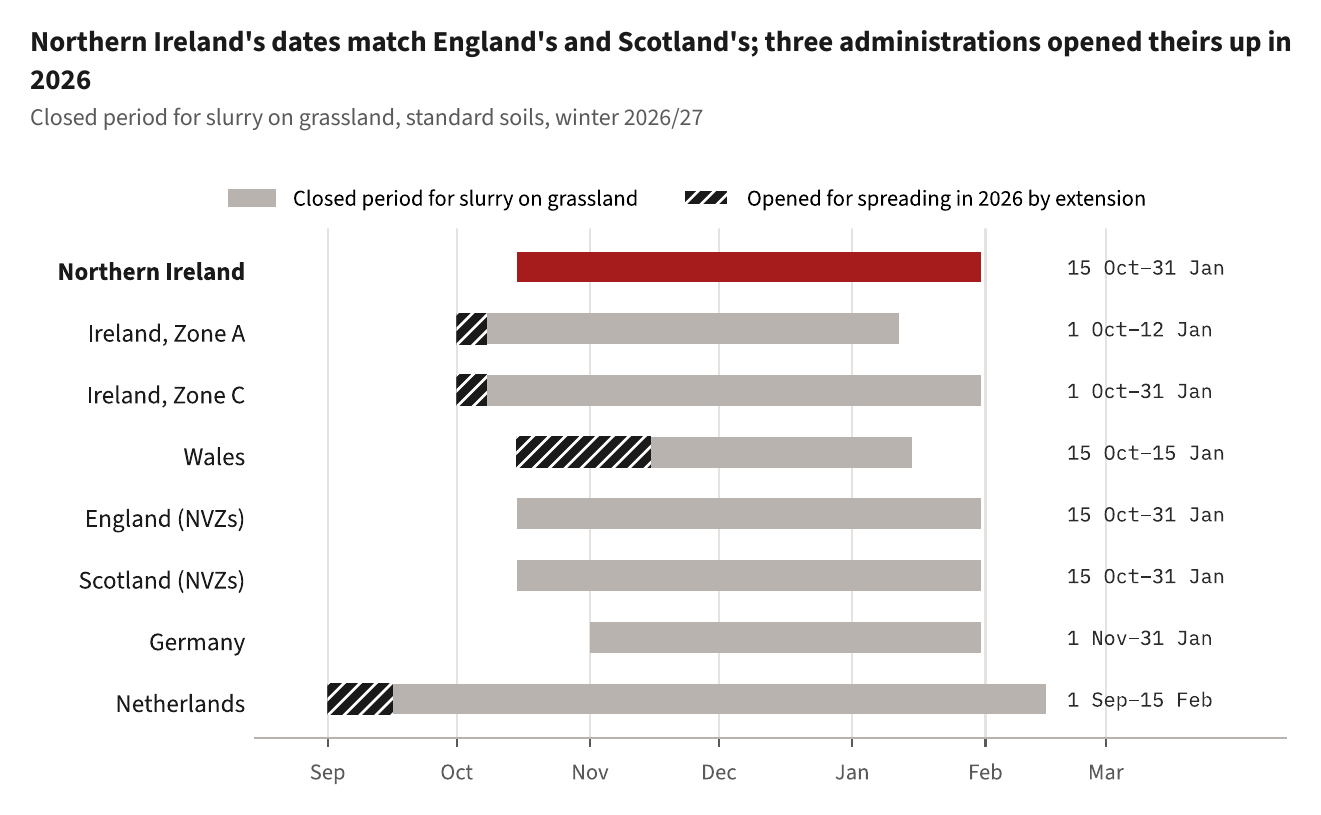
| Where | What happened in 2026 | How, and on what terms |
|---|---|---|
| Wales | Spreading allowed from 15 October to 15 November, one year only | By amending the regulations. Maximum 30 cubic metres per hectare, three weeks between applications, a field risk check, poultry manure excluded. Justified by summer drought leaving stores full. (Welsh Government) |
| Ireland | One extra week, to 7 October | A standing ministerial power for exceptional circumstances. Farmers had to register first. Buffer from watercourses doubled to 10 metres. Also used in 2011 and 2023; refused in 2019. (Irish Farmers Journal) |
| Netherlands | Two extra weeks, to 15 September | Ministerial decision on the advice of an expert committee that leaching would not rise meaningfully. Also granted in 2024. (RVO) |
| France | No 2026 case found | Departmental prefects may grant temporary derogations in exceptional weather, with nitrogen caps and a declaration. (Loire-Atlantique, December 2023) |
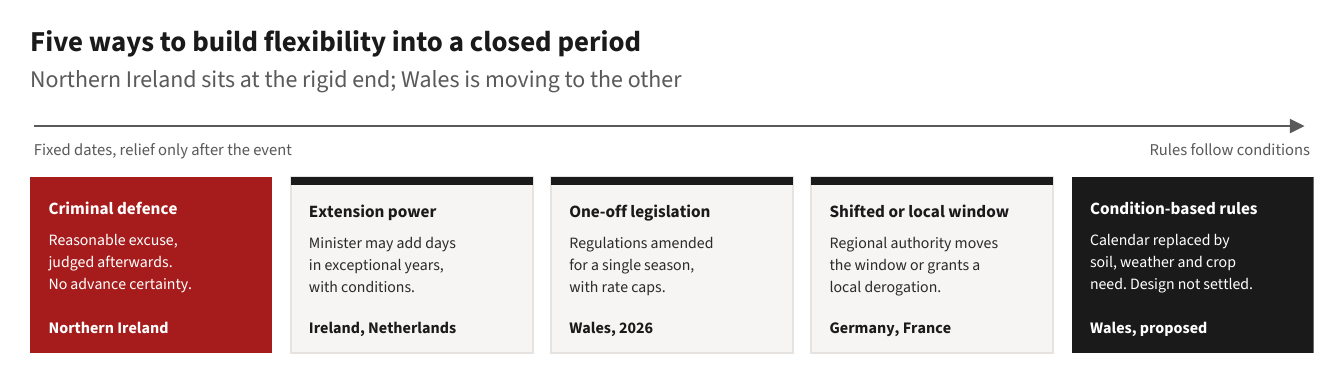
Two cautions apply. First, every 2026 extension answered a drought that stopped summer spreading, and each came with caps and conditions. The Minister told the Assembly that Northern Ireland had no drought, and Ms Hunter accepted that conditions here were less severe than in Wales. Second, the European Commission’s evaluation of the Nitrates Directive, published in July 2026, ranks closed periods and storage among the most effective measures. It also records farmers’ complaints about calendar farming and says national rules can adapt without changing the directive.
Lough Neagh: how much is at stake
‘Spreading more slurry and saving Lough Neagh do not go together.’ John Blair MLA, Alliance, Official Report, 24 November 2026
Supporters reply that the motion changes when slurry is spread and not how much. Alliance’s statement after the vote went further and accused the other parties of voting ‘for more slurry in our waterways’. Agriculture is the largest source of the lough’s phosphorus, so the concern is fair. The scale of what a short, conditional deferral would do is another matter.
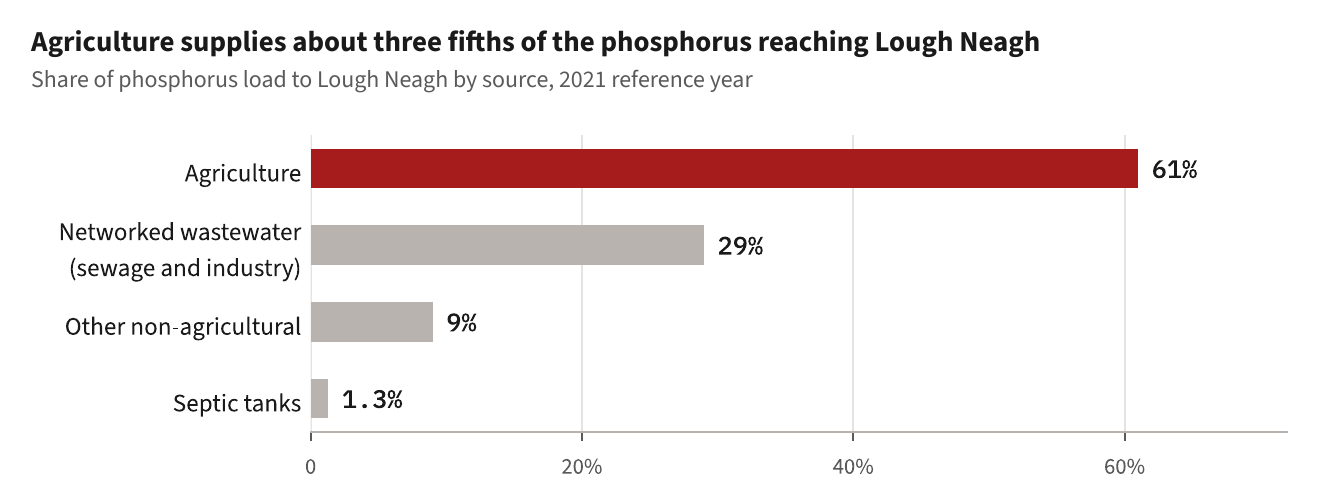
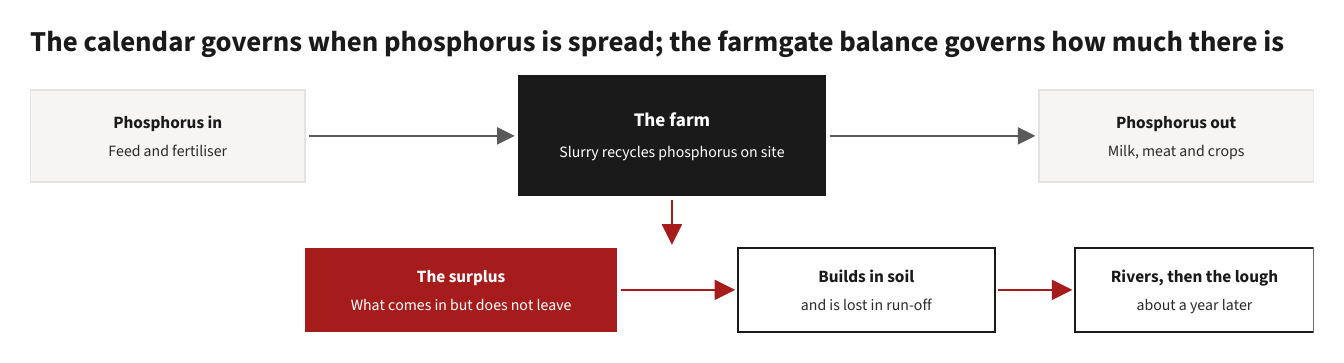
The deeper driver is the phosphorus surplus. More arrives on farms in feed and fertiliser than leaves in milk, meat and crops. Ulster University researchers found that river phosphorus tracks that national balance closely, with a one-year lag. They estimate that cutting the surplus to about 5.5 kg per hectare a year would bring rivers to at least the boundary between moderate and good status. I set out the whole chain, from feed imports to soil to lough, in Phosphorus: the nutrient that fed the farms and fouled the lough. Modelling that DAERA cites for the Lough Neagh catchment puts phosphorus supply at 123% of what crops and grass need.
The Ulster Unionists’ own evidence points the same way. Ms Armstrong cited the Audit Office: lakes at good ecological status fell from about 24% in 2015 to 14% in 2021, which is 5 of 21 lakes and then 3. In my view that is an argument for doing more, and it sits awkwardly beside a request for flexibility, however carefully framed. The Office for Environmental Protection has asked for the weeks either side of the closed period to be tightened, and the proposed programme for 2027 to 2030 does that.
The politics
The vote leaves the Minister heavily outnumbered without moving him. All three of his Executive partners, the Opposition and the TUV are now on record wanting change. He has a stakeholder group’s consensus package for 2027 to 2030 that proposes no change to the closed period, and a mandate that ends in spring. The last sitting is expected in mid-March 2027, with an election in May.
| Party | Vote | What it said |
|---|---|---|
| UUP | For | Moved the motion. Ms Armstrong: rules should follow conditions on the ground, not the calendar. Party leader Jon Burrows said the vote shows farmers have lost confidence in the Minister. |
| DUP | For | Mr Buchanan: planning restrictions block the storage farmers are told to build. Gareth Wilson: rules should reward the right environmental outcome, and NI Water is behind 11% of watercourse pollution incidents. |
| Sinn Féin | For | Mr McAleer proposed a derogation that farmers apply for, with inspections and penalties for polluters. Áine Murphy cited Ireland’s one-week extension in September. |
| SDLP | For | Ms Hunter: clarity on reasonable excuse is the main ask; flexibility must be evidence-led and exceptional. Daniel McCrossan had asked for the Welsh approach in October. |
| TUV | For | Mr Gaston asked for AFBI’s data to be published. He alleged the policy is driven by a biogas agenda and will end in destocking. |
| Alliance | Against | Mr Blair: follow the science; the motion cannot be squared with saving Lough Neagh. The Minister refused the first two requests. |
| People Before Profit | Against | Mr Carroll did not speak. No statement found on the party’s site. |
| Green Party NI | No MLAs | No statement found. The newest item on its news page on 26 November was dated 27 September 2026. |
Alliance has singled out the SDLP. Mr Blair asked how its support squares with its commitments on Lough Neagh, and the Minister said the Opposition’s climate credentials were ‘in the bin’. In September 2025 the SDLP’s Matthew O’Toole, Leader of the Opposition, had called other parties’ retreat from the nutrients programme a grave error. The SDLP can fairly reply that a verified, exceptional deferral is not abandonment. History adds a wrinkle: in October 2011 it was an SDLP Environment Minister, Alex Attwood, who declined to delay the closed period and pointed farmers to reasonable excuse.
The exchanges were sharp on both sides. The Minister called the motion half thought out. Mr Buchanan accused him of feigning friendship with farmers. Neither line helps a farmer with a full tank or a fisherman on the lough.
Two of the sharper claims deserve a straight answer, and I have written on both. Mr Wilson is right that farming is not the only polluter. In Lough Neagh and the price of clean water I argued that Stormont agrees on the cause and has not settled who pays, and that NI Water then faced lighter enforcement than farmers did. Mr Gaston says the closed period is being held to build a biogas industry. I have seen no evidence of that. In my response to the Department for the Economy on biomethane I argued that support will not create demand unless the gas counts where manufacturers report, and that digestate should be treated as a co-product with spreading kept off peat. Digestion moves phosphorus around. It does not remove it, a point I set out for pig slurry and for poultry and egg litter.
A better way
Each side holds half an answer. I support a better way, in four steps that respect both.
- Write down the tests the Minister read out. He told the Assembly how a reasonable excuse claim is judged: what happened, whether it could have been anticipated, what steps were taken and whether there was an alternative. A previous minister said much the same in 2016. Put that in guidance, with the evidence a farmer should keep. That informs farmers without licensing anyone. Publish the AFBI reviews in full alongside it.
- Legislate a narrow extension power on the Irish model. Autumn side only, days and not weeks, triggered on scientific advice when a failed summer has left stores full. Add prior registration, wider buffers, a rate cap and well-drained land only. Mr McAleer proposed something close to this in the debate, and the Minister’s own list of what a mechanism must weigh reads as its specification. A wet-autumn waiver does not fit the evidence.
- Unblock storage. The Minister has said he favours permitted development rights for covered stores. Farmers are entitled to a date.
- Keep the main effort on the surplus. The 30% cut in the phosphorus balance will do more for the lough than any argument over a fortnight in October.
The question for the next programme is how to make sure no farm needs an extension, and what the lawful route is in the rare year when one does.
Read alongside this briefing
- Phosphorus: the nutrient that fed the farms and fouled the lough, 24 November 2026. Why the surplus, not the spreading date, drives the problem.
- Lough Neagh and the price of clean water, 2 November 2026. Everyone agrees what is killing the lough. Nobody has agreed who pays.
- Will Northern Ireland’s manufacturers buy biomethane?, 21 November 2026. Only if the gas counts where they report, and only if digestate is handled as a co-product.
- More pigs, lower prices, fewer contracts, 21 November 2026. Pig slurry and the phosphorus test.
- Low-carbon meat, high-phosphorus problem, 23 November 2026. Eggs, laying hens and poultry litter.
Sources
The debate was read in full in the Official Report, including the division lists. The Alliance and Ulster Unionist statements, and the Farming Life report carrying the DUP, Sinn Féin and UUP leader statements, were read in full. The People Before Profit and Green Party NI sites carried no statement on the vote. Comparator and evidence sources were opened and checked on 25 and 26 November 2026.
- NI Assembly Official Report, 24 November 2026, ‘Slurry Spreading’ (Assembly site)
- Nutrient Action Programme Regulations (NI) 2019, regulations 7, 17, 18 and 32
- Alliance Party statement, 24 November 2026
- Ulster Unionist Party statement, 24 November 2026
- Farming Life, 25 November 2026: party reactions to the vote
- Irish Farmers Journal, 25 March 2026: Muir rules out change and 4 November 2026: Muir on Wales
- AFBI, April 2021: modelling of slurry rules and water quality
- Teagasc Agricultural Catchments Programme: nutrient loss and the closed period and Irish closed period dates by zone
- Welsh statutory review of the agricultural pollution regulations, March 2025 and Farmers Weekly: Welsh closed periods set for overhaul
- Defra: nitrogen fertilisers in Nitrate Vulnerable Zones and SEPA: storage and application of fertiliser
- Bavarian State Research Centre: shifting the grassland closed period
- Office for Environmental Protection: advice on the 2027 to 2030 programme and DAERA consultation on the Nutrients Action Programme 2027 to 2030
Robert J. Park is an environment, carbon and public affairs consultant based in Larne, Northern Ireland. Download the full briefing, *The slurry vote: 56 to 14* (PDF). Farm businesses, councils and MLAs who want to talk about the Nutrients Action Programme or Lough Neagh can email robert@robertjpark.co.uk.