
More pigs, lower prices, fewer contracts: where Northern Ireland's pig farms stand
If your Cookstown pig contract ends on 31 December, you have six weeks, a law on written pig contracts that now covers every contract, and a biomethane consultation closing on 15 December. Northern Ireland’s pig herd grew to June 2025, but prices have fallen since and the kill is shrinking. This piece sets out what has changed, and what to ask for.
General information as at 21 November 2026, not legal, financial or veterinary advice. Claims I have not checked against a primary source, and my own assessments, are in italics. The full briefing, with every section, table and source, is a 12-page PDF: download the full briefing (PDF). This page is the accessible version.
Key findings
- The herd grew; the margin has gone. NI had 744,858 pigs in June 2025, up 8% (DAERA/NISRA census, 11 December 2025). The NI clean pig kill has since fallen for four quarters in a row, down 5.2% from July to September 2026 (AHDB, 5 November 2026).
- Price down, costs up. DAERA’s finished clean pig price was 178.63p a kilo in the week ending 14 November 2026, down 10.9% on a year (DAERA Agricultural Market Report, 19 November 2026). In GB, AHDB puts the cost of production at 207p a kilo in July to September and the average loss at £24.95 a pig (AHDB, 9 November 2026).
- Contracts are ending. Sofina Foods at Cookstown has confirmed that a “small number” of NI supply contracts will not be renewed at the end of 2026.
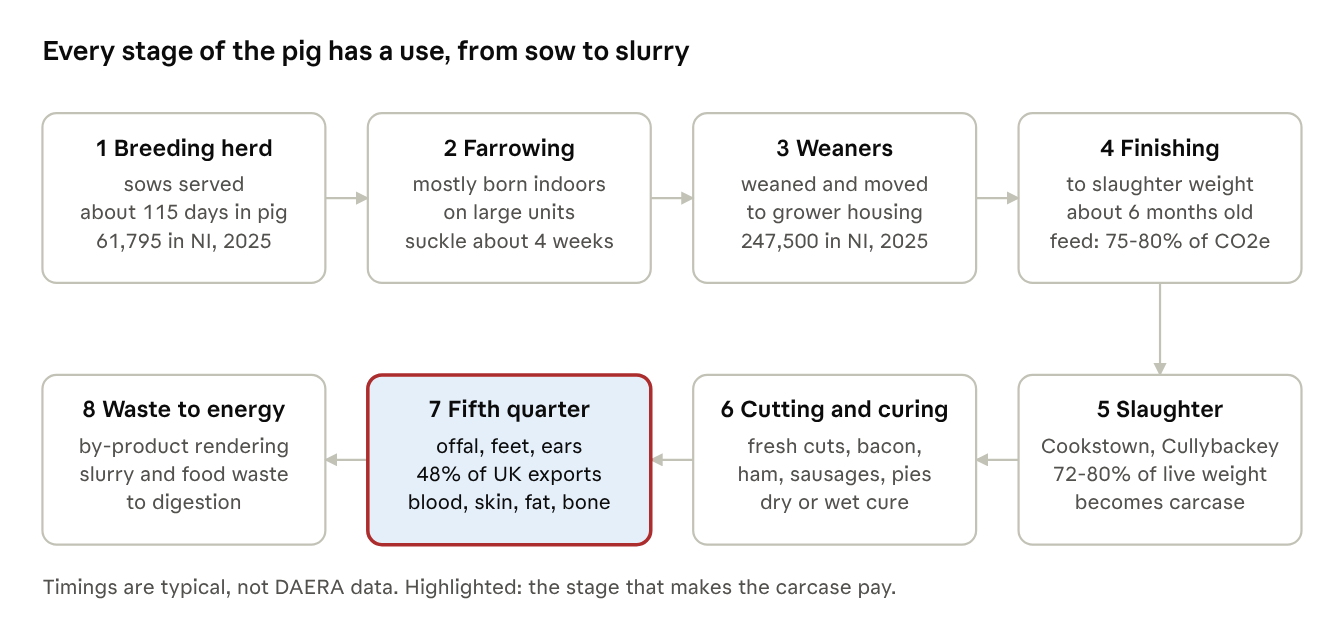
- The fifth quarter pays. Offal was 48% of UK pig meat and offal exports by volume in 2025.
- NI already works to stricter rules on nitrites in cured meat, under EU law.
- African swine fever is the largest single risk. It reached Spain in November 2025. No vaccine is authorised in the EU.
Prices and the margin squeeze
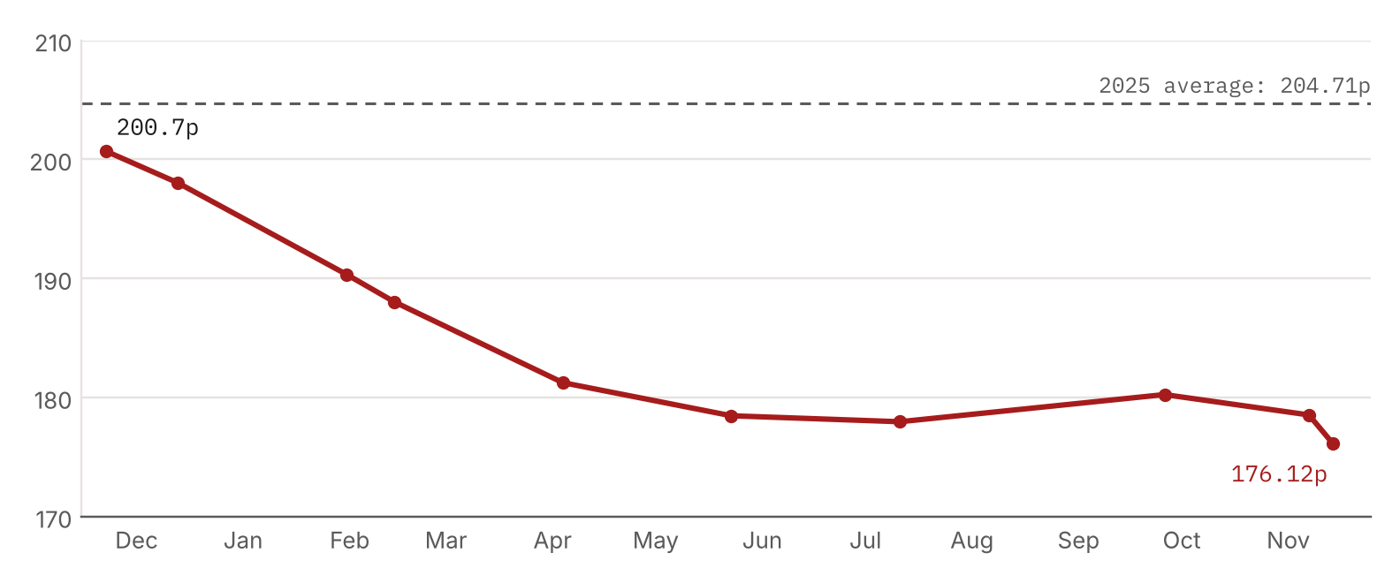
The GB Standard Pig Price fell 2.43p to 176.12p a kilo in the week ending 14 November 2026, 24.18p below a year earlier (AHDB). A brief rise in early November did not hold. The squeeze comes from both sides: the cost of production rose 6p a kilo in July to September while the price averaged 180p. The NI and GB prices are measured differently, and there is no published NI cost of production. With NI feed mostly imported, my assessment is that NI margins are unlikely to be better.
Two plants, and contracts ending
Sofina Foods at Cookstown (formerly Karro) and Cranswick at Cullybackey do the bulk of the kill. Sofina has confirmed that a “small number” of NI supply contracts will not be renewed at the end of 2026, citing increased European competition and downward pressure on the market (Agriland). The Irish Farmers Journal reports an aim to cut about 3,000 pigs a week, potentially affecting two producer groups of about 40 suppliers and one independent farm; Sofina has not published a figure. The Ulster Farmers’ Union has taken it to the Minister and to Tesco, which said it would follow up with Sofina. I have seen no report of Cranswick changing its NI contracts.
The processors’ case deserves a fair hearing. There has been a surplus of pigs all year, and AHDB reports industry warnings that about 10,000 pigs a week may lack slaughter space into Christmas. The question farmers ask in return is why Republic of Ireland pigs, about 8,000 a week and over a fifth of the NI kill in the first half of 2026 (Irish Farmers Journal, 10 June 2026), should keep their places while local contracts end. Neither side has published the numbers that would answer it.
The law on pig contracts
The Fair Dealing Obligations (Pigs) Regulations 2025 extend to Northern Ireland and require written contracts, with rules on pricing, notice and changes. They came into force on 13 August 2025, and every contract, old or new, had to comply by 13 August 2026 (Defra). Who enforces them in NI, and whether they reach a non-renewal as opposed to a termination, are questions for a lawyer.
If your contract is ending
- Check what your written contract says about notice and renewal.
- Ask the buyer, in writing, for the criteria it used.
- Keep every letter and email.
- Talk to the Ulster Farmers’ Union, and take a solicitor’s advice before you sign anything new.
Northern Ireland already works to stricter rules
Lower EU limits on nitrites in cured meat apply in Northern Ireland but not in Great Britain, phased in from 9 October 2025 (Regulation (EU) 2023/2108). Added nitrite falls to 80 mg/kg for most meat products, and traditionally cured bacon has a residual limit of 105 mg/kg. NI curers must meet them. That is the makings of a selling point: an Ulster dry cure, no added water, made to the stricter standard. The Melton Mowbray pork pie, protected since 2009, shows the route to a protected name.
The SPS agreement concluded at the UK–EU summit on 20 November 2026 is intended to apply from 1 March 2028 (Cabinet Office). It is not yet signed or in UK law. If GB aligns on food additives, NI’s head start fades, and GB pork will reach the Republic and the EU on easier terms. NI’s edge is widest now.
Swine fever, flu and the farm vet
African swine fever reached wild boar near Barcelona on 27–28 November 2025, and about a third of Spanish pork export certificates were reported blocked within days. No vaccine is authorised in the EU (Delegated Regulation (EU) 2026/1073). It has never been recorded in the UK or Ireland, and NI works to DAERA’s own contingency plan. On every farm the defences are the same: no pork products on site, strict control of visitors and vehicles, and sick pigs reported early.
Swine influenza is a notifiable disease in Northern Ireland, unlike GB (DAERA). An H3N2 strain unseen in GB pigs since 1997 was found in Yorkshire in December 2025; its H3 gene clusters apart from the vaccine strain, and how well the vaccine protects is not yet known (APHA). The farm vet is the first line of defence, and vet capacity matters as much as vaccine supply.
Every part but the squeal
Only 72–80% of a pig’s live weight becomes carcase. Feet, ears and stomachs that UK shoppers will not buy go abroad, most of them outside the EU. Blood makes black pudding, fat makes lard, skin makes crackling and gelatine, and bones make stock and the jelly in a pork pie. What is left goes to rendering or anaerobic digestion.
Local feed: acorns, apples and what is already in the trough
I found no NI pigs fed on acorns or on Armagh Bramley apples. But the pieces are here. AFBI’s eight-month trial at Loughgall, Co. Armagh, found outdoor pigs grew at 1.01 kg a day, and pigs under trees gained 7% more than pigs on grass (AFBI, 21 April 2026). The pulp left after pressing Armagh Bramleys is a traditional feed, best used near the press. AFBI found sows and growing pigs can take 10% whey permeate, and pregnant sows up to half their diet in food and drink co-products (AFBI).
| Feed | From | How much pigs can take | In NI pigs now |
|---|---|---|---|
| Whey permeate | Dairy processors | 10% for sows and growers | Yes, liquid feeding |
| Food and drink co-products | Manufacturers | Up to 50% for pregnant sows | Yes, liquid feeding |
| Brewers’ and distillers’ grains | Breweries, distilleries | NI rates not found | Not confirmed |
| Bramley apple pomace | Armagh pressers | Up to 15% of grower feed in trials abroad | Not found |
| Acorns and woodland | NI oak woodland | Autumn supplement only | Not found commercially; AFBI woodland trial, 2026 |
| Peas, beans, rapeseed meal | NI arable farms | Replaces some soya | Not found |
| Imported soya (for comparison) | South America | Main protein today | Yes |
Feed is 75–80% of a pig farm’s carbon footprint. My analysis, still to be checked by a life-cycle assessment: a co-product’s carbon is mostly counted against the food it came from, and it recycles phosphorus already in the NI food chain rather than importing more.
Slurry to gas: the phosphorus test
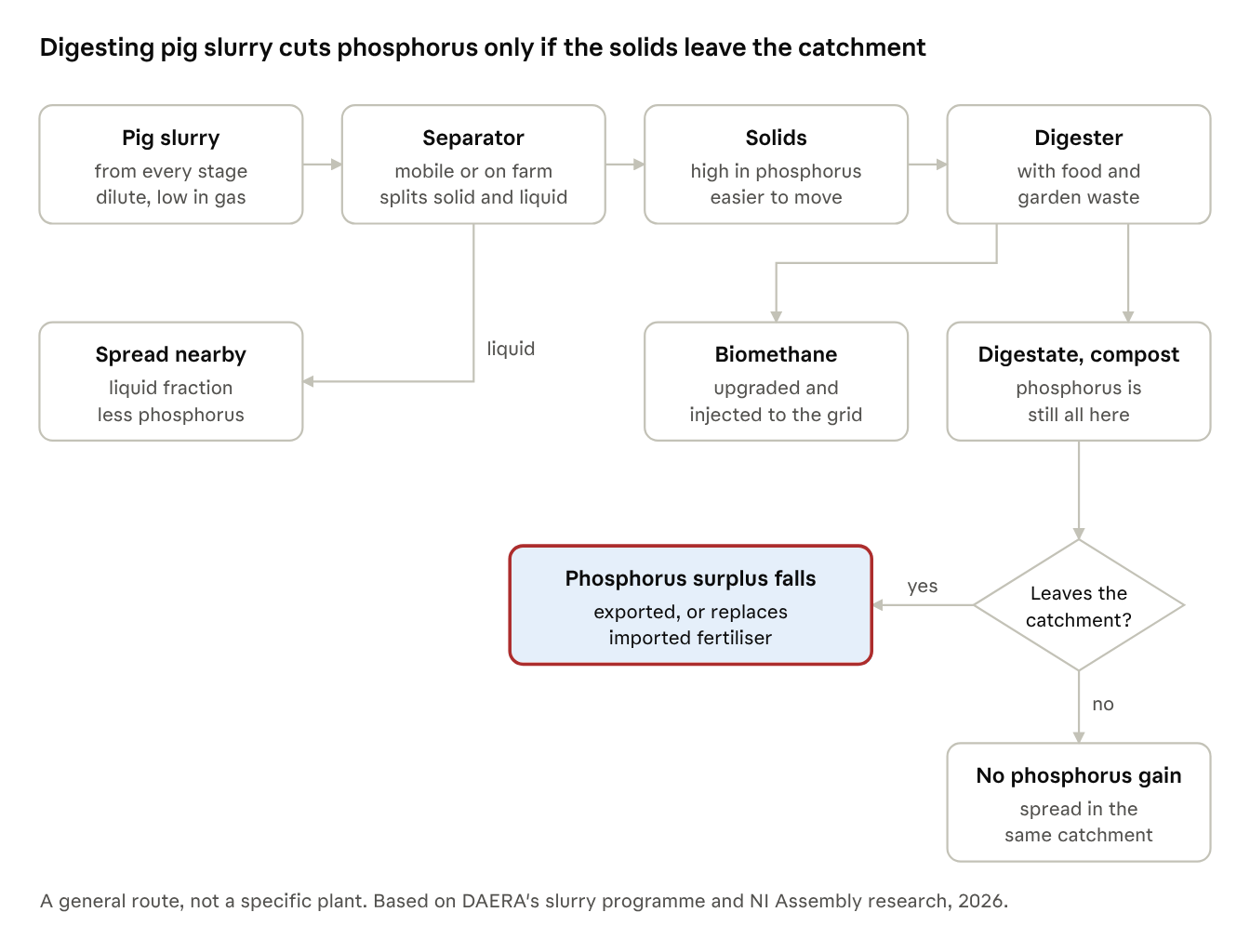
Anaerobic digestion makes gas. It does not remove phosphorus. DAERA’s slurry programme has made three £4m awards, about £12m in all, with projects running to October 2028 (DAERA, 19 February 2026). DAERA’s draft Nutrients Action Programme 2027–2030 proposes sector rules for intensive pig farms and a 30% cut in the national phosphorus surplus. The DfE and DAERA Biomethane Strategy consultation closes on 15 December 2026. For pigs the case is simple: fund separation and phosphorus export alongside gas, or the gas gain comes at Lough Neagh’s expense.
Welfare, and the case against
Most NI pigs are reared indoors on large units. That is where the efficiency and the carbon gains come from, and where critics point to farrowing crates, tail docking and barren housing. Tail docking is allowed in NI only where other measures have failed. AFBI’s trial shows another system can work here. Any honest plan for the sector has to answer that, and the health evidence on processed meat weighs on bacon and ham demand.
What to ask for
- DAERA: say what help is available to producers whose contracts end in 2026; set out how slurry processing and phosphorus export will be supported; publish swine influenza surveillance routinely; report on all-island swine fever preparedness.
- Sofina and Cranswick: show how contracts comply with the 2025 fair-dealing rules, give written criteria for changes, and say how many NI producers are affected.
- Retailers: back NI-origin pork on shelf and in own-label bacon and ham.
- Councils and industry: back an Ulster dry-cure producer group, rare-breed and whole-carcase pilots, and food-waste digestion.
- Farms and curers: build a simple carbon inventory now, before your retailer asks for Scope 3 data.
The full briefing
The 12-page PDF adds the key figures table, trade, carbon and phosphorus, the draft Nutrients Action Programme, vets, medicines and vaccines, the UK–EU “now and later” table, six openings and the risks, the full asks, and a list of what is not yet verified. It was reviewed by two panels: a fact-check against primary sources and a practitioner panel.
If retailers or processors are asking you for carbon figures, I can help: email robert@robertjpark.co.uk or call 07450 349480.
This is general information as at 21 November 2026, not legal, financial or veterinary advice. Created with assistive technology including AI and re-checked against the official sources listed.