
Lough Neagh and the price of clean water
Part of the Policy series: where the rules stand in Northern Ireland, who decides them, and what to do about it. Updated as the rules change.
The argument in brief
On 22 October 2026, Sinn Féin president Mary Lou McDonald asked the Irish government to intervene in the Lough Neagh crisis, and said any delay on wastewater reform was not coming from her party. In the same report, DAERA Minister Andrew Muir’s plan to end NI Water’s protection from environmental penalties had been before the Executive for months. Six weeks earlier, the Office for Environmental Protection (OEP) warned that his new farm nutrient rules may not go far enough or fast enough.
The lough has had blue-green algae every summer since 2023, and in 2026 signs appeared as early as February. Everyone agrees on the diagnosis: too much phosphorus from farms, sewage and septic tanks, made worse by warmer water and zebra mussels. No one agrees on who should pay. Every remedy costs a defined group: farmers, households, developers or other public services. Stormont has so far made each choice only part of the way. The Assembly rises on 16 March 2027, and the next five months will show which choices are settled and which are left to the next mandate.
This piece sets out the arguments on each side; the recommendations are the author’s. Facts checked to 30 October 2026; rechecked and updated 16 November 2026.
The lifecycle at a glance
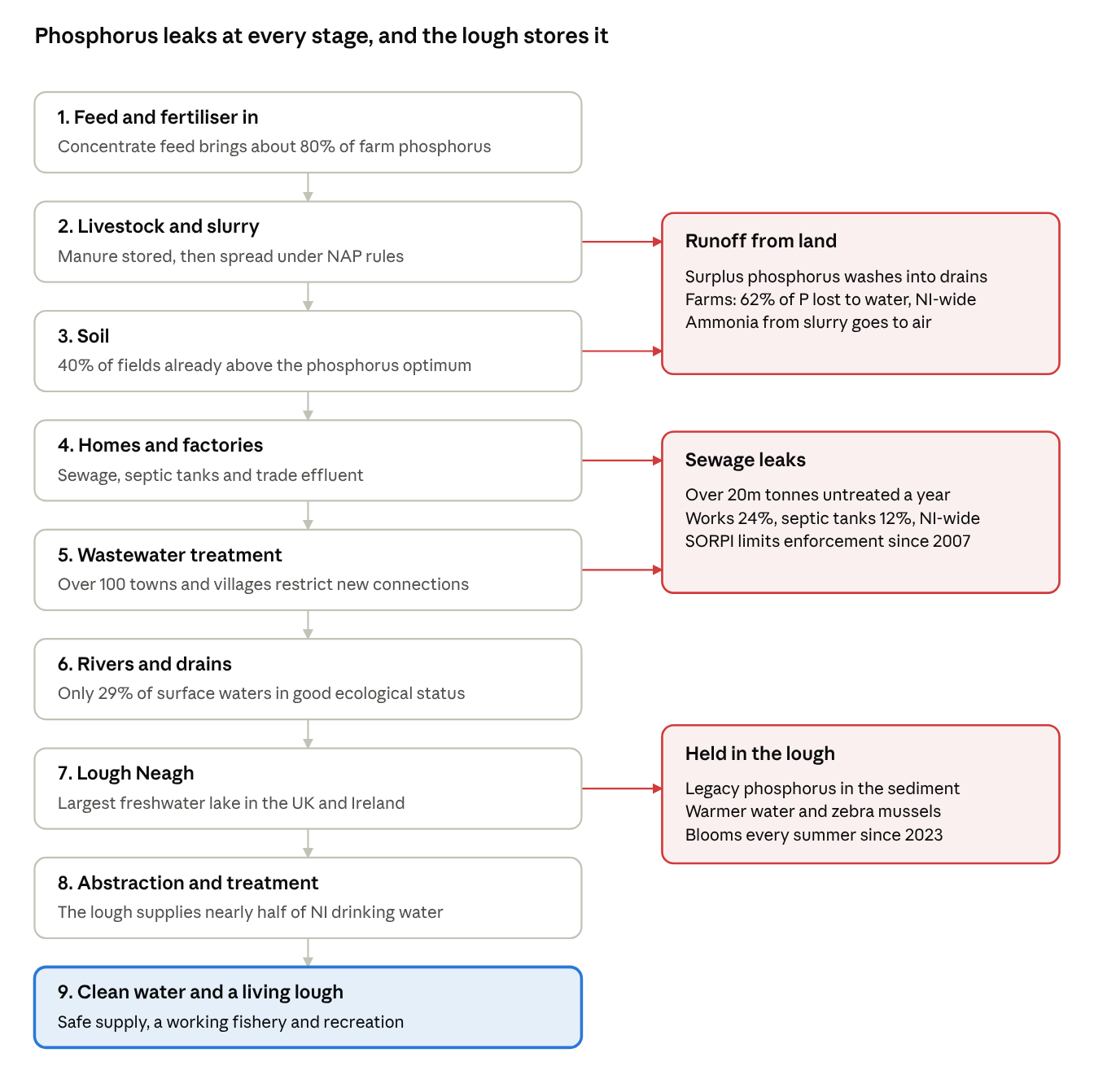
Phosphorus enters with feed and fertiliser, builds up in soil and leaks from farms and sewage before the lough stores it. Each red box is a cost someone must pay to close.
Then and now (2023 to October 2026)
| Rule or instrument | 2023 | Now (with date) | What changed and why |
|---|---|---|---|
| Algal blooms | First major lough-wide bloom, summer 2023 | Fourth year in a row; signs seen in February 2026 (River Action, 14 May 2026) | Legacy phosphorus in the sediment, warmer water and zebra mussels keep the cycle going |
| Lough Neagh Report and Action Plan | None | Executive approved the 37 actions on 18 July 2024; 23 delivered, 14 in progress (DAERA, updated 11 Aug 2026) | Political pressure after 2023. Many actions are studies or forums, and the plan sets no pollution-reduction milestones |
| Nutrients Action Programme (NAP) | 2019 Regulations in force | NAP 2027–2030 consultation ran 29 Jun to 7 Sep 2026; OEP advice 7 Sep 2026; no Executive decision found (28 Oct 2026) | The 2025 draft met an Assembly motion to scrap it. A stakeholder task group then reworked it |
| NI Water and the regulator (SORPI) | 2007 arrangement limits NIEA enforcement against NI Water | Withdrawal proposed 3 Mar 2026; not approved by the Executive (22 Oct 2026) | Farmers asked why NI Water faces less enforcement than they do |
| Pollution penalties | Old Water (NI) Order fines | Fisheries, Aquaculture and Water Environment Bill introduced 22 Jun 2026; at Committee Stage since 1 Jul 2026 (NI Assembly, checked 28 Oct 2026) | Higher maximum penalties for all pollution sources; a £50,000 cap and fixed penalties were trailed on 3 Mar 2026 |
| Independent environmental protection agency | 2020 New Decade, New Approach commitment unmet | Proposed 4 Nov 2025; blocked at the Executive in early Feb 2026 | DUP opposition. Muir says none will be set up this mandate (14 Feb 2026) |
| NI Water funding | PC21 underfunded | PC21 shortfall of about £470m; PC28 gap of about £2bn (12 Mar 2026); PC21 extended to 2027/28 at £693m allowed revenue, nominal (Utility Regulator, 21 Aug 2026). Budget (28 Oct 2026): extra £270m for the Executive and a £1.5bn three-year offer, neither earmarked for NI Water | Capital is funded from the Executive budget, with no domestic water charges |
| Developer contributions | None | Voluntary scheme confirmed 19 Mar 2026; compulsory levy not ruled out | Over 100 towns and villages have restricted wastewater connections |
| Lough bed ownership | Shaftesbury Estates, sand extraction licensed | The Earl is open to a transfer for nothing (7 Mar 2026); no deal reported | He says ownership will not fix catchment pollution |
Where the parties and governments stand (October 2026)
The main split is over sharing the cost. The DUP, TUV and, until September 2025, Sinn Féin and the UUP resisted farm rules first. Alliance, the SDLP and the Greens press for rules on farms and on NI Water together.
| Party or government | Position (dated) |
|---|---|
| Alliance / DAERA Minister Andrew Muir | NAP 2027–2030, end of SORPI, higher fines (3 Mar 2026); independent environmental protection agency (4 Nov 2025). Says he backs the science (4 Jan 2026) |
| DUP | Moved the June 2025 motion to scrap the NAP consultation. Blocked the agency in Feb 2026. Michelle McIlveen calls for a properly resourced NIEA instead (Feb 2026) |
| Sinn Féin | Backed the June 2025 motion, then reversed on 9 Sep 2025. Wants Dublin to intervene (22 Oct 2026). Infrastructure Minister Liz Kimmins rules out water charges (22 Mar 2026) |
| UUP | AERA Committee chair Robbie Butler called for the 2025 NAP consultation to be withdrawn and blamed wastewater too. No position found from leader Jon Burrows (in post since 31 Jan 2026) |
| SDLP | Tabled an amendment for an independent agency (19 Feb 2026). Proposed a levy on large agri-food firms (Sep 2025) |
| TUV | Says the NAP would devastate family farms (21 May 2025). Wants incentives and exemptions for small farms |
| Green Party NI | Public ownership of the lough under a community model (undated page) |
| Ulster Farmers’ Union | Accepts a role for farming. Wants funding, transition periods and action on sewage (4 Sep 2026) |
| UK Government and GB parties | No published position on Lough Neagh found (27 Oct 2026). Budget (28 Oct 2026): an extra £270m in Barnett consequentials for the Executive over the Spending Review period, and a separate £1.5bn over three years offered to help it agree a budget |
-
Who pays first. Unionist parties and the UFU say NI Water must face the same rules as farmers. Alliance agrees but says the DUP is delaying the SORPI change.
-
Water charges. Sinn Féin rules them out. Business and builders back a rates-based levy of about £1.25 a week (NI Chamber, 20 Jan 2026).
-
Independent oversight. The DUP prefers a stronger NIEA inside DAERA. Alliance, the SDLP and the RSPB want an arm’s-length agency.
-
All-island framing. Sinn Féin looks to Dublin and the Shared Island Fund. Unionists treat it as a Stormont matter.
Who decides what
Most levers sit at Stormont. Cross-cutting or controversial decisions need the whole Executive, which in practice gives any large party a veto.
| Instrument | Who decides | Whose approval is needed | Position in Northern Ireland |
|---|---|---|---|
| NAP Regulations 2027–2030 | DAERA Minister | Executive, then Assembly | Domestic regulations that must meet Water Framework Directive objectives. Nitrates Directive not on DAERA’s list of Windsor Framework Annex 2 law (3 Apr 2026) |
| Water Framework Directive Regulations 2017 | DAERA | Assembly for any change | Assimilated law; not on DAERA’s list of Windsor Framework Annex 2 law (3 Apr 2026), so EU updates do not apply automatically |
| SORPI withdrawal | DAERA and NIEA | Executive referral as cross-cutting | Proposed 3 Mar 2026; still awaiting Executive approval (22 Oct 2026) |
| Water pollution fines | Assembly | Bill stages before 16 Mar 2027 | Second Stage 30 Jun 2026; Committee Stage since 1 Jul 2026 |
| NI Water funding | Department for Infrastructure (DfI) and Utility Regulator | Executive budget | PC28 business plan due Nov 2026; draft determination Jun 2027 |
| Development connections | NI Water, council planners | DfI policy | Over 100 areas restricted (Mar 2026) |
| Independent environmental protection agency | DAERA | Executive, then primary legislation | Blocked this mandate |
| Lough bed | Shaftesbury Estates | Executive for any acquisition | No transfer agreed |
Where the pillars compete
-
Farm incomes against phosphorus cuts. The NAP proposals aim to cut the national phosphorus surplus by 30% from a 2024 baseline over four years. Low-emission slurry kit would be mandatory on farms over 100 livestock units from February 2028, reaching 50 units by 2030. Tiered rules put most duties on the most intensive farms, which could spare small ones.
-
Housing against pollution. Builders say the funding gap blocks about 6,150 homes over three years. DAERA says over 20 million tonnes of untreated sewage reach waterways each year. Connecting new homes to overloaded works adds load.
-
No water charges against investment. Ruling out charges protects households now. It also leaves a gap of about £2bn for 2028–2033 (an industry estimate), competing with health and schools in the same budget. The Budget of 28 Oct 2026 added £270m to that budget and offered £1.5bn more, but none of it is earmarked for water.
-
E against E. The OEP warns that loosening the 170 kg N limit could let many farms reach 250 kg N/ha, raising ammonia and nitrous oxide. Manure processing fixes water but may shift pollution to air.
-
Sand against ecology. Lough sand supplies construction. A Queen’s University Belfast and Newcastle University study found dredging has lowered parts of the bed by up to 17 metres, with plumes across much of the lake (15 Apr 2026). The 2025 eel season was suspended.
What it means for Northern Ireland firms and councils
-
Trade effluent costs will rise. NI Water’s price limit for 2027/28 is 3.4% above inflation (Utility Regulator, 21 Aug 2026). Trade effluent charges sit within it. Expect tighter consent limits as NI Water faces enforcement.
-
Discharge consents are under review. DAERA plans new standards across NI (3 Mar 2026). Firms with direct discharges should check headroom now.
-
Connections may block expansion. Over 100 towns have restricted wastewater capacity, so check sewerage early for any new site or extra shift.
-
Agri-food supply chains are exposed. New dairy excretion bands change farm nutrient budgets and may squeeze milk supply.
-
Councils carry planning risk. NI Water’s consultee responses can stop otherwise sound applications; local development plans need to reflect real capacity.
-
Environmental health workload is growing. The inter-agency blue-green algae protocol was updated in January 2026, and bathing-water warnings now reach the north coast.
Practical examples
-
A dairy processor fined £115,000. LacPatrick Dairies (NI) Ltd, a Lakeland subsidiary at Artigarvan, admitted seven PPC permit and nine Water Order offences at Strabane Magistrates’ Court on 13 August 2026. Milk and effluent reached the Glenmornan River in 2025. Lakeland says it has since upgraded wastewater treatment and monitoring (Irish Farmers Journal, 14 Aug 2026).
-
An eel fishery cut back. For 2026, DAERA allowed a 25-tonne catch of silver eels only and closed the yellow eel fishery for three years (DAERA, 4 Jun 2026). A food business that depends on the lough is shrinking while the remedies are argued over.
-
A fisherman takes DAERA to court. Eel fisherman Declan Conlon is seeking judicial review of DAERA’s pollution controls. By October 2026 River Action had permission to intervene. The court had not yet decided whether the case can go to a full hearing (River Action, 5 Oct 2026).
-
Capacity bought with public money. An extra £30m of capital has unlocked wastewater capacity for 5,300 more homes, above the 4,300 NI Water had planned by the end of PC28. A voluntary developer scheme comes next (NI Assembly, 19 Mar 2026).
-
Farm payments tied to soil data. About £240m in Farm Sustainability Payments had been paid by 1 September 2026. Claimants must join the Soil Nutrient Health Scheme, which links public farm support to soil nutrient testing (DAERA, 1 Sep 2026).
Recommendations
-
Executive: approve the SORPI withdrawal before Christmas 2026. Equal enforcement is the price of farmer consent to the NAP.
-
DAERA: adopt the OEP’s advice to fix an early phosphorus baseline. Without one, reported cuts may not be real.
-
DAERA: aim support at the highest-surplus farms. It is cheaper and fairer than blanket rules.
-
Executive and DfI: publish a multi-year NI Water capital settlement before PC28. Business plans due in November 2026 need certainty. The £270m and £1.5bn from the 28 Oct 2026 Budget give the Executive room to commit.
-
DfI: set a review date for the voluntary developer-contribution scheme. That gives a clear route to a compulsory levy if uptake is low.
-
Next Executive: legislate for an independent environmental protection agency early in the 2027 mandate. Trust in regulation needs distance from ministers.
-
Manufacturers: audit trade effluent and water use in 2026–27. Lower loads cut costs and ease connection risk.
-
Councils: map wastewater constraints into local development plans. That steers growth to places with capacity.
Sources
-
Irish News: Call for Irish government to intervene in Lough Neagh crisis (22 Oct 2026)
-
DAERA: Public consultation on NAP 2027–2030 (29 Jun–7 Sep 2026)
-
DAERA: NAP Stakeholder Task and Finish Group final report and proposed measures (Jun 2026)
-
DAERA: Plans to strengthen regulation of water pollution (3 Mar 2026)
-
DAERA: Fisheries, Aquaculture and Water Environment Bill introduced (23 Jun 2026)
-
NI Assembly AERA Committee: Fisheries, Aquaculture and Water Environment Bill (Committee Stage)
-
DAERA: Action being taken at Lough Neagh (updated 11 Aug 2026)
-
DAERA: Executive approves Lough Neagh Report and Action Plan (18 Jul 2024)
-
DAERA: Proposals for future of environmental governance (4 Nov 2025)
-
Irish Times: Muir warns of attempt to undermine science (4 Jan 2026)
-
NI Assembly: Written Ministerial Statement on developer contributions (19 Mar 2026)
-
Utility Regulator: Decision on approach to PC28 (18 Dec 2025)
-
Utility Regulator: Decision on NI Water’s allowed revenue for the PC21 extension year (21 Aug 2026)
-
Irish News: Earl of Shaftesbury will give Lough Neagh away for free (7 Mar 2026)
-
Derry Now: NI house builders warn on wastewater (12 Mar 2026)
-
River Action: Toxic algae returns for a fourth year (14 May 2026)
-
DAERA: Minister confirms 2026 eel fishery measures (4 Jun 2026)
-
Irish Farmers Journal: Lakeland fined £115,000 for Artigarvan pollution (14 Aug 2026)
-
Irish Legal News: Fisherman seeks judicial review over Lough Neagh pollution (24 Mar 2026)
-
River Action: Lough Neagh pollution legal challenge update (5 Oct 2026, modified 12 Oct 2026)
-
DAERA: First year of Farm Sustainability Payments (1 Sep 2026)
-
HM Treasury and NIO: Breathing space for Northern Ireland families and businesses (28 Oct 2026)
-
HM Treasury and HMRC: Budget 2026 Overview of Tax Legislation and Rates (28 Oct 2026)
Robert J. Park is an independent environment, carbon and public-affairs consultant based in Larne, Northern Ireland. He helps firms and public bodies measure their carbon and make their case on policy.
Agree or disagree? Get in touch on LinkedIn or WhatsApp @robertjpark.