
Phosphorus: the nutrient that fed the farms and fouled the lough
Element 15 grows our grass and our crops. Spread too much, and it grows algae instead.
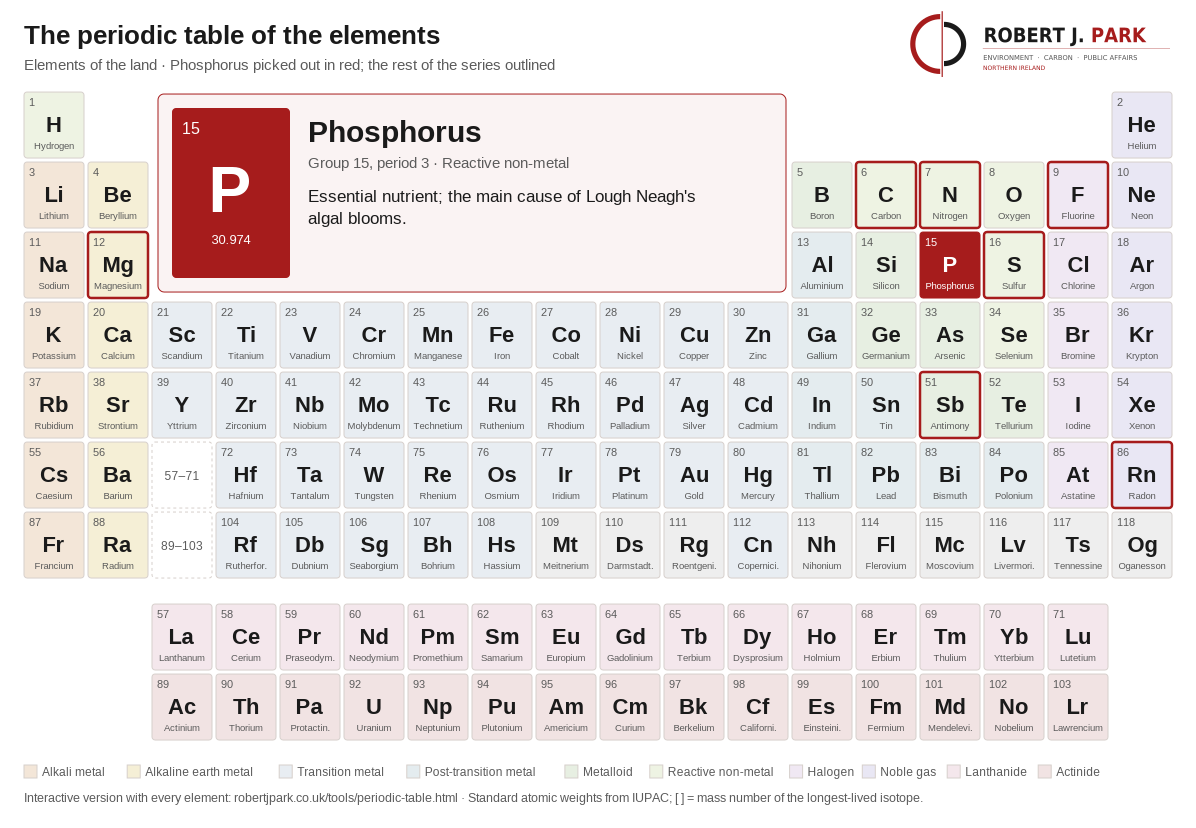
Every living cell needs phosphorus. It is in DNA, in bones and in the molecule that carries energy around the body. Plants cannot grow without it. That is why farmers spread it, as fertiliser and as slurry.
The trouble is what happens to the phosphorus that crops do not use. It stays in the soil, and some of it washes into streams. In fresh water, phosphorus is usually the nutrient in shortest supply. Add more and algae grow. DAERA says excess phosphorus is the main cause of water quality problems in Lough Neagh and across Northern Ireland.
The element in one minute
- Number 15, group 15, period 3. A reactive non-metal.
- Never found free in nature. It is mined as phosphate rock (apatite) and nearly always meets us as phosphate.
- White phosphorus catches fire on its own in air and is very toxic. Red phosphorus is stable and sits on the side of a matchbox.
- A critical mineral. Phosphorus is on the UK’s 2024 critical minerals list. Most phosphate rock comes from a handful of countries, led by Morocco.
Climate
Phosphorus has no greenhouse gas of its own. Its climate effects are indirect:
- Making fertiliser takes energy. Rock is mined, shipped, and dissolved in sulfuric acid to make phosphoric acid.
- Rich lakes emit more methane. Blooms die, sink and rot without oxygen.
- It limits growth. Where phosphorus is short, forests and grassland lock up less carbon.
Soil and land
Phosphate binds tightly to soil. That is good for keeping it in the field, and bad once a field holds more than it needs. Soil tests report phosphorus as an index; for intensive grassland, the agronomic target is Index 2+.
Northern Ireland’s farm system imports more phosphorus in feed and fertiliser than it exports in milk, meat and crops. The difference builds up in the soil. Modelling that DAERA cites for the Lough Neagh catchment found phosphorus supply met 123% of what crops and grass need (NAP technical papers, July 2026).
The Soil Nutrient Health Scheme, run by AFBI for DAERA, has now tested most farms. By December 2024 about 300,000 fields had been sampled. Its results show many fields above the phosphorus target and many below the right pH. Lime first: at the wrong pH, the phosphorus already in the soil is locked up.
Agri-food
- Feed is the main import. Much of the phosphorus entering Northern Ireland arrives in concentrates for pigs, poultry and dairy cows, not in fertiliser bags.
- Manure moves phosphorus around. Poultry litter and pig slurry are rich in it. Moving them from where they are made to where soil needs them is the hard part.
- Recovery is possible. Phosphorus can be recovered from wastewater and digestate as struvite, a slow-release fertiliser.
Atmosphere
Phosphorus barely enters the air. Dust and smoke carry a little, and phosphine, a toxic gas, is used as a grain fumigant. For practical purposes, phosphorus is a water and soil problem.
Why it matters in Northern Ireland
Lough Neagh supplies about two-fifths of Northern Ireland’s drinking water and has suffered repeated blue-green algal blooms. Reducing the phosphorus surplus is at the heart of the Lough Neagh Action Plan and the next Nutrients Action Programme.
The rules (as at 21 November 2026)
- Nutrients Action Programme (NAP). The current rules are the Nutrients Action Programme Regulations (Northern Ireland) 2019. DAERA consulted on a new programme for 2027–2030, closing 7 September 2026. Its proposals include limiting chemical phosphorus fertiliser on grassland. DAERA’s published timetable has final measures agreed in autumn 2026 and regulations in late 2026 or early 2027.
- EU fertiliser rules limit cadmium in phosphate fertilisers placed on the market; they apply in Northern Ireland under the Windsor Framework.
- Safety: COSHH and CLP apply to phosphorus and its compounds (below).
Safety and handling
COSHH applies to phosphorus and its compounds. White phosphorus is one of the most dangerous elements to handle; it is not something a farm or general workshop should ever hold.
| Form | Classification (CLP) |
|---|---|
| White (yellow) phosphorus | Pyr. Sol. 1 H250 (catches fire spontaneously in air); Acute Tox. 2 H300 + H330 (fatal if swallowed or inhaled); Skin Corr. 1A H314; Aquatic Acute 1 H400. Harmonised (CLP Annex VI). |
| Red phosphorus | Flam. Sol. 1 H228 (flammable solid); Aquatic Chronic 3 H412. Harmonised (CLP Annex VI). |
| Substance | Workplace exposure limit (EH40/2005) |
|---|---|
| Phosphine | 0.1 ppm LTEL; 0.2 ppm STEL |
| Orthophosphoric acid | 1 mg/m³ LTEL; 2 mg/m³ STEL |
| Yellow phosphorus | 0.1 mg/m³ LTEL; 0.3 mg/m³ STEL |
| UN number | Proper shipping name | Class |
|---|---|---|
| UN1381 | Phosphorus, white or yellow, dry or under water or in solution | 4.2 (6.1) |
| UN2447 | Phosphorus, white, molten | 4.2 (6.1) |
| UN1338 | Phosphorus, amorphous (red phosphorus) | 4.1 |
| UN1805 | Phosphoric acid, solution | 8 |
| UN2199 | Phosphine | 2.3 (2.1) |
Risks of the element itself. White phosphorus ignites in air at around 30 °C, burns deep into skin and is fatal in small doses; it is kept under water. Red phosphorus is far safer but burns easily and can release phosphine if contaminated. Phosphate fertilisers themselves are low hazard to people; the harm is to water.
Classification and limits change. Always work from the supplier’s current safety data sheet and your own COSHH assessment.
Compounds you will meet
| Where you meet it | Compound | Why it matters |
|---|---|---|
| Nature | Apatite (calcium phosphate) | the mineral in phosphate rock, bones and teeth |
| Orthophosphate (PO₄³⁻) | the form plants take up and the form that feeds algae | |
| Organic phosphorus | in manure, soil organic matter, DNA and ATP | |
| Manufacturing | Phosphoric acid (H₃PO₄) | made from rock and sulfuric acid; fertilisers, food, metal treatment |
| MAP, DAP and triple superphosphate | the main phosphate fertilisers | |
| Struvite (MgNH₄PO₄·6H₂O) | recovered from wastewater and digestate as a slow-release fertiliser | |
| Lithium iron phosphate (LiFePO₄) | battery cathode material | |
| Organophosphates | pesticides such as glyphosate and historic sheep dips | |
| Aluminium phosphide | grain fumigant that releases toxic phosphine gas (UN1397) | |
| Climate | No phosphorus greenhouse gas | phosphorus acts on climate indirectly |
| Algal blooms | nutrient-rich lakes emit more methane | |
| Fertiliser manufacture | energy for mining, acid production and transport |
What this means
- For farmers: test, lime, then decide. A field at Index 3 or above can usually go years without phosphate fertiliser.
- For processors and feed firms: the phosphorus in feed is part of the water problem and part of the answer.
- For policy: phosphorus is a whole-system balance, from ship to soil to lough. Rules that only look at the field miss most of it.
Further reading on this site
Sources
- DAERA, Public consultation on the proposed Nutrients Action Programme 2026–2029 (May 2025).
- DAERA, Public consultation on the proposed Nutrients Action Programme 2027–2030 (opened 29 June 2026, closed 7 September 2026) and technical subgroup papers (July 2026).
- AFBI, Soil Nutrient Health Scheme: sampling update and results (3 December 2024).
- British Geological Survey, UK 2024 Criticality Assessment (28 November 2024).
- HSE, EH40/2005 Workplace exposure limits (4th edition, January 2020), approved in Northern Ireland by HSENI.
- Regulation (EC) No 1272/2008 (CLP), Annex VI, harmonised classifications.
- UNECE, ADR 2025, dangerous goods list.
All sources checked 21 November 2026.
Robert J. Park is an environment, carbon and public affairs consultant based in Larne, Northern Ireland. Download the briefing, *Phosphorus* (PDF), with the full periodic table, the safety panel and the sources. This is one of eight learning briefings on the elements that shape climate, soil, land, agri-food and the atmosphere; the others are linked from the interactive periodic table. This is general information as at 21 November 2026, not legal, safety or agronomic advice. Created with assistive technology including AI and re-checked against the official sources listed.