
Twelve dates to Easter: what Northern Ireland firms need to do before April 2027
Update, 21 November 2026: the UK–EU summit of 20 November concluded an agreement to link the UK and EU carbon markets. The UK government says it intends to exempt goods of EU origin from UK CBAM from 1 January 2027; that is not yet law. This piece is as published; see what changes, and when and what the summit agreed.
Between now and Easter, Northern Ireland firms face a UK carbon border levy, a UK–EU summit that may change it, EU rules that apply here but not in Great Britain, and an energy-audit cut-off for larger businesses. These are the twelve dates that matter most, what each one means, and what to do first. Every date is checked against the official source on my NI Regulatory Horizon dashboard, which lists all 62.
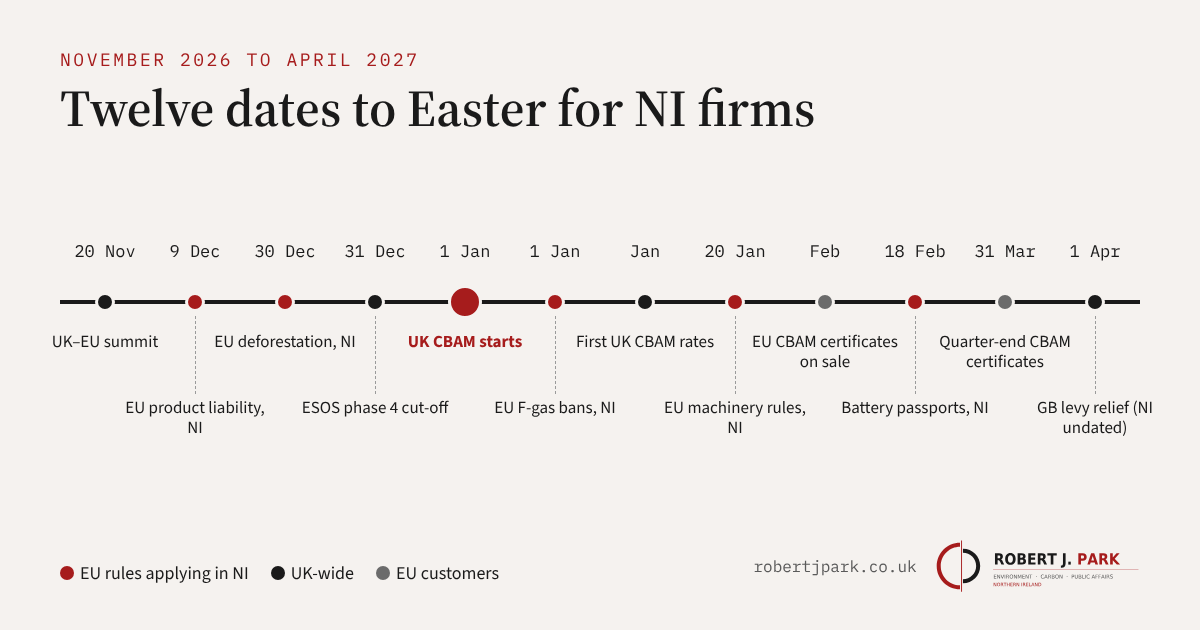
Before Christmas
20 November: UK–EU summit, Brussels. A draft agreement to link the UK and EU emissions trading systems was before the Council’s working party on the UK on 10 November, and an agri-food (SPS) agreement is also expected. A link could later exempt each side’s goods from the other’s carbon border levy. No text has been published, and nothing changes for either CBAM until both sides legislate. Do: plan on both CBAMs applying as they stand, and read the summit statement for a start date and for how goods moving from GB to NI are treated.
9 December: new EU product liability rules apply to products placed on the NI market. Software, digital files and online sellers come within strict liability for defective products. Do: check your product liability insurance and supply contracts cover products sold into NI from this date.
30 December: EU deforestation rules apply in NI. They cover cattle, cocoa, coffee, palm oil, rubber, soya and wood, for medium and large firms and for small firms already placing wood products. DAERA enforces for most commodities and OPSS for wood and rubber. Do: if you are first to place these goods on the NI market, collect plot locations from suppliers and file due diligence statements before 30 December.
31 December: ESOS phase 4 qualification date. You are in if, on that day, you or your UK group employ 250 or more people, or have turnover above £44m and a balance sheet above £38m. NIEA regulates organisations registered in NI. Do: check headcount and group accounts, then appoint a lead assessor early.
January
1 January: UK CBAM starts. The UK carbon border levy covers imported aluminium, cement, fertiliser, hydrogen, iron and steel of any non-UK origin, EU included: HMRC says no country is exempt yet. Liability starts once covered imports pass £50,000 in any 12 months. Do: from 1 January, record every covered import (commodity code, origin, mass, value and the supplier’s emissions data) and track the £50,000 test monthly. Origin means where the goods were made, not where your stockholder is, so steel from a Dublin merchant can still count.
1 January: EU F-gas bans on new cooling and heat pump kit in NI. Many small air-conditioning units, heat pumps and chillers using high-GWP refrigerants can no longer be placed on the NI market, and EU HFC supply halves. Great Britain keeps its own rules. Do: specify low-GWP refrigerants for kit bought for NI sites, and budget for dearer servicing gas.
By 1 January: first quarterly UK CBAM rates published. HMRC says it will publish each quarter’s rates by the beginning of the quarter, so the January to March 2027 rates come out on or before 1 January. Do: reprice 2027 import budgets and customer quotes using the published rate for your goods.
20 January: EU Machinery Regulation applies in NI. Do: makers and importers should update technical files, instructions and declarations of conformity for machinery placed on the NI market.
February and March
February: EU CBAM certificates go on sale. EU importers start buying certificates for goods imported in 2026. Goods made in NI are outside the EU CBAM, but goods you ship from GB or from outside the EU are not. Do: have product-level emissions figures ready, because EU customers will want verified data to cut their bill.
18 February: battery passports and removability rules in NI. EV, light-transport and industrial batteries above 2 kWh need a digital passport, and portable batteries must be user-replaceable. Do: confirm passport data and design changes with suppliers for stock reaching NI after this date.
31 March: EU importers must hold CBAM certificates at each quarter end. They must hold certificates for at least half the embedded emissions of goods imported since January. Do: expect EU customers to ask for emissions data every quarter, not once a year.
1 April: GB manufacturers exempted from some electricity levies; NI not yet. The British Industrial Competitiveness Scheme takes some renewables costs off eligible GB firms’ bills from 1 April. The NI Executive is being funded for a comparable scheme but has given no start date. Do: ask DfE when the NI scheme opens and on what terms.
Where to start
If you import steel, aluminium, cement or fertiliser, or sell to EU customers who are asking for carbon data, start with the two CBAM dates. A free first call on the CBAM Desk is the place to start.
Dates checked against the official sources linked on the NI Regulatory Horizon as at 9 November 2026. General information, not legal, tax or financial advice.