
Sulfur: acid rain's ingredient, now a fertiliser we buy
Element 16 used to fall on our fields for free, as pollution. We cleaned the air, and now farmers buy it in a bag.
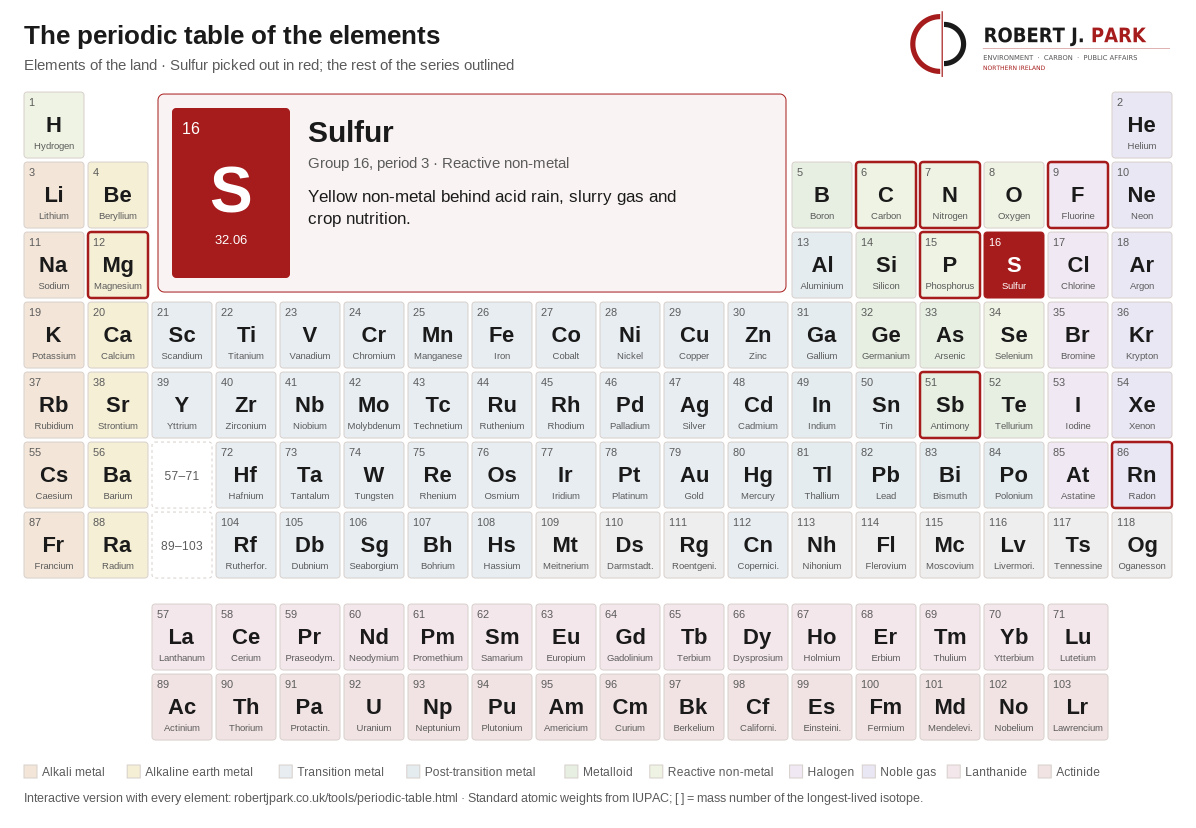
For a century, coal smoke filled the air with sulfur dioxide. It made acid rain and smog, and it also delivered sulfur to every field in Britain and Ireland.
Then the coal stopped. Defra reports that UK sulfur dioxide emissions fell by 98% between 1970 and 2022, mainly because power stations stopped burning coal. That is one of the great environmental successes. It also means crops and grass now often run short of sulfur.
A note on spelling: IUPAC and the Royal Society of Chemistry use “sulfur”. UK law and HSE guidance still often say “sulphur”. They are the same element.
The element in one minute
- Number 16, group 16, period 3. A yellow, brittle non-metal.
- Most sulfur today is a by-product of cleaning oil and gas, not mined.
- Sulfuric acid, made from it, is the most produced industrial chemical in the world.
Climate
Sulfur works on the climate in two opposite ways.
- Sulfate particles cool. Sulfur dioxide forms tiny particles that reflect sunlight and help clouds form. Cleaner air has removed some of that shade, so cutting pollution has unmasked part of the warming already under way.
- Sulfur hexafluoride (SF₆) warms, a lot. This insulating gas in electrical switchgear has a 100-year global warming potential of 23,500 (AR5) and lasts thousands of years. Leaks from substations matter.
- Shipping. A global 0.50% limit on sulfur in ship fuel has applied since 2020. It cut sulfur dioxide from ships, and with it some cooling over the oceans.
Soil and land
Plants take up sulfur as sulfate. They need it to make protein, and grass given plenty of nitrogen but too little sulfur uses that nitrogen badly.
Sulfur is one of the nutrients measured under Northern Ireland’s Soil Nutrient Health Scheme. Silage swards cut several times a year, and crops such as oilseed rape, have the highest demand.
Underground, sulfur can cause trouble. Pyrite (iron sulfide) exposed by excavation or mining turns to acid. Gypsum and plasterboard buried with rotting waste produce hydrogen sulfide.
Agri-food
- Fertiliser: many compound fertilisers now include sulfur, often as ammonium sulfate.
- Slurry gas: slurry releases hydrogen sulfide as it is mixed. HSENI warns that at high concentration one breath can kill, and the gas kills the sense of smell before it kills the person. Slurry is one of the four main causes of death and serious injury on Northern Ireland’s farms.
- Food: sulfites are used as preservatives in wine and dried fruit, and must be labelled as an allergen.
Atmosphere
Sulfur dioxide is now a minor air pollutant in Northern Ireland compared with nitrogen dioxide and fine particles. Natural sources remain: volcanoes, and dimethyl sulfide from ocean plankton, which helps seed clouds over the sea.
Why it matters in Northern Ireland
Two things make sulfur relevant here. Livestock farming means slurry and hydrogen sulfide on thousands of farms every spring and autumn. And the electricity network’s switchgear holds SF₆, which Northern Ireland must phase down under EU rules while Great Britain follows its own.
The rules (as at 21 November 2026)
- Workplace: COSHH applies to hydrogen sulfide and sulfur dioxide. New workplace exposure limits for sulfur dioxide came into force in Northern Ireland on 14 September 2018 (HSENI); see the table.
- Air: the UK’s emission reduction commitments cover sulfur dioxide; Defra publishes progress annually.
- F-gases: SF₆ is an F-gas. In Northern Ireland, Regulation (EU) 2024/573 applies under the Windsor Framework, which bans F-gases in new medium-voltage switchgear up to 24 kV from 1 January 2026 and from 24 to 52 kV from 1 January 2030. High-voltage switchgear must use gases with a GWP below 1 from 2028 (52–145 kV) and 2032 (above 145 kV). Equipment ordered before 11 March 2024 is exempt (Article 13). In Great Britain the retained 2014-based regime applies.
- Shipping: the 0.50% global sulfur cap under MARPOL Annex VI has applied since 1 January 2020.
Safety and handling
COSHH applies to sulfur and its compounds. On farms, the controlling risk is hydrogen sulfide from slurry: HSENI warns that one breath at high concentration can kill.
| Form | Classification (CLP) |
|---|---|
| Sulfur (element) | Skin Irrit. 2 H315 (causes skin irritation). Harmonised (CLP Annex VI). Sulfur dust is also combustible and can explode. |
| Substance | Workplace exposure limit (EH40/2005) |
|---|---|
| Sulfur | No specific WEL; general dust limits apply (10 mg/m³ inhalable, 4 mg/m³ respirable) |
| Hydrogen sulfide | 5 ppm LTEL; 10 ppm STEL |
| Sulfur dioxide | 0.5 ppm LTEL; 1 ppm STEL (from 2018) |
| Sulfuric acid (mist) | 0.05 mg/m³ LTEL, thoracic fraction |
| Sulfur hexafluoride | 1,000 ppm LTEL; 1,250 ppm STEL |
| UN number | Proper shipping name | Class |
|---|---|---|
| UN1350 | Sulphur (some formed sulphur such as prills or granules may be exempt; check ADR special provision 242) | 4.1 |
| UN2448 | Sulphur, molten | 4.1 |
| UN1053 | Hydrogen sulphide | 2.3 (2.1) |
| UN1079 | Sulphur dioxide | 2.3 (8) |
| UN1830 | Sulphuric acid | 8 |
| UN1080 | Sulphur hexafluoride | 2.2 |
Risks of the element itself. Solid sulfur is low in toxicity but burns with a blue flame to give choking sulfur dioxide, and its dust can explode. Molten sulfur releases hydrogen sulfide. Hydrogen sulfide deadens the sense of smell at high concentration, so the ‘rotten eggs’ warning disappears just when it matters.
Classification and limits change. Always work from the supplier’s current safety data sheet and your own COSHH assessment.
Compounds you will meet
| Where you meet it | Compound | Why it matters |
|---|---|---|
| Nature | Hydrogen sulfide (H₂S) | from slurry, bogs, sewers and volcanoes |
| Dimethyl sulfide (DMS) | released by marine plankton; seeds clouds over the sea | |
| Pyrite (FeS₂) and gypsum (CaSO₄·2H₂O) | common sulfur minerals | |
| Sulfate (SO₄²⁻) | the form plants take up | |
| Manufacturing | Sulfuric acid (H₂SO₄) | fertiliser production, batteries, metal pickling |
| Ammonium sulfate and sulfur-containing fertilisers | supply sulfur to grass and crops | |
| Gypsum and plasterboard | building material; must be kept separate from biodegradable waste in landfill | |
| Sulfur hexafluoride (SF₆) | insulating gas in electrical switchgear | |
| Climate | Sulfate aerosols | cool the climate by reflecting sunlight; their decline has unmasked some warming |
| Sulfur hexafluoride (SF₆) | 100-year global warming potential of 23,500 (AR5) and a lifetime of thousands of years | |
| Shipping fuel | the global 0.50% sulfur cap from 2020 cut ship SO₂ and some cooling with it |
What this means
- For farmers: test for sulfur on silage ground, and treat every slurry mixing as if it could kill, because it can.
- For network operators and large sites: SF₆ leaks are counted greenhouse gas emissions, and Northern Ireland’s rules differ from Great Britain’s.
- For policy: clean air brought a new fertiliser bill. Environmental wins can move costs somewhere else.
Further reading on this site
Sources
- Defra, Emissions of air pollutants in the UK: sulphur dioxide (updated 19 February 2024) and ENV01 data tables, 1970 to 2024 (February 2026).
- HSENI, Slurry: working safely with slurry (accessed 21 November 2026).
- AFBI, Soil Nutrient Health Scheme: sampling update and results (3 December 2024).
- Regulation (EU) 2024/573 on fluorinated greenhouse gases (in force 11 March 2024).
- HSE, EH40/2005 Workplace exposure limits (4th edition, January 2020).
- UNECE, ADR 2025.
All sources checked 21 November 2026.
Robert J. Park is an environment, carbon and public affairs consultant based in Larne, Northern Ireland. Download the briefing, *Sulfur* (PDF), with the full periodic table, the safety panel and the sources. This is one of eight learning briefings on the elements that shape climate, soil, land, agri-food and the atmosphere; the others are linked from the interactive periodic table. This is general information as at 21 November 2026, not legal, safety or agronomic advice. Created with assistive technology including AI and re-checked against the official sources listed.