
Two refrigerant rulebooks, one small market
Part of the Policy series: where the rules stand in Northern Ireland, who decides them, and what to do about it. Updated as the rules change.
The argument in brief
On 15 May 2026, Defra said it would not legislate in 2026 to change the Great Britain HFC phase-down step due on 1 January 2027. It had received 137 consultation responses, said further work was needed, and promised a report on next steps later in the year. As at 28 October 2026 no report had appeared on Defra’s consultation page. Northern Ireland follows a different rulebook. Under the Windsor Framework it applies EU Regulation (EU) 2024/573, which bans many new heat pumps using refrigerants with a global warming potential (GWP) of 150 or more from 1 January 2027.
The result is a two-speed market inside one country. GB keeps the 2014 regime and its quota cut. Northern Ireland faces EU product bans, an EU route to zero HFCs by 2050 and, possibly, an EU restriction on PFAS. At the same time NI has the UK’s heaviest reliance on heating oil and no heat pump grant. The Budget of 28 October 2026 tilted the sums further towards oil. It removed the 4% kerosene tariff, and from 1 April 2027 VAT on installing heat pumps in homes rises from 0% to 5%. Refrigerant policy and heat policy are being made in separate rooms, and NI manufacturers and households carry the cost of the gap. The pillars compete too: low-GWP fluorinated refrigerants can be PFAS, the natural alternatives are flammable or toxic, and heat pumps cut carbon but can raise costs for the households least able to pay.
This piece sets out the arguments on each side; the recommendations are the author’s. Facts checked to 30 October 2026; rechecked and updated 16 November 2026.
The lifecycle at a glance
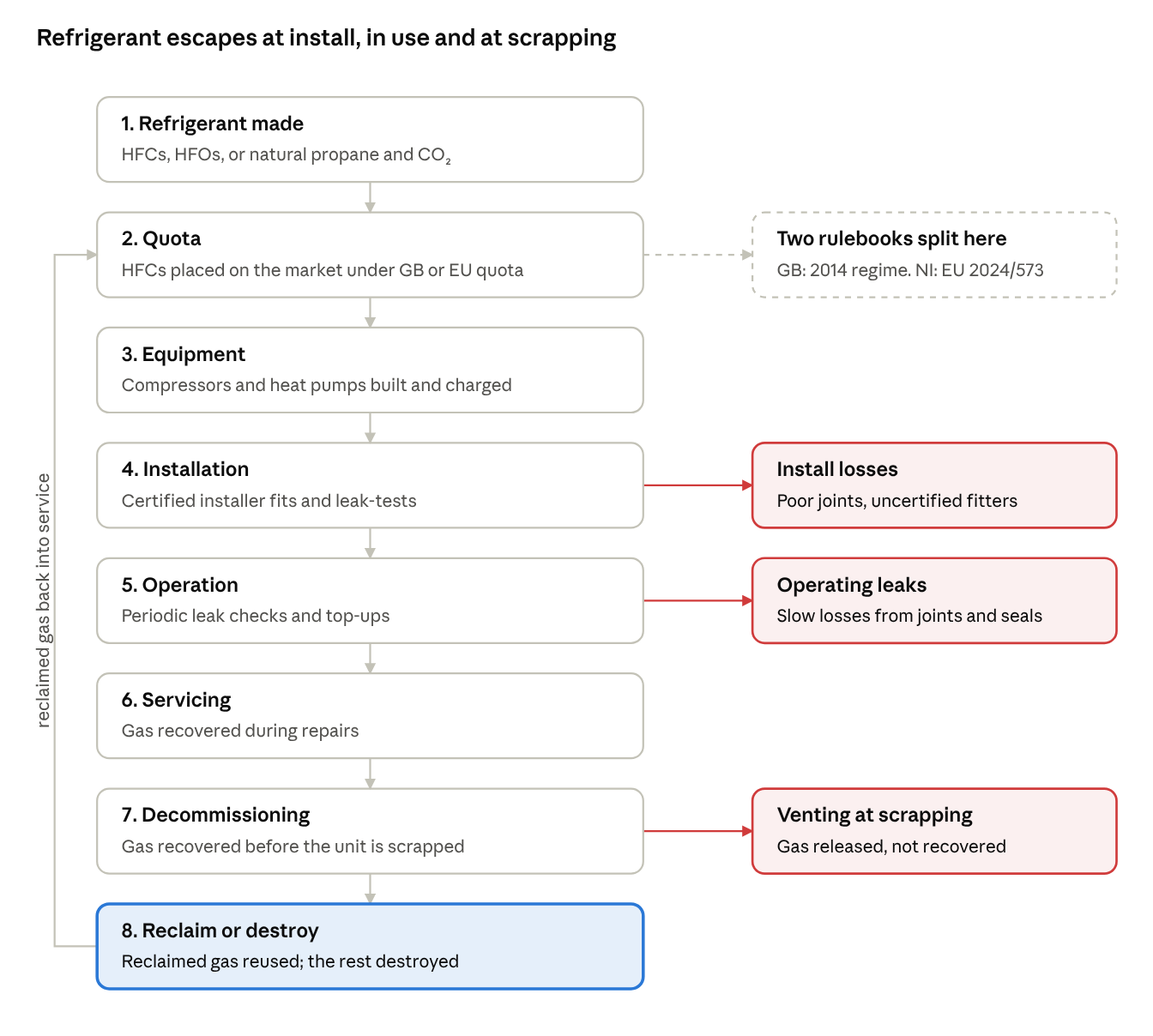
GB and NI rules part company where refrigerant and equipment are placed on the market. After that, the gas leaks at installation, in use and at scrapping, so recovery and reclamation decide how much ever reaches the air.
Then and now (2023 to October 2026)
| Rule or instrument | 2023 | Now (with date) | What changed and why |
|---|---|---|---|
| EU F-gas Regulation | Reg 517/2014 applied in the EU and NI | Reg 2024/573 in force since 11 Mar 2024, repealing 517/2014; applies in NI | The EU tightened the rules to meet climate targets; HFC consumption reaches zero by 2050 |
| GB F-gas regime | Assimilated 517/2014 | Still in force. The 15 May 2026 decision leaves the 2027 step unchanged | Defra consulted 5 Nov to 17 Dec 2025 on a much steeper cut, then said it needed more work |
| GB HFC quota | 31% of baseline (2024–26 step) | Falls to 24% on 1 Jan 2027 and 21% on 1 Jan 2030 (FETA, May 2026) | The existing schedule still applies; FETA puts the 2027 cut in available refrigerant at 22.6% |
| Heat pump product bans (EU/NI) | Split systems under 3 kg with GWP 750+ banned from 2025 | From 1 Jan 2027: GWP 150+ banned in self-contained units up to 50 kW and split air-to-water units up to 12 kW. All F-gases banned in small self-contained units from 2032 and small splits from 2035 (Annex IV, points 8 and 9) | Placing-on-market bans speed up the switch; a safety exemption allows GWP up to 750 |
| SF6 switchgear (EU/NI) | No ban | New switchgear relying on F-gases: up to 24 kV banned from 1 Jan 2026; 52–145 kV from 2028; 24–52 kV from 2030; above 145 kV from 2032 | SF6 is the most potent gas covered. GB’s consultation left SF6 out |
| EU universal PFAS restriction | Proposed 13 Jan 2023 | RAC final opinion adopted 2 Mar 2026; SEAC final opinion expected end 2026 (no later step found, 28 Oct 2026) | F-gas applications are one of the sectors assessed |
| Boiler Upgrade Scheme (England and Wales) | £5,000, then £7,500 from Oct 2023 | £9,000 for oil-heated homes in England and Wales from 21 Jul 2026 (DESNZ, 26 Jun 2026) | Targets rural homes switching from oil after 2026 price rises |
| NI domestic heat pump support | None | DfE response of 26 Jan 2026: scheme design in 2026, legislation in 2027, launch after that | The Renewable Heat Incentive scandal left caution about heat subsidies; 61% of NI homes heat with oil and 0.15% have a heat pump (Regen, 15 Jun 2026) |
| VAT on energy-saving materials (heat pumps) | 0% in GB from Apr 2022 and in NI from May 2023, to 31 Mar 2027 | Reverts to 5% from 1 Apr 2027 for installs in homes and charity buildings across the UK; heat batteries added to the relief (Budget, 28 Oct 2026) | The temporary zero rate ends. It adds 5% VAT to a home install before any NI grant exists |
| Heating oil (kerosene) | One-off alternative fuel payments (2022–23) | 4% tariff on kerosene removed (Budget, 28 Oct 2026) | HM Treasury says 61% of NI households rely on heating oil. Cheaper oil narrows the running-cost case for switching |
Where the parties and governments stand (October 2026)
The main split is between parties that would expand heat pump subsidy and parties that would cut it. In Northern Ireland, parties argue about short-term help with oil bills more than about heat pumps.
| Party or government | Position (dated) |
|---|---|
| UK Government (Labour; PM Andy Burnham since 20 Jul 2026) | Warm Homes Plan committed £15bn (Lords statement, 27 Jan 2026). BUS grant raised to £9,000 for oil-heated homes from 21 Jul 2026 (announced 26 Jun 2026). F-gas reform deferred (15 May 2026). Budget (28 Oct 2026): heat pump VAT relief reverts to 5% from 1 Apr 2027, heat batteries added; 4% kerosene tariff removed |
| Conservatives (Kemi Badenoch) | Pledged to repeal the Climate Change Act (2 Oct 2025). |
| Reform UK (Nigel Farage) | Pledged to abolish the BUS grant and scrap green levies (reported 10 Mar 2026) |
| Liberal Democrats (Ed Davey) | Free heat pumps and insulation for low-income homes (2024 manifesto). Earl Russell called the diluted deployment ambition troubling (Lords, 27 Jan 2026) |
| Green Party of England and Wales | No published position found (searched 27 Oct 2026) |
| Scottish Government (SNP) | Own Home Energy Scotland grant and loan: £7,500 grant, £7,500 loan and a £1,500 rural uplift (Regen, 15 Jun 2026) |
| Welsh Government (Plaid Cymru) | Covered by the UK BUS; no separate position found |
| NI Economy Minister Caoimhe Archibald (Sinn Féin) | Consultation favoured capital grants; DfE will design the scheme in 2026 and legislate in 2027 before launch (26 Jan 2026) |
| NI Communities Minister Gordon Lyons (DUP) | £100 heating oil card for more than 300,000 households, £36.4m (16 Apr 2026) |
| Sinn Féin and UUP | Both criticised the £17m Treasury heating oil support as too small (16 Mar 2026) |
| DAERA (Andrew Muir, Alliance) | DAERA’s 2024 assessment for the Windsor Framework scrutiny committee expected divergence from GB to be minimal. That has not held |
| TUV | No published position found (searched 16 Nov 2026) |
| SDLP | Urged urgent heating oil support and a fast-tracked Warm Healthy Homes Fund; no heat pump or F-gas position found (12 Apr 2026) |
-
Subsidy is the real dividing line. Labour and the Lib Dems would expand grants. Reform would abolish the BUS. The Conservatives question the timetable.
-
F-gas reform is a quiet issue. No party has campaigned on the 2027 GB step; criticism of Defra’s delay came from industry.
-
NI politics is about oil bills. Every Executive party argued about emergency oil support in 2026; none has published a heat pump uptake target.
-
DAERA’s 2024 assumption has aged badly. GB has not followed the EU’s bans, so the divergence is real.
Who decides what
Westminster sets the GB refrigerant rules. Brussels sets the NI refrigerant rules. Stormont controls NI heat subsidies.
| Instrument | Who decides | Whose approval is needed | Position in Northern Ireland |
|---|---|---|---|
| EU F-gas Regulation 2024/573 | European Parliament and Council; Commission implementing acts | EU co-legislators | Applies under the Windsor Framework, subject to Assembly scrutiny |
| GB F-gas regime | Defra Secretary of State | UK Parliament, with the Scottish and Welsh governments | Does not govern placing on the NI market |
| EU PFAS restriction | Commission draft, then REACH Committee vote | Member states, then Parliament and Council scrutiny | EU REACH applies in NI |
| Boiler Upgrade Scheme | DESNZ | HM Treasury | Not available in NI |
| VAT on energy-saving materials | HM Treasury | Parliament (Finance Bill) | Applies in NI as in GB; 5% from 1 Apr 2027 (Budget, 28 Oct 2026) |
| NI low-carbon heat grant | Department for the Economy | Executive agreement and Assembly legislation | Legislation planned for 2027; launch after |
| NI heating oil support | Department for Communities | Executive and Treasury funding | £100 card announced 16 Apr 2026; 4% kerosene tariff removed by HM Treasury (Budget, 28 Oct 2026) |
Where the pillars compete
-
E versus S: who pays for the switch. A grant that covers only part of the cost helps owners who can fund the balance first. NEA NI asks for full grants for low-income homes. The return of 5% VAT on home installs from 1 April 2027 adds to the balance owners must fund.
-
E versus S: efficiency before kit. Belfast City Council warned in Dec 2024 that heat pumps in poorly insulated homes could use more electricity and deepen fuel poverty.
-
E versus E: low-GWP fluorinated refrigerants can be PFAS. HFOs such as R1234yf (CF₃CF=CH₂) meet the GWP 150 test. Their fully fluorinated CF₃ group makes them PFAS under the OECD-based definition in the EU proposal. R134a (CF₃CH₂F) is PFAS too. R32 (CH₂F₂) has no fully fluorinated carbon, so it is not, but its GWP of 675 fails the 150 test. A firm that redesigns once for F-gas rules may have to redesign again.
-
E versus E: natural refrigerants still need fluoropolymers. Compressor makers argue that natural refrigerants raise the need for fluoropolymer seals. ECHA’s RAC supports only time-limited exemptions, such as for spare parts.
-
E versus safety. Propane (R290) is highly flammable, and units need clearance and rated parts in some designs. Without propane in split systems, GB relies on R32, which uses up quota.
What it means for Northern Ireland firms and councils
-
Two specifications for one product line. Equipment made in NI for the NI or EU market must meet the 2027 GWP 150 bans; the same unit can still be sold in GB.
-
An opportunity for the compressor cluster. Copeland’s Cookstown plant developed the company’s first CO₂ and R290 compressors and won a £19m expansion in 2024 to supply Europe.
-
Separate quota pools. NI contractors buy HFCs under EU quota; GB contractors face the 24% step. Prices and availability may differ across the Irish Sea.
-
SF6 bans. Since 1 January 2026, new NI switchgear up to 24 kV may not rely on F-gases such as SF6; 24–52 kV follows in 2030. Council and NI Water capital plans should reflect this now.
-
Councils are the first contact for households. Without a grant before 2027 at the earliest, councils will field questions on oil, heat pumps and safety, and building control will meet flammable-refrigerant installs.
-
Heat pump installs cost more from April 2027. VAT on installs in homes and charity buildings rises from 0% to 5% on 1 April 2027. Heat batteries join the relief (Budget, 28 Oct 2026). With no NI grant before 2027 at the earliest, households carry that cost.
-
Installer skills are the bottleneck. NI needs certified installers ready before any grant opens.
Practical examples
-
Cookstown builds for the EU rules. Copeland’s Cookstown plant developed the company’s first transcritical CO₂ and R290 propane compressors. Its £19m expansion was aimed at Europe’s heat pump demand (Cooling Post, 14 May 2024). DESNZ later added £4.6m from its Heat Pump Investment Accelerator for new lines and test labs (Cooling Post, 30 Apr 2025).
-
Housing Executive homes go fabric first. The Housing Executive and Phoenix Energy retrofitted 15 Belfast homes with insulation, new windows and doors, then hybrid heat pump and gas boiler systems. Phoenix is monitoring ten of them, including two gas-only comparators (Phoenix Energy, Oct 2026).
-
A 2021 install that the 2027 rules would bar. The RULET project, run by Ulster University, the Housing Executive and Grant, fitted a 6 kW R32 air-to-water unit in rural NI (Passive House Plus, 30 Aug 2021). R32 has a GWP of 675. From 1 January 2027 such units up to 12 kW cannot be placed on the NI market unless safety rules require it.
-
A housing association trial. Alpha Housing fitted hybrid heat pumps to two bungalows at Carnvue Court, Newtownabbey, as a fully monitored trial with Phoenix Energy (Business Eye, 12 Jun 2024).
-
The GB comparison. From 21 July 2026, oil-heated homes in England and Wales can get £9,000 off a heat pump, with leaflets sent to 200,000 eligible homes (DESNZ, 26 Jun 2026). NI’s oil-heated homes got a £100 heating oil card instead (DfC, 16 Apr 2026).
Recommendations
-
DfE: build a low-income tier into the NI grant and legislate in 2027. A part-grant open to all favours owners who can fund the balance. The return of 5% VAT on 1 April 2027 widens that balance.
-
DfE and DfC: fund insulation first for oil homes. Belfast’s warning on fuel poverty applies across NI’s oil-heated homes.
-
Defra: publish the promised next-steps report before 1 January 2027. Industry needs to know whether GB will adopt product bans or SF6 rules.
-
UK Government: publish an NI F-gas divergence assessment, and the Windsor Framework scrutiny committee should review it again.
-
Invest NI and DfE: back natural-refrigerant skills and exports. The Cookstown compressor base is an advantage worth building on.
-
NI manufacturers: design to the stricter EU rules by default. Avoid HFO lock-in until the PFAS restriction is settled.
-
Councils and public bodies: audit SF6 and HFC assets now, and specify low-GWP, PFAS-free options from 2027 where safe.
Sources
-
Defra: Amending the HFC phasedown schedule, update of 15 May 2026
-
Defra: F gas Regulation in Great Britain, reform of the HFC phasedown (Nov 2025)
-
Cooling Post: Defra delays GB F-gas phase-down (16 May 2026)
-
European Parliament OEIL: Fluorinated gases regulation summary (2024)
-
European Commission: stationary air conditioning and heat pumps
-
Regen: Is Northern Ireland being thrown under the BUS? (15 Jun 2026)
-
GB News: Reform vows to scrap heat pump grants (10 Mar 2026)
-
Grantham Institute: Badenoch vows to repeal Climate Change Act (2 Oct 2025)
-
Belfast City Council response on low carbon heating (13 Dec 2024)
-
ACR News: Copeland invests £19m in NI production (16 May 2024)
-
legislation.gov.uk: SI 2023/376, VAT relief for energy-saving materials in NI
-
Cedrec: EU tightens F-gas legislation, switchgear dates (2024)
-
Cooling Post: Defra’s F-gas decision is a delay, not a reprieve (10 Jul 2026)
-
Cooling Post: Copeland Cookstown expansion nears completion (14 May 2024)
-
Cooling Post: £4.6m grant for Copeland compressor production (30 Apr 2025)
-
Phoenix Energy: hybrid heating programme with the Housing Executive (Oct 2026)
-
Passive House Plus: Grant heat pumps in the RULET project (30 Aug 2021)
-
Business Eye: first NI housing association installs hybrid heat pumps (12 Jun 2024)
-
HM Treasury and HMRC: Budget 2026 Overview of Tax Legislation and Rates (28 Oct 2026)
-
HM Treasury and NIO: Breathing space for Northern Ireland families and businesses (28 Oct 2026)
Robert J. Park is an independent environment, carbon and public-affairs consultant based in Larne, Northern Ireland. He helps firms and public bodies measure their carbon and make their case on policy.
Agree or disagree? Get in touch on LinkedIn or WhatsApp @robertjpark.