
Fluorine: in your fridge, your frying pan and your teeth
Element 9 is the most reactive element there is. Bond it to carbon and it becomes almost indestructible, which is both the use and the problem.
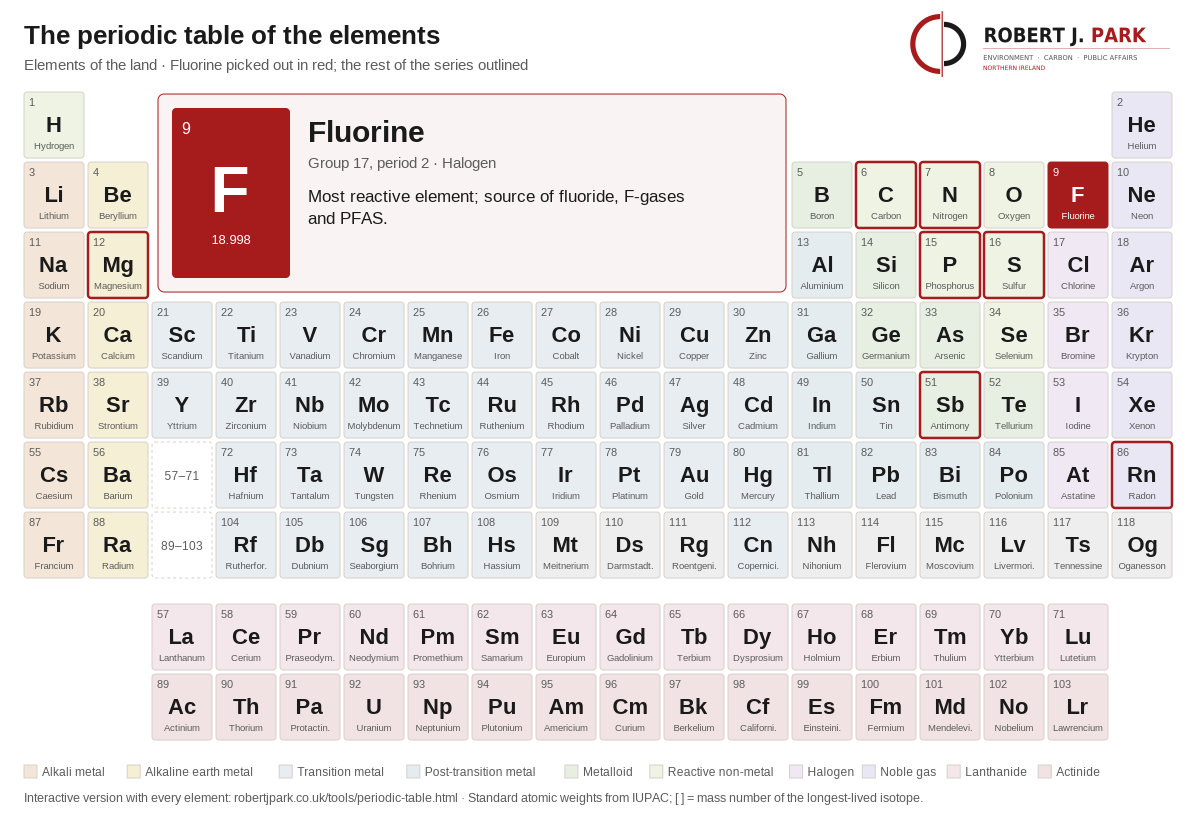
Pure fluorine is a pale yellow gas that attacks nearly everything it touches, glass included. Hardly anyone ever meets it. What we meet are its compounds: the refrigerant in a heat pump, the coating on a frying pan, the fluoride in toothpaste, and the “forever chemicals” turning up in water and blood.
The reason they last so long is chemistry. The bond between carbon and fluorine is the strongest single bond in organic chemistry. Nature has very few ways to break it.
The element in one minute
- Number 9, group 17 (the halogens), period 2.
- The most electronegative element: it pulls electrons harder than anything else.
- Mined as fluorspar (calcium fluoride), which is turned into hydrogen fluoride, the starting point for nearly every fluorine chemical. Fluorspar is on the EU’s critical raw materials list.
Climate
- F-gases are powerful, long-lived greenhouse gases. HFC-134a, a common refrigerant, has a 100-year global warming potential of 1,300 (AR5). In Northern Ireland, HFCs were 1.0% of greenhouse gas emissions in 2023 (NISRA, June 2025).
- Heat pumps need refrigerants. The switch from boilers to heat pumps makes the choice of refrigerant a climate question in its own right.
- Newer refrigerants are not the end of the story. Some break down to trifluoroacetic acid (TFA), a very persistent compound now building up in rain and water.
Soil and land
- Fertiliser fluoride. Phosphate rock is mostly fluoroapatite, so phosphate fertilisers carry fluoride (and cadmium) onto land.
- PFAS hotspots. Firefighting foams used at airports, fire-training grounds and some industrial sites are the main source of PFAS-contaminated land.
- Natural fluoride in groundwater varies with geology.
Agri-food
- Food contact: fluoropolymer coatings and some grease-proof packaging have used PFAS. Restrictions are tightening.
- Livestock: fluorosis in grazing animals has historically occurred near aluminium smelters and brickworks; it is now rare in the UK.
- Cold chain: almost all food refrigeration uses F-gases or their alternatives (CO₂, ammonia, hydrocarbons).
Atmosphere
Chlorofluorocarbons (CFCs) destroyed ozone and were banned under the Montreal Protocol. Their replacements, HFCs, spare the ozone layer but warm the climate. The Kigali Amendment now phases HFCs down too.
Why it matters in Northern Ireland
Two differences set Northern Ireland apart.
- Two F-gas rulebooks. Northern Ireland follows Regulation (EU) 2024/573 under the Windsor Framework, with its HFC phase-out and product bans. Great Britain still runs a regime based on the 2014 EU regulation; Defra consulted on tightening its HFC phasedown from 5 November to 17 December 2025. Engineers and wholesalers working across the Irish Sea face two sets of rules.
- No fluoridated water. NI Water confirmed in January 2025 that it has never artificially fluoridated the public supply since it was set up in 2007. Before then, two small schemes served Tandragee and Holywood (Hansard, 17 December 1997). Ireland has fluoridated since 1964.
The rules (as at 21 November 2026)
- F-gases: Regulation (EU) 2024/573 applies in Northern Ireland (in force 11 March 2024). The GB F-gas Regulation applies in Great Britain.
- PFAS: PFOS and PFOA are restricted as persistent organic pollutants. Broader PFAS restrictions are moving at different speeds in the EU and GB.
- Water: fluoridation in Northern Ireland would be a decision for the Department of Health under the Water and Sewerage Services (Northern Ireland) Order 2006.
- Safety: COSHH and CLP apply. Hydrofluoric acid needs specific first-aid arrangements.
Safety and handling
COSHH applies. Fluorine gas and hydrogen fluoride are among the most hazardous industrial chemicals; hydrofluoric acid burns may not hurt at first but can be fatal. Anyone handling them needs specific first aid (calcium gluconate) on site.
| Form | Classification (CLP) |
|---|---|
| Fluorine (gas) | Ox. Gas 1 H270 (may cause or intensify fire); Press. Gas H280; Acute Tox. 2 H330 (fatal if inhaled); Skin Corr. 1A H314. Harmonised (CLP Annex VI). |
| Substance | Workplace exposure limit (EH40/2005) |
|---|---|
| Fluorine | 1 ppm LTEL; 1 ppm STEL |
| Hydrogen fluoride (as F) | 1.8 ppm LTEL; 3 ppm STEL |
| Fluorides (inorganic, as F) | 2.5 mg/m³ LTEL |
| UN number | Proper shipping name | Class |
|---|---|---|
| UN1045 | Fluorine, compressed | 2.3 (5.1, 8) |
| UN1052 | Hydrogen fluoride, anhydrous | 8 (6.1) |
| UN1790 | Hydrofluoric acid | 8 (6.1) |
| UN1778 | Fluorosilicic acid | 8 |
| UN3159 | 1,1,1,2-Tetrafluoroethane (R-134a) | 2.2 |
| UN3163 | Liquefied gas, n.o.s. (e.g. R-410A blends) | 2.2 |
Risks of the element itself. Elemental fluorine is a pale yellow gas that is toxic, corrosive and ignites many materials on contact. It is handled only in specialist plant. Refrigerant gases are not toxic in normal use but displace oxygen in enclosed spaces and some are flammable (for example R-32 and the hydrocarbon alternatives).
Classification and limits change. Always work from the supplier’s current safety data sheet and your own COSHH assessment.
Compounds you will meet
| Where you meet it | Compound | Why it matters |
|---|---|---|
| Nature | Fluorite / fluorspar (CaF₂) | the main ore |
| Fluoroapatite | in phosphate rock; carries fluoride into fertilisers | |
| Fluoride ion (F⁻) | in groundwater, tea and toothpaste | |
| Manufacturing | Hydrogen fluoride (HF) | feedstock for almost all fluorochemicals |
| HFC refrigerants (R-134a, R-32, R-410A, R-404A) | fridges, heat pumps, air conditioning | |
| PTFE and fluoropolymers | non-stick coatings, seals, membranes | |
| PFAS (PFOS, PFOA and thousands more) | firefighting foam, textiles, food packaging | |
| Lithium hexafluorophosphate (LiPF₆) | electrolyte salt in lithium-ion batteries | |
| Climate | HFCs | e.g. HFC-134a, 100-year GWP 1,300 (AR5) |
| Sulfur hexafluoride (SF₆) and nitrogen trifluoride (NF₃) | very high GWP, very long-lived | |
| Trifluoroacetic acid (TFA) | a breakdown product of some newer refrigerants, building up in water |
What this means
- For businesses buying cooling or heat pumps: check which F-gas rulebook applies to your site, and ask what the refrigerant will cost to service in ten years.
- For landowners near airports and fire-training grounds: PFAS is a contaminated-land question worth asking early.
- For policy: fluorine shows how one fix (CFC to HFC) can become the next problem. Persistence should count as a hazard in itself.
Further reading on this site
Sources
- Regulation (EU) 2024/573 on fluorinated greenhouse gases and the European Commission F-gas legislation page (accessed 21 November 2026).
- Defra, F-gas Regulation in Great Britain: reform of the HFC phasedown (5 November to 17 December 2025).
- NI Water, Environmental information response NIW 2425512 on fluoridation (29 January 2025).
- NISRA, Northern Ireland greenhouse gas emissions down 7.1% in 2023 (10 June 2025).
- HSE, EH40/2005 Workplace exposure limits (4th edition, January 2020).
- Regulation (EC) No 1272/2008 (CLP), Annex VI.
- UNECE, ADR 2025.
All sources checked 21 November 2026.
Robert J. Park is an environment, carbon and public affairs consultant based in Larne, Northern Ireland. Download the briefing, *Fluorine* (PDF), with the full periodic table, the safety panel and the sources. This is one of eight learning briefings on the elements that shape climate, soil, land, agri-food and the atmosphere; the others are linked from the interactive periodic table. This is general information as at 21 November 2026, not legal, safety or agronomic advice. AI was used to lay out this document and to generate leads from the consultant’s research, knowledge and questioning; figures were checked against the official sources listed.