
Forever chemicals, two rulebooks
Part of the Policy series: where the rules stand in Northern Ireland, who decides them, and what to do about it. Updated as the rules change.
The argument in brief
On 6 July 2026 the UK Government replied to the Environmental Audit Committee’s PFAS report and made no firm commitment to any of its recommendations. It said it would wait for the EU’s universal PFAS restriction before deciding on a group-wide approach. On 23 October 2026 the first duties under the EU’s ban on PFAS in firefighting foam started to apply in Northern Ireland. Great Britain has no equivalent rule yet.
PFAS has become the clearest case of regulatory divergence inside the UK. Under the Windsor Framework, Northern Ireland follows EU REACH. Great Britain follows UK REACH, which has not restricted any new PFAS group since 2021. NI firms will reach EU standards first, whether or not Westminster follows. The harder question is how fast to move. Fluoropolymers sit inside some of the hardware that decarbonisation needs, and clean-up costs land on water bills and councils. Both sides of that argument rest on real evidence.
This piece sets out the arguments on each side; the recommendations are the author’s. Facts checked to 30 October 2026; rechecked and updated 16 November 2026.
Why “forever”? A chemist’s note. Fluorine is the most electronegative element. So the carbon–fluorine bond is highly polar and very strong: an average of about 485 kJ/mol, against about 410 kJ/mol for carbon–hydrogen. It is the strongest single bond carbon forms. In a perfluorinated chain, the fluorine atoms also form a tight sheath that shields the carbon backbone from attack. PFAS barely absorb sunlight, and water and microbes rarely break the bond. These molecules last for decades or longer, and destroying them usually needs high-temperature incineration. Many PFAS are only partly fluorinated. Their non-fluorinated parts can break down, leaving perfluorinated acids that persist.
The lifecycle at a glance
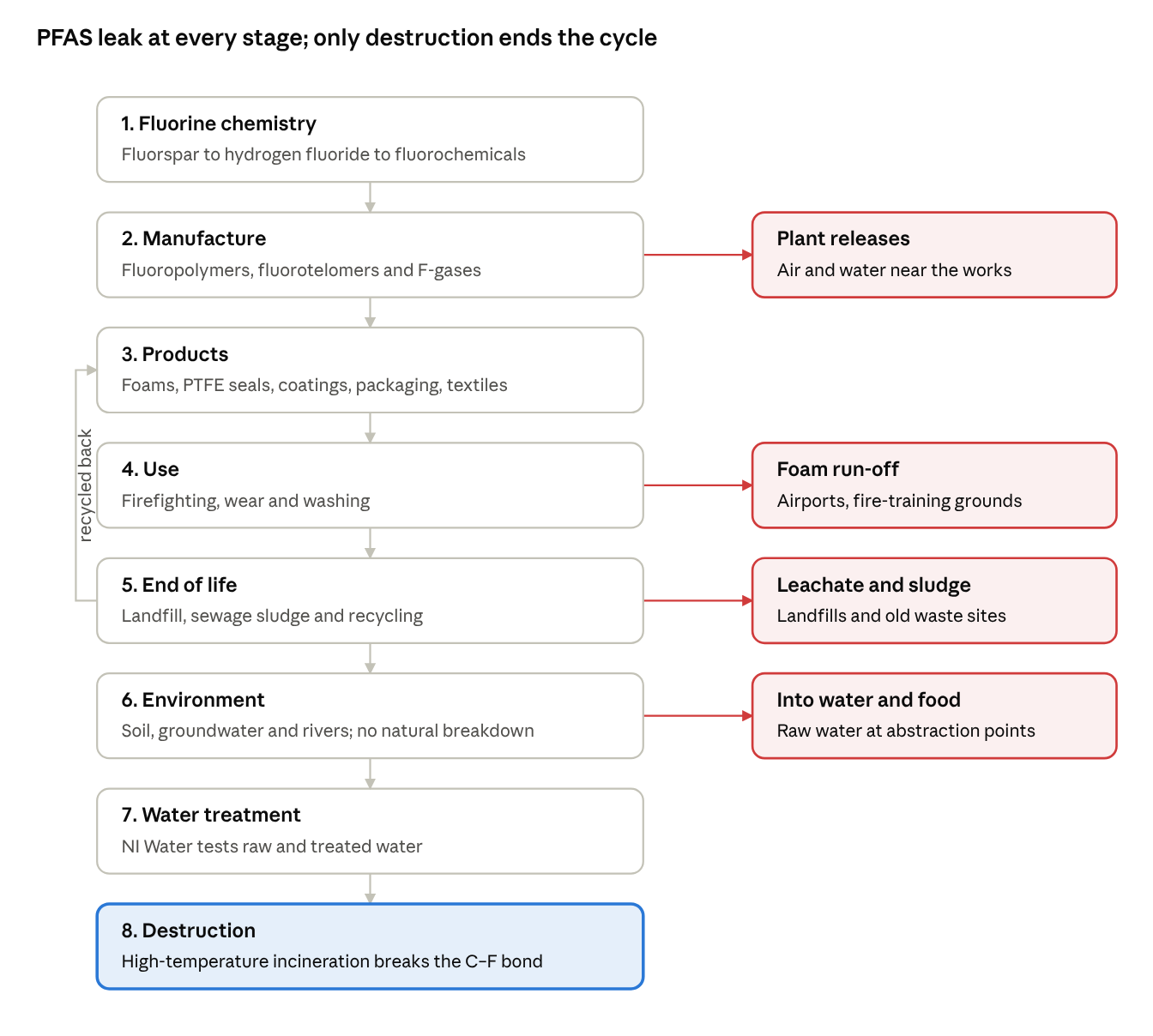
PFAS escape at manufacture, use, disposal and in the environment, and recycling can carry them back into new products. Only high-temperature destruction ends the cycle, so every earlier stage is a point where regulation can cut releases.
Then and now (2023 to October 2026)
| Rule or instrument | 2023 | Now (with date) | What changed and why |
|---|---|---|---|
| EU universal PFAS restriction (REACH) | Proposal submitted 13 Jan 2023; consultation 22 Mar to 25 Sep 2023 | RAC final opinion 2 Mar 2026; SEAC draft 10 Mar 2026; consultation closed 25 May 2026; SEAC final expected end 2026 (no later step found, 28 Oct 2026) | RAC found no safe level of emissions. SEAC wants more data before setting sector transition periods |
| EU firefighting foam restriction | Under ECHA committee review | Regulation (EU) 2025/1988 in force 23 Oct 2025. First duties 23 Oct 2026; general 1 mg/L limit 23 Oct 2030; some derogations to 2035 | Foam is a large, well-defined source. Applies in NI under the Windsor Framework |
| UK REACH firefighting foam restriction (GB) | Not started; Defra asked HSE on 5 Mar 2024 | Annex 15 consultation closed 18 Feb 2026; draft socio-economic opinion consulted 9 Jul to 7 Sep 2026; decision expected 2027 | GB tracks the EU but runs about three years behind |
| PFAS in food-contact packaging | EU PPWR still in negotiation | PPWR Article 5 applies from 12 Aug 2026, including in NI (DAERA FAQ, Aug 2026). No GB equivalent being taken forward | The EU chose a packaging-law route; GB has not followed |
| EU PFHxA restriction (Reg 2024/2462) | Backed by ECHA committees in 2021; awaiting Commission decision | Limits apply to consumer clothing, accessories and footwear from 10 Oct 2026; other textiles and leather from 10 Oct 2027 | First group restriction on a short-chain PFAS. Applies in NI; no GB equivalent listed (Fieldfisher, Feb 2026) |
| Drinking water limits | EU recast Drinking Water Directive limits due 2026; non-statutory guidance in England and Wales | EU limits apply from 12 Jan 2026. England and Wales use a 0.1 µg/L guideline for the sum of 48 PFAS (DWI, Mar 2025). NI has no statutory PFAS standard (NI Water, 13 Mar 2026). Defra will consult on a statutory limit for England; no date (3 Feb 2026) | NI Water voluntarily tests against the EU limits |
| UK policy framework | UK REACH options analysis (Mar 2023) | Defra PFAS Plan 3 Feb 2026; EAC report 23 Apr 2026; Government response 6 Jul 2026; UK REACH reform by Dec 2028 | Government chose monitoring and alignment with the EU unless there are compelling reasons to diverge |
| UK persistent organic pollutants list | PFOS and PFOA listed | GB: Defra confirmed on 10 Sep 2026 it will add long-chain PFCAs, intended by 16 Dec 2026; no SI confirmed (16 Nov 2026). NI: the EU POPs Regulation applies | GB and NI implement Stockholm Convention listings through separate laws |
Where the parties and governments stand (October 2026)
The split runs between “act now on non-essential uses”, backed by the EAC, the Lib Dems and Sinn Féin in Europe, and “follow the EU and monitor first”, which is the UK Government’s line. Most NI parties have said nothing in public.
| Party or government | Position (dated) |
|---|---|
| UK Government (Labour) | Response of 6 Jul 2026: no phase-out of non-essential uses, no remediation fund, UK REACH reform by Dec 2028, alignment with the EU unless there are compelling reasons not to. No change found since Andy Burnham became PM on 20 Jul 2026 (checked 28 Oct 2026) |
| Conservatives | Shadow Defra Minister Neil Hudson welcomed the EAC report and said more needs to be done; wants prevention, pressure on water companies and polluter pays (24 Apr 2026) |
| Reform UK | No published position found (searched 27 Oct 2026) |
| Liberal Democrats | Munira Wilson MP’s Ten Minute Rule bill would require the Chief Inspector of Drinking Water to issue PFAS guidance to water companies (bill printed 22 Jan 2025; 2024–26 session) |
| Green Party of England and Wales | No national published position found (searched 27 Oct 2026) |
| Scottish Government (SNP) | No ministerial statement found. SEPA found PFAS at nearly 90% of surface-water sites, with no standards exceeded (9 Jul 2026) |
| Welsh Government (Plaid Cymru) | Plaid’s 2026 manifesto pledged mandatory testing in high-risk areas (Senedd Research, 4 Jun 2026). No new government statement found |
| NI Executive / DAERA (Andrew Muir) | No ministerial PFAS position found. DAERA is implementing the PPWR PFAS rules (Aug 2026). NIEA commissioned a PFAS note on Mobuoy (Apr 2026) |
| Sinn Féin | Lynn Boylan MEP welcomed the recommendation for a broad EU ban (30 Mar 2026). No NI-specific statement found |
| DUP, Alliance, UUP, SDLP, TUV | No published position found (searched 27 Oct 2026) |
| European Commission | Commissioner Roswall backed a PFAS phase-out in an op-ed (reported 24 Apr 2026) |
-
Speed. The EAC wants non-essential uses restricted from 2027 (23 Apr 2026). The Government’s legislative horizon is December 2028.
-
Who pays. The EAC wants a remediation fund and a central backstop for councils. The Government points to existing contaminated-land law.
-
Alignment. The Government follows EU decisions by default, which narrows the practical gap between parties.
-
NI silence. EU rules apply in NI automatically, so local parties have had little reason to take positions, leaving no local voice on costs or exemptions.
Who decides what
EU institutions decide most PFAS rules for NI. Westminster, with Scottish and Welsh consent, decides for GB.
| Instrument | Who decides | Whose approval is needed | Position in Northern Ireland |
|---|---|---|---|
| EU universal restriction | European Commission, after ECHA opinions | REACH Committee (member states), then Parliament and Council scrutiny | Applies under the Windsor Framework. The UK has no vote |
| EU foam restriction 2025/1988 | Commission (adopted 2 Oct 2025) | Done | Applies now; first duties from 23 Oct 2026 |
| UK REACH foam restriction | Defra Secretary of State | Scottish and Welsh ministers | GB only; NI already covered by the EU rule |
| PPWR Article 5 (food-contact PFAS) | EU | Done | Applies from 12 Aug 2026 |
| Drinking water PFAS standard | Defra and DWI in England; devolved governments elsewhere | Parliament or devolved legislatures | No NI statutory standard; NI Water aligns voluntarily |
| UK REACH reform | UK Government | Devolved consent for GB | GB only |
Where the pillars compete
-
E versus E: hydrogen and energy hardware. PEM electrolysers and fuel cells rely on fluorinated membranes. SEAC did not accept a blanket carve-out for fluoropolymers (March 2026). A fast ban could slow green hydrogen; a slow one locks in more persistent material.
-
E versus E: the circular economy. RAC saw derogations for PFAS in recycled materials as possibly justified. The European Environmental Bureau argues they keep toxic chemicals cycling (26 Mar 2026).
-
E versus S: safety at sea and in the air. EU foam derogations for aviation, maritime and offshore run to 2035. Defra flags friction for ferries such as Belfast to Cairnryan if GB and NI rules differ (15 Jun 2026).
-
E versus S: who pays. Partial clean-up of short-chain PFAS in Europe could cost about €100bn a year (NGI, Jan 2025). Without a polluter-pays fund, bill payers and councils carry it.
-
Health speed versus data gaps. RAC found no safe level of emissions; SEAC says data on alternatives and costs is still thin. Waiting delays health gains, and acting first risks costly substitution.
What it means for Northern Ireland firms and councils
-
Two regimes. NI manufacturers selling into GB and the EU face two PFAS regimes. Building to the EU standard covers both markets for now.
-
Food-contact packaging placed on the NI market since 12 August 2026 must meet PPWR PFAS limits.
-
Fixed foam systems at airports, ports and chemical sites must plan for the 23 October 2030 limit, including disposal of legacy foam stock.
-
Legacy waste carries PFAS. NIEA’s Mobuoy note found raw groundwater up to 1.28 µg/L for the sum of 48 PFAS (March 2026), with no impact found at the Carmoney abstraction.
-
Drinking water. NI Water reports treated water within EU limits, but those limits have no statutory force in NI.
-
Councils running landfills or depots may face PFAS in leachate and soil, with no national backstop fund promised.
Practical examples
-
NI Water tests ahead of the law. NI Water has sampled raw and treated water for PFAS since 2020. It reports all treated results below 0.01 µg/L, the lowest tier in the English guidance it borrows (NI Water response 2526600, 13 Mar 2026).
-
DAERA holds data but no programme. Asked for all PFAS sampling since 2024, DAERA released results for private water supplies, marine sediments and Mobuoy. It described no wider monitoring programme (DAERA/26-482, 17 Aug 2026).
-
A council-led investigation in Lancashire. Wyre Council and partner agencies have sampled gardens near the former ICI site at Thornton-Cleveleys for PFOA. Most homes needed no further action, and no land had been designated under Part 2A (Wyre Council, 2 Mar 2026). The site’s operator, AGC Chemicals Europe, proposed closing the plant on 13 July 2026, citing four years of losses (ITV News).
-
Airports tested under permit powers. The Environment Agency used permit notices to make 24 commercial airports in England test for PFAS; reports indicate 17 found elevated levels (Henderson Chambers, 16 Oct 2026).
-
The bill for legacy foam. In April 2026 Guernsey sought approval for up to £16.54m to dig out about 15,000 tonnes of foam-contaminated soil at its airport (Henderson Chambers, 16 Oct 2026).
-
Clothing rules already live in NI. Since 10 October 2026, consumer clothing, accessories and footwear placed on the NI market must meet EU limits of 25 ppb for PFHxA and its salts, and 1,000 ppb for related substances (Regulation (EU) 2024/2462). NI textile and workwear firms selling into the EU need supplier test data now.
Recommendations
-
DAERA and DfI: write the EU drinking water PFAS limits into NI regulations. NI Water already meets them, so the cost is low and confidence improves.
-
NIEA: publish an NI PFAS monitoring programme like SEPA’s, starting with airports, landfills, fire-training grounds and Lough Neagh abstractions.
-
Defra: bring the GB foam decision forward from 2027. It would remove friction for ferries and fire-equipment suppliers.
-
DAERA: commence Part III of the 1997 Order with PFAS in scope. Mobuoy shows the need, and NI has no statutory contaminated-land regime.
-
NI Executive: set out NI’s interests in the EU restriction through UK–EU structures before the REACH Committee vote. NI has no vote, so it needs to make its case early.
-
Firms: map PFAS in products and processes now. Look at seals, coatings, PTFE parts, foams and packaging, and ask suppliers for total-fluorine data.
-
Energy and engineering firms: give trade bodies evidence on essential fluoropolymer uses. Exemptions go to sectors that supply data.
-
Councils: specify fluorine-free foams and PFAS-free packaging in procurement. Switching now is cheaper than cleaning up later.
Sources
-
Linklaters: SEAC draft opinion on the universal restriction (Mar 2026)
-
EAC 9th Report: Addressing the risks from PFAS (23 Apr 2026)
-
The Chemical Engineer: UK government shies away from PFAS ban (15 Jul 2026)
-
HSE: UK REACH restriction on PFAS in firefighting foam (closed 7 Sep 2026)
-
Defra Explanatory Memorandum on Regulation (EU) 2025/1988 (15 Jun 2026)
-
DAERA FAQ: Packaging and Packaging Waste Regulation (Aug 2026)
-
Henderson Chambers: PFAS, AFFF and contaminated land (16 Oct 2026)
-
Neil Hudson: Shadow Defra Minister on EAC PFAS report (24 Apr 2026)
-
NGI: costs of cleaning PFAS pollution for Europe (17 Jan 2025)
-
WaterstofNet: PFAS alternatives for electrolysers (30 May 2024)
-
Hansard: Government PFAS Plan, written statement (3 Feb 2026)
-
EAC 2nd Special Report: PFAS Government Response, HC 519 (6 Jul 2026)
-
Defra: POPs Regulation 2026, summary of responses and government response (10 Sep 2026)
-
CMS: EU-wide PFAS restriction, what happens next (8 Apr 2026)
-
UK Parliament: Poly and Perfluorinated Alkyl Substances (Guidance) Bill
-
Wyre Council: multi-agency soil sampling update (2 Mar 2026)
-
ITV News: AGC Chemicals proposes Thornton-Cleveleys closure (13 Jul 2026)
Robert J. Park is an independent environment, carbon and public-affairs consultant based in Larne, Northern Ireland. He helps firms and public bodies measure their carbon and make their case on policy.
Agree or disagree? Get in touch on LinkedIn or WhatsApp @robertjpark.