
Crown Dependencies, ferries and carbon: the Isle of Man, Jersey and Guernsey under the UK ETS and CBAM
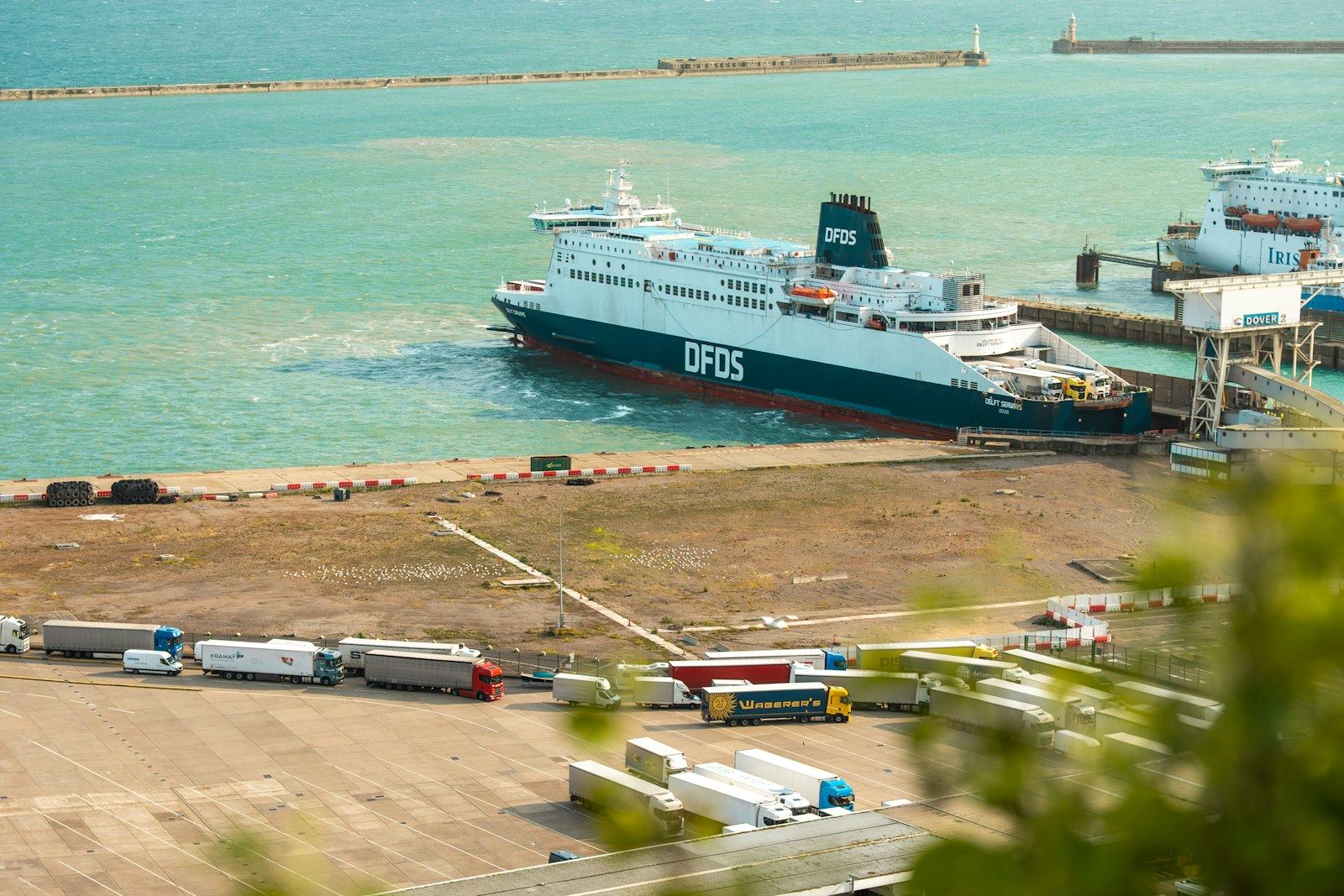
Rules checked 24 November 2026 against GOV.UK, legislation.gov.uk, the European Commission and EUR-Lex. General information, not legal, tax or customs advice. The 2028 changes are agreed politically and are not law.
The short version
- Today, ferry voyages between the UK and the Isle of Man, Jersey or Guernsey are outside the UK Emissions Trading Scheme (UK ETS). Time alongside in a UK port is charged in full.
- From 1 January 2028, the UK says half the emissions on those voyages will come in. That needs the UK–EU linking treaty and UK legislation.
- A drafting anomaly, and an academic one. As the Order is written, a ship that makes a genuine call at Douglas between Great Britain and Northern Ireland is not on a UK ETS voyage at all. I expect that to be closed.
- UK CBAM treats goods arriving from the islands as imports. An island warehouse delays the charge; it does not remove it.
- Where a ferry company is based makes no difference.
Ferries today
The UK ETS has covered shipping since 1 July 2026, for ships of 5,000 gross tonnage and above (SI 2026/392). Three rules in that Order decide the islands’ position.
- A voyage is UK port to UK port. It must start and end at UK ports of call and must not arrive at a port of call outside the UK’s jurisdiction (Schedule 2A, paragraph 7).
- A port of call is a commercial stop. Passengers or crew get on or off, or cargo is loaded or unloaded. A stop only for fuel, supplies, crew relief, repairs or shelter does not count (paragraph 6).
- Port time is charged whatever the voyage. A ferry arriving from Douglas or St Helier pays for its emissions while alongside in Heysham, Liverpool, Larne, Belfast, Portsmouth or Poole.
The UK ETS Authority said in July 2025 that it did not intend to include Crown Dependency voyages at the 2026 launch, and that it might do so later, particularly if operators start gaming the rules (interim response). The exemption for Scottish island ferries has not been extended to other islands (main response, 25 November 2025).
On the EU side, a ship of 5,000 gross tonnage or more sailing between an EU port and an island port (St Malo and Jersey, Dublin and Douglas) surrenders for half that voyage and for all its time in the EU port (European Commission).
What changes in 2028
The government’s explainer on the UK–EU linking agreement (20 November 2026) says that from 1 January 2028:
- the UK ETS will include half the emissions from international voyages, including journeys between the UK and the Crown Dependencies;
- the 50% deduction on voyages between Great Britain and Northern Ireland ends, so those crossings are charged in full;
- the UK will align with the EU’s temporary relief for passenger and ro-pax voyages to islands with fewer than 200,000 residents and no road or rail link, until at least 31 December 2030.
None of that is law. The legal text is not published (DESNZ explainer).
The island relief is narrower than it sounds. In the EU Directive a member state must ask for it, it covers passenger and ro-pax ships but not freight-only ships, and it applies to voyages between an island and a port of the same member state (Article 12(3-d) of Directive 2003/87/EC, inserted by Directive (EU) 2023/959). The Isle of Man, Jersey and Guernsey are not part of the UK, so whether their routes qualify depends on how the UK writes its version. The explainer does not say.
The stopover question: an academic point
This section is about how the Order is drafted. It is not a route plan. I expect the gap it describes to be closed: the government has already said island voyages come into the scheme from 2028, and the UK ETS Authority has said it may act sooner if the rule is gamed. Anyone who built a service around it would be building on a rule that is on notice.
Since 1 April 2026 the Isle of Man Steam Packet has run a year-round service between Larne and Douglas, alongside its sailings from Douglas to Heysham and Liverpool (Steam Packet, Larne). So the anomaly is visible on a real timetable from Larne, which is why it is worth setting out.
| Crossing | UK ETS at sea today | From 2028, if the terms become law |
|---|---|---|
| Great Britain to Northern Ireland, direct | 50% | 100% |
| Great Britain to Douglas to Northern Ireland, with a genuine call | Nil on both legs | 50% of each leg |
| Great Britain to France, direct | Nil (EU ETS takes 50%) | 50% UK and 50% EU |
| Great Britain to Jersey or Guernsey to France, with a genuine call | Nil; EU ETS takes 50% of the island-to-France leg only | 50% UK on the first leg, 50% EU on the second |
The table applies in both directions. Port time in UK ports is charged in full in every row.
Geography decides whether this matters. On my own straight-line measurements, which understate real sea tracks, a call at Douglas adds almost nothing to Belfast or Larne to Liverpool, about 2% to Belfast to Heysham and about 5% to Larne to Heysham. On Larne to Cairnryan it roughly quadruples the distance. Poole or Portsmouth to St Malo passes close to Jersey; the Normandy routes do not.
A stop is not free. It costs hours, harbour dues, a berth and a broken timetable, and through-freight on two sailings is handled twice. At today’s carbon price the saving is small beside those costs. On paper the gap widens in 2028, when the direct Northern Ireland crossing is charged in full and an island routing at half, or less if the island relief applies. That is the strongest reason to expect the drafting to be tightened before then, and it is a fair question to put to ministers.
Why I treat it as academic:
- The rule is on notice. The Order has no anti-avoidance clause, but the Authority has said it may bring these voyages in if gaming appears, and the 2028 terms already bring them in at half. The EU’s anti-evasion rule for nearby transhipment ports covers container ships only; for everything else the Commission has a duty to monitor.
- The call must be real. A stop with no passengers or cargo exchanged is not a port of call.
- The company’s address is irrelevant. The operator is the ship’s registered owner or its safety-management company, wherever based. Flag is only a reporting field.
Goods: UK CBAM and island warehouses
UK CBAM starts on 1 January 2027. HMRC’s policy summary says goods entering the UK from the Crown Dependencies, including the Isle of Man, will be subject to it (HMRC, updated 23 November 2026).
- Isle of Man. The Finance Act 2026 treats a CBAM good imported into the UK from the Isle of Man as an import, unless the Treasury excludes it by regulations. There is no customs declaration on that movement, so the importer is “the person on whose behalf the good is imported” and the records carry the weight (Finance Act 2026, Part 5, sections 144 and 146).
- Jersey and Guernsey. The Act does not name them. They are in a customs union with the UK but outside its VAT area, and goods moving to the UK are declared. Which limb of the Act applies is a question for HMRC.
- Warehouses and free zones. Holding CBAM goods under a customs procedure delays the charge until they are released. Processing them into something that is not a CBAM good does not wash the charge out: it is then calculated on the original CBAM good (section 145). An island warehouse therefore defers UK CBAM until the goods reach the UK, much as a UK warehouse does. Jersey has a customs warehousing regime (Jersey Customs, Directive 17). I found no free zone designated in Jersey or Guernsey. On the Isle of Man, the government says goods can be entered, held or processed under duty or tax suspension regimes with customs approval (Isle of Man Government). A House of Commons Library paper recorded in 2018 that the island had a free port when the UK had none (CDP-2018-0211); I could not confirm its current designation from the Manx government’s own pages.
- Origin, not route. The UK intends to exempt goods of EU, EEA or Swiss origin from 1 January 2027; draft legislation was published on 23 November 2026 and is not law. Eligibility turns on where goods were made, so routing third-country steel or fertiliser through an island gains nothing.
- EU CBAM. The islands are not on the EU’s list of exempt territories (Annex III of Regulation (EU) 2023/956, original text).
What is not settled
- Whether goods imported into an island and used there face any carbon border charge. I found no CBAM measure of the Isle of Man, Jersey or Guernsey.
- Whether CBAM goods processed on the Isle of Man outside a customs procedure, then sent to Great Britain as something else, are caught.
- Who the importer is when an island seller delivers duty-paid to several UK customers.
- How the island relief will be written for islands outside the UK.
- Each vessel’s tonnage. Several fast craft on these routes are reported to sit close to the 5,000 gross tonnage line; I have not checked the registers.
These are questions for HMRC, Isle of Man Customs and Immigration, the Jersey and Guernsey customs services, and a customs specialist.
What to do
- Freight buyers in Northern Ireland: ask your ferry operator how its carbon surcharge is built and what it expects on 1 January 2028. Read the 2028 ETS horizon and The Irish Sea carbon bill.
- Importers of steel, aluminium, cement, fertiliser or hydrogen through an island: keep origin evidence and dated records of every movement into the UK, and count them towards the £50,000 threshold. Start with Is it a CBAM good?.
- Councils and ports: shore power cuts the one charge every ship pays, the time alongside.
A free 30-minute first call is available through the CBAM Desk.
Created with assistive technology including AI and re-checked against the official sources listed.