
The Irish Sea carbon bill: who pays to cross
Part of the Policy series: where the rules stand in Northern Ireland, who decides them, and what to do about it. Updated as the rules change.
The argument in brief
On 10 March 2026 the Northern Ireland Assembly voted 49 to 30 to approve the order putting domestic shipping into the UK Emissions Trading Scheme (UK ETS). DAERA Minister Andrew Muir moved the motion. Two days later the Lords rejected a fatal motion by 134 votes to 26. In that debate Lord Empey (UUP) said NI parties had been misled, and Lord Dodds (DUP) asked why Scottish island ferries are exempt and Northern Ireland is not. The order came into force on 1 July 2026 as SI 2026/392.
Freight carbon costs fall hardest on a region that depends on sea links. Northern Ireland moves almost everything by ferry and HGV, and it sits across two carbon regimes. The 50% discount on GB–NI voyages is temporary by design. The UK ETS Authority says it lasts only while Irish Sea carbon pricing differs, and GB–NI voyages move to full surrender if international voyages join the UK ETS (Nov 2025). The UK and EU agreed on 20 November 2026 to link their emissions trading schemes, aiming for 1 January 2028; under the linking terms the UK ETS takes in half of international voyages from that date and the 50% reduction for GB–NI voyages is removed (DESNZ explainer, 20 November 2026). Both sides say they aim to apply the agreement from 2028 (Joint Statement, para 49). The treaty is not yet concluded and the legal text is not published, so none of this is law yet.
The real choice for firms is whether to treat today’s small surcharge as the start of a rising cost line. The author argues they should, and that the money raised should come back to NI ports and fleets.
This piece sets out the arguments on each side; the recommendations are the author’s. Facts checked to 30 October 2026; summit lines updated on 21 November 2026 from the joint statement of 20 November 2026.
The lifecycle at a glance
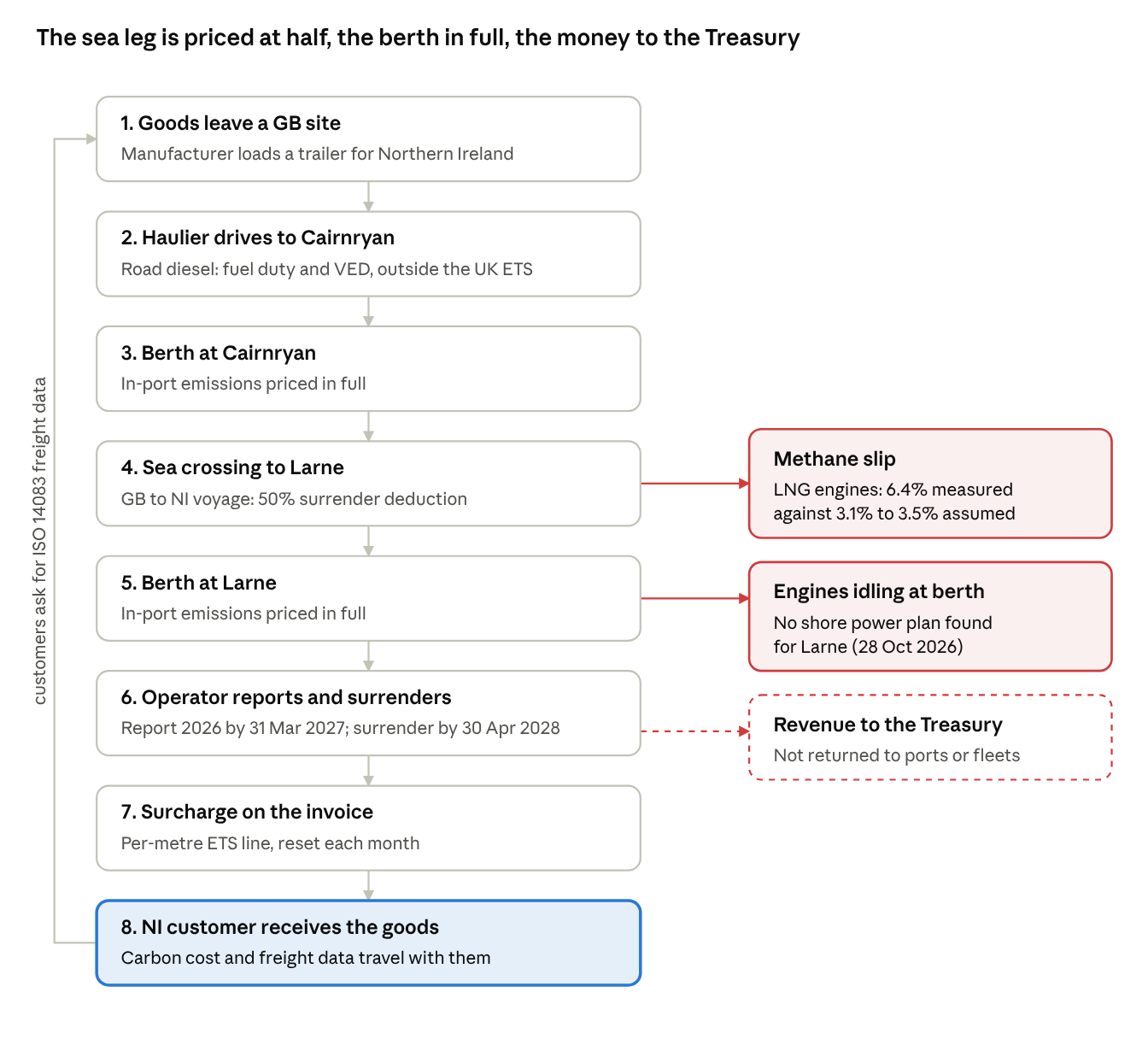
A trailer from GB to Larne pays full carbon price while its ferry sits at either berth, and half price at sea. The cost reaches the shipper as a monthly surcharge, while the revenue goes to the Treasury rather than to ports.
Then and now (2023 to October 2026)
| Rule or instrument | 2023 | Now (with date) | What changed and why |
|---|---|---|---|
| UK ETS maritime | Under consultation; shipping not covered | In force 1 Jul 2026 for ships of 5,000 GT and over; covers CO₂, methane and N₂O. GB–NI voyages get a 50% deduction; berth time counts in full. 2026 emissions reported by 31 Mar 2027 and surrendered by 30 Apr 2028 | Brought in to match the EU ETS and keep NI goods clear of EU CBAM. Scottish island ferries exempt. Threshold and exemptions reviewed in 2028 |
| UK ETS international voyages | Not proposed | Agreed in the linking terms of 20 Nov 2026: half of international voyages from 1 January 2028, subject to the treaty being concluded and UK ETS legislation (DESNZ explainer) | The 50% reduction for GB–NI voyages is removed under the linking terms (DESNZ explainer, 20 Nov 2026) |
| EU ETS maritime | Agreed; due 2024 | 70% of 2025 emissions surrendered in 2026, 100% from 2027. Methane and N₂O covered from 2026. EU–UK voyages count at 50% | Fit for 55 phase-in. Already applies to Ireland–GB routes |
| FuelEU Maritime | Adopted | In force since 1 Jan 2025: 2% cut in GHG intensity, 6% by 2030, measured well-to-wake | Pushes operators to cleaner fuels; shore power at major EU ports from 2030 |
| Zero-emission HGV phase-out | 2035 (up to 26t) and 2040 (all), set May 2022 | Same dates. DfT consulted on how to regulate them (6 Jan–17 Mar 2026). Conservatives pledged to scrap them (27 Aug 2026) | Policy now depends on who governs |
| EU ETS2 (road and heating fuels) | Due 2027 | Delayed to 2028. Ireland seeks an exemption because it has a carbon tax (Sep 2026) | Cost-of-living pressure. Does not apply in NI |
| Fuel duty and HGV VED | Duty frozen with 5p cut | September rise postponed; 52.95p a litre held to end of 2026 (20 May 2026). HGV VED £1 for renewals 1 Jul 2026 to 30 Jun 2027 (17 Jun 2026). Budget (28 Oct 2026): 5p cut extended to 30 Jun 2027; pre-March 2022 rates from 1 Jul 2027, then RPI uprating. HGV VED and HGV levy rise by RPI from 1 Apr 2027 | Response to fuel price spikes. The Budget (28 Oct 2026) set an end date for the 2022 cut |
| UK–EU SPS agreement | Not on the table | Negotiations concluded at the 20 Nov 2026 summit; aimed at 1 March 2028 (Joint Statement, para 48). Not yet law | Agreed at the May 2025 reset. NI already follows EU SPS rules |
Where the parties and governments stand (October 2026)
The split is between those who see maritime carbon pricing as protection against EU CBAM and those who see it as a tax on a peripheral region.
| Party or government | Position (dated) |
|---|---|
| UK Government (Labour) | Lord Whitehead put the freight cost impact below 1% and did not recognise an industry figure of 6% (12 Mar 2026). The UK ETS Authority says the NI deduction lasts only while Irish Sea pricing differs (Nov 2025) |
| Conservatives (Badenoch) | Andrew Bowie said they would vote against the order (3 Feb 2026). Pledged to scrap the UK ETS and CBAM (1 Apr 2026) and the HGV phase-out dates (27 Aug 2026) |
| Reform UK (Farage) | Would scrap CBAM and green levies (Feb 2026). No maritime-specific position found |
| Liberal Democrats (Davey) | Baroness Suttie backed the order and the NI deduction, and asked how to avoid a cliff edge after the 2028 review (12 Mar 2026) |
| Green Party (Polanski) | Baroness Bennett backed the order and raised cruise-ship air quality at Belfast (12 Mar 2026) |
| Scottish Government (Swinney) | Island and peninsula ferries exempt to protect access to essential services (26 Nov 2025; 30 Jan 2026). Review in 2028 |
| Welsh Government (ap Iorwerth) | No published position found (searched 27 Oct 2026) |
| NI Executive: DAERA (Muir, Alliance) | Moved approval; carried 49–30 (10 Mar 2026) |
| NI Executive: Infrastructure (Kimmins, SF) | Consulted on rules for zero-emission goods vehicles (10 Mar 2026); higher weight limit for ZE vans (30 Jul 2026) |
| DUP | Lord Dodds challenged the NI–Scotland gap and asked whether NI can draw on the £271m maritime fund (12 Mar 2026) |
| UUP | Lord Empey opposed it, quoting an NIO estimate of £10m–£15m a year in allowance costs (12 Mar 2026) |
| TUV | Jim Allister called it “a carbon tax on my constituents”, including Rathlin islanders (3 Feb 2026) |
| Sinn Féin, SDLP, Alliance | Their five AERA Committee members voted for; the four DUP and UUP members voted against, 5–4 (9 Mar 2026) |
| Haulage bodies | RHA wants a “practical, affordable” multi-fuel route to zero emission (27 Aug 2026). No Logistics UK position on maritime ETS found (searched 27 Oct 2026) |
-
Equal treatment. Unionists compare NI with Scottish islands. The government compares NI with Ireland–GB routes, which pay EU ETS at 50%.
-
Permanence. The linking terms agreed on 20 November 2026 would end the 50% deduction from 1 January 2028, if the treaty and the UK ETS changes are made in time. Labour and the Lib Dems accept a path to full pricing. The Conservatives and Reform would scrap the whole scheme.
-
Revenue. No proceeds are earmarked, and nobody has committed money to NI ports.
-
CBAM leverage. Supporters say approval keeps NI exports clear of EU CBAM. Lord Empey says that risk was overstated.
Who decides what
The UK ETS is run jointly by four governments. EU rules reach NI through the Windsor Framework.
| Instrument | Who decides | Whose approval is needed | Position in Northern Ireland |
|---|---|---|---|
| UK ETS maritime | UK ETS Authority (UK, Scottish, Welsh governments and DAERA) | Both Houses, Scottish Parliament, Senedd and NI Assembly | Applies. 50% deduction on GB–NI voyages; berth time counts in full |
| EU ETS maritime and FuelEU | EU | Council and Parliament | Cover Ireland–GB and EU-port legs, not GB–NI |
| Zero-emission HGV dates and CO₂ rules | DfT (GB) | UK Parliament | EU Regulation 2024/1610 notified under the Windsor Framework |
| Fuel duty, VED, HGV levy | HM Treasury | UK Parliament | UK-wide |
| ETS2 | EU | Council and Parliament | Applies in Ireland from 2028, not NI |
| Shore power and ports | Harbour authorities; DfI for trust ports | Port boards, Utility Regulator, NIE Networks | Belfast Harbour’s £1.3bn plan includes its first shore power (19 May 2026); no published plans found for Larne or Warrenpoint (28 Oct 2026) |
Where the pillars compete
-
Decarbonisation against cost of living (E against S). The government puts the freight cost effect below 1%; Baroness Hoey cited about 6% (12 Mar 2026). A small percentage on every pallet from GB weighs more on a peripheral region.
-
Equal treatment against lifeline exemption (S against S). Scottish island ferries are exempt to protect essential services. NI’s two million residents depend on sea links too.
-
LNG against diesel (E against E). The ICCT’s FUMES project measured average methane slip of 6.4% from common LNG engines, against 3.1% assumed by the EU and 3.5% by the IMO. The UK ETS prices methane, so the assumed rate sets the bill (Nov 2025). A low-CO₂ ferry can warm the climate more than its paperwork shows.
-
Port growth against local air (E against S). Belfast Harbour is completing a £90m cruise terminal (19 May 2026). Berth time is charged in full under the UK ETS, so shore power helps both the carbon bill and local air.
-
Cross-border fuel prices (S against E). ETS2 will raise road fuel costs in Ireland from 2028 unless Dublin wins the exemption it is seeking. NI is outside ETS2, which may shift where fleets refuel.
What it means for Northern Ireland firms and councils
-
Surcharges are already on invoices. Stena’s monthly notices for its Belfast routes set a per-metre UK ETS charge: £1.08 in July and £1.13 in September 2026. It tracks the carbon price and would rise if the 50% deduction ends.
-
Larne–Cairnryan is a domestic route. It gets the deduction at sea, but berth time in Larne and Cairnryan is charged in full. Turnaround time and shore power matter.
-
Customers will ask for Scope 3 freight data. GLEC Framework v3 aligns with ISO 14083:2023.
-
Update contract clauses. Check carriage contracts for carbon pass-through, fuel indexation and who carries ETS costs after 2028.
-
Fuel duty steps up in July 2027. The 5p cut now ends on 30 June 2027. Rates then return to pre-March 2022 levels and rise with RPI (Budget, 28 Oct 2026). Hauliers pricing 2027 contracts should build in the step.
-
Councils have three roles. Mid and East Antrim (Larne), Belfast and Newry, Mourne and Down host ports; they manage air quality and plan HGV routes and depots.
-
Fleet renewal is live. NI appears to follow EU HGV CO₂ rules (45% cut by 2030). GB policy depends on the next election.
Practical examples
-
Stena’s ETS line on Belfast freight. Stena Line Freight set its UK ETS charge at £1.08 a metre for July 2026 and £1.13 for September, on its Belfast routes to Cairnryan, Heysham and Liverpool. On a 13.6-metre trailer that is about £15 a crossing (author’s arithmetic). Stena Line Freight, September 2026 notice
-
Larne berth time counts in full. The UK ETS covers every in-port emission at a UK port, whatever the voyage. On Larne–Cairnryan, time alongside at both ends is charged in full, while the sea leg gets the 50% deduction (Nov 2025). UK ETS Authority response
-
A hybrid freight ferry on the Irish Sea. Stena Futura entered service on Belfast–Heysham on 22 September 2025. It is methanol-ready and can run on batteries and shore power “when available”. Stena Line release, 18 Sep 2025
-
Belfast plans shore power; Larne has no plan found. Belfast Harbour’s £1.3bn 25-year plan, set out on 19 May 2026, includes its first shore power for docked ships. We found no published shore power plan for Larne (28 Oct 2026). RTÉ, 19 May 2026
-
A £1 road tax year for hauliers. Most HGVs renewing vehicle excise duty between 1 July 2026 and 30 June 2027 pay £1. VED is a UK-wide tax, so NI fleets renewing in that window benefit too. The Budget of 28 October 2026 kept the £1 rate to 30 June 2027 and raises HGV VED and the HGV levy by RPI from 1 April 2027. GOV.UK, 17 Jun 2026
-
Methane slip measured at twice the assumption. The ICCT’s FUMES project measured average slip of 6.4% from common four-stroke LNG engines on 18 ships. The EU assumes 3.1% and the IMO 3.5% (Jan 2024). ICCT FUMES report
Recommendations
-
UK ETS Authority: ring-fence a share of maritime proceeds for NI port shore power. None is earmarked, and berth emissions are charged in full.
-
DESNZ and NIO: publish route-level cost estimates for GB–NI freight before the 2028 review. The 1% and 6% figures cannot both be right, and ministers have also said ticket prices would rise by a “low single digit” percentage (written answer HL15805, 7 Apr 2026).
-
UK Government: put the end date of the NI deduction into law, and say early if it slips. The linking terms of 20 November 2026 remove it from 1 January 2028, but the legal text is not published and the treaty is not concluded. Firms need a known date.
-
UK ETS Authority: tighten default methane-slip values for LNG ferries. Measured slip runs about twice the assumed rate.
-
DfI: publish an NI HGV charging and depot plan tied to the 2030 EU CO₂ targets. Grid capacity near Larne, Belfast and Warrenpoint is the binding constraint.
-
Firms: ask carriers for ISO 14083 data and an ETS line on invoices.
-
Firms: add carbon pass-through and review clauses to freight contracts now. A cost that is small today is designed to rise.
-
Councils: map port air quality and HGV routes, and back shore power in local plans.
Sources
-
Hansard: Commons Delegated Legislation Committee on the draft Order (3 Feb 2026)
-
UK ETS Authority: domestic maritime main response (Nov 2025)
-
gov.scot: Island Communities Impact Assessment (26 Nov 2025)
-
Council of the EU: Joint Statement, EU–UK Summit, 20 November 2026 (ST 16174/26); GOV.UK copy
-
DESNZ: UK–EU ETS linking agreement explainer (20 November 2026)
-
Stena Line: Stena Futura enters Belfast–Heysham service (18 Sep 2025)
-
ICCT: FUMES methane emissions from LNG-fuelled ships (Jan 2024)
-
Transport Operator: Conservatives pledge to scrap diesel HGV dates (27 Aug 2026)
Added 30 October 2026 (Budget):
- Budget 2026: Overview of Tax Legislation and Rates (OOTLAR), HM Treasury and HMRC (28 Oct 2026), paragraphs 1.79 (HGV VED and levy), 2.18 (fuel duty) and 2.23 (£1 HGV VED rate)
Robert J. Park is an independent environment, carbon and public-affairs consultant based in Larne, Northern Ireland. He helps firms and public bodies measure their carbon and make their case on policy.
Agree or disagree? Get in touch on LinkedIn or WhatsApp @robertjpark.
This piece is general information for Northern Ireland businesses, not tax, legal or financial advice. Check your own position with your adviser before acting on it.