
The 2028 ETS horizon: what linking the UK and EU carbon markets means for Northern Ireland
In brief. On 20 November 2026 the UK and the EU concluded talks to link their emissions trading schemes (ETS). They are aiming for the link to operate from 1 January 2028. It is not law yet: the legal text is unpublished and both sides need to legislate in 2027.
For Northern Ireland, four things change:
- One carbon price. UK and EU allowances become interchangeable. NI’s power stations (EU ETS) and NI industry (UK ETS) will face converging prices.
- No UK price floor. The UK auction reserve price goes, and UK free allocation follows EU rules, including the phase-out for sectors covered by the carbon border adjustment mechanism (CBAM).
- Dearer GB–NI shipping. The 50% discount for voyages between Great Britain and Northern Ireland ends, and half of international voyages come into the UK ETS.
- Fewer carbon borders on goods. The UK intends to exempt EU goods from UK CBAM from 2027; the EU is expected to exempt UK goods from 2028.
Download the briefing (PDF) · Companion piece: The 2027 CBAM horizon
Status as at 21 November 2026. Every fact about the agreement comes from government summaries, because the treaty text is not yet published. General information, not legal or tax advice.
Terms used. ETS: emissions trading scheme, where emitters surrender one allowance per tonne of carbon dioxide equivalent. UK ETS / EU ETS: the two schemes. Linking: each side accepts the other’s allowances. Free allocation: allowances given free to industry at risk of moving abroad. Auction reserve price: the UK’s minimum auction price. CBAM: carbon border adjustment mechanism, a charge on the carbon in imported goods. ETS2: the EU’s separate scheme for buildings and road fuel. CORSIA: the international scheme for offsetting flight emissions. SEM: the all-island Single Electricity Market. Windsor Framework: the arrangements under which NI electricity generation stays in the EU ETS.
What was agreed, and what is still to come
- Start and first surrender. The aim is to operate from 1 January 2028. Allowances from either scheme can be used for 2027 emissions, and the first surrender in which both count is due on 30 September 2028 (DESNZ explainer, 20 November 2026).
- Rules. The agreement “includes elements of dynamic alignment”. The UK applies listed EU ETS rules when the EU does, with agreed adaptations. The UK gets early “decision-shaping” rights, not a vote. The UK ETS Authority, which includes DAERA, keeps its decision-making powers.
- Cap and market. UK caps are no more than 62.2 million allowances in 2028, 59.5 million in 2029 and 57.6 million in 2030. From 2031 the cap is limited to 7.1% of the EU cap for shared activities. The UK sets up its own market stability reserve in 2028. The auction reserve price is removed when the link starts.
- Governance and exit. Disputes go to independent arbitration. Either side may suspend mutual recognition, and the agreement can be ended on 18 to 30 months’ notice.
- Still to happen. Publication of the legal text, signature and conclusion; UK secondary legislation in 2027, with an impact assessment; EU legislation; and approval of UK ETS Order amendments by all four legislatures. The NI Assembly is due to dissolve in March 2027 for the May election, so any Order it has not approved by then waits for a new Assembly.
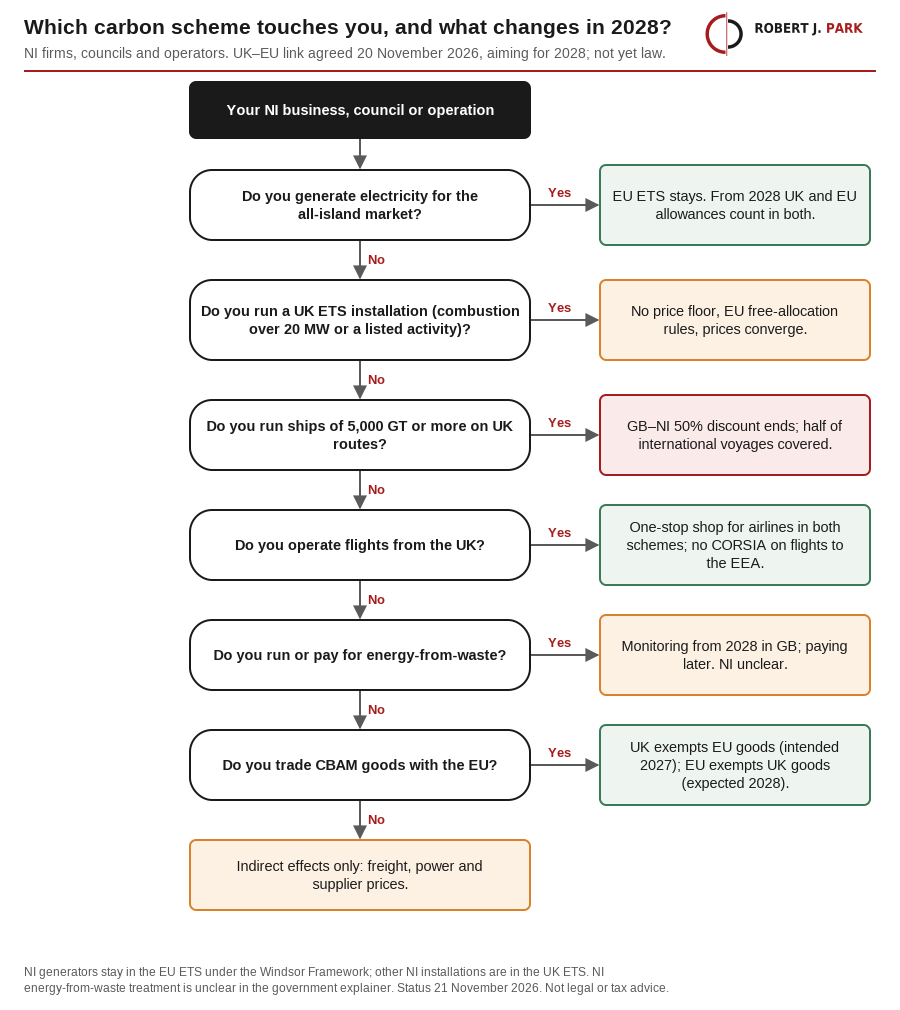
Eight cases
1. An NI power station (EU ETS, all-island market)
- 2027: No change. NI electricity generation stays in the EU ETS under the Windsor Framework, and the agreement does not apply to Windsor Framework areas.
- 2028 onwards: UK and EU allowances become interchangeable. The carbon price gap between GB power and SEM power narrows, so flows over the Moyle interconnector and the links to Ireland should follow fuel costs and capacity more than carbon prices.
- CBAM on electricity. In March 2026 the Secretary of State told the Lords committee that the Commission’s proposals “clarify that electricity exports from the UK to the EU should not face a CBAM charge based on current carbon prices”. He added that GB–NI flows are internal to the UK (letter to Lord Carlile, 5 March 2026). A separate electricity agreement is due in 2027.
- Caution: the figure of about £130m a year off NI energy bills is a ministerial claim, not an impact assessment.
2. GB–NI ferry freight
- Now: Since 1 July 2026, ships of 5,000 gross tonnage and above are in the UK ETS (SI 2026/392). Voyages between NI and GB surrender for only half their emissions.
- 2028: The linking terms remove that reduction and bring 50% of international voyage emissions into the UK ETS. The carbon cost of a GB–NI crossing roughly doubles.
- Who pays: the shipowner surrenders. Hauliers and shippers pay through operators’ surcharges, and how much is passed on depends on each contract. No official data on pass-through was found.
- Action: ask your ferry operator how its surcharge is calculated, and budget for a step up on 1 January 2028.
3. An NI manufacturer with a UK ETS permit (creamery, cement, bricks)
- 2027: UK ETS as now.
- 2028: The price floor goes, and prices move towards the EU’s. Free allocation follows EU rules, with transitional measures to 2030. For CBAM sectors (cement, steel, aluminium, fertiliser, hydrogen) it phases out on the EU timetable. Some installations must submit a climate neutrality plan by 30 June 2028.
- 2031 onwards: UK benchmarks follow the EU’s.
- Action: model allowance costs at EU price levels from 2028, and check whether the climate neutrality plan requirement applies to you.
4. A small emitter or hospital
- Hospital and small emitter, and ultra-small emitter, status already granted is protected for 2026 to 2030. From 2031, new applications follow the EU opt-out rules, which are not yet published in UK form (GOV.UK guidance).
- Action: keep your current status, watch for the 2031 rules, and check how a biomass boiler counts towards the 20 MW threshold.
5. Energy-from-waste and councils
- In GB, monitoring and reporting becomes mandatory for plants of 20 MW and above from 1 January 2028. When they must start paying follows the EU’s review, with no date set.
- For NI the explainer says two different things. One passage says NI energy-from-waste stays in the EU ETS; another says NI and GB will be “aligned” on incineration from 2028. Unresolved until the legal text is published.
- Action: councils should write a carbon-cost reopener into gate-fee contracts that run past 2028.
6. Flights from Belfast and Derry
- Domestic flights and departures to the European Economic Area (EEA) and Switzerland stay in the UK ETS. From 2028 airlines in both schemes get a one-stop shop, and the UK will not apply CORSIA to flights to the EEA. 1.5 million allowances are set aside to 2030 for sustainable aviation fuel.
- For passengers there is no new charge, but the carbon element of fares follows the converging price.
7. CBAM goods, both ways
- NI importer of EU goods: UK CBAM starts on 1 January 2027. The UK intends to exempt EU, EEA and Swiss-origin goods from that date, but HMRC still says no country is exempt. Goods made elsewhere and routed through the EU stay liable. See The 2027 CBAM horizon.
- NI exporter to the EU: goods produced or released in NI are already outside EU CBAM. For GB-made goods, the EU exemption is expected from 1 January 2028, subject to EU legislation.
- Action: keep proof of origin for every consignment.
8. Energy bills, heating fuel and ETS2
- The EU’s second scheme for buildings and road fuel (ETS2) is “not in scope” of the agreement. Neither the UK nor NI has to join it. NI heating-oil and road-fuel suppliers face no ETS2 cost.
- Bills move only through the price of power and through supplier prices.
- Caution: the government’s figure of up to £3.8 billion a year by 2040 is an estimate of the gain to the UK economy, not revenue.
Where firms may switch
| Choice | 2027 | 2028 (if the link starts) | 2030 and after |
|---|---|---|---|
| Freight route: GB–NI crossing vs Dublin–Holyhead | GB–NI at half rate; the international route carries little UK ETS cost | GB–NI at full rate; half of international voyages covered, so the gap narrows | One price; route choice goes back to time, capacity and fares |
| Where to make goods: GB, NI or Ireland | CBAM pulls buying towards UK-made goods (see the CBAM piece) | Common price and CBAM exemptions both ways: the carbon reason to choose largely goes | Free allocation and energy costs decide |
| Biomethane: direct supply vs gas from the grid | Direct supply to the installation counts towards lower reported emissions | Grid-injected biomethane depends on rules against double counting (not verified) | Watch the EU monitoring rules, which the UK will follow |
| Energy contracts priced on GB or SEM carbon | Two prices: specify which | Prices converge; price risk falls | Single price signal |
Checklist: what to ask now
| # | Question | Why it matters |
|---|---|---|
| 1 | Which scheme covers my site: UK ETS, EU ETS (Windsor Framework) or neither? | Decides your price and your rules from 2028 |
| 2 | Am I under 20 MW thermal input, counting biomass? | Threshold for coverage |
| 3 | Do I hold small emitter or hospital status, and when does it end? | Protected only to 2030 |
| 4 | Will I need a climate neutrality plan by 30 June 2028? | Free allocation may depend on it |
| 5 | How much free allocation will I get from 2028, and am I in a CBAM sector? | It falls on the EU timetable |
| 6 | Which of my 2027 allowances will I surrender on 30 September 2028? | First surrender where both types count |
| 7 | Do my ferry and haulage contracts pass on carbon surcharges, and how? | GB–NI costs rise in 2028 |
| 8 | Is my sea route GB–NI or international? | Different treatment from 2028 |
| 9 | Can I prove UK or EU origin for my goods? | Both CBAM exemptions depend on origin |
| 10 | Do my energy contracts assume GB or SEM carbon prices? | They converge |
| 11 | Is my biomethane supplied directly or through the grid? | Affects what you can report |
| 12 | Do my waste contracts allow a carbon-cost reopener? | Energy-from-waste payment date not set |
| 13 | What happens to my contracts if the link is suspended or ended on notice? | 18 to 30 months’ notice; suspension possible |
Dates to watch
| Date | Event | Status |
|---|---|---|
| 31 December 2026 | Voluntary energy-from-waste monitoring applications close (GB) | Agreed politically |
| 1 January 2027 | UK CBAM starts; intended exemption for EU, EEA and Swiss goods | Law (start); intention (exemption) |
| During 2027 | UK and EU legislation; Assembly approval of UK ETS Order changes; electricity agreement | Intention |
| March 2027 | NI Assembly dissolves before the May election | Scheduled |
| 1 January 2028 | Link aims to operate; GB–NI shipping discount ends; EU exemption for UK goods expected | Agreed politically / expected |
| 30 June 2028 | Climate neutrality plans due; free allocation issued | Agreed politically |
| 30 September 2028 | First surrender in which both allowance types count (2027 emissions) | Agreed politically |
| 1 January 2031 | UK cap limited to 7.1% of the EU cap; phase II to 2040 | Agreed politically |
Sources
- DESNZ, UK–EU linking agreement: explainer (20 November 2026)
- Cabinet Office, UK/EU Summit 2026: key documents (20 November 2026), including the Joint Statement (paras 49–52) and the ETS linking explainer
- The Greenhouse Gas Emissions Trading Scheme (Amendment) (Maritime) Order 2026, SI 2026/392
- GOV.UK, opt out of the UK ETS as a hospital or small emitter
- HMRC, CBAM policy summary (updated 2 November 2026); Finance Act 2026, s.156
- Secretary of State for Northern Ireland, letter to Lord Carlile, 5 March 2026
- NI Assembly Research and Information Service, paper 65/25 (September 2025)
Not yet checked against a primary source: the treaty text (unpublished), the Windsor Framework Annex 4 wording, the ETS2 start date, the NI energy-from-waste position, ferry surcharge pass-through and current allowance prices. Created with assistive technology including AI and re-checked against the official sources listed.
For a review of what this means for your sites, contracts or supply chain: robert@robertjpark.co.uk · 07450 349480 · WhatsApp @robertjpark.