
The 2027 CBAM horizon: the transition for Northern Ireland's goods
In brief. From 1 January 2027 the UK carbon border adjustment mechanism (CBAM) charges iron and steel, aluminium, cement, fertiliser and hydrogen imported into the UK. A good that comes into Northern Ireland from Ireland counts as imported. The EU’s own CBAM, in force since 1 January 2026, does not apply to goods produced or released in Northern Ireland. So Northern Ireland sits between two carbon borders, and the route a consignment takes can decide the bill.
- Goods made in the UK, including Great Britain (GB), are out of scope.
- The UK intends to exempt EU, EEA and Swiss-origin goods from 1 January 2027, but no instrument has been made.
- Goods from elsewhere that are released into the EU first may pay twice.
- For most firms the barrier is data, not money: carbon price relief needs verified installation emissions.
Status as at 21 November 2026. General information, not legal, tax or customs advice. Points marked “unsettled” need a customs or tax specialist, and a written answer from HMRC.
Terms used. CBAM: carbon border adjustment mechanism, a charge on the carbon emitted in making imported goods. ETS: emissions trading scheme (UK ETS, EU ETS). EEA: European Economic Area (the EU plus Norway, Iceland and Liechtenstein). SEM: the all-island Single Electricity Market. Origin: where a good was last substantially processed, under the non-preferential customs rules. Carbon price relief: the UK deduction for a carbon price already paid abroad (SI 2026/809). Default values: the emissions figures used when no verified data is supplied. Declarant / importer: the person liable to report and pay.
Where the law stands (21 November 2026)
- UK CBAM. Finance Act 2026, Part 5, applies to goods imported on or after 1 January 2027 (s.158). A Union good that enters Northern Ireland is treated as imported into the UK, unless Treasury regulations exclude it (s.144(5)(a)). UK-origin goods are exempt (s.147(2)(a)).
- Who pays. The importer: the person in whose name, or on whose behalf, the customs declaration is made. A broker can file returns but cannot take on the liability (HMRC importer test). Goods moving from Ireland into Northern Ireland usually move with no declaration, and HMRC guidance does not yet say who is liable then. Unsettled.
- Threshold. £50,000 of CBAM goods, by value, tested two ways: imports expected in the next 30 days, checked daily, and imports over the past 12 months, checked on the first of each month. Registration opens on 1 January 2028; the first return and payment for 2027 are due by 31 May 2028 (HMRC policy summary, updated 2 November 2026).
- No country is exempt yet. HMRC’s summary says “There are currently no jurisdictions exempt from CBAM.” On 20 November 2026 the UK said it intends to exempt goods of EU, EEA and Swiss origin from 1 January 2027, and both sides aim to link their emissions trading schemes from 1 January 2028 (DESNZ explainer, 20 November 2026). The instrument for the 2027 exemption has not been made or named. Section 156 allows emissions in goods from a linked country to be excluded by affirmative regulations.
- Carbon price relief. SI 2026/809 deducts a carbon price already paid, up to the UK charge. It needs installations taking part in the scheme by law, verified emissions and a verifier’s form, with records kept for six years. Whether EU CBAM paid by an EU importer counts is unsettled: the definition of a carbon pricing scheme includes charges on imports, but the installation test points the other way. Assume no relief until HMRC says otherwise.
- EU CBAM. In the definitive period since 1 January 2026; certificate sales start on 1 February 2027. The threshold is 50 tonnes a year per importer, with none for hydrogen and electricity. “Goods produced and/or released for free circulation in Northern Ireland are not subject to CBAM”; third-country goods transiting Northern Ireland to the EU are (Commission CBAM Q&A, 15 October 2026, Q7.12–7.14). EEA and Swiss goods are outside EU CBAM. EU CBAM has no refund when goods move on to Northern Ireland.
- Electricity. Not in UK CBAM. In EU CBAM, with no threshold.
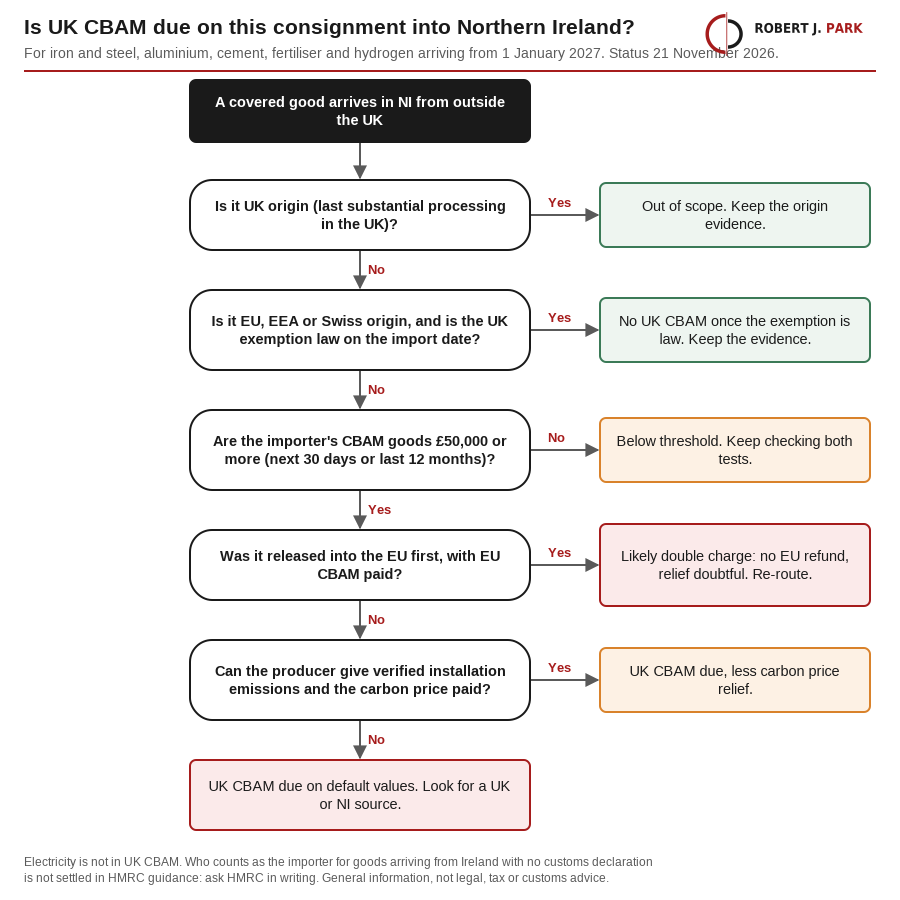
Eight cases
1. Cement made in Ireland, bought by an NI builders’ merchant
UK CBAM is due from 1 January 2027 unless the EU-origin exemption is law by then. The Irish works pays EU ETS, so carbon price relief could cut the bill sharply, but only with verified installation emissions and a verifier’s form. Without them the merchant pays on default values. The obvious alternative is cement made in Northern Ireland, which is UK origin and out of scope. GB cement shipped across the Irish Sea is unlikely to beat it. Action: ask the Irish supplier now whether it will provide verified data, and get a quote for NI-made cement.
2. Turkish rebar bought from a Dublin stockholder, delivered to an NI contractor
The Dublin stockholder is the EU CBAM declarant and has the certificate cost in its price. When the rebar crosses into Northern Ireland, UK CBAM is due too. Relief for EU CBAM is unsettled, so assume a double charge. The EU-origin exemption does not help, because the steel is Turkish, and an ETS link covering UK and EU goods would not either. Action: buy direct into Belfast or Larne (UK CBAM only), or use GB-made rebar.
3. Norwegian fertiliser for an NI farm
Most fertiliser comes straight into NI ports through NI merchants and blenders, so the merchant, not the farmer, is usually the importer. Norway is in the EEA, so there is no EU CBAM, even if it comes via an Irish merchant. UK CBAM applies from 1 January 2027 unless the intended EEA exemption is made law. Until then, Norwegian works are in the EU ETS, so relief is possible with verified data. Action: farmers should ask their merchant whether CBAM is in the price; merchants should ask the producer for verified data now.
4. Steel sections made in GB, delivered to Northern Ireland
UK origin, so out of scope: no CBAM, no paperwork. On carbon alone, GB steel is the easy buy. But the only GB sections maker is British Steel at Scunthorpe. It is under government control and has run below target (National Audit Office, March 2026). Supply capacity, not carbon, is the limit.
5. An NI fabricator using Chinese steel and selling into Ireland
UK CBAM is paid when the steel lands in Northern Ireland, subject to the £50,000 threshold. The finished fabrication sold into Ireland pays no EU CBAM, because goods produced in Northern Ireland are outside it. That is not much of a loophole: a UK carbon price has been paid, although it is lower than the EU’s. The EU’s proposed extension of CBAM to downstream goods from 2028 (COM(2025) 989) is still a proposal, and it covers goods entering the EU, not NI-produced goods. Expect EU scrutiny under its anti-circumvention rules (Article 27 of Regulation (EU) 2023/956, which the proposal would widen).
6. Chinese aluminium extrusions for an NI joinery firm: three routes
- Released in Rotterdam, sold via Dublin, delivered to Northern Ireland. EU CBAM in the Netherlands, then UK CBAM in Northern Ireland: a likely double charge.
- Moved under transit through the EU to Northern Ireland, or shipped direct to Belfast. UK CBAM only.
- Bought from a GB distributor. UK CBAM paid once when it enters GB; the move to Northern Ireland adds nothing. Extrusions made in GB from imported billet are probably UK origin, so the charge sits upstream on the billet.
The route decides the bill. Any NI firm buying through EU distributors should check now.
7. Steel sent to Ireland for galvanising and brought back
Returned goods relief only covers Union goods reimported within three years in the same state, and galvanising changes the state. HMRC’s outward processing rules let a UK carbon price already borne reduce the charge, and only the added value counts towards the threshold. Because no customs formalities happen between Northern Ireland and Ireland, how this is evidenced is unsettled. Action: ask HMRC before relying on it.
8. Electricity between GB, Northern Ireland and Ireland
Electricity is not in UK CBAM. Power from GB into Ireland over the direct links (EWIC and Greenlink) is an EU CBAM import, with no threshold. GB to Northern Ireland over the Moyle interconnector is internal to the UK. The Commission’s December 2025 package clarified that UK electricity exports to the EU “should not face a CBAM charge” at current carbon prices. The Government had left this out of a reply to the Lords and later said it regretted that (Secretary of State’s letter, 5 March 2026). So, for now, the route a GB unit takes into the all-island market makes little difference to its carbon charge. That depends on the carbon price gap staying small, and the ETS link should settle it from 2028.
Biomethane and digestate
Biomethane is not a CBAM good in either regime. It matters in two ways.
- Digestate competes with imported fertiliser. Anaerobic digestion leaves digestate, which replaces some mineral nitrogen. Any UK CBAM cost on imported fertiliser from 2027 improves the case for using digestate, and so for NI anaerobic digestion and biomethane. That case should be made in responses to the DfE and DAERA biomethane strategy consultation, which closes on 15 December 2026.
- Biomethane can lower embedded emissions. In the EU ETS, biomass fuels that meet the sustainability criteria count as zero emissions. A plant making ammonia, steel or cement with biomethane could therefore report lower embedded emissions, and its customers would pay less CBAM. Whether grid-injected biomethane bought with certificates qualifies depends on the monitoring rules. Not re-checked against the regulation.
Switching to GB supply, 2027 and after
GB-made goods are UK origin and out of scope, so switching is the simplest way to avoid UK CBAM. Three things limit it: what GB actually makes, freight, and how long the advantage lasts.
| Switch | 2027 | 2028 (if the ETS link starts) | 2030 and after |
|---|---|---|---|
| Turkish rebar via Dublin → GB-made rebar | Saves the double charge and the paperwork | Still saves it: a link does not cover Turkish goods | Advantage grows as EU free allocation falls |
| Irish cement → NI-made cement (GB rarely competitive) | Saves the charge only if the EU exemption is not yet law | Advantage gone once the exemption or link is in force | Little difference; buy on price and quality |
| Chinese extrusions via an EU distributor → a GB extruder or distributor | One charge, paid upstream, not two | Unchanged | Unchanged unless EU and UK rules on third-country goods are aligned |
| Norwegian fertiliser → GB-made ammonium nitrate | Saves the charge only if Norwegian data cannot be verified and the EEA exemption is not law | Advantage gone once the EEA exemption is law | Little difference |
Two costs offset the gain. Shipping from GB now carries a UK ETS charge on ferries, at half rate for GB–NI voyages; under the linking terms that discount is removed from 2028 (DESNZ explainer). And GB capacity is thin: there is one sections mill, almost no primary aluminium, and Billingham now makes ammonium nitrate from imported ammonia. A GB supplier selling third-country material is fine. UK CBAM is paid once in GB and nothing more is due on the move to Northern Ireland.
Route checklist: use or avoid?
Ask these questions of every supply route for a covered good. One “avoid” answer is enough to look again.
| # | Question | Use the route if… | Avoid or re-route if… |
|---|---|---|---|
| 1 | Where was the good last substantially processed, and what origin is declared? | UK origin is documented | Origin is unclear or undocumented |
| 2 | Is it EU, EEA or Swiss origin, and is the UK exemption law on the delivery date? | Yes, with evidence | You are relying on an announcement |
| 3 | Who is the importer into Northern Ireland: you, the supplier or nobody named? | The supplier is, and says so in the contract | Nobody is named |
| 4 | Are your CBAM goods across all suppliers £50,000 or more (next 30 days or last 12 months)? | Below, and you are monitoring | Above, and you have not planned for it |
| 5 | Has the good already been released into the EU and paid EU CBAM? | No | Yes: likely double charge |
| 6 | Can it move under transit, or come direct to an NI port, instead? | Yes | No alternative exists |
| 7 | Will the producer give verified installation emissions and a verifier’s form? | Yes | No: you pay on default values |
| 8 | Was the producing works under an ETS, and which one? | EU, UK or a linked ETS, with proof of price paid | No carbon price paid |
| 9 | Is there processing abroad (galvanising, coating, cutting)? | No, or HMRC has confirmed the treatment | Yes, with no evidence trail |
| 10 | Is there a UK or NI-made equivalent within the lead time? | Compared on price, carbon and freight | Not checked |
| 11 | Does the contract say who carries the CBAM cost if the rules change in 2027 or 2028? | Yes | No |
| 12 | For electricity contracts: does the price assume a CBAM charge on imports into Ireland? | Stated and capped | Silent |
Two questions for HMRC
- Does EU CBAM paid on goods later moved into Northern Ireland count as a qualifying carbon price for relief under SI 2026/809?
- What instrument, under which section, will deliver the intended EU, EEA and Swiss-origin exemption from 1 January 2027, and who is the importer for goods entering Northern Ireland from Ireland with no customs declaration?
Sources
- Finance Act 2026, Part 5: ss.144, 147, 156, 158
- The Carbon Border Adjustment Mechanism (Carbon Price Relief) Regulations 2026, SI 2026/809
- HMRC, CBAM policy summary (updated 2 November 2026)
- HMRC, check if you’re classed as the importer for CBAM
- DESNZ, UK–EU linking agreement explainer (20 November 2026)
- European Commission, CBAM questions and answers (15 October 2026)
- Regulation (EU) 2023/956 and Regulation (EU) 2025/2083; COM(2025) 989 (proposal)
- Secretary of State for Northern Ireland, letter to Lord Carlile, 5 March 2026
- National Audit Office, British Steel Scunthorpe investigation, March 2026
Not re-checked against a primary source: NI cement works capacity, Moyle flows and capacity, GB fertiliser output. Created with assistive technology including AI and re-checked against the official sources listed.
If your firm imports any of these goods, CBAM Desk does a fixed-price route check. Questions: robert@robertjpark.co.uk · 07450 349480 · WhatsApp @robertjpark.