
Nitrogen: from the air, through the cow, into the lough and the sky
Element 7 is most of the air we breathe and does nothing. Change its form and it feeds the world, kills bogs and warms the planet.
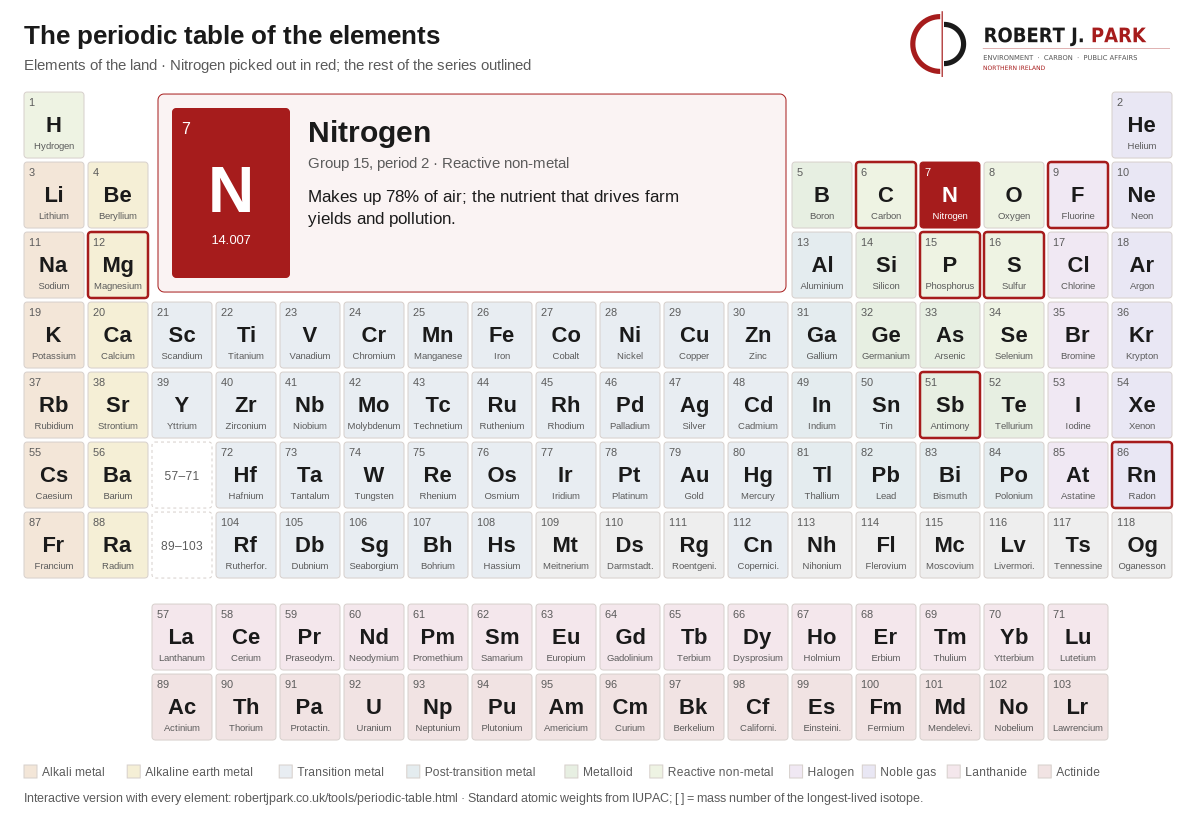
Nitrogen gas makes up 78% of the air. It is so unreactive that plants cannot use it. To become food, it has to be “fixed”: by lightning, by bacteria in clover roots, or by a fertiliser plant.
Once fixed, nitrogen is called reactive nitrogen, and it moves. It runs from bag to grass to cow to slurry, then into the air as ammonia, into water as nitrate, and into the sky as nitrous oxide. Each step has its own problem and its own rules.
The element in one minute
- Number 7, group 15, period 2. A non-metal and a colourless gas.
- The triple bond in N₂ is one of the strongest in chemistry. That is why fixing it takes so much energy.
- The Haber–Bosch process combines nitrogen with hydrogen, usually from natural gas, to make ammonia. Nearly all nitrogen fertiliser starts there.
Climate
- Nitrous oxide (N₂O) is a greenhouse gas about 265 times as strong as CO₂ over 100 years (the AR5 value used in the UK inventory). It comes mainly from soils given nitrogen, and from manure.
- Fertiliser manufacture burns gas for heat and hydrogen. Fertilisers are covered by EU CBAM, and are due to be covered by UK CBAM from 1 January 2027.
- In Northern Ireland, nitrous oxide was 7.3% of greenhouse gas emissions in 2023 (NISRA, June 2025).
Soil and land
Grass is hungry for nitrogen. It gets it from fertiliser, slurry, clover and the slow breakdown of soil organic matter. Whatever the grass does not take up can leach as nitrate in wet weather or be lost as gas.
Clover is the cheapest source. Bacteria in its root nodules fix nitrogen from the air for free.
Agri-food
- Most of the nitrogen fed to a cow leaves in dung and urine. That is where slurry’s value, and its pollution, come from.
- Protected urea and low-emission spreading (trailing shoe, trailing hose, injection) cut the ammonia lost when nitrogen is applied. DAERA reports protected urea can cut ammonia loss by up to 79% compared with ordinary urea.
- Less fertiliser shows up in the figures. DAERA’s 2024 inventory says lower nitrogen fertiliser use partly offset the rise in livestock emissions.
Atmosphere
Ammonia (NH₃) is the nitrogen problem most specific to Northern Ireland. DAERA reports that 97% of Northern Ireland’s ammonia comes from agriculture, with cattle responsible for around 62% of the agricultural share.
Ammonia does not warm the climate directly. It drifts a short distance, falls on bogs, heaths and woodland, and over-fertilises plants adapted to poor soils. It also combines with other pollutants to form fine particles that harm health.
Nitrogen oxides (NOₓ) from engines and boilers are a separate problem: they harm lungs and help form ground-level ozone.
Why it matters in Northern Ireland
Northern Ireland has a dense livestock sector close to protected habitats. That is why planning applications for livestock buildings are screened for ammonia, and why ammonia policy has been contested for years.
The rules (as at 21 November 2026)
- Air: the UK has an ammonia reduction commitment of 16% by 2030 against 2005, as DAERA set out to its NAP stakeholder forum in July 2026. Habitats Regulations assessment applies to new and expanding farms.
- Water: the Nutrients Action Programme sets limits and closed periods for manure and fertiliser. A new programme for 2027–2030 was consulted on until 7 September 2026.
- Climate: nitrous oxide counts towards Northern Ireland’s carbon budgets under the Climate Change Act (Northern Ireland) 2022.
- Safety: COSHH and the confined-spaces rules apply. Ammonium nitrate fertiliser has its own storage and security guidance.
Safety and handling
Nitrogen gas is not toxic, but it is a simple asphyxiant: in a confined space it displaces oxygen without warning. COSHH applies to the nitrogen compounds below, and confined-space rules apply to nitrogen gas.
| Form | Classification (CLP) |
|---|---|
| Nitrogen, compressed gas | Press. Gas H280 (contains gas under pressure; may explode if heated). No harmonised CLP entry; this is the supplier classification. |
| Nitrogen, refrigerated liquid | Press. Gas H281 (contains refrigerated gas; may cause cryogenic burns). |
| Substance | Workplace exposure limit (EH40/2005) |
|---|---|
| Nitrogen | No WEL: an asphyxiant. Control is by keeping oxygen above safe levels. |
| Ammonia, anhydrous | 25 ppm LTEL; 35 ppm STEL |
| Nitrogen dioxide | 0.5 ppm LTEL; 1 ppm STEL (from 2018) |
| Nitrogen monoxide | 2 ppm LTEL (from 2018) |
| Nitrous oxide | 100 ppm LTEL |
| UN number | Proper shipping name | Class |
|---|---|---|
| UN1066 | Nitrogen, compressed | 2.2 |
| UN1977 | Nitrogen, refrigerated liquid | 2.2 |
| UN1005 | Ammonia, anhydrous | 2.3 (8) |
| UN1942 | Ammonium nitrate (≤0.2% combustible) | 5.1 |
| UN2067 | Ammonium nitrate based fertiliser | 5.1 |
| UN1070 | Nitrous oxide | 2.2 (5.1) |
| UN2031 | Nitric acid | 8 (5.1 above certain strengths) |
Risks of the element itself. Nitrogen gas causes asphyxiation in tanks, silos and cold rooms; liquid nitrogen causes cold burns and expands about 700 times as it boils. Ammonium nitrate fertiliser is an oxidiser and must be stored away from fuel and organic matter.
Classification and limits change. Always work from the supplier’s current safety data sheet and your own COSHH assessment.
Compounds you will meet
| Where you meet it | Compound | Why it matters |
|---|---|---|
| Nature | Dinitrogen (N₂) | 78% of air |
| Ammonium and nitrate | plant-available nitrogen in soil | |
| Organic nitrogen | proteins in grass, manure and soil organic matter | |
| Manufacturing | Ammonia (NH₃) | made by Haber–Bosch; the root of nearly all nitrogen fertiliser |
| Urea and protected urea | solid fertiliser; protected urea cuts ammonia loss | |
| Ammonium nitrate and calcium ammonium nitrate (CAN) | the main straight nitrogen fertilisers in the UK and Ireland | |
| Nitric acid (HNO₃) | made from ammonia; its production emits nitrous oxide | |
| Adipic acid and nylon | another industrial source of nitrous oxide | |
| Climate | Nitrous oxide (N₂O) | a greenhouse gas with a 100-year global warming potential of 265 (AR5, as used in the UK inventory) |
| Ammonia | not a greenhouse gas, but it re-deposits and part of it is later emitted as N₂O | |
| Nitrogen oxides (NOₓ) | form ground-level ozone, itself a greenhouse gas |
What this means
- For farmers: every kilo of nitrogen kept on the farm is a kilo not bought. Low-emission spreading and protected urea pay back in fertiliser saved.
- For planners and developers: ammonia is a site-by-site question. Distance to protected sites decides most cases.
- For policy: ammonia, nitrate and nitrous oxide are one cycle. Rules that tackle one can push the problem into the next.
Further reading on this site
Sources
- DAERA, Ammonia emissions in Northern Ireland (accessed 21 November 2026) and Ammonia emissions and agriculture (11 January 2023).
- DAERA, NAP Stakeholder Forum: ammonia presentation (27 July 2026).
- NISRA, Northern Ireland greenhouse gas emissions down 7.1% in 2023 (10 June 2025).
- DAERA, Public consultation on the proposed Nutrients Action Programme 2027–2030 (closed 7 September 2026).
- HSE, EH40/2005 Workplace exposure limits (4th edition, January 2020).
- UNECE, ADR 2025.
All sources checked 21 November 2026.
Robert J. Park is an environment, carbon and public affairs consultant based in Larne, Northern Ireland. Download the briefing, *Nitrogen* (PDF), with the full periodic table, the safety panel and the sources. This is one of eight learning briefings on the elements that shape climate, soil, land, agri-food and the atmosphere; the others are linked from the interactive periodic table. This is general information as at 21 November 2026, not legal, safety or agronomic advice. Created with assistive technology including AI and re-checked against the official sources listed.