
Fertiliser: a small tax, a big bill and a lough
Update, 21 November 2026: the UK–EU summit of 20 November concluded an agreement to link the UK and EU carbon markets. The UK government says it intends to exempt goods of EU origin from UK CBAM from 1 January 2027; that is not yet law. This piece is as published; see what changes, and when and what the summit agreed.

Part of the Policy series: where the rules stand in Northern Ireland, who decides them, and what to do about it. Updated as the rules change.
Published early, on 9 November 2026. I’ll update this piece in December, with a refresh of the NI Agriculture and Land Carbon dashboard, once the first UK CBAM rates and the outcome of the 20 November UK–EU summit are known.
The argument in brief
On 26 October 2026 Reform UK published a 65-point alternative Budget, two days before the Prime Minister’s first Budget. Point 7 pledges to stop the Carbon Border Adjustment Mechanism (CBAM), and names “the fertiliser tax” as part of it. The Conservatives made the same promise in April. On 19 October the government confirmed that the UK CBAM starts on 1 January 2027 regardless. The Budget of 28 October 2026 made no fertiliser-specific CBAM change.
The row is loud, but the tax itself is small. HMRC’s illustrative 2027 rate for fertiliser is £1.45 per tonne of CO2e. On ammonium nitrate (AN) that comes to about £3.77 a tonne, against a market price of around £480 a tonne in October. What actually sets the bill is gas prices, disrupted shipping through the Strait of Hormuz since February 2026, EU tariffs on Russian supply and the fact that the UK no longer makes its own ammonia.
In Northern Ireland the binding constraint is the nutrient rules, not CBAM. The new Nutrients Action Programme (NAP) and Lough Neagh will shape how much fertiliser NI farms buy and spread far more than any carbon border levy. The CBAM charge is low only while free allowances last, and it will rise as they taper. The political fight is over a cost that has barely started.
This piece sets out the arguments on each side; the recommendations are the author’s. Facts checked to 30 October 2026; rechecked and updated 16 November 2026 (tariff, summit and fertiliser-rules lines).
The lifecycle at a glance
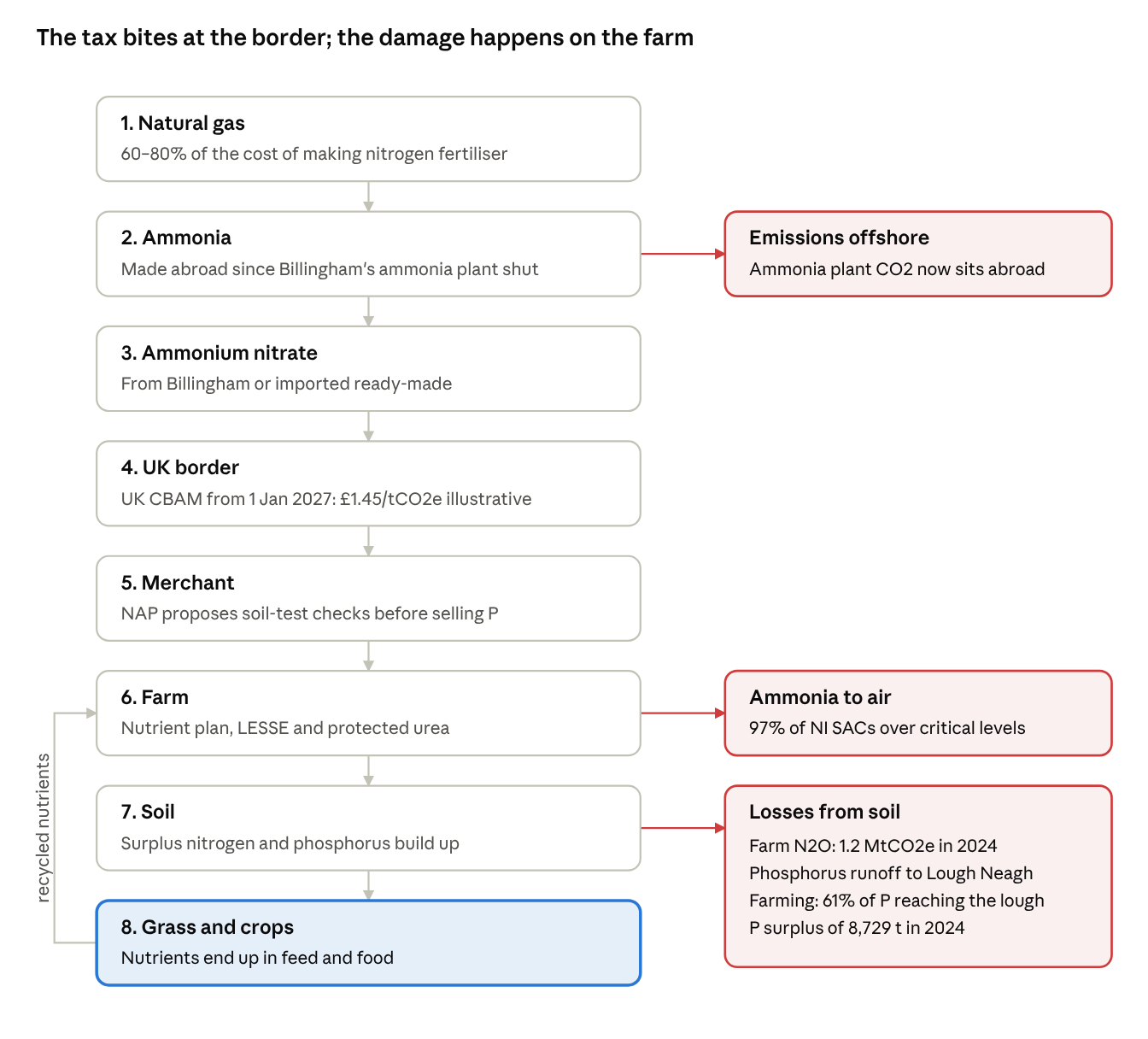
The UK CBAM touches fertiliser once, at the border (stage 4), at an illustrative £1.45/tCO2e. The bigger losses to air and water happen at stages 6 and 7, which the NAP governs and the border charge does not reach.
Then and now (2023 to October 2026)
| Rule or instrument | 2023 | Now (with date) | What changed and why |
|---|---|---|---|
| UK CBAM on fertiliser | Announced Dec 2023, no design yet | Starts 1 Jan 2027. Illustrative fertiliser rate £1.45/tCO2e (HMRC, 16 Oct 2026). UK-wide, including NI | Legislated against carbon leakage. Low because HMRC’s formula implies about 97.5% of allowances stay free in 2027 (author’s calculation) |
| EU CBAM on fertiliser | Transitional reporting from 1 Oct 2023 | Definitive phase since 1 Jan 2026; certificates on sale 1 Feb 2027. The “emergency brake” (Article 27a) is still disputed: Parliament voted 464 to 50 to delete it (15 Sep 2026); the Council keeps it | Farm lobbies in France, Italy and Ireland pushed for suspension. The Fertiliser Action Plan (19 May 2026) did not exempt fertiliser |
| EU tariffs on Russian and Belarusian fertiliser | None | Regulation (EU) 2025/1227 since 1 Jul 2025: 6.5% plus €60–70/t since 1 Jul 2026, rising to €315–430/t from 1 Jul 2028 | Cut Russia’s revenue. EU suspended general tariffs on other suppliers for a year (May 2026) |
| UK domestic ammonia | Billingham closure announced 25 Jul 2023 | UK makes about 40% of its nitrogen fertiliser; Billingham makes AN from imported ammonia | Gas and carbon costs made UK ammonia uncompetitive |
| Fertiliser prices | Falling after the 2022 peak | AN and urea about £480–485/t, up about 35% on a year (Farmers Weekly, 19 Oct 2026) | Hormuz shipping disrupted since February 2026; gas is 60–80% of nitrogen production cost |
| Fuel duty on farm red diesel | Temporary cut from March 2022 in place | 3.7p cut for rebated fuels extended to 30 Jun 2027; rates return to pre-March 2022 levels from 1 Jul 2027, then rise with RPI (Budget, 28 Oct 2026) | Short-term relief on farm running costs. The rise lands in summer 2027, just after the first CBAM year starts |
| NI Nutrients Action Programme | 2019 programme rolled over | 2027–2030 consultation 29 Jun to 7 Sep 2026: 30% cut in the phosphorus surplus, merchant checks on chemical P, phased low-emission slurry spreading (LESSE) and protected urea | The 2025 draft was dropped after an Assembly row and redrafted with stakeholders |
| UK fertiliser product rules | 1991 rules in GB; EU FPR 2019/1009 in NI from July 2022 | Four-government consultation, 19 Mar to 10 Jun 2026. NI firms could choose EU or UK rules; no response yet (16 Nov 2026) | Allow recycled-nutrient products and improve supply resilience |
| NI carbon budgets | Under consultation | Approved Dec 2024: 33%, 48%, 62% average cuts; 77% by 2040 | Agriculture is the largest sector, 31.4% of 2024 emissions |
Where the parties and governments stand (October 2026)
The government and the EU keep fertiliser inside carbon pricing. Reform and the Conservatives would scrap the UK CBAM. The farm unions on both islands want a pause. Most NI parties focus on cost support and the NAP rather than CBAM.
| Party or government | Position (dated) |
|---|---|
| UK Government (Labour) | Pressing ahead from 1 Jan 2027 (19 Oct 2026). Defra minister Angela Eagle said initial liabilities would be “modest” (10 Jun 2026). The 6% tariff on UAN is suspended from 5 Aug 2026 to end-2028. The Budget (28 Oct 2026) made no fertiliser-specific CBAM change and extended the fuel duty cut on rebated fuels, including farm red diesel, to 30 Jun 2027. The government denied May 2026 reports that ministers had discussed shelving the levy (Law360, 29 May 2026) |
| Conservatives (Badenoch) | Would abolish CBAM; Victoria Atkins pledged to scrap the “fertiliser tax” (5 Apr 2026) |
| Reform UK (Farage) | Point 7 of the 65-point plan: stop CBAM, including the fertiliser tax (26 Oct 2026). First pledged by Richard Tice (Feb 2026) |
| Liberal Democrats (Davey) | Led a debate on farm costs (29 Apr 2026). No 2026 CBAM position found |
| Green Party E&W; Scottish and Welsh Governments | No published position found (searched 27 Oct 2026). NFU Scotland wants direct fertiliser support |
| NI Executive / DAERA (Muir) | Consulted on NAP 2027–2030 (29 Jun 2026). No targeted support for fertiliser costs |
| NI party leaders (joint) | Leaders of all six main parties wrote to the PM seeking action on fuel and fertiliser costs (20 Apr 2026) |
| Sinn Féin | Declan McAleer MLA accused DAERA of “serious contradictions” on fertiliser preparedness (2026) |
| DUP | Carla Lockhart called the 2025 draft NAP a “hammer blow” (summer 2025). No 2026 CBAM position found |
| UUP | Robbie Butler cautiously welcomed the revised NAP and wants the impact assessment published (29 Jun 2026) |
| SDLP | Matthew O’Toole accused Executive parties of abandoning Lough Neagh by halting the NAP consultation (10 Jun 2025) |
| TUV | No published position found (searched 27 Oct 2026) |
| UFU | Called CBAM timing “disastrous” (Apr 2026); called the revised NAP “a significant improvement” (30 Jun 2026) |
| NFU | Postpone CBAM and review after 12 months (17 Apr 2026); asks for protections in the Budget (19 Oct 2026). The Budget (28 Oct 2026) made no fertiliser-specific CBAM change |
| IFA (Ireland) | Immediate suspension of EU CBAM on fertiliser (18 May 2026) |
-
Scrap or pause. Conservatives and Reform would remove the whole UK CBAM. The unions ask only for a delay to the fertiliser element.
-
Leakage logic. Labour argues CBAM matches what domestic producers pay. That is weak for ammonia, because the UK has almost no ammonia production left to protect.
-
NI has two fights. At Westminster the fight is CBAM. At Stormont it is the NAP and Lough Neagh.
-
Support or rules. The UFU and Sinn Féin want cost support now. DAERA points to nutrient efficiency.
Who decides what
Westminster sets the tax, Brussels sets some product rules for NI, and Stormont sets the nutrient limits.
| Instrument | Who decides | Whose approval is needed | Position in Northern Ireland |
|---|---|---|---|
| UK CBAM | HM Treasury and HMRC | Parliament (Finance Act 2026 plus regulations) | Applies UK-wide, including NI (GOV.UK, 16 Oct 2026) |
| EU CBAM (Reg. 2023/956) | European Commission | Council and Parliament | Not applied in NI; NI exporters still face EU customers asking for emissions data |
| EU tariffs on Russia/Belarus (Reg. 2025/1227) | Commission | Council and Parliament | Application to goods entering NI not confirmed |
| Fertilising Products Regulation (EU) 2019/1009 | EU | Commission, Council, Parliament; NI Assembly scrutiny | Applies in NI alongside domestic rules |
| NI NAP 2027–2030 | DAERA Minister | Likely Executive agreement; Assembly procedure | Domestic NI regulations |
| NI carbon budgets | DAERA | Executive, then Assembly | Set December 2024 |
Where the pillars compete
-
Food security against water quality (S against E). NI farms carried a phosphorus surplus of 8,729 tonnes in 2024. Modelling attributes 61% of the phosphorus reaching Lough Neagh to agriculture (FactCheckNI, 2025). Tighter rules protect the lough but squeeze margins in a year of high input costs.
-
Farm incomes against nitrous oxide (S against E). NI agriculture emitted 5.8 MtCO2e in 2024, 1.2 Mt of it N2O. Emissions from manufactured fertiliser rose 16.9% from 2023 to 2024 (DAERA bulletin, 9 Jun 2026). Cost support that cuts the price of fertiliser also encourages more spreading.
-
Domestic production against imported low-carbon ammonia (E against E). Billingham’s ammonia plant closed on gas and carbon costs, moving the emissions offshore. CBAM now applies to imports with no UK plant left to shield. Green ammonia from abroad could cut emissions faster than rebuilding at home, at a cost to supply security.
-
Recycled nutrients against contamination (E against E). Digestate and biosolids replace mineral fertiliser; 87% of UK biosolids go to farmland (CIWEM, Jul 2025). Even sewers serving only homes carry PFAS, and the sludge rules date from 1989.
-
Ammonia against climate (E against E). LESSE and protected urea cut ammonia, and 97% of NI Special Areas of Conservation exceed ammonia critical levels (DAERA, 27 Jul 2026). Retaining more nitrogen can raise N2O losses unless the amount spread falls too.
What it means for Northern Ireland firms and councils
-
Merchants and blenders. The NAP proposes point-of-sale checks: a soil test and nutrient plan before selling chemical P for grassland, plus training. Plan for this before 2027.
-
Importers. Anyone bringing in ammonia, nitric acid or nitrogen fertiliser from outside the UK must account for UK CBAM from 1 Jan 2027. The first annual return and payment are due by 31 May 2028.
-
Agri-food processors. Supplier emissions data matters for EU customers and your own Scope 3. Fertiliser N2O is a large part of dairy, beef and grain footprints.
-
Councils. Expect more LESSE and slurry-store conditions in planning, and more questions on biosolids and PFAS.
-
ETS linkage. A draft deal to link the two ETSs, with mutual CBAM exemptions “subject to respective laws and procedures”, is expected at the 20 November summit (Euronews, 6 Nov 2026).
Practical examples
-
Grants for slurry kit. DAERA’s £40m Sustainable Farming Investment Scheme offered 40% of the cost, up to £25,000 a business. Its first window ran from 21 July to 3 September 2026, with LESSE applications ranked separately (DAERA; Farmers Journal, 15 Jul 2026). Farms with 200 or more cattle units were excluded because they must already use LESSE.
-
An NI machinery maker in the scheme. Fleming Agri listed its 7.5m and 9.2m trailing shoes and dribble bars as SFIS-eligible LESSE kit before the scheme opened on 21 July 2026 (Farming Life). Nutrient rules create orders for local manufacturers as well as costs for farms.
-
Billingham stops making ammonia. On 25 July 2023 CF Fertilisers proposed closing its idle Billingham ammonia plant, citing UK gas and carbon costs, with up to 38 redundancies. It kept making ammonium nitrate from imported ammonia (CF Industries).
-
Soil data at scale. The Soil Nutrient Health Scheme reached 92.5% of NI farm businesses by September 2025. It is a condition of the Farm Sustainability Payment from 2026 (AFBI, 18 Sep 2025). Merchants asked to check soil tests under the new NAP will have data to work from.
-
What the charge comes to. HMRC’s draft default values (16 Oct 2026) give ammonium nitrate (CN 3102 30 90) 2.600 tCO2e per tonne and CAN at up to 28% nitrogen, the 27% product sold here (3102 40 10), 2.120. At the illustrative £1.45 rate that is about £3.77 a tonne of AN and £3.07 a tonne of CAN, against £480–485 delivered (Farmers Weekly, 19 Oct 2026). Fertiliser defaults carry no UK mark-up. A 100-tonne merchant order of AN would carry about £377 of CBAM in 2027 (author’s arithmetic). The importer pays: usually the merchant or co-op that brings the fertiliser in, not the farm, which sees it in the price. Origin decides, not route: urea made in Egypt and bought through an Irish merchant is non-UK origin either way, and fertiliser made in the EU and delivered into NI counts as an import too (Finance Act 2026, s.144(5)(a)). Each 8-digit code has its own default value, so check the code on the invoice.
Recommendations
-
HM Treasury: publish the free-allocation taper for fertiliser to 2034. A low starting rate gives false comfort; farms need the full path.
-
HM Treasury: keep the fertiliser CBAM but recycle revenue into nutrient-efficiency grants. This meets the competitiveness complaint without reopening leakage.
-
DAERA: publish the NAP economic impact assessment before making the regulations. The UUP and UFU have asked, and it would steady the consensus.
-
DAERA and DfE: collect data on fertiliser stocks. Without it, supply risk cannot be judged.
-
UK and EU negotiators: secure mutual CBAM exemption as part of ETS linkage. This would remove the UK charge on EU-made fertiliser coming into NI from Ireland, and the EU charge on GB-made goods going the other way.
-
DAERA and NI Water: set PFAS testing for biosolids before their use grows.
-
Firms: map CBAM-covered imports by CN code now. Ammonia (2814), nitrogen fertilisers (3102) and mixed fertilisers (3105) are in scope.
-
Farms and advisers: switch to protected urea and LESSE ahead of the 2028 tier. The first SFIS window (closed 3 Sep 2026) paid 40% of the cost, up to £25,000; more rounds are planned.
Sources
-
Illustrative CBAM rates and worked example, HMRC (16 Oct 2026)
-
Government presses on with fertiliser import tax, Farmers Weekly (19 Oct 2026)
-
Reform UK vows to scrap Britain’s carbon border tax, E&E News (19 Feb 2026)
-
Fertiliser and carbon taxes a threat to food security, Farmers Guardian (5 Apr 2026)
-
Agriculture: Government Support, Westminster Hall (29 Apr 2026)
-
UK suspends 6% tariff on UAN, Fertilizer Daily (11 Aug 2026)
-
IFA calls for immediate CBAM suspension, Farmers Journal (18 May 2026)
-
Farmers call for CBAM fertiliser suspension clause, Argus (7 Jul 2026)
-
CF Fertilisers proposes Billingham ammonia closure, CF Industries (25 Jul 2023)
-
Proposed NAP rules for NI farmers, Farmers Weekly (30 Jun 2026)
-
Muir welcomes Assembly approval of emissions targets, DAERA (11 Dec 2024)
-
Should we be putting sewage sludge on land?, CIWEM (31 Jul 2025)
Added at final review, 28 October 2026:
-
Sustainable Farming Investment Scheme key information, DAERA (updated 4 Sep 2026)
-
Grant funds driven by LESSE demand, Farmers Journal (15 Jul 2026)
-
Fleming Agri products eligible under DAERA SFIS 2026, Farming Life (Jul 2026)
-
NI greenhouse gas inventory 1990–2024 statistical bulletin, DAERA/NISRA (9 Jun 2026)
-
CBAM: European Parliament stalls on the emergency clause, Renewable Matter (16 Sep 2026)
-
UK farmers call for carbon tax break despite government denials, Law360 (29 May 2026)
Added 30 October 2026 (Budget):
- Budget 2026: Overview of Tax Legislation and Rates (OOTLAR), HM Treasury and HMRC (28 Oct 2026), paragraphs 2.18 (fuel duty) and 2.28 (CBAM)
Added 16 November 2026 (recheck):
Robert J. Park is an independent environment, carbon and public-affairs consultant based in Larne, Northern Ireland. He helps firms and public bodies measure their carbon and make their case on policy.
Agree or disagree? Get in touch on LinkedIn or WhatsApp @robertjpark.
This piece is general information for Northern Ireland businesses, not tax, legal or financial advice. Check your own position with your adviser before acting on it.