
Caught here, landed elsewhere: where Northern Ireland's seafood goes
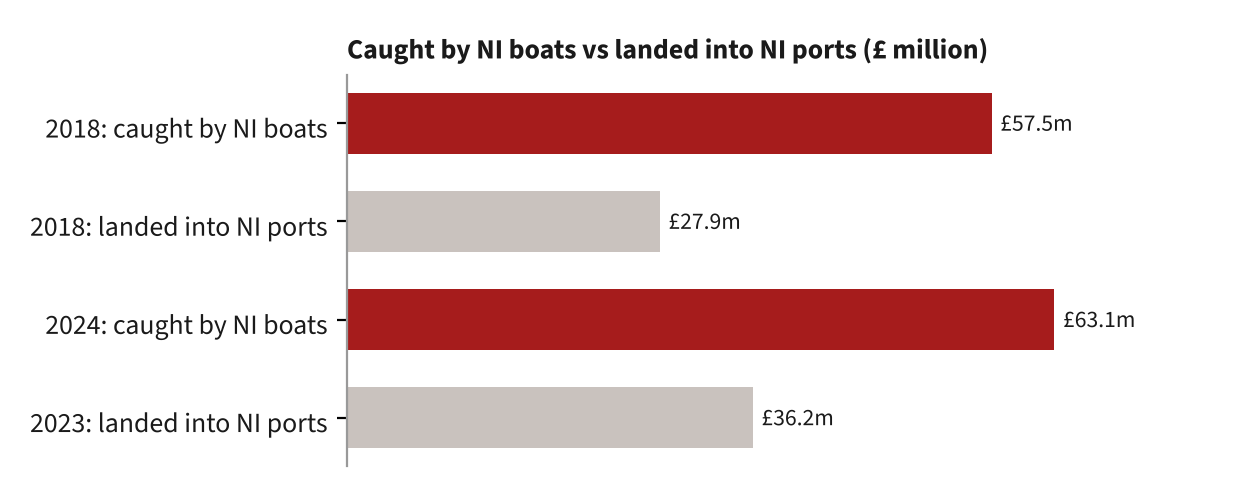
Northern Ireland’s fishing boats caught fish and shellfish worth £63.1 million in 2024. In 2023 the value landed into Northern Ireland’s own ports, by boats from anywhere, was £36.2 million. On those figures, roughly £27 million of our catch is landed somewhere else, and probably more, because the port figure includes boats from GB and Ireland (the years differ: 2024 catch, 2023 landings). Most of it is mackerel, unloaded in Killybegs, Scotland, Norway and Denmark and processed there.
That gap is the story of NI seafood. It explains where the value goes, why the Windsor Framework matters more to fish than to almost any other food, where the growth is, and why NI people should be eating far more of their own catch.
Where it is landed
NI has three fishing harbours run by one authority: Kilkeel, Ardglass and Portavogie. The Co. Down fleet, mostly small trawlers working for Dublin Bay prawns, lands most of its catch there. Kilkeel is the processing centre, and home to what DAERA’s 2020 review called Europe’s largest scampi producer.
The pelagic fleet is different. It is three large vessels. Two fishing as a pair land most of their mackerel and all their herring into Belfast for NI processors. The largest lands mainly into the big pelagic ports of Europe, because, as DAERA’s Fishing and Seafood Development Programme found, the limit is processing capacity as much as harbour space. Back in 2018 the fishing industry told the Commons Northern Ireland Affairs Committee that two-thirds of the NI fleet’s catch was landed outside NI, over 12,000 tonnes of it pelagic fish into Killybegs.
The gap has been there for years. In 2018 NI boats caught £57.5 million and NI ports took in £27.9 million.
Where it goes
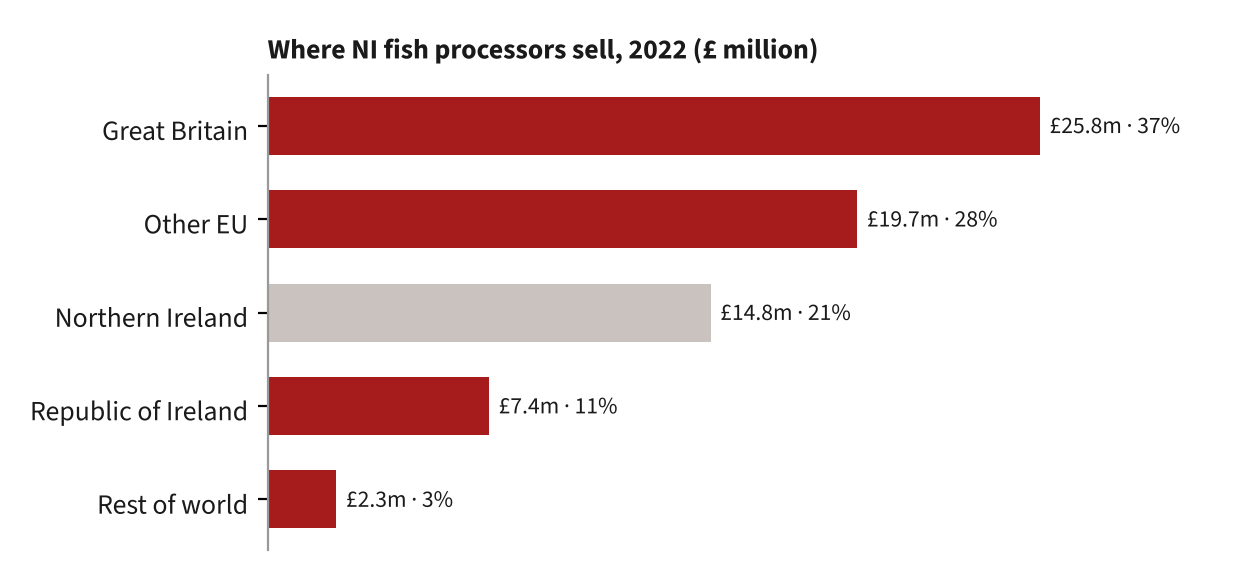
The best official picture of where NI seafood ends up comes from DAERA’s food and drinks processing statistics. In 2022 NI fish processors turned over £69.9 million. Of that:
- Great Britain took £25.8 million, about 37%
- other EU countries took £19.7 million, about 28%
- the Republic of Ireland took £7.4 million, about 11%
- Northern Ireland itself took £14.8 million, about 21%
- the rest of the world took £2.3 million.
So nearly four-fifths of what our processors make leaves NI, and the EU and Ireland together (£27.1 million) now take slightly more than GB (£25.8 million). On top of that, whole Dublin Bay prawns, crab and live shellfish go straight from the boat to buyers in Spain, France and Italy, and do not show up in these figures at all.
A smaller point worth noting: processors bought 70% of their fish from NI in 2022, down from 83% in 2021. DAERA flags its purchase figures as statistics in development, so I would not build a case on one year.
How the Windsor Framework is involved
Here is the part most people miss.
Under the Windsor Framework, Northern Ireland applies EU food and animal health law. NI fish is already inside the EU system. GOV.UK guidance (updated 1 October 2026) is plain: fish moving from NI to the EU needs no illegal-fishing catch certificate, and there are no other requirements for fish moving from NI to the EU or from NI to GB. Fish landed in NI is the only UK catch that can go both ways without catch or health certificates.
Fish coming the other way is different. Fish from GB into NI needs an export health certificate and a catch certificate, through an NI point of entry.
Now the paradox. An NI boat that lands straight into Killybegs is a UK vessel entering an EU port. DAERA’s direct landing guidance says it needs an illegal-fishing catch certificate, must use a designated Irish port, and must give prior notice: four hours for fresh fish, 72 hours for frozen. Land the same fish in Kilkeel and put it on a lorry south, and none of that applies.
On paperwork alone, landing at home is the easier route into the EU. The fish still goes south because Northern Ireland lacks the processing capacity to take it.
Who else fishes our waters
The flow runs both ways. Under the UK–EU fisheries deal, EU boats keep full access to UK waters, including the Irish Sea around Northern Ireland, until 30 June 2038; the UK still sets quotas with the EU each year and licenses every foreign boat that fishes here. About 150 EU vessels hold licences for the UK’s 6–12 mile zone.
Closer in, the old voisinage, or neighbourhood, arrangement from the 1960s lets Irish-registered boats fish Northern Ireland’s 0–6 mile zone, and Northern Ireland boats fish Ireland’s. It was lopsided for three years: Ireland’s Supreme Court ruled in 2016 that NI boats had no legal right to fish Irish inshore waters, while the UK kept letting Irish boats in. Ireland restored NI access by law in 2019, after the Irish Naval Service detained two Northern Ireland boats in Dundalk Bay. Today NI boats may fish Ireland’s 0–6 mile zone only if their UK licence says so, and Irish boats need a UK licence to fish NI’s.
And EU boats can land here. Fish from EU waters landed into Northern Ireland needs no catch certificate, because NI sits inside EU food rules. Some of the £36.2 million landed into NI ports comes from Irish and other boats; that is a market NI harbours can grow, Windsor Framework in hand.
What the SPS agreement changes
The UK and EU concluded negotiations on a sanitary and phytosanitary (SPS) agreement at the summit on 20 November 2026. It is not yet signed, ratified or in UK law. The summit’s joint statement gives 1 March 2028 as the intended start; I have not yet seen the legal text.
For NI, little changes on the way out: we are already inside EU rules. On the way in, GOV.UK expects health certificates and most checks on GB fish to go, though illegal-fishing catch certificates stay. Live class B mussels and oysters from GB, barred from EU purification plants since 2021, are expected to be allowed back. That is competition for NI growers and, if we invest first, raw material for NI purifiers.
The advantage NI has today will narrow. It will not disappear, and it is worth using while it is widest.
Opportunities for growth
Land more at home. DAERA’s Marine Environment and Fisheries Fund already requires a boat to have landed more than half its catch by value into NI ports to qualify for on-board investment grants (DAERA vessel guidance note, 2026/27). The fund is £3.05 million for 2026/27. NI also has £10 million from the UK’s £360 million Fishing and Coastal Growth Fund. DAERA’s own review found that more pelagic landings need new processing capacity as well as harbour space.
Decide on the harbours. The 2020 review recommended costing a Kilkeel extension for the demersal fleet and part of the pelagic fleet, and reviewing the Ardglass feasibility study. Six years on, nothing is decided. In February 2024 an MLA told the Assembly of a £73 million plan for a new harbour at Kilkeel, and the Minister reported £1.47 million approved for the environmental and technical studies behind an outline business case for the harbours. On 22 September 2026 DAERA told Down News that its review of the programme had not concluded, that no final decisions had been taken, and that funding could only be considered once the review was complete. The planned small-boat pontoon at Ardglass came in well over its initial £3.5 million budget. The only Kilkeel works licensed this year are routine maintenance dredging. Any capital decision now falls to the Executive, in my view after the May 2027 Assembly election.
Keep the Dublin Bay prawn’s value in NI. Whole prawns earn far more than tails. Heads are usually discarded at sea, lawfully, because tailing aboard keeps quality and saves hold space; landing them would need chilled storage and a buyer. Tail more ashore, collect the heads, and sell them for oil and chitin. On the boats, DAERA has granted £171,850 from its fisheries fund to turn a prototype stunning and tailing machine into a full-capacity system, after an earlier £100,000 UK grant built and sea-tested the first one on an English trawler. Trade press reported sea trials and an onshore demonstration in Kilkeel planned for spring 2026; I have not found the results or DAERA’s own announcement. Tailing at sea and landing heads ashore pull in different directions, and that trade-off needs settling with the fleet.
Sell NI as the dual-market seafood hub. No other UK port can offer EU and GB buyers supply free of catch and health certificates. That needs telling, plainly, to buyers in Ireland and the Continent.
Invest in purification before 2028. Most NI shellfish beds are class B. Purification capacity built now can take NI and GB volume when the SPS agreement applies.
Protect a sea name. NI’s two protected fish names are both from Lough Neagh. Nothing from the sea is protected: not Strangford oysters, not Co. Down Dublin Bay prawns.
Grow the home market. Which brings me to health.
Health: why we should eat our own catch
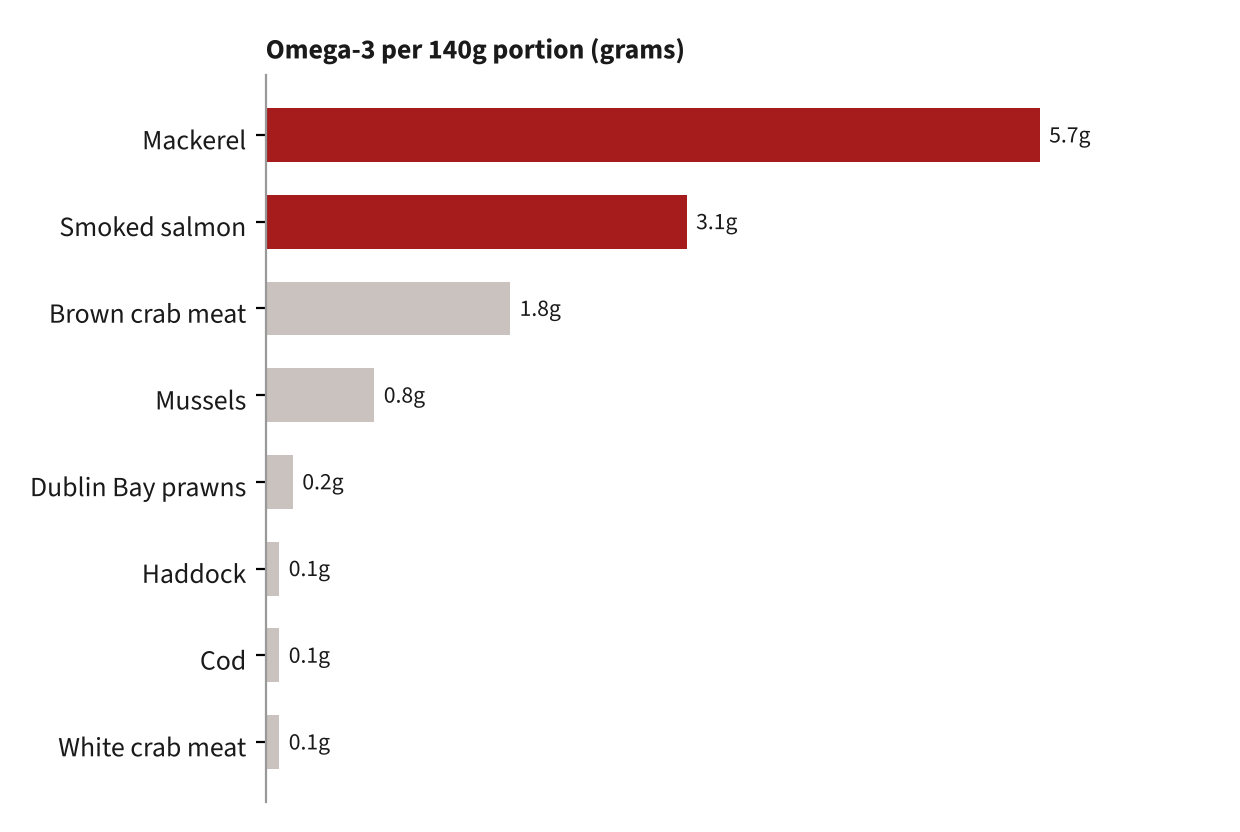
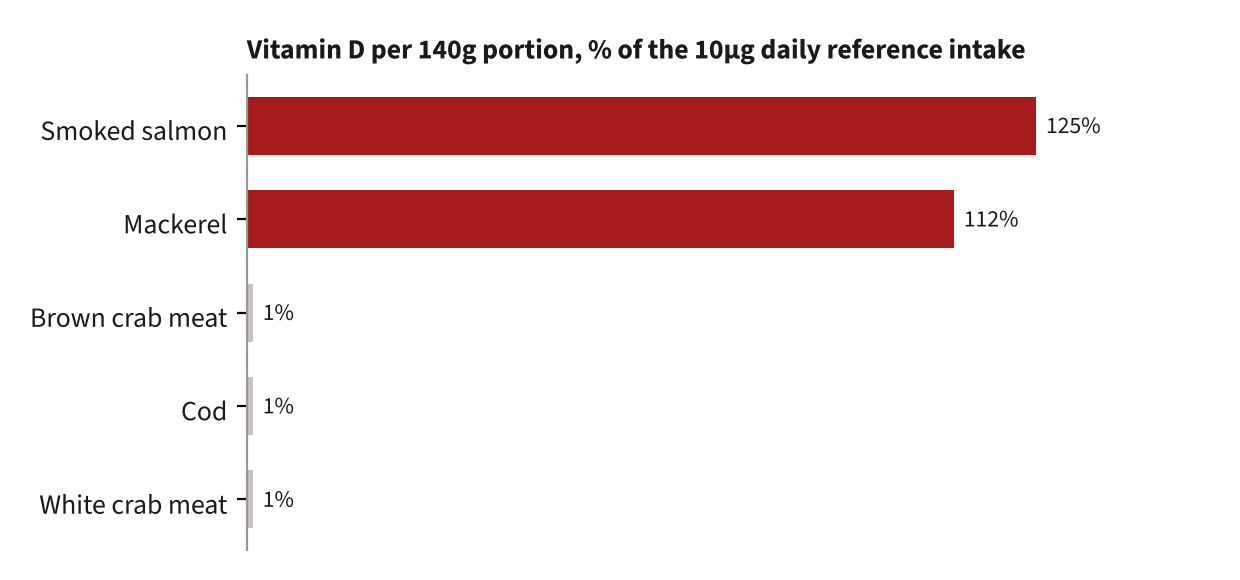
Fish is one of the very few foods that gives you vitamin D, and oily fish is the best of it. One 140g portion of mackerel gives about 11µg of vitamin D, more than the 10µg a day the government’s scientific advisers (SACN, 2016) recommend for everyone over four. The same portion carries about 5.7g of total omega-3 fats and 25g of protein. Mussels and brown crab are among the richest sources of vitamin B12, selenium and iodine. Dublin Bay prawns are lean: about 28g of protein a portion and almost no fat. These figures are the Department of Health’s own analysis of fish sold in the UK (2013).
At landing, the numbers add up quickly. One tonne of mackerel fillet is about 7,100 portions, 40kg of omega-3 and enough vitamin D for 8,000 person-days. Over 12,000 tonnes of NI-caught pelagic fish went into Killybegs alone in 2018, whole weight before filleting. That nutrition is landed, processed and eaten somewhere else.
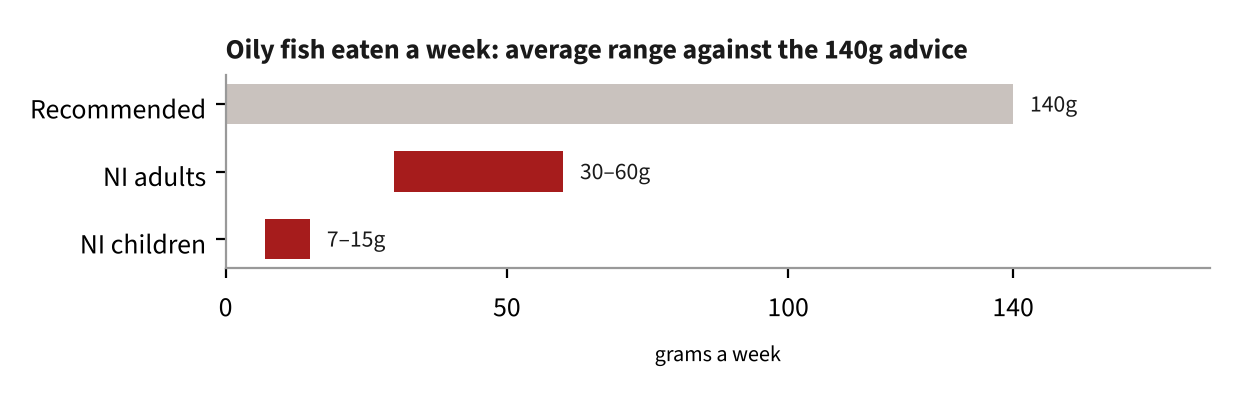
Meanwhile, NHS advice is at least two 140g portions of fish a week, one of them oily. The last detailed NI figures from the Food Standards Agency’s National Diet and Nutrition Survey (2012/13 to 2016/17) put adult oily fish intake at 30 to 60 grams a week, and children’s at 7 to 15 grams. The newer NI report, published in September 2025, again found that we do not eat enough oily fish. Safefood found in 2010 that nearly one person in five on the island never ate fish at all.
Mackerel and herring are exactly the oily fish people are short of, and they are NI’s biggest catch by tonnage. Most of them never touch an NI plate. Public procurement for schools and hospitals is one obvious lever.
The usual cautions stand. Pregnant women and girls should eat no more than two portions of oily fish a week and avoid shark, swordfish and marlin. Raw oysters carry a norovirus risk and should be avoided by older people, pregnant women, young children and anyone with weak immunity. The FSA classifies NI shellfish beds, and class B shellfish are purified, relaid or cooked before sale.
Three life cycles
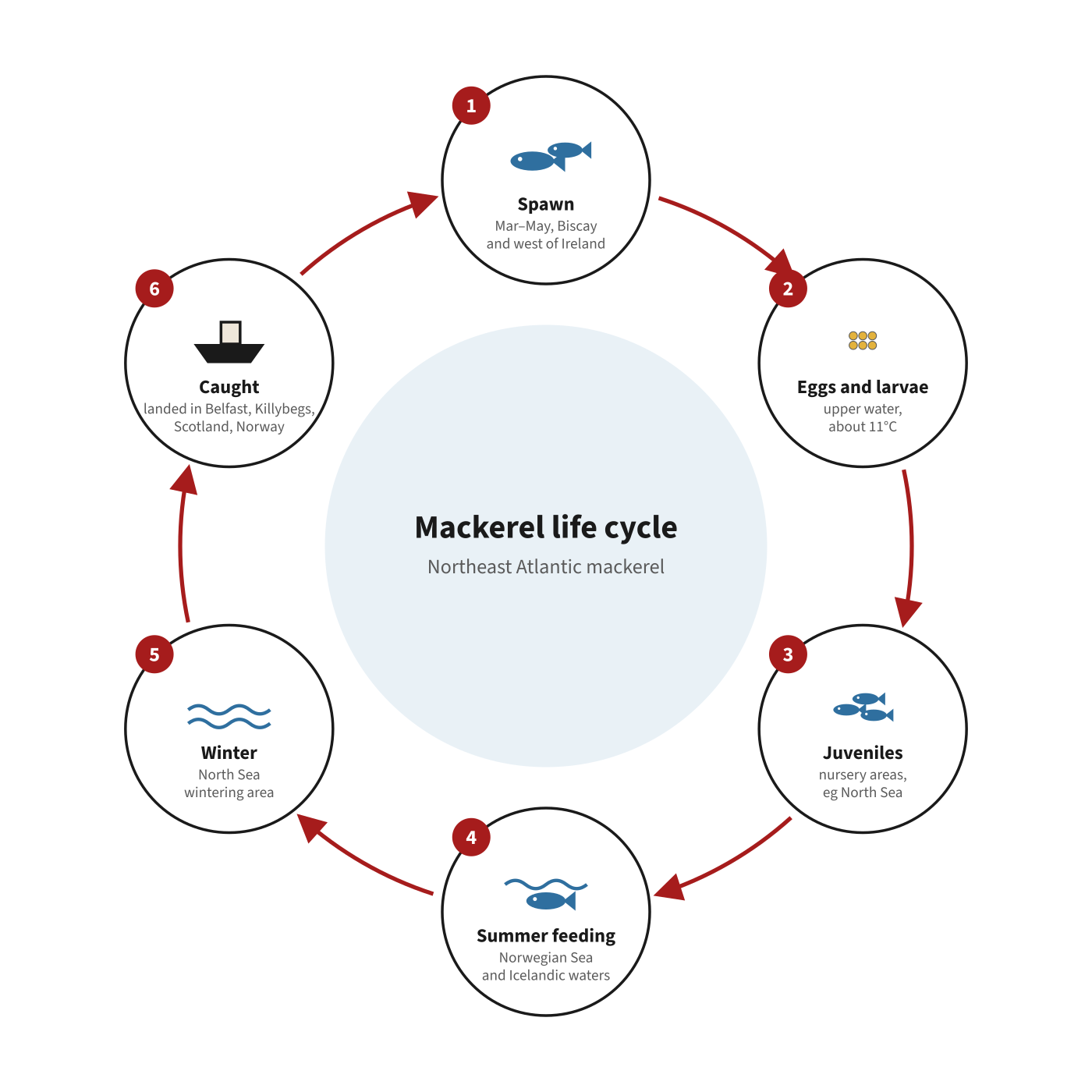
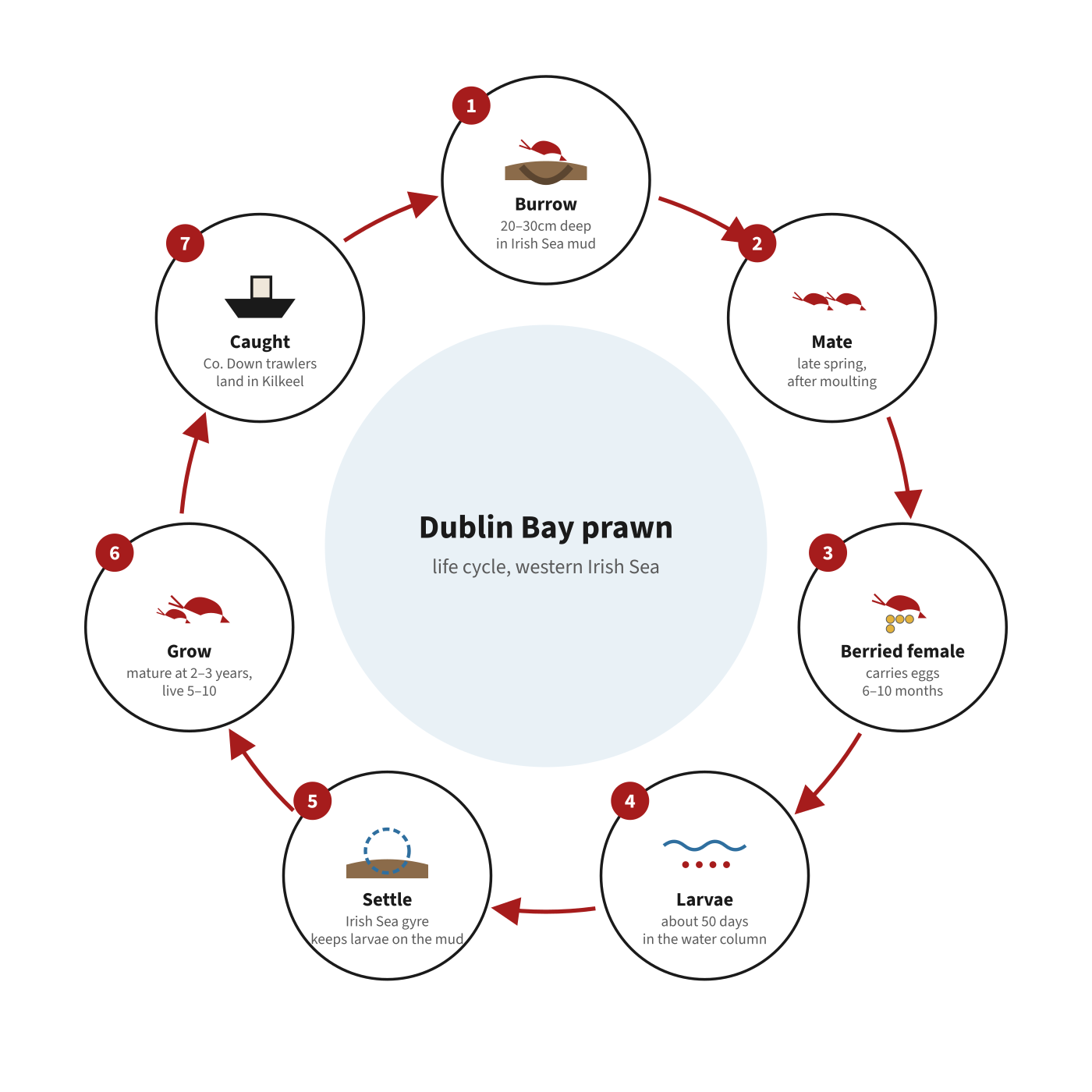
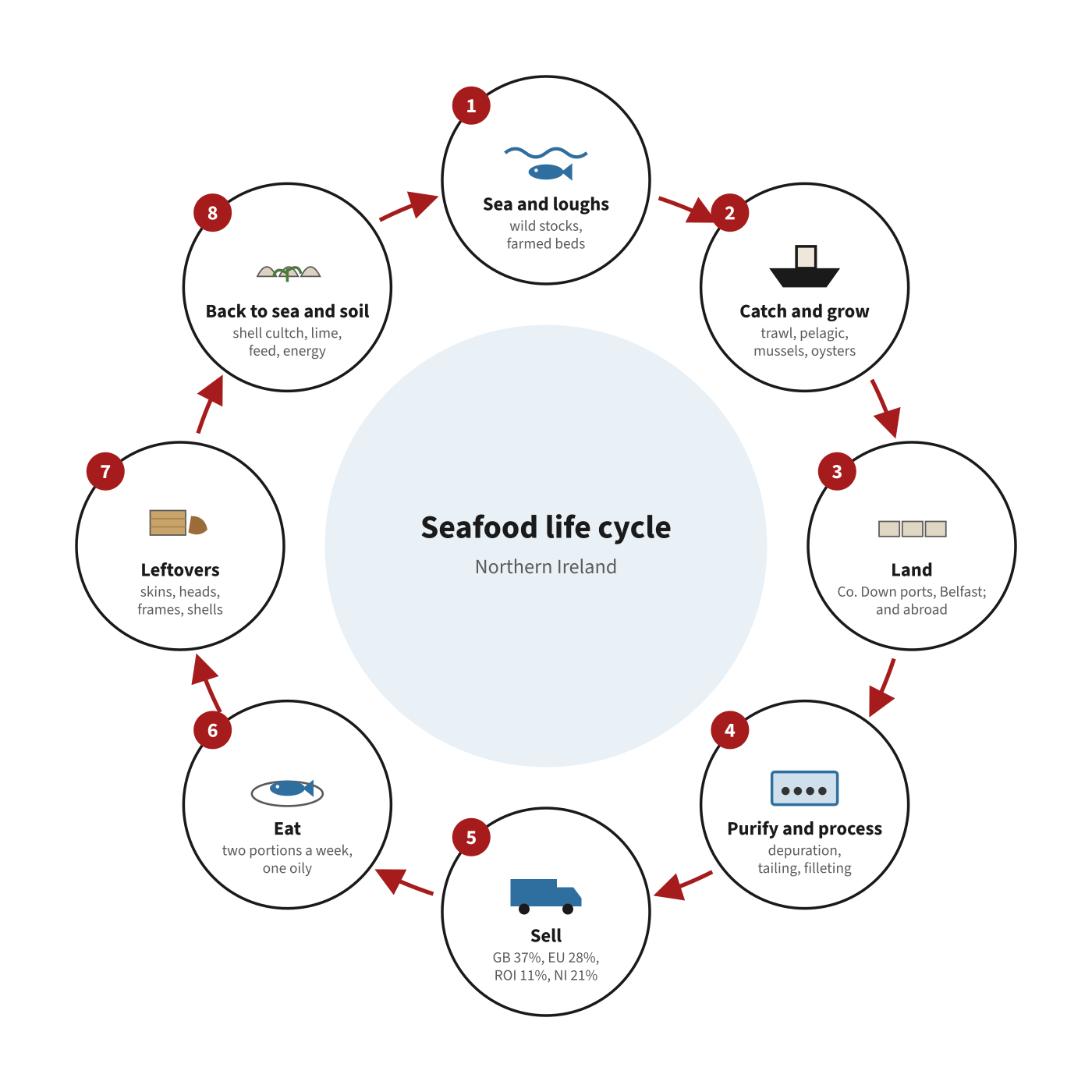
Every fish on a plate has two life cycles: its own, in the sea, and the one we give it, from boat to plate and back. Here are three: the mackerel that, with herring, makes up most of NI’s pelagic catch by weight, the Dublin Bay prawn that pays the Co. Down fleet’s bills, and the seafood chain itself.
Mackerel spawn mainly from March to May in the Bay of Biscay and west of Ireland, in the upper water at around 11°C. The young grow in nursery areas such as the North Sea; adults feed in summer in the Norwegian Sea and Icelandic waters and winter in the North Sea before returning south to spawn.
Dublin Bay prawns live in burrows 20 to 30cm deep in the Irish Sea mud. Females carry their eggs for six to ten months; the larvae drift for about 50 days, and the western Irish Sea gyre keeps them over the mud where they settle, which AFBI credits for the stock’s high density. They mature at two to three years and live five to ten.
Curing, pickling and smoking
Salt, smoke and vinegar are how these islands kept fish before refrigeration, and they are still how a cheap catch becomes a premium product.
- Cold smoking. The fish is cured in salt, then smoked at low heat so it stays silky and raw-textured: smoked salmon, kippers (split herring), smoked trout. Ewing’s in Belfast has done it for over a century; North Coast Smokehouse in Ballycastle smokes Glenarm salmon and dulse.
- Hot smoking. Smoked hot enough to cook: smoked mackerel, hot-smoked salmon, smoked eel. Most Lough Neagh eels are still smoked in the Netherlands, which is value we export with the fish.
- Brining and dry curing. Salt draws out water and is the first step of all smoking, and of salt fish and gravlax.
- Pickling. Vinegar, salt and spice give rollmops, soused herring and pickled mackerel. Herring curing was once a large trade at Ardglass and Portavogie; I have not yet checked that history against a primary source.
Smoking keeps the goodness. Smoked mackerel still carries about 8µg of vitamin D per 100g, but it also carries about 1.9g of salt (McCance and Widdowson’s Composition of Foods), so the salt is worth watching.
The rules are worth knowing. Fishery products such as wild herring, mackerel and salmon that are cold-smoked, salted, marinated or eaten raw must be frozen first, at -20°C for 24 hours or -35°C for 15 hours, to kill parasites such as Anisakis, unless the core reaches 60°C for a minute (FSA, applying Regulation 853/2004 as amended by 1276/2011). Vacuum-packed chilled fish has a 10-day shelf life unless other controls are proved, because of botulism risk (FSA, December 2020).
The Windsor Framework matters here too. The EU has delisted its liquid smoke flavourings (Implementing Regulation (EU) 2024/2067). In fish products where they replace real smoking, they may be used only until 1 July 2029. Because NI follows EU food law, NI firms using liquid smoke must switch; smokehouses using real wood smoke are unaffected and can sell into both markets.
The opportunity: smoke and pickle more of the herring and mackerel we now ship whole, bring eel smoking home from the Netherlands, and sell NI kippers, rollmops and smoked pollan under one NI seafood name.
The loughs: eels, pollan and trout
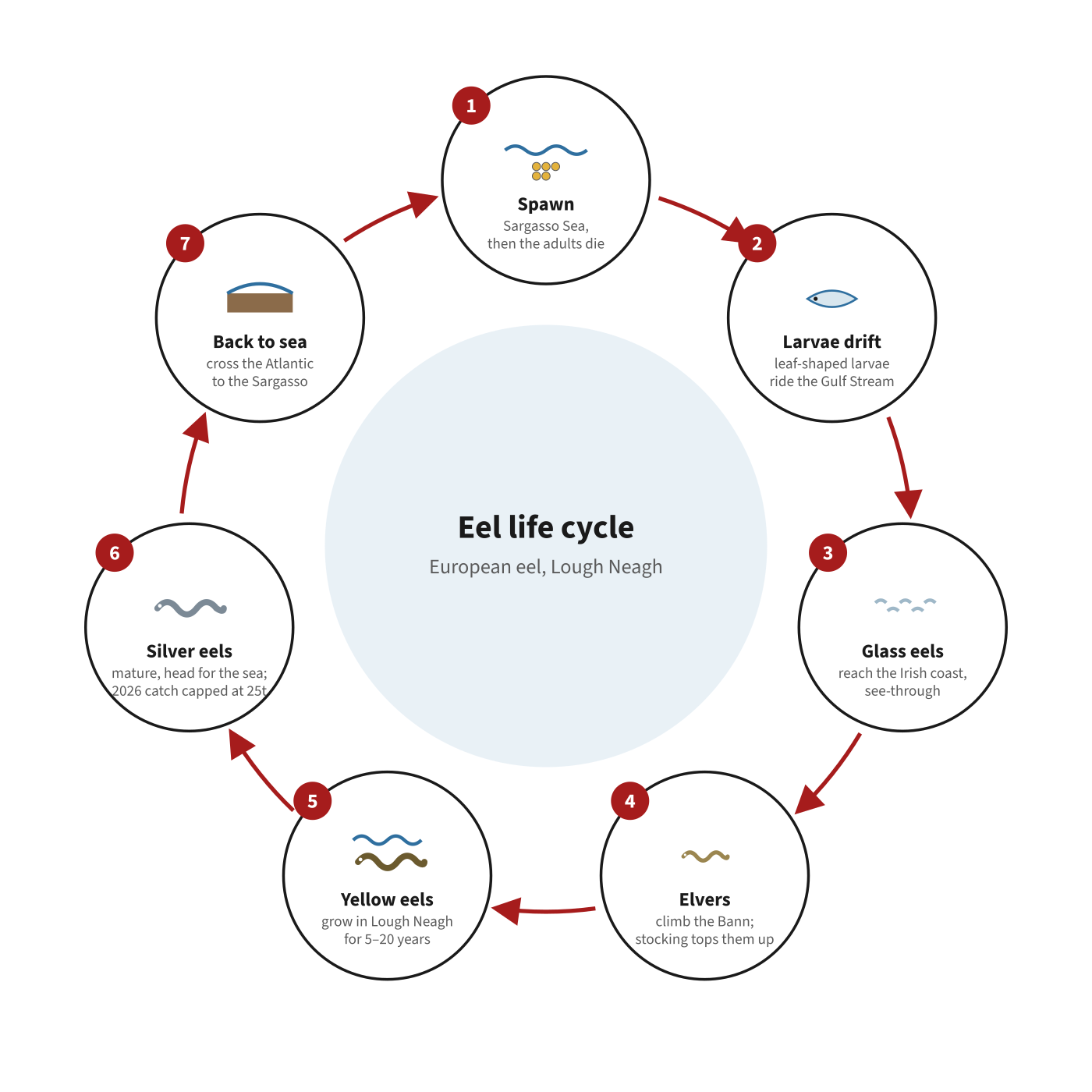
Not all NI seafood comes from the sea. Lough Neagh holds Europe’s largest wild eel fishery, owned by the Lough Neagh Fishermen’s Co-operative since 1971. It is not eel farming in the usual sense: the eels grow wild in the lough, but the run of baby eels from the Sargasso Sea has collapsed, so between 1984 and 2016 the co-op added 107 million elvers to the natural run, at a cost of £4.8 million, according to AFBI. Each eel spends 5 to 20 years in fresh water before swimming back to the Sargasso to spawn.
The Windsor Framework bites here too. Because NI follows EU rules, glass eels from the River Severn count as imports from outside the EU and cannot be used to restock Lough Neagh.
In 2026 the yellow eel fishery closed for three years. Silver eels are capped at 25 tonnes with a 90cm maximum size (DAERA, 4 June 2026). AFBI had advised a catch of zero (DAERA, eel conservation), and ICES advises zero catch of glass eels even for restocking and aquaculture. Lough Neagh Eels are a protected PGI product.
The lough’s other treasure is pollan, a freshwater whitefish found in few places in Europe and NI’s first PDO. With CAFRE, the co-op now brines and oak-smokes pollan and trout here instead of sending them abroad. On Lough Erne, commercial eel fishing ended under the 2010 eel management plan; elvers are now carried upstream past the dams instead (2.7 million in 2016).
Trout is NI’s real freshwater farming. Eighteen farms produced 641 tonnes of rainbow trout and 42 tonnes of brown trout in 2017, according to NI’s plan for the North Atlantic Salmon Conservation Organisation, and DAERA’s own farm at Movanagher stocked 16,000 rainbow and 29,500 brown trout into angling waters in 2025. Wild Atlantic salmon are catch and release only; the salmon on NI plates comes from the organic sea farm at Glenarm and the smokehouses of Belfast and Ballycastle.
The growth case: freshwater fish is local, traceable and protected by name. Smoke more eel and pollan here, put NI trout on NI menus, and back the lough’s water-quality clean-up, because the blue-green algae blooms of 2023 and 2024, and the suspended 2025 eel season, come from the same phosphorus problem running through the pork, beef and poultry pieces.
Leftovers: from waste to value
Skin is about 8% of a fish’s weight, according to Iceland’s Atlantic Leather, and a Dublin Bay prawn’s tail is only a fraction of the animal. Most of what is left goes to meal, to waste or, lawfully, back over the side. It can earn far more.
- Skins to dog treats. Dried fish skins are premium dog chews. Skipper’s Pet Products in Grimsby sells fish-skin twists and jerky, and Pooch & Mutt launched upcycled fish-skin treats in May 2026. In NI they are Category 3 animal by-products: the maker needs DAERA approval, and FSA guidance sets out how pet food can be made in the same premises as human food.
- Portavogie. A fish-skin dog treat maker is reported to work in Portavogie; I could not confirm its name and would welcome it. The harbour already has the raw material and the trade: C-Fish, a family fish processor started in the 1980s; Something Fishy NI, which sells Portavogie prawns and prawn tails online; and the Northern Ireland Fish Producers Organisation, based at the harbour. None of these is known to make pet food.
- Skins to leather. Tanned salmon and whitefish skin is a luxury leather. Atlantic Leather in Iceland and Ictyos in France supply fashion houses, and in Scotland Felsie bark-tans salmon skins from the Dunkeld Smokehouse. NI smokehouses throw away the same skins. Fish-leather labels on wine and spirit bottles would be a striking NI product; I found no one doing it here yet.
- Dublin Bay prawn heads to oil and chitin. Heads carry omega-3 oil comparable to krill oil, and shell is a source of chitin and chitosan. They would need landing and chilling ashore.
- Frames and guts to fish oil, pet food and biogas. In the Republic, Pelagia’s C Fish plant (no relation to C-Fish in Portavogie) describes itself as the only licensed Category 3 fish intermediary plant in Ireland. This links straight to the NI biomethane strategy, which closes for comments on 15 December 2026.
- Shells to lime and reefs. Mussel and oyster shell can replace quarried lime, become poultry grit, or go back to sea as cultch for native oyster restoration, which began in Strangford Lough in 2022.
For NI food businesses
Three things to check now:
- Is your raw material NI-landed? If so, it moves to the EU and GB without catch or health certificates. If it is landed in Killybegs or GB, it may not.
- Does your smoking rely on liquid smoke? In NI, fish products using it have until 1 July 2029 to switch.
- What does the SPS deal do to your GB supply from 2028? Fewer checks on GB inputs, but more GB competition, notably in shellfish.
And one carbon point, because that is my trade: Irish life-cycle figures put rope-grown mussels at about 0.11kg CO2e per kg and pelagic mackerel at about 0.23kg, against 1.5 to 2.9kg for trawled Dublin Bay prawns and whitefish (BIM, 2023). Shipping whole fish abroad to be processed and sold back adds transport on top. If you want to know what that means for your business, email robert@robertjpark.co.uk.
The point
Northern Ireland catches more than it lands, lands more than it processes, and processes more than it eats. Each step loses value and jobs. The Windsor Framework gives NI-landed fish an access to both markets that no other part of the UK has. The question is whether we build the ports, plants and brand to use it before 2028.
A note on names: I call Nephrops norvegicus “Dublin Bay prawns” throughout, and on purpose. It is the name these islands have used for generations, and the one AFBI, our own fisheries scientists, use. “Langoustine” is French for “little spiny lobster”, which this animal is not. And having left the EU, it seems a shame to hand the menu straight back to France. A langoustine is just a Dublin Bay prawn that has been on a gap year in Brittany and come back charging more.
This is commentary, not legal, customs or tax advice. Figures were read from the sources below on 21 November 2026. DAERA’s processing figures for 2023 and 2024 are due on 15 December 2026, and the 2022 destination figures here will need updating then. The UK sea fisheries statistics have lost their accredited official statistics status; the NI catch figure used here comes from DAERA.
Created with assistive technology including AI and re-checked against the official sources listed.
Sources
- NI Assembly RaISe paper 29/26, 15 April 2026
- DAERA, Statistical Review of NI Agriculture 2024 (November 2025)
- DAERA, Fishing and Seafood Development Programme Stage 1 (February 2020)
- House of Commons NI Affairs Committee, Brexit and Northern Ireland: fisheries (2018)
- DAERA, NI Food and Drinks Processing Report 2022 (10 April 2025)
- GOV.UK, Exporting or moving fish from the UK (updated 1 October 2026)
- DAERA, direct landing requirements for NI-registered vessels
- GOV.UK, Fish and shellfish: preparing your business for the SPS agreement (updated 30 July 2026)
- DAERA, Marine Environment and Fisheries Fund 2026/27
- Defra, Fishing and Coastal Growth Fund (October 2025)
- FSA, NDNS report for NI 2012/13 to 2016/17
- FSA, NDNS 2017 to 2023 report for NI (September 2025)
- NHS, fish and shellfish (reviewed 26 June 2026)
- NI Assembly Official Report, 27 February 2024 (Kilkeel harbour)
- Down News, DAERA says sea fishing programme still under review, 22 September 2026 (secondary)
- DAERA, Kilkeel inner harbour disposal licence MLVAR2026052 (26 October 2026)
- GOV.UK, Nephrops stunning and tailing prototype case study
- World Fishing, DAERA grant for automated tailing (trade press)
- GOV.UK, NI Food and Drinks Processing Report 2023 and 2024 release notice
- Department of Health, Nutrient analysis of fish and fish products (March 2013)
- SACN, Vitamin D and health (2016)
- AFBI, Dublin Bay prawn fact sheet
- ICES Journal of Marine Science, mackerel spawning (2024)
- Frontiers in Marine Science, mackerel migration (2022)
- DAERA, approved pet food plants (March 2026)
- FSA, pet food guidance (updated 10 February 2026)
- Seafood Source, Skipper’s Pet Products (trade press)
- European Commission, Don’t bin the skin (2021)
- DAERA, 2026 eel fishery measures for Lough Neagh (4 June 2026)
- DAERA, eel conservation
- AFBI, experts visit Europe’s largest eel fishery
- NASCO implementation plan, UK (Northern Ireland)
- nidirect, 2025 fish stocking figures
- NI Assembly, Eel Fishing Regulations 2010 (Committee record)
- DAERA, inland fisheries statistics digest (2018)
- FSA, freezing fish and treatment for parasites
- Commission Regulation (EU) No 1276/2011, legislation.gov.uk
- FSA, vacuum packaging guidance (revised 14 December 2020)
- Commission Implementing Regulation (EU) 2024/2067, EUR-Lex
- FSAI, smoke flavourings
- C-Fish Portavogie
- Something Fishy NI
- GOV.UK, Decision on fisheries access, 1 July 2026 to 30 June 2038
- GOV.UK, UK Single Issuing Authority (vessel licensing)
- House of Commons NI Affairs Committee, the Voisinage Arrangement (2018)
- Sea-Fisheries (Amendment) Act 2019, Irish Statute Book
- GOV.UK, Importing or moving fish to the UK
- Pelagia, C Fish (company site)
- DAERA, MEFF 2026/27 on-board investment guidance note
- BIM, carbon footprint of Irish seafood (2023)
- Safefood, finfish food chain review summary (2010)