
The price of a separate grid
Part of the Policy series: where the rules stand in Northern Ireland, who decides them, and what to do about it. Updated as the rules change.
The argument in brief
On 21 July 2026, the day after he took office, Prime Minister Andy Burnham announced a zero VAT rate on household electricity in Great Britain for six months from 1 October. Northern Ireland was left out, because EU VAT rules still apply to electricity here under the Windsor Framework. Communities Minister Gordon Lyons (DUP) blamed post-Brexit rules. Economy Minister Caoimhe Archibald (Sinn Féin) said it continued a pattern of London overlooking Northern Ireland. In September the Treasury funded a one-off credit for NI households instead. The Budget of 28 October 2026 extended the GB zero rate to 30 June 2027; HMRC guidance of 8 September kept NI at 5%.
The VAT row is the household version of a bigger gap for industry. Since 2023, Westminster has built a set of tools to cut electricity costs for GB manufacturers: 90% network charge relief, the British Industrial Competitiveness Scheme (BICS) and the planned end of Carbon Price Support. None of them reaches Northern Ireland, because NI sits in the all-island Single Electricity Market and energy is devolved. The Budget of 28 October 2026 changed that for industry. It funds the NI Executive to set up its own version of BICS for heavy electricity users in manufacturing. No amount was stated, and design and timing are for the Executive.
Northern Ireland cannot simply copy GB relief. GB funds part of it by moving costs elsewhere, and in a small market those costs would land on households, many of them fuel poor and dependent on heating oil. The lasting fix is cheaper NI generation and a stronger grid: renewables auctions and the North–South interconnector. Those take years, and business needs help sooner. The funded NI version of BICS could bridge the gap, and Exchequer money keeps its cost off household bills. How soon depends on the Executive.
This piece sets out the arguments on each side; the recommendations are the author’s. Facts checked to 30 October 2026; rechecked and updated 16 November 2026.
The lifecycle at a glance
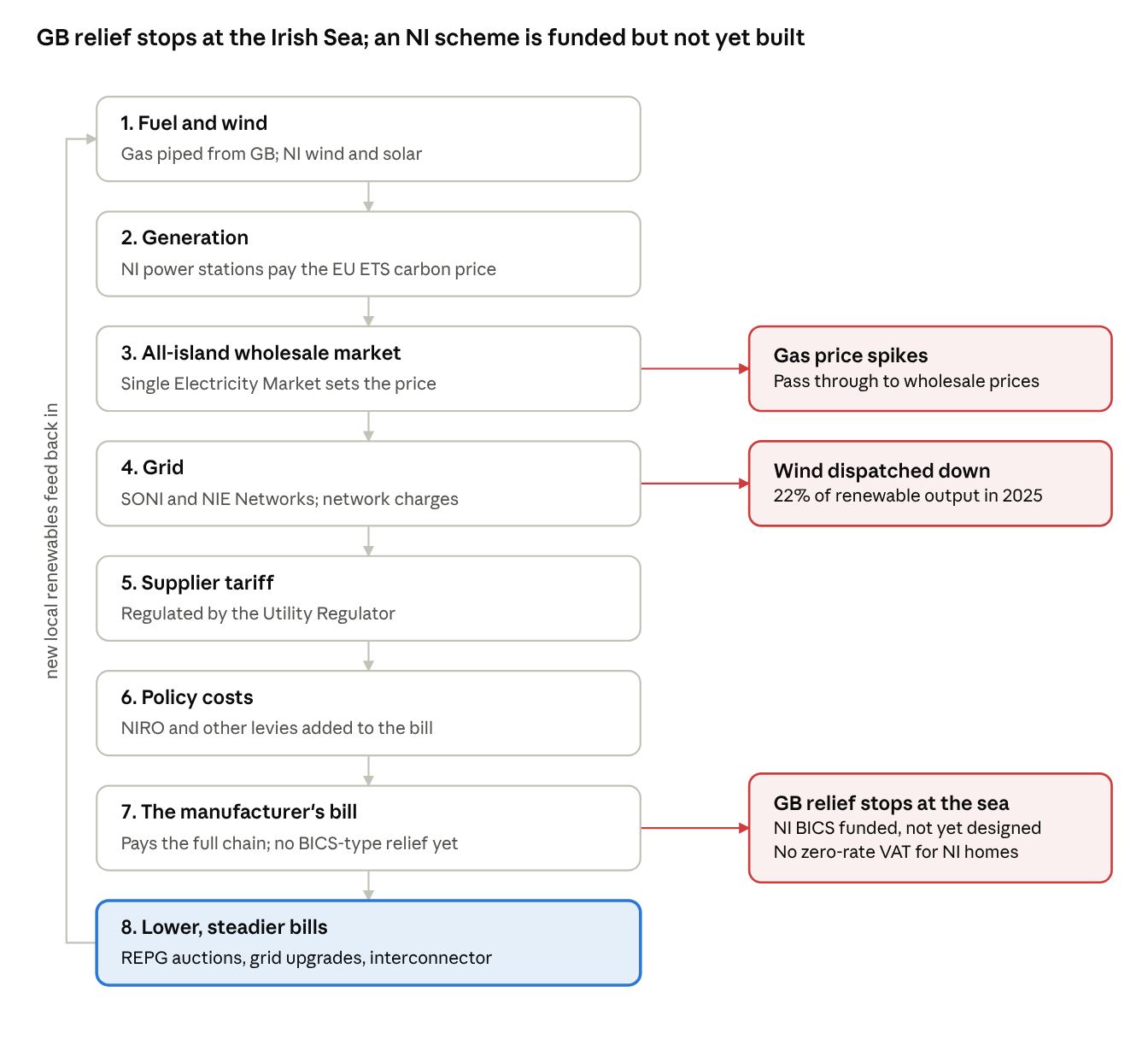
Cost builds at every stage, and gas spikes and wasted wind add to it. GB relief comes off the bill at stage 7. The Budget of 28 Oct 2026 funded an NI version of BICS, still to be designed. The lasting fix is cheaper local power fed back into the market.
Then and now (2023 to October 2026)
| Rule or instrument | 2023 | Now (with date) | What changed and why |
|---|---|---|---|
| Network charging compensation (British Industry Supercharger) | Package being developed for GB | Relief raised from 60% to 90% from 1 April 2026; GB only | Government says it saves up to £420m a year (Commons, 16 Apr 2026). NI is excluded because it is in the Single Electricity Market |
| British Industrial Competitiveness Scheme (BICS) | Did not exist | Guidance published 10 Aug 2026; applications 1 Oct to 30 Nov 2026; RO and FiT exemptions from April 2027, Capacity Market exemption from October 2027; GB only. Budget (28 Oct 2026) funds the NI Executive to set up its own version; no amount stated | Industrial Strategy response to high GB industrial power prices. Government says up to £40/MWh off for over 10,000 firms (written statement, 16 Apr 2026) |
| Carbon Price Support | In force for GB generators; NI generators not covered | To be removed from April 2028 (Treasury statement, 16 Apr 2026) | Treasury says it has done its job; removing it helps offset the cost of BICS |
| Climate Change Levy (CCL) | Main rates set at each Budget; Climate Change Agreement (CCA) holders pay reduced rates | From 1 Apr 2028 the electricity main rate is frozen at the 2027–28 level; gas and solid fuel rise by RPI; LPG stays frozen (Budget, 28 Oct 2026) | Shifts the levy in favour of electricity over gas. UK-wide, so NI firms benefit. CCA reduced rates stay fixed percentages of the main rates |
| VAT on domestic electricity | 5% across the UK | 0% in GB from 1 Oct 2026 to 31 Mar 2027; Budget (28 Oct 2026) to extend this to 30 Jun 2027; NI stays at 5% (HMRC, 8 Sep 2026) | Burnham’s first cost-of-living measure. Windsor Framework VAT rules apply in NI, so NI homes get a one-off credit instead |
| Link between gas and electricity prices (GB) | Review of electricity market arrangements under way | Package of 21 Apr 2026: voluntary wholesale CfDs for older renewables, allocation planned for 2027; generator levy to rise from 45% to 55% | Gas price spike linked to the Middle East conflict. GB measures only |
| NI renewables support | No scheme; design consultation Feb 2023 | Renewable Electricity Price Guarantee (REPG) final design Sept 2025. Enabling Bill passed Second Stage 8 Sep 2026 and is in Committee (Oct 2026). No auction date set; lawyers expect early 2028 | The 80% by 2030 target in the Climate Change Act (NI) 2022 cannot be met without new projects |
| NI renewable share of electricity | About 50% | 50% for July 2025 to June 2026 (NISRA, 3 Sep 2026) | Up from 44% a year earlier, but well short of the 80% target for 2030 |
| NI household bill support | Energy Price Support Scheme ending | One-off £63 credit from 6 Oct 2026 for about 860,000 homes, combining NIRO relief and a VAT equivalent; NIRO relief continues in 2027 and 2028 (DfE, 17 Sep 2026) | NI’s equivalent to GB levy and VAT cuts, delivered by the Department for the Economy (DfE) |
| Heating oil (kerosene) | One-off alternative fuel payments (2022–23) | 4% tariff on kerosene removed (Budget, 28 Oct 2026) | Aimed at oil-heated homes. HM Treasury says 61% of NI households rely on heating oil |
| Funding for the NI Executive | Executive suspended; 2023–24 budget set by the Secretary of State | Extra £270m in Barnett consequentials over the Spending Review period; a separate £1.5bn over three years offered to help agree a budget (28 Oct 2026) | Barnett money is not ring-fenced, so the Executive decides how much goes to energy support |
| North–South Interconnector | Consented, before construction | Handed to NIE Networks to build; completion estimated for 2031 (Apr 2026) | Long-delayed fix for constraints in the all-island market. Local opposition continues |
Where the parties and governments stand (October 2026)
The main split is between parties that would cut bills by removing carbon and policy costs, and parties that would cut them by building renewables and restructuring older subsidy contracts. In NI, parties disagree less about the problem than about whether London or Stormont should pay.
| Party or government | Position (dated) |
|---|---|
| UK Government (Labour, PM Andy Burnham) | Zero VAT on GB domestic electricity from 1 Oct 2026, extended to 30 Jun 2027 in the Budget; £25.7m for an NI equivalent (Sep 2026). Keeps the April 2026 gas-decoupling package, BICS and the end of Carbon Price Support in 2028. Business Secretary Peter Kyle said the Government is working with the Assembly on an NI scheme (16 Apr 2026). The Budget (28 Oct 2026) funds the Executive to set up its own BICS, with no amount stated. It also removes the 4% kerosene tariff and adds £270m of Barnett money |
| Conservatives (Kemi Badenoch) | Would scrap the UK ETS, Carbon Price Support and UK CBAM (1 Apr 2026) |
| Reform UK (Nigel Farage) | Promises a £250 bill cut within 100 days: remove VAT on energy permanently, take policy costs off bills and scrap carbon taxes on generators (conference, 3 Sep 2026) |
| Liberal Democrats (Ed Davey) | Halve household bills by 2035; move older Renewables Obligation projects onto CfDs and break the gas link (16 Jul 2025) |
| Green Party of England and Wales (Zack Polanski) | Called for the energy price cap to be extended beyond June 2026 (March 2026) |
| NI Economy Minister Caoimhe Archibald (Sinn Féin) | Called NI’s £17m heating oil share clearly inadequate and is pressing UK ministers (March 2026). Introduced the Renewable Electricity Generation Bill (30 Jun 2026). Has met large energy users about exclusion from BICS (early 2026) |
| DUP (Gordon Lyons, Jim Shannon) | Lyons wants an EU derogation so the VAT cut applies in NI (July 2026). Shannon asked for BICS-type help for NI manufacturers (16 Apr 2026) |
| SDLP (Claire Hanna, Colum Eastwood) | Hanna wants any Barnett money spent on visible local benefit (July 2026). Eastwood called NI’s exclusion from the Supercharger a blow (2023–24, under the Conservative government) |
| Alliance, UUP, TUV | Alliance MP Sorcha Eastwood sought fuel duty and VAT cuts part-funded by windfall taxes (13 Apr 2026). No UUP or TUV position on industrial energy costs found (27 Oct 2026) |
-
Who pays. Reform and the Conservatives would remove carbon costs and levies. Labour and the Lib Dems would move costs onto the Exchequer or restructured contracts. Under every option, someone other than the bill payer still pays.
-
Carbon pricing. Scrapping the UK ETS would not touch NI generators, which sit in the EU ETS.
-
Constitution versus money. The DUP presents the VAT gap as a Windsor Framework problem; Sinn Féin presents it as London underfunding Stormont. Both want more money for NI.
-
Speed. GB relief starts in 2027. NI’s structural fixes, renewables auctions and the interconnector, arrive from 2028 to 2031. The funded NI version of BICS has no start date yet (28 Oct 2026).
Who decides what
Most GB relief is a Westminster decision. NI electricity is governed by Stormont, the Utility Regulator and the all-island market.
| Instrument | Who decides | Whose approval is needed | Position in Northern Ireland |
|---|---|---|---|
| BICS, Supercharger | Department for Business and Trade and DESNZ (GB); NI Executive (NI version) | Parliament for levy changes; Treasury | GB scheme is GB only. The NI Executive is funded to set up its own version and decides its design and timing (Budget, 28 Oct 2026). Windsor Framework Article 10 subsidy rules apply to NI support |
| Carbon Price Support | HM Treasury | Finance Bill | Never applied to NI generators |
| Climate Change Levy | HM Treasury | Finance Bill | Applies UK-wide; electricity main rate frozen from 1 Apr 2028 (Budget, 28 Oct 2026) |
| VAT on electricity | HM Treasury | EU agreement needed for NI under the Windsor Framework | Stays at 5%; Treasury-funded credit instead |
| Carbon price on power generation | EU (EU ETS) | EU institutions | NI generators covered by the EU ETS |
| Wholesale market rules | SEM Committee | Utility Regulator and CRU (Ireland) | All-island market |
| Regulated tariffs and network price controls | Utility Regulator | Statutory duties set by DfE | Power NI, firmus and SSE Airtricity Gas tariffs; NIE Networks controls |
| Renewables auctions (REPG) | DfE | Assembly legislation; subsidy control | Bill in Committee (Oct 2026); no auction date set |
| 80% renewable target | Climate Change Act (NI) 2022 | Assembly | Statutory target for 2030 |
Where the pillars compete
-
Industrial relief against fuel poverty. DfE’s Head of Energy Group, Richard Rodgers, told the Economy Committee that GB-style relief is funded through household bills, which makes it hard to copy in NI without hurting fuel-poor homes (reported early 2026). Exchequer funding for an NI version of BICS, announced on 28 Oct 2026, eases this if the scheme stays off household bills.
-
Cheaper gas power now against carbon signals. Ending Carbon Price Support in 2028 lowers the cost of GB gas generation. That cuts bills but weakens the reason to switch away from gas.
-
Two-way contracts. Under the NI price guarantee, consumers pay in when wholesale prices are low and get money back when they are high. That protects against gas spikes but can add to bills in calm years.
-
Grid against land. The interconnector and about £1.3bn of SONI grid projects are needed to cut wasted wind (22% of renewable output was dispatched down in 2025). Landowners oppose the routes.
-
Electricity relief misses oil-heated homes. Half of NI households rely on oil alone for central heating (Census 2021), so help with electricity bills does not reach their heating. The Budget removed the 4% kerosene tariff (28 Oct 2026); HM Treasury says 61% of households rely on heating oil.
What it means for Northern Ireland firms and councils
-
GB competitors get lower costs from 2027. Benchmark against DESNZ figures: GB manufacturing power averaged 17.4p/kWh excluding Climate Change Levy in Q2 2026.
-
Heavy electricity users should engage early on the NI version of BICS. The Budget (28 Oct 2026) funded the Executive to set it up but gave no amount, criteria or start date.
-
Climate Change Levy payers get a frozen electricity rate. From 1 Apr 2028 the electricity main rate stays at the 2027–28 level while gas rises by RPI. That helps the case for electrifying heat.
-
Regulated tariffs are rising. Power NI went up 6.2% from 1 July 2026. Firmus gas rose 15.7% in July, then a further 9% (Utility Regulator notice, 4 Sep 2026).
-
Groups with GB sites should check BICS eligibility for those plants and flag the Windsor Framework Article 10 question.
-
Councils can offer land, rooftops and planning certainty for renewables projects ahead of the first REPG auction, and look at generation for their own estate.
-
Large users should respond to the Utility Regulator’s four-year review of network tariff structures (consultation opened 23 Sep 2026) using their own load profiles.
Practical examples
-
NI manufacturers named in Parliament. Jim Shannon (DUP) said Magellan Aerospace, T.G. Eakin and Mash Direct may not qualify for BICS. Peter Kyle replied that the Government was working with the Assembly so NI manufacturers would benefit (Commons, 16 Apr 2026).
-
A council buying local wind power. Belfast City Council became the first customer for power from 3T Power’s Ballyutoag wind farm. The supply covers City Hall and over 200 other council buildings (Belfast City Council, 9 Dec 2025).
-
The credit that replaced the VAT cut. About 860,000 NI homes get a one-off £63 discount from 6 October 2026, costing an estimated £53m (ITV News, 17 Sep 2026). It combines NIRO relief with a VAT equivalent (DfE, 25 Aug 2026).
-
Small firms under strain. A Utility Regulator study of 42 NI small businesses found upfront cost was the main barrier to efficiency work. Awareness of available support was low (Utility Regulator, 14 Oct 2026).
-
Wind the grid could not take. In 2025, 22% of NI renewable output was dispatched down, against 29.6% in 2024. SONI’s draft plan to 2034 lists over £1.3bn of grid projects (Farmers Journal, 8 Apr 2026).
Recommendations
-
NI Executive and HM Treasury: set the amount, rules and start date for the funded NI version of BICS. The Budget (28 Oct 2026) gave funding but no figure. Exchequer funding keeps the cost off household bills.
-
HM Treasury and DfE: extend the NI credit to match the GB zero VAT rate, now extended to 30 June 2027. Otherwise NI households fall behind again.
-
DfE and the Assembly: pass the Renewable Electricity Generation Bill and set a firm date for the first auction. On NISRA’s latest figures, 80% needs about 2,700 GWh more renewable output a year at today’s demand.
-
Utility Regulator: publish a regular NI and GB non-domestic price comparison by size band. The last full analysis dates from 2016.
-
DfE and DfC: target heating oil households separately. Electricity relief misses most rural homes. The 4% kerosene tariff removal (28 Oct 2026) helps, and the extra £270m of Barnett money gives room for more.
-
Firms: model costs under both GB and NI regimes, including EU ETS pass-through and BICS for any GB sites and the NI version once designed, before deciding where to invest.
-
Councils: prepare sites and planning guidance for renewables and grid upgrades. Faster consents bring down future prices.
Sources
-
Irish News: VAT cut won’t apply in NI until EU says so (21 Jul 2026)
-
Irish News: Burnham excludes NI from flagship measures (23 Jul 2026)
-
DfE: Minister provides update on domestic electricity discount scheme (25 Aug 2026)
-
ITV News: Households to get £63 off electricity bills (17 Sep 2026)
-
GOV.UK: BICS guidance for applicants (10 Aug 2026, updated 12 Oct 2026)
-
Hansard: Written statements on BICS (HCWS1521) and Carbon Price Support (HCWS1519) (16 Apr 2026)
-
Hansard: Commons sitting of 16 Apr 2026, BICS statement and debate
-
Travers Smith: decoupling gas and electricity prices (27 Apr 2026)
-
NISRA: Electricity consumption and renewable generation (3 Sep 2026)
-
DfE: Archibald publishes final scheme design for the REPG (19 Sep 2025)
-
DfE: Archibald introduces Renewable Electricity Generation Bill (30 Jun 2026)
-
A&L Goodbody: Renewable Electricity Generation Bill introduced (2 Jul 2026)
-
DAERA: Emissions trading schemes, NI generators in the EU ETS (updated 15 Sep 2025)
-
Farmers Journal: Renewables driving investment in grid (8 Apr 2026)
-
Utility Regulator: firmus regulated gas tariff to rise 9% (4 Sep 2026)
-
Utility Regulator: Consultation on a cost-reflective tariff structure (23 Sep 2026)
-
Utility Regulator: Small business experience of energy stress (14 Oct 2026)
-
Utility Regulator: Electricity Prices in NI, a factual analysis (2016)
-
Manufacturing NI response to the Utility Regulator (12 Feb 2026)
-
Belfast City Council: Council venues switch to locally generated green power (9 Dec 2025)
-
4NI: Alliance calls for cross-party effort on energy (13 Apr 2026)
-
HM Treasury and HMRC: Budget 2026 Overview of Tax Legislation and Rates (28 Oct 2026)
-
HM Treasury and NIO: Breathing space for Northern Ireland families and businesses (28 Oct 2026)
Robert J. Park is an independent environment, carbon and public-affairs consultant based in Larne, Northern Ireland. He helps firms and public bodies measure their carbon and make their case on policy.
Agree or disagree? Get in touch on LinkedIn or WhatsApp @robertjpark.