
The land law Stormont never switched on

Part of the Policy series: where the rules stand in Northern Ireland, who decides them, and what to do about it. Updated as the rules change.
The argument in brief
On 22 May 2026, DAERA Minister Andrew Muir (Alliance) briefed Foyle MLAs on Mobuoy, which he called one of the largest illegal dumping sites in western Europe. He promised a final remediation strategy, a new cost estimate and a business case. Four days later the SDLP complained that the site still had “not one penny in place”. That row shows the wider gap. Northern Ireland has no working legal regime for historically contaminated land.
Part III of the Waste and Contaminated Land (Northern Ireland) Order 1997 would create that regime. It is the NI version of Part 2A of the Environmental Protection Act 1990, which has applied in Great Britain since 2000–2001. Almost 30 years on, Part III has never been commenced. DAERA’s project page, last updated on 14 April 2026, says a tender for a report on the cost and resources of the regime received no bids, officials are considering next steps, and the work may be completed in 2027. In practice, contamination is dealt with when someone applies for planning permission. Land that nobody develops is not dealt with at all.
This piece argues that the Executive should agree to commence Part III within the current Assembly mandate, phased in and with capped funding. The case against is serious. Councils face costs, homeowners could face blight and liability, and remediation money competes with money for housing. Those risks can be managed. Doing nothing is also a choice, and the public pays for it later.
This piece sets out the arguments on each side; the recommendations are the author’s. Facts checked to 30 October 2026; rechecked and updated 16 November 2026.
The lifecycle at a glance
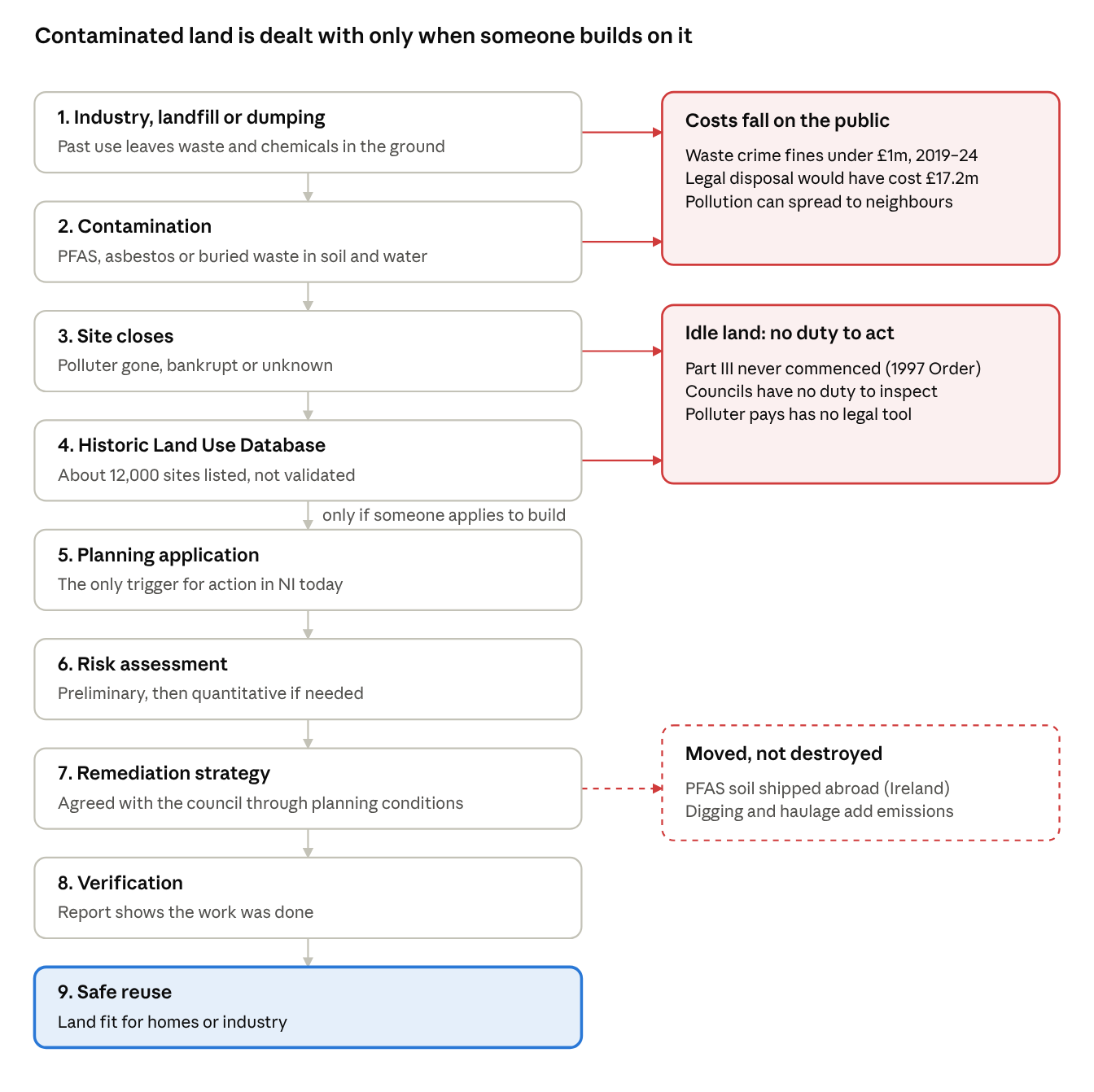
The chain breaks between stages 4 and 5. Land that nobody applies to develop is never assessed, and its costs fall on neighbours and the public.
Then and now (2023 to October 2026)
| Rule or instrument | 2023 | Now (with date) | What changed and why |
|---|---|---|---|
| Part III, Waste and Contaminated Land (NI) Order 1997 | Enacted but not in force | Still not in force. Cost and resources tender drew no bids; work may be completed in 2027 (DAERA, updated 14 Apr 2026) | A ministerial decision was made to commission costings, but the market did not respond. No timetable has been set |
| NI Audit Office scrutiny | Waste crime review in progress | Waste Crime in Northern Ireland (3 Jul 2025) asks DAERA to propose a timeline for commencing the 1997 Order | The audit links the land gap to waste crime and to costs falling on the public purse |
| Mobuoy, Co. Londonderry | Under investigation; directors not yet sentenced | Consultation held 13 Jun–2 Oct 2025; responses published 12 Mar 2026; strategy, costing and business case pending (22 May 2026) | Sentencing in 2025 opened the way to remediation. The money is still unresolved |
| Environmental Liability (Prevention and Remediation) Regulations (NI) 2009 | In force since 24 Jul 2009 | Unchanged | Does not cover damage from events that ended before July 2009, so it cannot reach legacy land |
| Planning route (DAERA guidance; Practice Guide, Apr 2019) | Main tool in practice | Main tool in practice (DAERA page last changed 10 Jun 2020) | Developers carry out remediation when they build. Idle sites are never assessed |
| GB Part 2A | In force: England and Scotland 2000, Wales 2001; English statutory guidance dates from Apr 2012 | Unchanged. English capital grants ended 1 Apr 2017 | Without grants, much of the work moved into planning in GB too |
| EU Soil Monitoring Directive 2025/2360 | Proposal under negotiation | In force 16 Dec 2025; three years to transpose; public register of potentially contaminated sites due within 10 years | Ireland must list its sites. Not on DAERA’s 3 Apr 2026 list of Annex 2 law under UK direction and control |
| PFAS on land | Barely addressed in UK or Irish land practice | CL:AIRE published 13 PFAS site profiles for the Environment Agency (29 Jul 2026). Dublin Airport warned of a legal gap for PFAS soil (Irish Examiner, 27 May 2026) | Firefighting foam legacies at airfields, fire stations and military sites are now being mapped |
| NI Housing Supply Strategy 2024–2039 | In development | Published Dec 2024: at least 100,000 homes, one third social | The strategy does not mention brownfield land or contamination |
| Landfill tax and waste crime funding (UK Budget) | Rates set each year by HM Treasury | Budget (28 Oct 2026): standard rate rises by RPI from 1 Apr 2027 and applies in NI. Funding to cover tax liabilities from clearing six illegal waste sites, not stated to cover NI | Dearer landfill widens the saving from illegal dumping. No new money for NI legacy land |
Where the parties and governments stand (October 2026)
Everyone says Mobuoy must be cleaned up. Nobody has said who will pay, and no NI party has a published pledge to commence Part III.
| Party or government | Position (dated) |
|---|---|
| NI Executive / DAERA Minister Andrew Muir (Alliance) | Part III not commenced; cost report tender failed; next steps under consideration (14 Apr 2026). On Mobuoy: strategy, costing, business case (22 May 2026). Said remediation could cost up to £700m, will seek UK Government help and sees merit in a public inquiry (24 Oct 2025) |
| SDLP | Wants a clean-up timeline and secured funding, with a UK Government contribution; says delay raises risk and cost (26 May 2026) |
| UUP (AERA spokesperson Robbie Butler MLA) | After the NIAO report of Jul 2025 (statement undated): wants polluter pays, asset seizure and a timetable for high-risk legacy sites. Does not mention Part III |
| NI Audit Office (not a party) | Asks DAERA to propose a timeline for commencing the 1997 Order (3 Jul 2025) |
| DUP, Sinn Féin, TUV, Green Party NI | No published position found (searched 27 Oct 2026) |
| UK Government (Labour, PM Andy Burnham) | No published position found on Part 2A reform. Part 2A remains in force in England. Budget (28 Oct 2026): an extra £270m in Barnett consequentials for the Executive over the Spending Review period, and a separate £1.5bn over three years offered to help it agree a budget. Neither is earmarked for contaminated land |
| Scottish Government (SNP) / Welsh Government (Plaid Cymru) | Part 2A in force since 2000 (Scotland) and 2001 (Wales). No new position found |
| Conservatives, Reform UK, Liberal Democrats, Greens (E&W) | No published position found (searched 27 Oct 2026) |
| Government of Ireland | Must transpose the EU Soil Monitoring Directive 2025/2360 by December 2028 |
-
The real argument is about money. Muir and the SDLP both look to London for help. No party has costed an NI-funded regime. The £1.5bn offered to the Executive on 28 Oct 2026 creates room to argue for a budget line.
-
Mobuoy is treated as a one-off crime scene. NIAO puts the wider legacy at 466 sites, with an estimated £250m clean-up cost (2015 estimate).
-
“Polluter pays” has no live tool. Party calls for it sit uneasily with having no statutory power to make polluters pay for historic land.
-
Councils are absent from the debate. In 2018 they preferred commencement with a capped capital fund. SOLACE NI backed none of the options (DAERA, 2019).
Who decides what
Commencement is a DAERA order, but it needs Executive agreement and a budget line. Councils then do most of the work.
| Instrument | Who decides | Whose approval is needed | Position in Northern Ireland |
|---|---|---|---|
| Part III commencement order | DAERA Minister | Executive agreement and funding (DAERA, 2019 report) | Not in force |
| Statutory guidance under Part III | DAERA | Executive and Assembly process | None issued; GB’s 2012 guidance is a model |
| Council inspection strategies | 11 district councils | Would follow commencement, within 12 months | No duty today |
| Mobuoy remediation | DAERA and NIEA, using Water (NI) Order 1999 duties | Business case approval; Executive or UK funding | Strategy being finalised |
| Environmental Liability Regulations 2009 | DAERA | None | In force, not retrospective |
| Planning conditions | Councils (local development plans), DfI policy | None | Main route in practice |
| EU Soil Monitoring Directive | EU | Member states transpose | Applies in Ireland; not on DAERA’s 3 Apr 2026 list of Annex 2 law under UK direction and control |
Where the pillars compete
-
Clean-up versus homes. NIAO’s best Mobuoy estimate is £107m, inside a £17m–£700m range (Jul 2025). Every extra pound spent digging out waste cannot go on social homes under the 100,000-home ambition.
-
Polluter pays versus innocent owners. Under GB Part 2A, current owners or occupiers carry liability where no polluter can be found (s78F). DAERA’s 2019 report warned NI homeowners could be exposed the same way.
-
Removal versus carbon (E versus E). Dublin Airport says even low PFAS levels force soil to be shipped abroad; MetroLink may need over 300,000 m³ exported (May 2026). Digging and hauling moves the risk and adds emissions.
-
Certainty versus blight. A public register can stigmatise land. Without one, land stays idle because its condition is unknown (DAERA, 2019). Both outcomes hurt regeneration and old industrial towns.
-
Enforcement versus deterrence. Waste crime fines from 2019 to 2024 came to under £1m, while legal disposal of the same waste would have cost £17.2m (NIAO). Crime pays, and the taxpayer covers the difference.
What it means for Northern Ireland firms and councils
-
Hidden risk on old land. About 12,000 sites appear in DAERA’s unvalidated Historic Land Use Database.
-
Expansion triggers the planning route. Expect requests for a Preliminary Risk Assessment, then possibly quantitative work, a remediation strategy and verification.
-
Few remedies against neighbours. With no statutory regime, a firm hit by contamination from next door has little leverage.
-
PFAS is next. Airfields, fire training grounds, metal finishing and textiles are the likely sources; check against the CL:AIRE sector list.
-
Councils would be the regulators. Environmental health teams need staff, budget and early notice.
-
Cross-border comparison. Ireland must register contaminated sites under EU law, and investors will compare the two systems.
Practical examples
-
A £4,000 fine and a site still dirty. NIEA found about 1,000 tonnes of illegal waste at a County Down site between 2017 and 2019. The operator pleaded guilty in September 2019 and was fined £4,000; legal disposal would have cost £177,780. The site has not been remediated (NIAO, 3 Jul 2025).
-
A polluter with nothing to pay. At a County Tyrone site holding over 5,300 tonnes, the bankrupt offender got community service and a £1 confiscation order in 2018 (NIAO, 3 Jul 2025). Without Part III, nobody else can be made to clean up.
-
Cross-border waste still in the ground. About 270,000 tonnes from the Republic of Ireland were dumped at 17 NI sites by 2004. Repatriation began in 2010, yet the five largest sites still hold about 137,000 tonnes. NIEA has spent £492,000 on 12 sites (NIAO, 3 Jul 2025).
-
Mobuoy, uncovered in 2012. The site holds an estimated 1.6 million tonnes of waste, 635,000 tonnes of it illegally deposited (NIAO, Jul 2025). DAERA is moving towards a final strategy, then a new cost estimate and business case, with no dates given (DAERA, 22 May 2026).
-
PFAS soil at Dublin Airport. daa found PFAS at a former fire training ground, first seen in 2023 during apron works. On one underpass job it was cheaper to class 150 tonnes as contaminated than to test it (Irish Examiner, 27 May 2026).
-
England maps PFAS source sectors. CL:AIRE published 13 site profiles for the Environment Agency’s PFAS Risk Screening Project, covering metal finishing, paper and textiles among others (CL:AIRE). NI manufacturers in those sectors can use them to screen their own sites.
Recommendations
-
Executive: agree in this mandate to commence Part III in phases. It gives a legal footing that does not depend on someone choosing to develop a site.
-
DAERA: produce the cost and resources assessment in-house or re-tender now. Waiting until 2027 leaves the decision to the next Executive.
-
Department of Finance and Executive: create a capped, risk-ranked capital fund (the 2019 “Option 4”). Councils asked for this; England shows duties without money stall. The £1.5bn three-year offer of 28 Oct 2026 is one possible source.
-
DAERA: issue NI statutory guidance that protects innocent homeowners. Exclusion and hardship tests keep the regime aimed at risk, not blight.
-
DAERA and NIEA: validate the Historic Land Use Database and add PFAS screening. Good data lowers costs for councils and lenders.
-
DAERA: publish its response and timeline to NIAO’s July 2025 recommendation. The audit already asked for it.
-
Councils: draft inspection strategies now and link them to local development plans. Twelve months after commencement is a short time.
-
Firms: commission a desk study of your own site and review leases and insurance. Knowing your liabilities first is cheaper than finding out when a buyer asks.
Sources
-
DAERA, Development land potentially affected by contamination (updated 10 Jun 2020)
-
DAERA, Minister updates political leaders on Mobuoy (22 May 2026)
-
DAERA, Consultation on draft Mobuoy remediation strategy (Jun–Oct 2025)
-
NI Audit Office, Waste Crime in Northern Ireland (3 Jul 2025)
-
Limerick Leader/PA, Muir sees merit in Mobuoy inquiry (24 Oct 2025)
-
legislation.gov.uk, Environmental Liability Regulations (NI) 2009
-
European Commission, Soil Monitoring Law published (Nov 2025)
-
HM Treasury and HMRC, Budget 2026 Overview of Tax Legislation and Rates (28 Oct 2026)
-
HM Treasury and NIO, Breathing space for Northern Ireland families and businesses (28 Oct 2026)
-
letsrecycle, Live sector reactions to the Autumn Budget 2026 (29 Oct 2026)
Robert J. Park is an independent environment, carbon and public-affairs consultant based in Larne, Northern Ireland. He helps firms and public bodies measure their carbon and make their case on policy.
Agree or disagree? Get in touch on LinkedIn or WhatsApp @robertjpark.