
The end of the paper trail: digital waste tracking

Part of the Policy series: where the rules stand in Northern Ireland, who decides them, and what to do about it. Updated as the rules change.
The argument in brief
On 1 October 2026 the Environment Secretary, Dame Angela Eagle, told waste criminals they would have “nowhere to hide”. That day, every permitted waste site in England and Wales had to start recording each load it receives online. Defra’s own press release of 24 April 2026 listed Northern Ireland for October too. It was wrong, or it slipped. DAERA (page updated 25 June 2026) and GOV.UK (updated 1 October 2026) now both say January 2027 for NI receivers.
Three months matters less than what the system can see. Northern Ireland’s worst waste crime happened under paper. At Mobuoy, near Derry, an estimated 635,000 tonnes were deposited illegally. The NI Audit Office found in July 2025 that NIEA had carried out no inspections matching waste movements in the previous two years.
Digital tracking is the right fix. The problem is the order it arrives in. Phase 1 records waste only when it reaches a permitted site. The legs where waste goes missing stay on paper until at least October 2027: carriers, brokers, exempt sites and cross-border loads. Firms will keep paper notes and the digital record side by side. And the data deters no one unless NIEA has people to read it.
The Welsh Government’s own assessment makes the point in numbers. Receivers alone return 17p per £1 of cost; the full system returns £1.26 (explanatory memorandum, March 2026). Phase 1 only pays if Phase 2 lands on time.
This piece sets out the arguments on each side; the recommendations are the author’s. Facts checked to 30 October 2026; NI status rechecked and post updated 16 November 2026.
The lifecycle at a glance
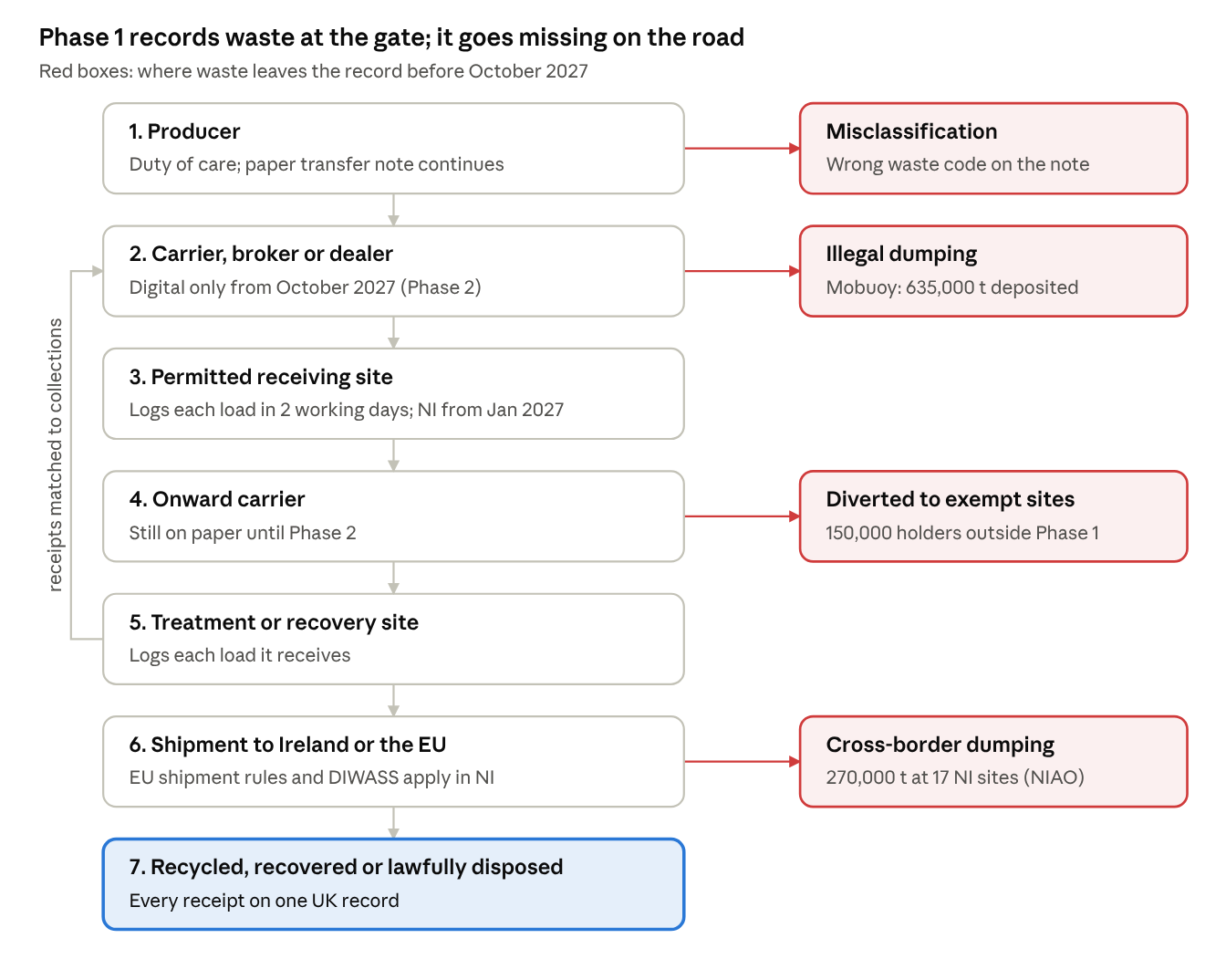
Only the receiving and treatment sites (stages 3 and 5) report digitally in Phase 1. Every leak on the right sits on a leg that Phase 1 does not record, and most stay that way until at least October 2027.
Then and now (2023 to October 2026)
In 2023 digital tracking was a consultation and an unused power. By October 2026 it is law in three nations and promised in the fourth.
| Theme | Then (2023) | Now (28 October 2026) | What changed and why |
|---|---|---|---|
| Legal basis | Powers inserted by the Environment Act 2021, unused. For NI, section 59 added Articles 5G and 5H to the 1997 Waste Order. | England: SI 2026/729, made 24 June, in force 1 October 2026. Wales: SI 2026/105, in force 1 October 2026. Scotland: SSI 2026/145, in force 1 January 2027. NI: the Assembly’s AERA Committee lists the Digital Waste Tracking Regulations (Northern Ireland) 2026; no made Statutory Rule found (16 Nov 2026). | Each nation legislates separately. NI’s first set needs Assembly approval of a draft. |
| Timetable | Joint consultation closed 15 April 2022; go-live later set for April 2025. NI had no minister (Environment Ireland, 20 November 2023). | Voluntary from 28 April 2026. Mandatory for receivers: England and Wales 1 October 2026; NI and Scotland January 2027. Carriers, brokers and dealers: October 2027 (GOV.UK, updated 1 October 2026). | Four governments delayed April 2025 to April 2026 after industry said it was not feasible (Cedrec, February 2025). NI then moved three months behind. |
| Who is in scope | Consultation proposed all waste holders (summary of responses, December 2022). | Phase 1: about 12,000 permitted sites. Phase 2: about 300,000 carriers, brokers and dealers. About 150,000 exemption holders and green-list exports come in a later phase. | Phasing spreads the IT build and the cost. |
| Paper records | NI transfer notes kept by the issuer, not sent to NIEA. About 28,000 consignment notes a year, with a review backlog (NIAO, July 2025). | Transfer notes, hazardous consignment notes, Annex VII forms and returns all continue during Phase 1 (letsrecycle, 1 October 2026). | Paper retires only after transition plans. Wales expects quarterly returns to go from 2028. |
| Cost to operators | Not known; consultees asked for detail. | £26 a year per legal entity, first due by 31 January 2027 in England and Wales. Software estimated at £632 a year per business (Welsh memorandum, March 2026). | Fee set in each nation’s Regulations to recover running costs. |
| Enforcement | NI: no movement-matching inspections in two years; carriers not routinely inspected (NIAO, July 2025). | England and Wales: offences, £1,000 fixed penalties, variable penalties, compliance notices and a public register. The Environment Agency will match collections against receipts. | Enforcement becomes data-led, if regulators fund the analysis. |
| Cross-border movements | EU Regulation 1013/2006 applied in NI under the Protocol; paper Annex VII for green-list waste. | EU Regulation 2024/1157 applies in NI under Windsor Framework Article 13(3). The EU’s DIWASS platform went live 21 May 2026; paper allowed for green-list waste until 31 December 2026 (European Commission). | The EU replaced its shipment law. NI follows it for movements to and from the EU. |
Where the parties and governments stand
All four governments back the system, and no party has published opposition to it. Most parties have said nothing specific at all.
| Party or government | Position | Date |
|---|---|---|
| UK Government (Labour) | Introduced mandatory tracking. Minister Mary Creagh called the inherited paper system “not fit for purpose” (Defra). Added £45m over three years for Environment Agency enforcement. The Budget funded tax liabilities from clearing six illegal waste sites; it did not say any are in NI. | 24 April 2026; Budget 28 October 2026 |
| Conservatives | Took the powers in the Environment Act 2021 and ran the joint consultation in government (January to April 2022). Shadow minister Dr Neil Hudson responded at the Commons committee. The Regulations passed without a division (Hansard, 16 Jun 2026). | 2021 to 2022 |
| Reform UK | No published position found (searched 28 October 2026). | To 28 Oct 2026 |
| Liberal Democrats | No published position found (searched 28 October 2026). | To 28 Oct 2026 |
| Green Party (England and Wales; NI) | No published position found (searched 28 October 2026). | To 28 Oct 2026 |
| Scottish Government (SNP) | Cabinet Secretary Gillian Martin moved approval. She said few people would be digitally excluded and the switch adds no new data protection risk. Agreed without division (Scottish Parliament committee report). | 3 February 2026 |
| Welsh Government | Senedd agreed the Wales Regulations on 24 March 2026. Household waste recycling centres left out of scope (Welsh Government). | 24 March 2026 |
| DAERA (Minister Andrew Muir, Alliance) | Department commits to January 2027 for receivers and October 2027 for the rest of the industry. No ministerial statement on digital tracking found (searched 28 October 2026). | Page updated 25 June 2026 |
| SDLP | Daniel McCrossan MLA said NI needs “meaningful deterrents and proper enforcement” on illegal dumping (Irish News). Not specific to tracking. | 10 May 2026 |
| DUP, Sinn Féin, UUP, TUV, People Before Profit | No published position on digital tracking found (searched 28 October 2026). | To 28 Oct 2026 |
-
Consensus by silence. The England Regulations were approved by both Houses by 17 June 2026 as a draft affirmative instrument (Parliament procedure record). The Scottish committee recorded no contributions from members.
-
The NI gap is administrative. No NI party has argued against tracking. The delay sits in DAERA’s legislative timetable.
-
Enforcement is the live argument. In NI the political pressure is about prosecutions and fines, which the tracking data could support.
Who decides what
| Body | What it decides | Northern Ireland relevance |
|---|---|---|
| Defra | Builds and runs the UK service; sets England policy and the shared timetable. | NI uses the same service. |
| DAERA | NI policy; makes NI Regulations under Article 5G of the Waste and Contaminated Land (NI) Order 1997. | Sets the NI mandatory date, fee and digitally excluded route. |
| NI Assembly | Approves the first NI Regulations by draft affirmative resolution. Its Windsor Framework committee scrutinised EU Regulation 2024/1157 (report, June 2024). | Gatekeeper for the NI start date. |
| NIEA | Regulator: permits, carrier registration, consignment notes, enforcement. | Will hold the data; needs staff to use it. |
| Environment Agency, NRW, SEPA | Regulators in England, Wales and Scotland. | Matter for NI firms using GB sites. |
| District councils | Run recycling centres and enforce against fly-tipping; report council waste data. | Scope for NI recycling centres not yet published. |
| European Commission | Runs DIWASS and the EU Waste Shipment Regulation. | Applies to NI shipments to and from the EU. |
Where the pillars compete
Tracking serves the environment by making waste visible. Its costs fall on small operators and on privacy. The phasing also creates an environmental risk of its own.
-
E: waste crime and data quality. Receivers must log each load within two working days, with the carrier and waste code. The Environment Agency will compare reported collections with receipts to flag suspicious loads. NIEA has never had this. The NIAO found it held about 28,000 consignment notes a year with a review backlog, and never saw transfer notes at all.
-
S: burden on small firms. The fee is small at £26 a year. Software is the real cost, estimated at £632 a year per business. The Welsh assessment notes extra burdens on micro operators, such as data security, that it did not cost. During Phase 1, firms also keep every paper record they keep today.
-
S: digital exclusion. Each set of Regulations exempts “digitally excluded” operators, who keep written records instead. The Welsh memorandum expects only natural persons, such as sole traders, to qualify. A small limited company with poor broadband does not.
-
S: privacy and commercial confidence. In the 2022 consultation, commercial confidentiality was the commonest reason for objecting to proposed data access. Scotland’s Cabinet Secretary said in February 2026 that no extra commercially sensitive data would be published. The England and Wales Regulations put civil sanctions on a public register.
-
E versus E: displacement. Phase 1 lights up permitted sites while carriers, brokers and exempt sites stay on paper. A rogue load has every reason to avoid a permitted gate until October 2027. No evidence of this exists yet, so regulators should watch for it.
The honest balance: the burden on a well-run site is modest, and the crime it targets is large. In NI the NIAO put waste crime at about £34m a year. The weak point is the 12 months when firms pay for two systems and criminals can route around the new one.
What it means for Northern Ireland firms and councils
Manufacturers producing waste. You are not in Phase 1. Your duty of care and transfer notes are unchanged. From January 2027 your contractor’s receiving site must log your loads with a waste code. A wrong code on your note will now show up against their record. Check codes and descriptions now.
Firms that receive waste. If you hold a permit or licence to take third-party waste, you are a receiver. Register, pay the fee, and choose the API through your software or the Defra spreadsheet. GOV.UK expects the spreadsheet to stay until at least October 2027.
Hauliers and brokers. Phase 2 brings you in from October 2027, with a public beta in spring 2027. England is also moving carriers into environmental permitting. The NIAO found NI carrier registration is a single flat fee with no routine inspection.
Firms shipping waste to Ireland or the EU. EU shipment law applies in NI under the Windsor Framework. Dublin City Council’s guidance treats shipments to NI as within the EU. Green-list paperwork moves onto DIWASS after the 31 December 2026 transition.
Councils. Wales left recycling centres out. England does not require household waste from residents to be logged in Phase 1. DAERA has not published how NI recycling centres will be treated. Over time the service could replace much of councils’ separate waste data reporting, which matters for recycling targets and packaging EPR.
Practical examples
-
Mobuoy, Co Londonderry. About 1.6 million tonnes of waste sit on the site, an estimated 635,000 tonnes deposited illegally. The best clean-up estimate is £107m, mostly falling to the public sector (NIAO, 3 July 2025).
-
Cross-border dumping. About 270,000 tonnes of waste from the Republic was dumped at 17 NI sites. The five largest still held about 137,000 tonnes, and NIEA had spent £492,000 on 12 sites (NIAO case study 6, July 2025).
-
Prosecutions in NI. NIEA secured 29 illegal dumping prosecutions over five years, between four and seven a year from 2021 to 2025. The figures came from Assembly answers (Irish News, 10 May 2026).
-
England’s launch. From 1 October 2026 more than 12,000 permitted sites report every load in near real time. Defra paired the launch with a Waste Crime Crackdown Group and named site clearances in Kidlington, Bradford and Wigan (Defra, 1 October 2026).
-
Clearance funding in the Budget. The UK Budget funded the tax liabilities from planned clearance of six illegal waste sites. It did not say any are in NI, where Mobuoy alone is estimated at £107m (letsrecycle, 29 October 2026).
-
Councils treated differently. Wales left household waste recycling centres out of scope (Welsh Government, 30 June 2026). England’s centres need not log residents’ household waste in Phase 1 (letsrecycle, 1 October 2026).
-
Industry-built design. Scotland’s service was shaped by a user panel of more than 450 operators, the Cabinet Secretary told MSPs on 3 February 2026 (Scottish Parliament).
Recommendations
These are the author’s recommendations.
-
DAERA should lay the NI Regulations and confirm January 2027 in one public notice. It should publish the NI fee, the digitally excluded route and the treatment of recycling centres at the same time.
-
NIEA needs analysts as well as a database. Ring-fence staff to match receipts with collections. This answers the NIAO’s first recommendation on inspecting transfer and consignment notes. DAERA should also ask HM Treasury whether its new clearance funding (28 October 2026) can reach NI sites.
-
Hold the October 2027 date for carriers and brokers. Every month of slip extends the displacement risk. Pair it with reform of NI carrier registration, as the NIAO recommended.
-
Set a date to retire duplicate paper. Name when transfer notes, consignment notes and quarterly returns end for digital users. Wales already expects returns to go from 2028.
-
Confirm how NI shipments reach DIWASS. NI firms sending waste to Ireland need one clear route before the green-list paper transition ends on 31 December 2026.
-
For firms now: check your contractor’s permit, correct your waste codes, and ask your software supplier whether it connects to the Defra API.
Sources
All pages opened on 28 October 2026, except the Budget reactions page, added 30 October 2026.
Official: UK and devolved governments
-
Defra, Digital waste tracking service, updated 1 October 2026
-
Defra, No hiding place: new tracking system exposes waste criminals, 1 October 2026
-
Defra, Game-changing digital tracking takes fight to rogue waste traders, 24 April 2026
-
Defra, Waste Crime Action Plan, 20 March 2026
-
Defra and devolved administrations, Mandatory digital waste tracking: summary of responses, December 2022
-
Environment Agency, Digital waste tracking goes live, 30 April 2026 (its infographic still shows NI in October 2026; superseded)
-
DAERA, Digital waste tracking, updated 25 June 2026
-
NetRegs, Digital waste tracking
-
Welsh Government, Mandatory digital waste tracking system, updated 30 June 2026
-
Welsh Government, Explanatory memorandum and regulatory impact assessment, March 2026
Legislation and parliaments
-
The Digital Waste Tracking (England) Regulations 2026, SI 2026/729
-
The Digital Waste Tracking (Wales) Regulations 2026, SI 2026/105
-
The Digital Waste Tracking (Scotland) Regulations 2026, SSI 2026/145
-
UK Parliament, procedure record for the England Regulations
-
UK Parliament, written statement on the Waste Crime Action Plan, HCWS1430, 23 March 2026
-
Scottish Parliament, Net Zero, Energy and Transport Committee report, 18 February 2026
-
NI Assembly, Windsor Framework Democratic Scrutiny Committee report on Regulation (EU) 2024/1157, June 2024
-
NI Assembly, Defra briefing to the committee, 30 May 2024
Audit, EU and Ireland
-
NI Audit Office, Waste Crime in Northern Ireland and media release, 3 July 2025
-
European Commission, New Waste Shipment Regulation and DIWASS go live, 21 May 2026
-
Dublin City Council (National TFS Office), WSR 2024/1157 briefing notice, 2 September 2025
News and trade press (framing)
-
letsrecycle, Digital Waste Tracking goes live: what happens now?, 1 October 2026
-
The Irish News, Fewer than six illegal dumping prosecutions a year, 10 May 2026
-
Environment Ireland, Digitalising waste, 20 November 2023
-
Cedrec, UK government delays digital waste tracking rollout to 2026, February 2025
-
letsrecycle, Live sector reactions to the Autumn Budget 2026, 29 October 2026
Robert J. Park is an independent environment, carbon and public-affairs consultant based in Larne, Northern Ireland. He helps firms and public bodies measure their carbon and make their case on policy.
Agree or disagree? Get in touch on LinkedIn or WhatsApp @robertjpark.