
The Act that outran its plan
Part of the Policy series: where the rules stand in Northern Ireland, who decides them, and what to do about it. Updated as the rules change.
Published early, on 9 November 2026, and correct as at that date. I’ll update it in January 2027, when the Climate Action Plan and the fourth carbon budget are due to come forward ahead of the May 2027 election.
Where I stand. The Act’s targets are law and should be met, but through a plan that keeps farming and industry producing here, not by pushing emissions offshore and importing the same goods from places with weaker rules. A transition that leaves Northern Ireland poorer will not last. The Executive should publish the plan now, as the Act requires.
The argument in brief
On 14 April 2026 the DUP asked the Assembly to tell DAERA Minister Andrew Muir to withdraw Northern Ireland’s draft Climate Action Plan. MLAs defeated the motion by 56 votes to 26. Muir told the chamber he had no power to withdraw it. The UUP said it would have backed a motion to revise the targets instead. Six months on, the plan still has not been laid; on 3 September 2026 DAERA said it was with Executive colleagues for approval.
The Climate Change Act (Northern Ireland) 2022 is law, but most of the machinery it requires is late. The first Climate Action Plan was due by June 2024. The fourth carbon budget was due by 31 December 2025 and has not been set. Emissions in 2024 were 29.4% below the base year, against a first-budget average cut of 33%. That budget runs to 2027, so the gap is a warning, not yet a breach.
The real political argument is whether the targets are revised after the May 2027 election, not whether they are met. For firms and councils, the duties that already bite are reporting, procurement and planning. Those will survive any revision of the targets.
This piece sets out the arguments on each side; the recommendations are the author’s. Facts checked to 30 October 2026; rechecked and updated 16 November 2026.
The lifecycle at a glance
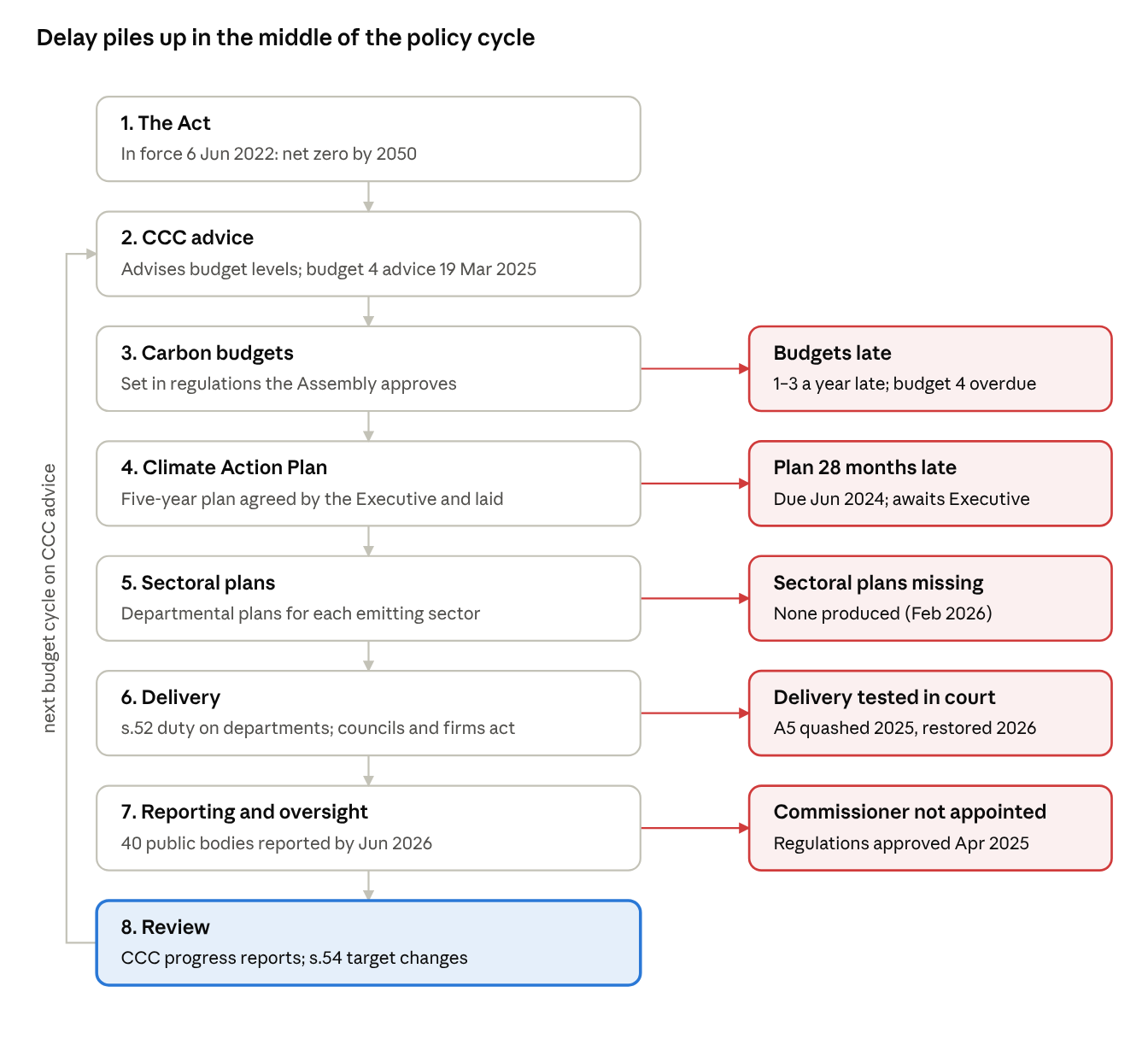
The Act and the CCC’s advice are in place. Delay starts at the budgets and builds through the plan and sectoral plans, so delivery and oversight run without the framework the Act expected.
Then and now (2023 to October 2026)
| Rule or instrument | 2023 | Now (with date) | What changed and why |
|---|---|---|---|
| Climate Change Act (NI) 2022 | In force since 6 Jun 2022: net zero 2050, at least 48% by 2030, 80% renewable electricity by 2030 | Unchanged. Muir said he had “no plans” to review the targets (12 Nov 2025). The First Minister said she was open to amending it to get the A5 built (23 May 2026) | The Act is now a dividing line for the 2027 election |
| Carbon budgets 1–3 (2023–37) | Not set; deadline end of 2023 | Approved by the Assembly Dec 2024 (DAERA, 11 Dec 2024): 33%, 48%, 62% average cuts; 2040 target 77% | About a year late after the collapse of devolution |
| First Climate Action Plan (s.51) | Not drafted | Draft of 52 policies consulted 19 Jun–8 Oct 2025; response summary 13 Apr 2026; with the Executive (3 Sep 2026); no laying found (30 Oct 2026); Minister still pressing for adoption and plans a second plan (9 Nov 2026) | About 28 months past the statutory date |
| Fourth carbon budget (2038–42) | No advice | CCC advised 77% (19 Mar 2025); consulted Jul–Nov 2025; not set, “in due course” (3 Sep 2026); no draft regulations found (30 Oct 2026) | Missed the 31 Dec 2025 deadline |
| Climate Commissioner (s.50) | Regulations not made | Regulations approved by the Assembly, DUP and TUV against (Apr 2025). About £1m a year. Not appointed (Oct 2026) | DUP cited cost; the First Minister called unionist opposition “illogical” (8 Apr 2025) |
| Just Transition Commission | Not established | Regulations approved 27 Apr 2026; Chair and 15 members recruited May–Jul 2026; appointments expected by 1 Feb 2027 (DAERA) | Muir pledged to set it up “without delay” (27 Apr 2026) |
| Public body reporting | Regulations pending | All 40 specified bodies filed first reports (11 Jun 2026) | Reporting Bodies Regulations 2024 now apply |
| Section 52 duty on departments | Untested | High Court quashed the A5 decision on s.52 (27 Jun 2025); Court of Appeal reversed on all grounds (6 Oct 2026) | s.52 read as a duty of rational, evidenced decisions, not a bar on emitting projects |
Where the parties and governments stand (October 2026)
Alliance, Sinn Féin and the SDLP want the 2022 targets delivered. The UUP wants them revised, and Sinn Féin is flexible where roads are concerned. The DUP and TUV want the plan withdrawn or the targets cut back.
| Party or government | Position (dated) |
|---|---|
| UK Government (Labour, PM Burnham) | “Determined” to reach UK net zero by 2050 (21 Sep 2026). Budget (28 Oct 2026): funds the Executive to set up its own industrial electricity scheme, adds £270m for the Executive and offers £1.5bn over three years. No UK ETS change |
| Conservatives (Badenoch) | Pledged to repeal the UK Climate Change Act 2008 (Oct 2025) |
| Reform UK (Farage) | Opposes net zero; urged Reform councils to drop carbon targets (Jul 2025) |
| Scottish Government (SNP) | Carbon budgets approved 8 Oct 2025; the UUP cites Scotland’s revision of targets as a model |
| DAERA (Muir, Alliance) | “There can be no rolling back” (3 Sep 2026) |
| First Minister (O’Neill, Sinn Féin) | Called unionist opposition to the Commissioner “illogical” (8 Apr 2025); open to amending the Act for the A5 (23 May 2026) |
| DUP | Moved to withdraw the plan for a “fair, not a fast” path, putting its cost to 2027 above £1bn (14 Apr 2026); opposed the Commissioner on cost (Apr 2025) |
| Sinn Féin (MLAs) | Opposed withdrawal, warning that changing targets could harm dairy processors with net zero commitments (14 Apr 2026) |
| UUP | Robbie Butler: “revise, don’t retreat” (Apr 2026) |
| SDLP | Opposed withdrawal (14 Apr 2026). PAC chair Daniel McCrossan warned energy investment could go elsewhere (22 Oct 2026) |
| TUV | Timothy Gaston said the 2030 targets imply about 20% fewer livestock (11 Nov 2025) |
| Ulster Farmers’ Union | Called the Act “deeply flawed” and its targets unrealistic (18 Jun 2025) |
| Green Party NI, PBP, CBI NI, NI Chamber, Manufacturing NI | No published 2026 position on the plan found (searched 27 Oct 2026) |
-
The Act began as a DAERA bill brought by a DUP minister, Edwin Poots, and was heavily amended before it passed in 2022.
-
The disagreement is about pace and who carries the cost, especially farmers. Few parties openly reject the 2050 goal.
-
Sinn Féin is split between holding the targets and delivering the A5. The Court of Appeal ruling takes some heat out of that.
-
The UUP’s “revise” position is the likely ground for any compromise. Section 54 allows target changes only on CCC advice or “significant developments”.
Who decides what
DAERA drafts the plan and budgets. Under the Executive’s cross-cutting rules, any party in the Executive can delay them.
| Instrument | Who decides | Whose approval is needed | Position in Northern Ireland |
|---|---|---|---|
| Carbon budgets and targets | DAERA | Executive, then Assembly (draft affirmative); CCC advice considered | Budgets 1–3 set; budget 4 overdue |
| Climate Action Plan | DAERA with all departments | Executive, then laid before the Assembly | With the Executive |
| Sectoral plans (ss.13–22) | Each department (DfE energy and industry, DfI transport, DAERA agriculture and waste) | Executive | Not yet produced (Assembly research, Feb 2026) |
| Climate Commissioner | Executive Office (FM and dFM jointly) | Assembly approved regulations | Not appointed |
| Electricity emissions trading | EU for NI generators | Windsor Framework | NI generators in the EU ETS; other installations in the UK ETS |
| UK net zero and UK ETS | UK Government | Parliament | UK-wide alongside the NI Act |
Where the pillars compete
-
Livestock against the methane cut (E against S). Agriculture produced 31.4% of NI emissions in 2024, the largest sector share. The TUV says the 2030 target implies about 20% fewer livestock (11 Nov 2025). Muir says the plan has no herd-reduction proposals.
-
Plan cost against public services (E against S). The draft plan sets out £718m of capital over 2023/24 to 2026/27, with £341m for transport, £70m for agriculture and £16m for business. The DUP claims the cost to 2027 is above £1bn (14 Apr 2026). The Budget of 28 Oct 2026 gave the Executive an extra £270m and offered £1.5bn over three years, none of it earmarked for climate.
-
Cheaper heating oil against heat decarbonisation (S against E). The Budget of 28 Oct 2026 removed the 4% tariff on kerosene, and 61% of NI households rely on heating oil. It eases bills now but makes oil boilers cheaper to keep.
-
Road safety against emissions (S against E). The A5 has a serious crash record. It was blocked under s.52 until the Court of Appeal reversed the ruling, showing how a missing plan can stall social infrastructure.
-
Forestry against peat and biodiversity (E against E). Belfast City Council challenged the plan’s treatment of conifer planting as nature-based and asked for a review of forests on peat.
-
Bioenergy against water and air (E against E). Bioenergy supplied 18% of NI’s renewable generation in the year to June 2026. AD feedstock and digestate need managing near Lough Neagh.
What it means for Northern Ireland firms and councils
-
Public procurement. Section 52 binds departments now. Expect carbon questions and whole-life carbon requests in tenders whatever happens to the plan.
-
Grants. Invest NI consultancy support is limited to firms spending over £30k a year on energy and resources, which leaves many small firms out.
-
Supply-chain asks. NI dairy and meat processors have their own net zero commitments, and supplier asks will continue even if Stormont softens targets.
-
Future regulation. The draft plan includes mandatory commercial recycling, tighter building standards and F-gas compliance.
-
Councils. All 40 specified public bodies, including councils, filed emissions and adaptation reports by June 2026. Each sets out emissions, actions, climate risks and adaptation.
-
Energy. Renewables met 50% of NI electricity consumption in the year to June 2026, against 80% required by 2030. The PAC warned on 22 Oct 2026 that uncertainty is pushing investment elsewhere.
-
Industrial electricity costs. The Budget of 28 Oct 2026 funds the Executive to set up its own version of the British Industrial Competitiveness Scheme (BICS). It is for heavy electricity users in manufacturing. No amount was given, and design and timing are for the Executive (HM Treasury and NIO, 28 Oct 2026).
Practical examples
-
O&S Doors, Dungannon. The door maker is installing a £9m biomass CHP plant that burns over 10,000 tonnes a year of its own MDF dust. It expects to save about 1,500 tonnes of carbon a year, helped by a £2.4m Shared Island grant awarded by Invest NI (Executive Office, 28 Jan 2026).
-
The A5 and section 52. The Court of Appeal held on 6 Oct 2026 that s.52 does not require each project’s emissions to be mapped onto a quantified pathway. Consistency with the Act’s objectives, as far as possible, is enough (Irish Legal News, 7 Oct 2026). For public clients, the test is evidenced reasoning.
-
First public body reports. All 40 specified bodies, including councils and the Housing Executive, met their first statutory climate reporting duty. Each report covers emissions, actions, risks and adaptation (DAERA, 12 Jun 2026).
-
Energy strategy audit. The NI Audit Office found progress on the key 2030 energy targets “lagging considerably”, after about £107m of spending since 2020 (NIAO, 21 Oct 2025). The Assembly’s Public Accounts Committee followed with its own report on 22 Oct 2026 (PAC inquiry).
-
Which renewables figure to use. Renewables met 50% of NI electricity consumption in the year to June 2026, 4,431 of 8,865 GWh. The 53% figure in some reports measures NI generation and ignores imports. The 80% target uses the 50% measure (DfE, 3 Sep 2026).
Recommendations
-
Executive: agree and lay the Climate Action Plan without further delay. The statutory date passed in June 2024, and delay raises legal and investment risk.
-
DAERA: lay draft regulations for the fourth carbon budget with a statement on the missed deadline. Openness protects credibility.
-
Executive Office: set a date to appoint the Climate Commissioner. A vacancy invites challenge.
-
Invest NI and DfE: open technical consultancy to firms spending under £30k a year on energy and resources. Many small manufacturers fall below it.
-
Parties: publish costed climate positions in 2027 manifestos, including any s.54 target changes.
-
Firms: build an audit-ready carbon inventory now. Public buyers and processors will ask whatever happens at Stormont.
-
Councils: use your 2026 reports to set local adaptation priorities and bid for funding together.
Sources
-
MLAs don’t want to ditch climate plan, Farmers Journal (15 Apr 2026)
-
Muir welcomes Assembly approval of emissions targets, DAERA (11 Dec 2024)
-
Summary of responses, fourth carbon budget, DAERA (13 Feb 2026)
-
Summary of responses, first Climate Action Plan, DAERA (13 Apr 2026)
-
Draft CAP financial, social and economic impact assessment, DAERA (Jun 2025)
-
Progress on implementing the Climate Change Act, Assembly RaISe (16 Mar 2026)
-
Assembly approves Just Transition Commission, DAERA (27 Apr 2026)
-
Minister Muir to convene summit on climate action and the green economy, DAERA (9 Nov 2026)
-
Public bodies celebrated for climate reporting, DAERA (12 Jun 2026)
-
Unionist opposition to climate role ‘illogical’, Irish Post (8 Apr 2025)
-
O’Neill open to amending climate law for A5, Irish News (23 May 2026)
-
Muir sticking with NI climate targets, Farmers Journal (12 Nov 2025)
-
Court of Appeal overrules High Court decision on A5, Irish Legal News (7 Oct 2026)
-
Court of Appeal clears way for A5, A&L Goodbody (8 Oct 2026)
-
Electricity consumption and renewable generation, year ending June 2026, DfE (3 Sep 2026)
-
Inquiry into Northern Ireland Energy Strategy, Public Accounts Committee, NI Assembly
-
NI risks missing 2030 energy goals: PAC, BBC via Yahoo (22 Oct 2026)
-
Northern Ireland Energy Strategy, NI Audit Office (21 Oct 2025)
-
O&S Doors to turn dust into power, Executive Office (28 Jan 2026)
-
Reduce waste and save energy, Invest NI (updated 24 Aug 2026)
-
Andy Burnham firms up net zero commitment, Solar Power Portal (21 Sep 2026)
-
Northern Ireland’s draft Climate Action Plan 2023–2027, DAERA (updated 6 May 2026)
-
Consultation on setting NI’s fourth carbon budget, DAERA (updated 13 Feb 2026)
-
Breathing space for Northern Ireland families and businesses, HM Treasury and NIO (28 Oct 2026)
-
Budget 2026 Overview of Tax Legislation and Rates, HM Treasury and HMRC (28 Oct 2026)
Robert J. Park is an independent environment, carbon and public-affairs consultant based in Larne, Northern Ireland. He helps firms and public bodies measure their carbon and make their case on policy.
Agree or disagree? Get in touch on LinkedIn or WhatsApp @robertjpark.