
One data set, many requests

Part of the Policy series: where the rules stand in Northern Ireland, who decides them, and what to do about it. Updated as the rules change.
The argument in brief
On 30 September 2026 the Financial Conduct Authority (FCA) published its final rules for listed companies’ sustainability reporting (PS26/19). It had consulted in January on making climate reporting under UK SRS S2 mandatory, then settled on “comply or explain” for all of it, citing the burden on smaller issuers. Three weeks earlier, on 7 September 2026, the business department launched a consultation on modernising corporate reporting. The same day the Chancellor pledged to cut the burden of business regulation by 25%.
Both sides of the Irish Sea are cutting reporting duties in the name of competitiveness. For a Northern Ireland SME manufacturer the effect is mixed. The EU now caps what large customers can demand from smaller suppliers. The UK has no such cap, and public buyers still ask for carbon plans. Requests will keep arriving in 2027, in fewer and more standard formats. The sensible response is to build one data set that answers all of them. The political cost of the cuts falls mostly on the social pillar and on impact reporting; investor-focused climate data survives best.
This piece sets out the arguments on each side; the recommendations are the author’s. Facts checked to 30 October 2026; rechecked and updated 16 November 2026.
The lifecycle at a glance
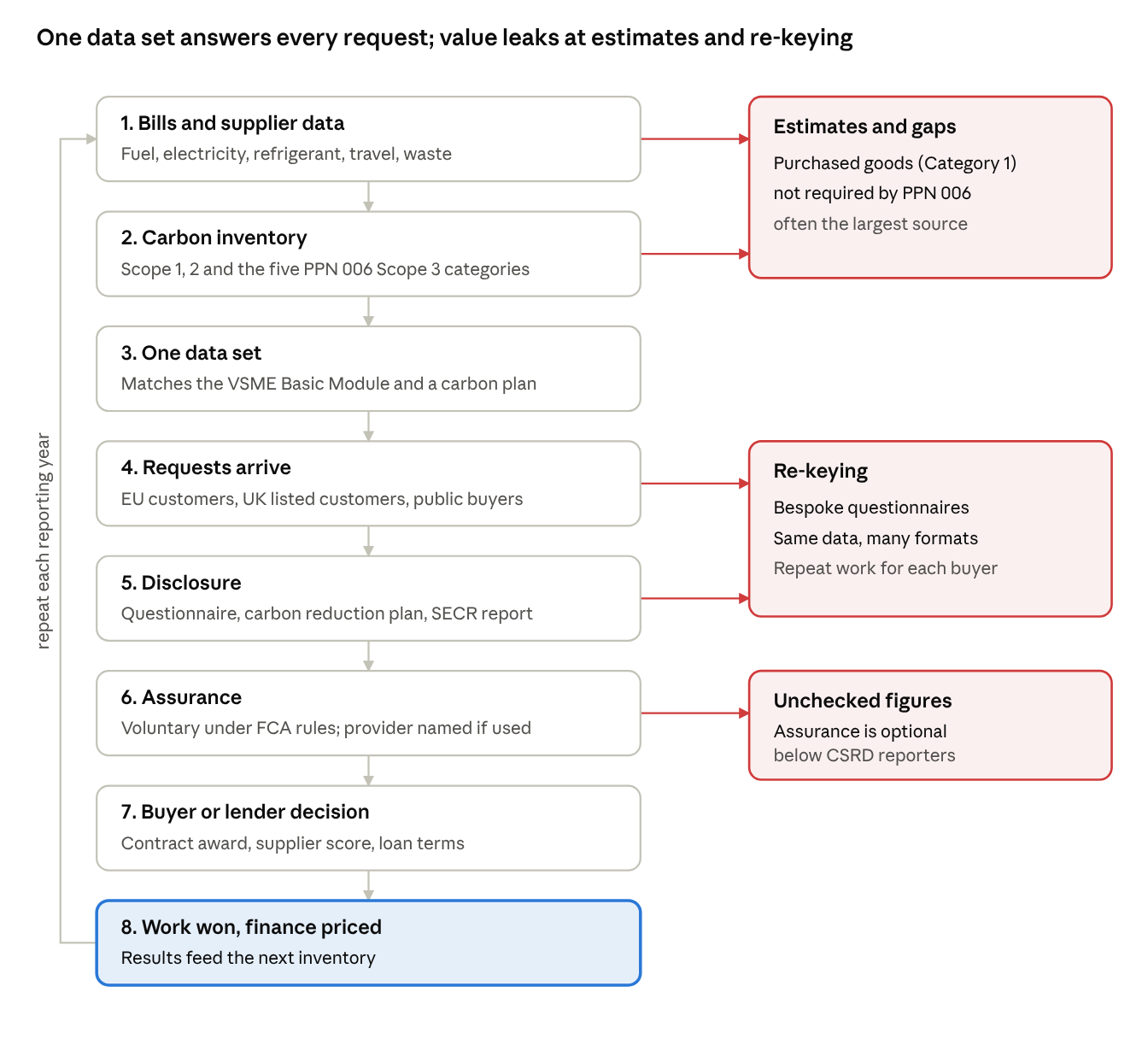
The same bills and supplier figures feed every request, from an EU customer’s questionnaire to a public buyer’s carbon plan. Value leaks where firms estimate, re-key the same data for each buyer, or publish figures nobody checks.
Then and now (2023 to October 2026)
| Rule or instrument | 2023 | Now (with date) | What changed and why |
|---|---|---|---|
| EU CSRD scope | Large EU companies (250+ staff), phased in from FY2024 | Directive (EU) 2026/470 published 26 Feb 2026, in force 18 Mar 2026: over 1,000 employees and over €450m turnover. Transposition by 19 Mar 2027 | Omnibus I simplification after competitiveness pressure from member states and the EPP group |
| Value-chain requests | No limit on what reporters could ask suppliers | Firms averaging no more than 1,000 employees can decline requests beyond the Voluntary Standard, for financial years from 1 Jan 2027 | Protects SMEs from trickle-down questionnaires |
| ESRS | 2023 delegated act, about 1,100 datapoints | Delegated Regulation (EU) 2026/1563 adopted 3 Jul 2026, published 21 Sep 2026, in force 10 Nov 2026; 61% fewer mandatory datapoints; mandatory from FY2027 | Commission and EFRAG simplification |
| Voluntary Standard (VSME) | EFRAG draft only | Delegated Regulation (EU) 2026/1560 published 21 Sep 2026, in force 24 Sep 2026; the value-chain cap applies from FY2027. Basic Module is the minimum; Comprehensive Module adds strategy, targets and risks | A common format for supplier and bank requests |
| EU CSDDD | Under negotiation | Scope now €1.5bn turnover and 5,000 employees; climate transition plan duty deleted and EU civil liability removed; transposition by 26 Jul 2028, compliance from 26 Jul 2029 | France and Germany called for repeal in May 2025 |
| UK SRS and FCA rules | TCFD-aligned Listing Rules | UK SRS S1/S2 published 25 Feb 2026 for voluntary use. FCA PS26/19 (30 Sep 2026): comply or explain from 1 Jan 2027, first reports 2028, one year of Scope 3 relief | FCA cited the burden on smaller issuers |
| Streamlined Energy and Carbon Reporting (SECR) | In force since 2019 | Post-implementation review (26 May 2026): retain with amendments. DESNZ to consult on SECR and ESOS later in 2026 | Ongoing costs £140m a year against £31m forecast |
| Carbon reduction plans (PPN 006) | Required for central government contracts over £5m a year | Reissued for the Procurement Act regime from 24 Feb 2025; same threshold and five Scope 3 categories | Continuity under the new Act |
| NI public sector | Climate Change Act (NI) 2022 duties pending | Reporting Bodies Regulations made 12 Apr 2024; all 40 specified bodies met their first reporting duties (DAERA, 12 Jun 2026) | First reporting cycle completed |
Where the parties and governments stand (October 2026)
The split is between those trimming reporting but keeping its architecture and those who would scrap mandatory reporting outright.
| Party or government | Position (dated) |
|---|---|
| UK Government (Labour) | Endorsed UK SRS for voluntary use (25 Feb 2026); no decision on mandatory use. Business department consulting on corporate reporting reform (7 Sep to 30 Nov 2026), the day the Chancellor pledged a 25% cut in regulatory burden. Still weighing transition-plan responses (Sep 2026) |
| FCA (independent regulator) | Comply or explain across UK SRS for listed issuers (30 Sep 2026) |
| Conservatives (Badenoch) | Scrap all mandatory sustainability and climate reporting, including the carbon reporting framework, and repeal the Climate Change Act (9 Nov 2025). |
| Reform UK (Farage) | Scrap net zero targets and subsidies (2024 manifesto). No specific statement on reporting found |
| Liberal Democrats (Davey) | Opposed repealing the Climate Change Act (Pippa Heylings MP, 2 Oct 2025). No statement on company reporting found (searched 28 Oct 2026) |
| Green Party of England and Wales (Polanski) | Non-bank financial institutions, including pension funds, to divest from fossil fuels by 2030 (2024 manifesto). No 2026 statement on reporting found |
| Crossbench (Baroness Young) | Private Member’s Bill for UK human rights and environmental due diligence (page updated 17 Jun 2026) |
| Scottish and Welsh Governments | No published position found (searched 27 Oct 2026) |
| NI Executive / DAERA (Muir) | Public sector has a leadership role (12 Jun 2026). The Executive approved revised PPN 01/21 with at least 10% social value weighting (in effect 24 Feb 2025) |
| DUP, Sinn Féin, Alliance, UUP, SDLP, TUV | No published position on corporate sustainability reporting found (searched 27 Oct 2026) |
| EU: EPP and right-wing groups | Parliament’s final vote on Omnibus I passed 428 to 218 (16 Dec 2025) |
| France and Germany | Macron and Merz called for the CSDDD to be scrapped (27 May 2025) |
-
Labour and the FCA keep the ISSB-based framework but make it softer and slower. The Conservatives would remove the framework itself, including SECR.
-
Reform’s position is about net zero policy, not reporting.
-
In the EU, cuts came from the centre-right working with right-wing groups, backed by Paris and Berlin.
-
In Northern Ireland, policy runs through procurement and public-body duties, not company law, and no party has staked out ground.
Who decides what
Brussels, Westminster, the FCA and the NI departments each control a different lever. Customers pass all of them down the supply chain.
| Instrument | Who decides | Whose approval is needed | Position in Northern Ireland |
|---|---|---|---|
| CSRD, ESRS, Voluntary Standard | European Commission, Parliament, Council | Member state transposition; delegated acts need no objection from Parliament or Council | Company law, outside the areas the Windsor Framework applies in NI (goods, customs, VAT, agri-food, state aid). Reaches NI firms through EU customers |
| CSDDD | EU co-legislators | Transposition by 26 Jul 2028 | Through EU customers only |
| UK SRS | UK Government | Mandatory use needs legislation or FCA rules | UK-wide |
| FCA Listing Rules | FCA | FCA board | UK-wide |
| SECR and Companies Act reporting | Department for Business, Innovation, Science and Trade (DBT until Jul 2026) and DESNZ | Parliament (statutory instruments) | UK-wide |
| PPN 006 carbon reduction plans | Cabinet Office | None | UK central government departments, agencies and NDPBs; NI departments follow PPN 01/21 |
| Climate Change (Reporting Bodies) Regulations (NI) 2024 | DAERA | NI Assembly | NI public bodies |
Where the pillars compete
-
The social pillar took the deepest cut. The CSDDD lost EU-wide civil liability and its transition-plan duty, and its scope moved up to 5,000 employees. Human-rights due diligence is now a large-firm matter only.
-
Investor materiality is winning over impact materiality. UK SRS and the FCA rules follow the ISSB investor lens, and the VSME uses an “if applicable” test instead of double materiality. Harms to people and places get less reporting than risks to profit.
-
In NI procurement the social pillar is compulsory and carbon is optional. PPN 01/21 makes fair-work measures mandatory; the zero-carbon theme is one option among several.
-
E against E: the easy carbon gets measured. PPN 006 requires five Scope 3 categories, but not purchased goods (Category 1), which is the largest source of embodied carbon for most manufacturers.
-
Cost against transparency. The SECR review found ongoing costs of £140m a year against £31m forecast, and 14–23% non-compliance. It also found that 79% of compliers disclosed data they would not otherwise have published.
What it means for Northern Ireland firms and councils
-
EU customers. From FY2027, an in-scope EU customer can only insist on Voluntary Standard-level data from a supplier with no more than 1,000 employees. Customers outside CSRD scope can still ask for anything as a commercial condition.
-
UK listed customers. UK SRS reporting begins with periods from 1 January 2027 and first reports in 2028. Expect supplier emissions requests to rise through 2027 and 2028.
-
Public buyers. Central government contracts over £5m a year need a published carbon reduction plan. NI departments score social value at 10% or more and may include carbon.
-
NI councils and public bodies have filed their first emissions baselines. As they start to measure procurement emissions, supplier data requests will follow.
-
The formats are converging: one EU format (VSME), one UK format (UK SRS and the GHG Protocol) and one public-sector format (the carbon reduction plan).
Practical examples
-
All 40 NI public bodies reported. Every specified body met its first duty under the 2024 Reporting Bodies Regulations, and two more reported voluntarily. Minister Andrew Muir said the public sector has “a crucial leadership role” (DAERA, 12 Jun 2026).
-
NILGOSC reports without being made to. The council pension fund has published climate disclosures against TCFD voluntarily since 2021. Its latest report covers the year to 31 March 2026 (NILGOSC, page checked 28 Oct 2026).
-
SECR cost four times the forecast. The official review put ongoing compliance costs at £140m a year, against £31m predicted. The average firm spent £7,100 a year, against £2,300 forecast (DESNZ post-implementation review, 26 May 2026).
-
The EU’s SME format is now law. The Voluntary Standard, Delegated Regulation (EU) 2026/1560, was published on 21 September 2026. Its Basic Module covers energy, emissions, workforce and governance metrics; it is the minimum for any firm that uses it (Ashurst, 21 Sep 2026 update).
-
NI manufacturers are pooling the work. Invest NI’s Industrial Decarbonisation for Northern Ireland network brings together more than 200 firms, councils and government bodies. It offers a shared roadmap and a sustainability toolkit (Invest NI, 9 Jan 2025).
Recommendations
-
DESNZ: in the promised SECR and ESOS consultation, adopt a template that matches the VSME Basic Module and PPN 006. One format cuts repeat work.
-
Department for Business, Innovation, Science and Trade: consider a UK value-chain cap like the EU’s in the corporate reporting consultation (closes 30 Nov 2026).
-
NI Department of Finance: issue guidance accepting a PPN 006-style carbon reduction plan in place of bespoke questionnaires.
-
DAERA: when guiding public bodies on Scope 3, point them to supplier VSME and carbon reduction plan data, to avoid a new council-by-council survey burden.
-
Firms: build one data set in 2026–27: Scope 1 and 2, the five PPN 006 Scope 3 categories, energy use, and Basic Module workforce and policy data. Answer every request from it.
-
Firms: add an estimate for purchased goods (Category 1). It is the number customers will ask for next.
-
Firms with EU customers: use the cap. From FY2027 you can politely decline requests beyond the Voluntary Standard.
-
Councils: publish a short supplier note on which formats you accept, to cut costs for SMEs bidding locally.
Sources
-
Linklaters: Omnibus I Directive (EU) 2026/470 published in the OJ (Feb 2026)
-
EFRAG: Commission publishes delegated act on revised ESRS and Voluntary Standard (3 Jul 2026)
-
Ashurst: simplified ESRS and Voluntary Standard published in the OJ (update of 21 Sep 2026)
-
Agence Europe: final green light from Parliament (16 Dec 2025)
-
Seneca ESG: Macron joins Germany’s call to scrap CSDDD (27 May 2025)
-
Linklaters: modernising corporate reporting, sustainability angles (Sep 2026)
-
GOV.UK: 2026 post-implementation review of SECR (26 May 2026)
-
DESNZ: SECR post-implementation review, full report (26 May 2026)
-
DoF NI: PPN 01/21 Scoring Social Value (revised, 24 Feb 2025)
-
NI Assembly: EU law and Northern Ireland under the Windsor Framework
-
City AM: Conservatives pledge to scrap ESG reporting (9 Nov 2025)
-
Liberal Democrats: response to Conservative plans on the Climate Change Act (2 Oct 2025)
-
BusinessGreen: Greens pledge fossil fuel divestment by 2030 (2024 manifesto)
-
UK Parliament: Commercial Organisations and Public Authorities Duty Bill [HL]
-
HM Treasury and HMRC: Budget 2026 Overview of Tax Legislation and Rates (28 Oct 2026)
Robert J. Park is an independent environment, carbon and public-affairs consultant based in Larne, Northern Ireland. He helps firms and public bodies measure their carbon and make their case on policy.
Agree or disagree? Get in touch on LinkedIn or WhatsApp @robertjpark.