
Northern Ireland's waste bill

Part of the Policy series: where the rules stand in Northern Ireland, who decides them, and what to do about it. Updated as the rules change.
The argument in brief
On 2 June 2026, SDLP MLA Colin McGrath warned of a “costly catastrophe” in how Northern Ireland handles its rubbish. DAERA Minister Andrew Muir had confirmed in a written answer that only two landfill sites still take household waste: Cottonmount and Craigmore. The Irish News reported that Northern Ireland has about 3% of the UK’s population but sends 16% of the UK’s residual waste exports.
Waste rules in Northern Ireland are moving faster than the infrastructure and money behind them. Producers now pay councils through packaging EPR, with £52.2 million going to NI councils in 2026–27. A deposit return scheme starts in October 2027. Parts of the EU Packaging and Packaging Waste Regulation (PPWR) apply here from 12 August 2026. Westminster has delayed carbon pricing for incineration in Great Britain. NI energy-from-waste plants stay under the EU carbon market, which plans to phase incineration in from 2031. Each rule is defensible on its own. Together they move costs onto households, small shops and council budgets, while the biggest environmental harm, illegal dumping, remains underfunded.
This piece sets out the arguments on each side; the recommendations are the author’s. Facts checked to 30 October 2026; rechecked and updated 16 November 2026.
The lifecycle at a glance
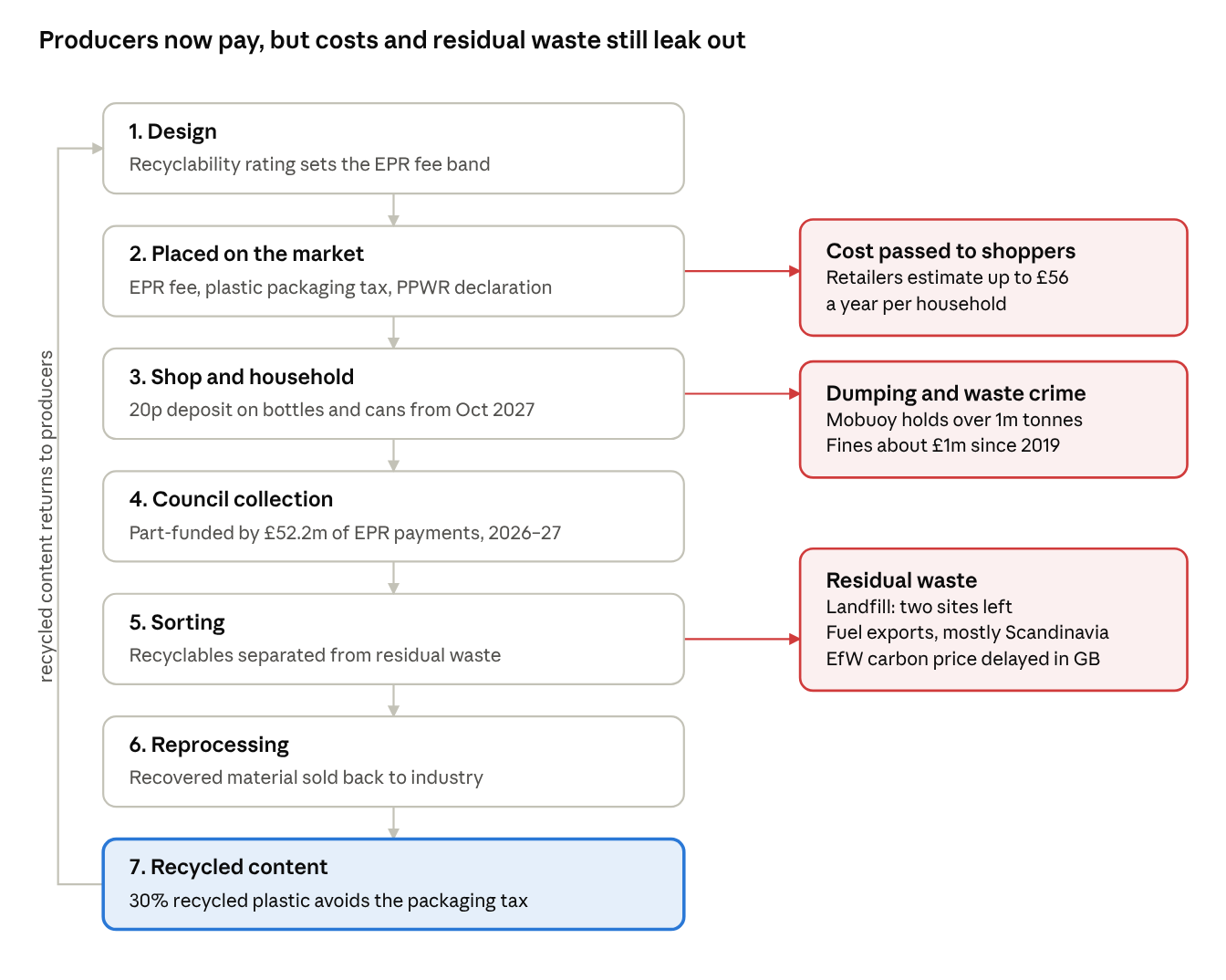
The new rules bite at the start of the chain, on design and on the market. The leaks open later: costs passed to shoppers, dumping, and residual waste with only two landfill sites left.
Then and now (2023 to October 2026)
| Rule or instrument | 2023 | Now (with date) | What changed and why |
|---|---|---|---|
| Packaging EPR (PackUK) | Regulations still being drafted; fees not set | Year 2 runs 1 Apr 2026 to 31 Mar 2027. Illustrative fees (Dec 2025) put plastic at £415 green, £455 amber, £545 red per tonne. Red is 1.2× amber, rising to 1.6× in Year 3 and 2× in Year 4. Confirmed Year 2 fees still not published (16 Nov 2026); bills are due at the end of 2026 | Modulation rewards recyclable design. Amid reports of a Treasury review, a government spokesperson said on 5 May 2026 there are no plans to scrap EPR |
| EPR payments to NI councils | None | £52.2m across 11 councils for 2026–27; Belfast gets £8.1m (GOV.UK, 25 Mar 2026) | Disposal costs move from ratepayers to producers |
| Deposit return scheme | Planned for England and NI | Starts October 2027: 20p deposit on PET bottles and cans from 150ml to 3 litres, run by Exchange for Change | Earlier dates slipped. Exchange for Change confirmed the 20p deposit in April 2026. The Budget left the VAT treatment of unredeemed deposits unchanged (28 Oct 2026) |
| UK ETS and energy from waste | Government consulting on adding incineration | DESNZ said on 26 Aug 2026 that expansion will not take place in 2028; no new date set. DESNZ says NI plants stay under the EU ETS through the Windsor Framework | Councils warned of the cost; the LGA estimated up to £747m a year for English councils |
| Landfill tax | Lower than now | Standard rate £130.75 per tonne and lower rate £8.65 per tonne from 1 Apr 2026; applies to England and NI. Both rise from 1 Apr 2027: the standard rate by RPI, rounded to the nearest 5p, and the lower rate by the same cash amount (Budget, 28 Oct 2026) | The standard rate rises with RPI; the lower rate more than doubled. The Landfill Communities Fund cap rises from 5.3% to 8.3%, about £25.3m in 2027–28. Dredged material loses its stabiliser exemption (Budget, 28 Oct 2026) |
| Plastic packaging tax | In force since 2022 | £228.82 per tonne from 1 Apr 2026, for packaging with under 30% recycled content. Rises by CPI from 1 Apr 2027 (Budget, 28 Oct 2026) | Annual uprating. Certification of the 30% recycled-content threshold becomes mandatory from 1 Apr 2030 (Budget, 28 Oct 2026) |
| NI waste strategy | Older strategy in place | Draft Rethinking Our Resources to 2031 consulted 15 Jan to 6 May 2026: 70% recycling by 2030, landfill at 10% or less by 2035 | Climate Change Act (NI) 2022 targets |
| EU PPWR | Still being negotiated | Applies from 12 Aug 2026. In NI, heavy-metal and PFAS limits need a declaration of conformity now; labels follow two years after the EU implementing act. EPR, DRS, reuse targets and most waste rules do not apply (DAERA FAQ, Aug 2026) | The Windsor Framework covers goods rules |
| NI Environmental Principles Policy Statement | Not in force | In effect from 2 Sep 2026, including polluter pays | Required by the Environment Act 2021 |
Where the parties and governments stand (October 2026)
The parties split mainly over who carries the cost and over incineration. Very few have set out a full waste programme.
| Party or government | Position (dated) |
|---|---|
| UK Government (Labour) | Spokesperson said there are no plans to scrap EPR, amid reports of a review (5 May 2026). Delayed the ETS expansion to incineration (26 Aug 2026). Budget raised landfill tax by RPI and plastic packaging tax by CPI from 1 Apr 2027. It also funded tax liabilities for clearing six illegal waste sites, not stated to cover NI (28 Oct 2026) |
| Conservatives (Badenoch) | No published UK-wide position found (searched 27–28 Oct 2026) |
| Welsh Conservatives | Darren Millar MS called for glass to be dropped from Wales’s DRS because of costs for small brewers (14 Jul 2026) |
| Reform UK | 2024 manifesto pledged to scrap net zero and backed better recycling; no detail on EPR or incineration (summary, 9 Feb 2026) |
| Liberal Democrats; Greens (E&W) | No published position found (searched 27–28 Oct 2026) |
| Scottish Government (SNP) | Joins the UK DRS from October 2027 (ACS guide, June 2026) |
| Welsh Government (Plaid) | Plans a DRS that includes glass, with glass deposits from 2031 (ACS, June 2026) |
| NI Executive / DAERA Minister Muir (Alliance) | Draft strategy with a 70% recycling target (15 Jan 2026). Moving to adopt a Mobuoy remediation strategy, with costs still to be worked out (22 May 2026) |
| SDLP | McGrath wants a rethink of landfill and export (2 Jun 2026). Durkan criticised the lack of any Mobuoy funding (26 May 2026) |
| DUP | Cllr Henry Reilly called Newry, Mourne and Down’s 5% commercial waste rise a “bin tax” (19 Mar 2026) |
| Sinn Féin | Its councillors passed the same rise 7–6 to protect services (19 Mar 2026). Has opposed the Hightown incinerator |
| UUP; TUV | No published position found (searched 27–28 Oct 2026) |
-
Who pays. Labour keeps EPR producer-funded. Retailers say costs pass through to shoppers. The DUP frames council charges as a tax.
-
Incineration. Arc21 councils still back Hightown. Sinn Féin and campaigners have opposed it. The SDLP questions the cost of exporting waste.
-
Glass. Wales keeps glass in its DRS. England and NI leave it out. Welsh Conservatives want it removed.
-
Carbon pricing. Westminster has paused carbon pricing for incineration in GB. NI plants stay in the EU scheme, so policy now splits within the UK.
Who decides what
Most packaging and tax rules are made at UK level. Collections, strategy and enforcement are devolved to DAERA and councils.
| Instrument | Who decides | Whose approval is needed | Position in Northern Ireland |
|---|---|---|---|
| Packaging EPR | Defra and PackUK, with the devolved administrations | DAERA for NI | Applies; NIEA regulates. Collection of nation data delayed to 1 Jan 2028 (NIEA, Sep 2026) |
| DRS | Defra and DAERA; Exchange for Change runs it | Assembly for NI regulations | Applies from Oct 2027. The urban threshold for small-shop exemptions is 5,000 people, against 10,000 in GB |
| Landfill tax; plastic packaging tax | HM Treasury and HMRC | Parliament, through the Finance Act | UK taxes that apply in NI. Both rise from 1 Apr 2027 (Budget, 28 Oct 2026) |
| UK ETS (energy from waste) | UK ETS Authority (four governments) | All four governments | GB expansion delayed. DESNZ says the EU ETS still covers NI incinerators (26 Aug 2026). The Commission proposed on 17 Jul 2026 to phase incineration in, from 25% of emissions in 2031 to 100% in 2034 |
| EU PPWR | EU | Council and Parliament | Substance limits apply now and labels later; EPR, DRS and targets do not |
| Waste strategy and collections | DAERA; councils deliver | Executive and Assembly | Councils must apply the TEEP test to collections |
| Contaminated land (Part III, 1997 Order) | DAERA | Commencement order | Never commenced (separate piece) |
Where the pillars compete
-
Producer pays, shopper pays. EPR is meant to shift costs from ratepayers to producers. Retailers estimate up to £56 a year per household passes through to prices (their own figure, May 2026). A flat cost on food packaging hits low-income households hardest.
-
Recyclability versus food protection (E versus E). Red fees apply to paper and board with more than 5% non-fibre content. The Foodservice Packaging Association warns this could discourage barrier coatings that cut food waste.
-
Incineration versus recycling. Campaigners estimate Hightown would cost about £1.5bn over 25 years and say higher recycling could halve the waste it needs. Exporting to Scandinavia carries shipping emissions and cost risk.
-
Carbon price versus council budgets. Delaying ETS pricing protects council finances but removes a signal to take fossil plastics out of residual waste.
-
Waste crime versus public spending. The NI Audit Office found about £1m in fines since 2019, against an estimated £17m in avoided disposal costs (3 Jul 2025). Mobuoy still has no committed funding. The UK Budget funded tax liabilities for clearing six illegal waste sites (28 Oct 2026). It did not say any are in NI.
What it means for Northern Ireland firms and councils
-
Manufacturers: red-rated packaging gets dearer each year, from 1.2× to 1.6× and then 2×. Your recyclability ratings now affect costs directly. Plastic packaging tax rises by CPI from 1 Apr 2027, and recycled-content certification becomes mandatory from 1 Apr 2030 (Budget, 28 Oct 2026).
-
Exporters to Ireland and the EU: you now need a PPWR declaration of conformity for heavy metals and PFAS. Harmonised labels follow later. The EU Council agreed on 21 Oct 2026 to ease obligations for small producers; talks with Parliament have not started.
-
Councils: EPR income helps, but stagnant recycling rates put it at risk. The provisional recycling rate for January–March 2026 was 47.2%, against a 70% target. Landfill tax on residual waste rises again from 1 Apr 2027 (Budget, 28 Oct 2026).
-
Councils with energy-from-waste contracts: a future carbon cost could pass through gate fees, with no support mechanism announced.
-
Small shops: register with Exchange for Change and decide whether to seek an exemption. The manual handling fee is 3p per container.
Practical examples
-
Illegal waste site, Belfast. On 25 June 2026 Laganside Crown Court jailed an operator for nine months over about 367 tonnes of waste at two Crumlin Road sites. NIEA cleared both sites at public expense (DAERA).
-
Mobuoy, near Derry. The site holds over a million tonnes of waste. DAERA’s summary of consultation responses found no fundamental change was needed to the remediation methods (Derry Now, 26 Mar 2026). Costs were still being worked out in May (DAERA, 22 May 2026).
-
Hightown, Mallusk. arc21’s incinerator application is still undecided. The Department for Infrastructure asked for more information on 6 March 2026, with three months to reply (UKWIN, a campaign group, updated 20 Apr 2026).
-
Fuel exports. NI councils exported 281,660 tonnes of waste as refuse-derived fuel in figures reported in November 2024. Most went to Scandinavia, and over two-thirds left through Warrenpoint (Irish News, 6 Nov 2024).
-
Less packaging, Moy Park. Northern Ireland’s largest private firm cut its packaging by 10% in a year. It targets 5% less packaging and 5% more recyclable packaging each year (Packaging Gateway, 3 Jan 2024).
-
PFAS in food packaging. Food-contact packaging placed on the NI market from 12 August 2026 must meet PPWR PFAS limits. Older stock can sell through, and the Food Standards Agency enforces (DAERA FAQ, Aug 2026).
Recommendations
-
DAERA: publish the final strategy with a costed plan for residual waste. Capacity decisions should follow the recycling plan.
-
DAERA and councils: report each year how the £52m of EPR income is spent. Households should see the offset.
-
DAERA, with DESNZ: set out how NI would meet any future carbon price on incineration. The Commission’s proposed 2031 start leaves little lead time.
-
Executive and Department of Justice: fund Mobuoy and act on the NIAO waste crime review. Penalties must exceed the profits. Ask HM Treasury whether its new funding for clearing illegal waste sites (28 Oct 2026) can extend to NI.
-
DAERA: decide collection consistency with an equality assessment. Charities have raised concerns for older and disabled householders.
-
Firms: run recyclability assessments now and redesign red-rated lines first. The penalty doubles by Year 4. Build evidence of recycled content too: certification becomes mandatory from 1 Apr 2030.
-
Firms selling into NI or the EU: prepare PPWR declarations now and plan label changes once the EU implementing act is published.
-
Small retailers: price the handling fee against staff time before applying for an exemption.
Sources
-
Irish News: Warning of potential costly catastrophe over NI’s two landfill sites (2 Jun 2026)
-
GOV.UK: EPR local authority payment values 2026 to 2027, Northern Ireland (25 Mar 2026)
-
Council of the EU: stance on small packaging producers (21 Oct 2026)
-
letsrecycle: UK delays ETS expansion to waste incineration (26 Aug 2026)
-
DAERA: Environmental Principles Policy Statement in effect (2 Sep 2026)
-
Circular Online: What a Reform government could mean (9 Feb 2026)
-
DAERA: Deposit return scheme for single-use drinks containers
-
Scottish Grocer: 20p deposit value confirmed for DRS (23 Apr 2026)
-
Loyens & Loeff: Commission proposal to extend the EU ETS to waste incineration (17 Jul 2026)
-
DAERA: Prison sentence for 367 tonnes of unauthorised waste (conviction 25 Jun 2026)
-
Derry Now: DAERA publishes responses to Mobuoy consultation (26 Mar 2026)
-
HM Treasury and HMRC: Budget 2026 Overview of Tax Legislation and Rates (28 Oct 2026)
-
letsrecycle: Live sector reactions to the Autumn Budget 2026 (29 Oct 2026)
Robert J. Park is an independent environment, carbon and public-affairs consultant based in Larne, Northern Ireland. He helps firms and public bodies measure their carbon and make their case on policy.
Agree or disagree? Get in touch on LinkedIn or WhatsApp @robertjpark.