
Green money, fewer rules: what sustainable finance now asks of Northern Ireland

Part of the Policy series: where the rules stand in Northern Ireland, who decides them, and what to do about it. Updated as the rules change.
The argument in brief
On 30 September 2026 the Financial Conduct Authority (FCA) dropped its plan to make climate reporting mandatory for listed companies. Under policy statement PS26/19, listed companies will report against the UK Sustainability Reporting Standards on a “comply or explain” basis from January 2027. Three weeks earlier, on 7 September, Chancellor John Healey promised to cut the cost of business regulation by 25% by the end of this Parliament. The same day the business department opened a consultation proposing to replace the Companies Act list of reporting topics, such as environment and employees, with five baseline requirements.
Rules about where money goes are loosening at the top. The demand for carbon data from smaller firms is not going away, though. It is passing from regulators to banks, customers and investors. Banks must now understand climate risk in their loan books. EU customers still need value-chain data. Green loans and grants need evidence. A Northern Ireland manufacturer that builds one solid carbon data set can answer all of these, and can use it to borrow more cheaply.
The ESG pillars do not line up neatly. Nuclear is now “green” in UK gilts. Fossil-fuel firms may qualify as “transition” investments in the EU. Pension trustees are caught between the duty to earn returns and political pressure from all sides.
This piece sets out the arguments on each side; the recommendations are the author’s. Facts checked to 30 October 2026; rechecked and updated 16 November 2026.
The lifecycle at a glance
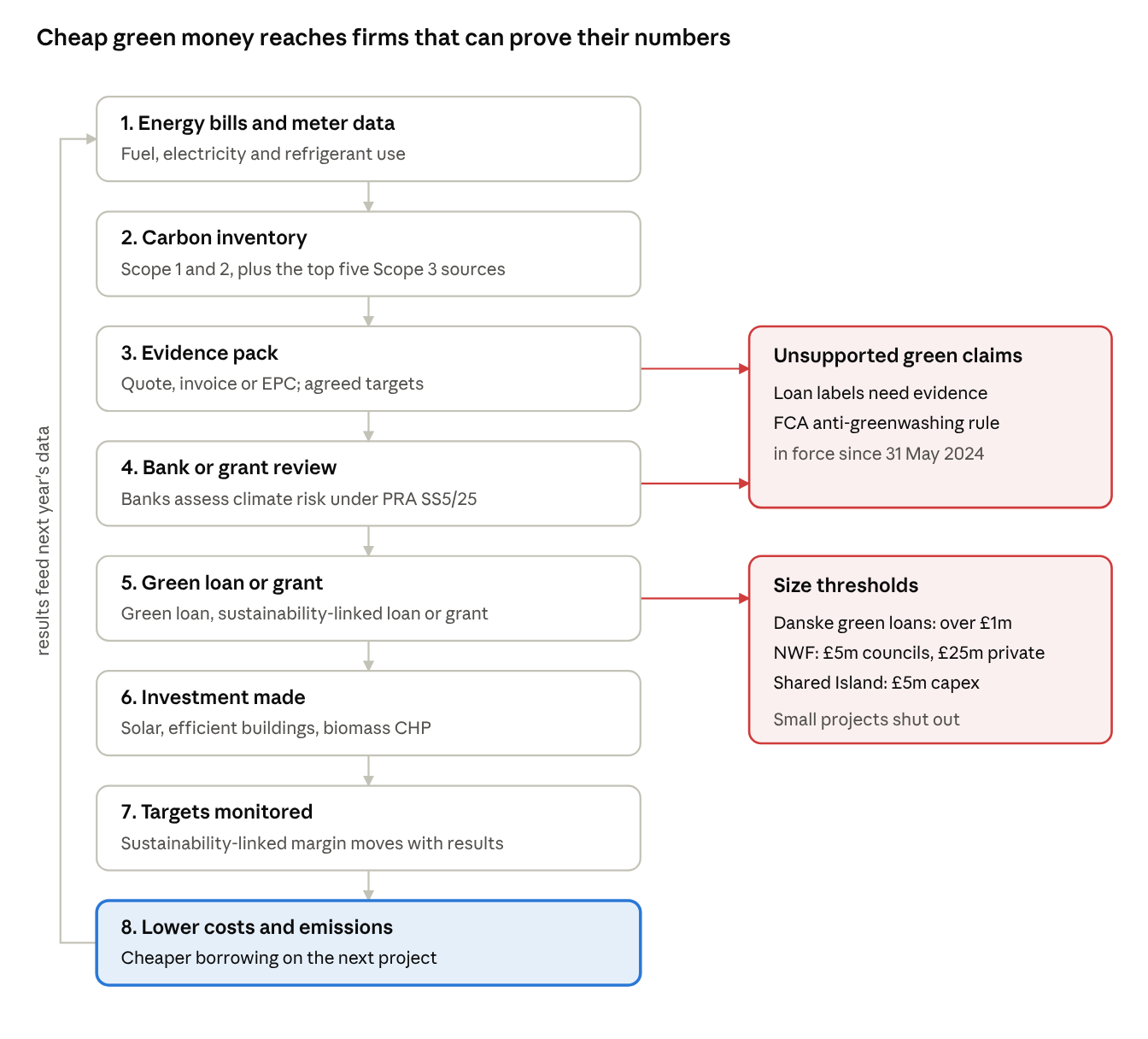
Green money flows from bills to borrowing and back again, but only for firms that can evidence their numbers. It leaks where claims lack evidence and where minimum deal sizes shut out small projects.
Then and now (2023 to October 2026)
| Rule or instrument | 2023 | Now (with date) | What changed and why |
|---|---|---|---|
| FCA Sustainability Disclosure Requirements (SDR) and labels | Final rules PS23/16 (28 Nov 2023) | Anti-greenwashing rule in force since 31 May 2024; four labels since 31 Jul 2024. Extension to portfolio managers shelved (30 Apr 2025) | FCA said it was “not the right time”; focus moved to the Consumer Duty |
| UK Green Taxonomy | In development | Dropped (Treasury response, 15 Jul 2025) | “No compelling evidence” it would meet its aims |
| Listed company climate reporting | TCFD-aligned FCA rules | UK SRS S1 and S2 endorsed for voluntary use (25 Feb 2026). FCA PS26/19 (30 Sep 2026): comply-or-explain from 1 Jan 2027 | FCA dropped mandatory S2 after cost and competitiveness concerns |
| Transition plans | Voluntary | Consulted on (25 Jun 2025); government still weighing responses (Sep 2026). Listed firms must say whether they have one, or explain why not (PS26/19) | To be weighed alongside the corporate reporting review |
| ESG ratings providers | Voluntary code | Legislation published (Oct 2025); FCA CP25/34 (1 Dec 2025); final rules PS26/22 (3 Nov 2026); authorisation applications from 24 Jun 2027; regime starts 29 Jun 2028. EU regime applies from 2 Jul 2026 | Ratings shape capital flows and were opaque |
| UK green gilts | 2033 and 2053 gilts | Framework updated to include nuclear (Nov 2025). £6.25bn 4⅝% Green Gilt 2037 sold (10 Mar 2026) | Nuclear became eligible; impact reporting now annual |
| Bank supervision of climate risk | PRA SS3/19 (2019) | Replaced by SS5/25 (3 Dec 2025) | More proportionate, but material exposures must be evidenced |
| EU SFDR | Article 8 and 9 categories | SFDR 2.0 proposed (20 Nov 2025); Council mandate (Jun 2026); Parliament negotiating mandate adopted (Oct 2026); trilogues under way; likely to apply late 2028 or 2029 | Three categories: Transition, ESG Basics, Sustainable |
| EU Taxonomy and CSRD | CSRD phasing in | Taxonomy simplification (8 Jan 2026). Omnibus Directive (EU) 2026/470 (26 Feb 2026): CSRD now for firms over 1,000 staff and €450m turnover | Member state pressure; requests to suppliers averaging up to 1,000 staff capped from FY2027 |
Where the parties and governments stand (October 2026)
The split is between a government seeking growth through lighter regulation while keeping green finance tools, a right that would scrap reporting outright, and a left that wants divestment.
| Party or government | Position (dated) |
|---|---|
| UK Government (Labour; Chancellor Healey) | Pledged a 25% cut in regulatory burden (7 Sep 2026). Lowered the Green Book discount rate to 3%, favouring long-term projects. Business department consulting on replacing mandatory reporting topics with five baseline requirements (7 Sep to 30 Nov 2026). Still weighing transition-plan responses (Sep 2026) |
| Conservatives (Badenoch) | Would scrap all mandatory sustainability and climate reporting, including the carbon reporting framework, and repeal the Climate Change Act (9 Nov 2025) |
| Reform UK (Farage) | Seven of nine Reform-led councils have scrapped climate targets (Grantham Institute, 20 Mar 2026) |
| Liberal Democrats (Davey) | Opposed repealing the Climate Change Act (Pippa Heylings MP, 2 Oct 2025). No position on SDR or transition plans found |
| Green Party E&W (Polanski) | 2024 manifesto: non-bank financial institutions, including pension funds, to divest from fossil fuels by 2030. No update under Polanski found (searched 28 Oct 2026) |
| Scottish Government (Swinney) | SNIB strategy gives more weight to energy security (8 Jul 2026); review advised keeping its net zero mission (17 Aug 2026) |
| Welsh Government (ap Iorwerth) | Development Bank of Wales remit embeds net zero and community ownership pilots (30 Sep 2026) |
| NI Executive: Economy (Archibald, SF) | Energy decarbonisation central to economic priorities; 80% renewable electricity by 2030 (11 Jun 2025). FM and dFM welcomed a £2.4m Shared Island grant to O&S Doors (29 Jan 2026) |
| NI parties (Assembly vote) | An Alliance motion backing renewables for energy security passed 40–26 (24 Mar 2026); all 26 No votes came from unionist-designated MLAs, including DUP and UUP members. TUV: no green finance position found |
-
Reporting. Labour is trimming disclosure while keeping the frameworks. The Conservatives would remove them.
-
Pension money. Reform-led councils have dropped climate targets. The Greens want divestment. Labour pushes pooled funds towards UK investment.
-
Public investment banks. Scotland’s and Wales’s public investment banks keep net zero in their remits. Northern Ireland has no equivalent bank.
-
Northern Ireland. The Assembly divide is over energy policy. No party has set out a position on finance rules.
Who decides what
Most finance rules are set in London and apply UK-wide. EU finance rules reach NI only through customers and lenders in the Republic.
| Instrument | Who decides | Whose approval is needed | Position in Northern Ireland |
|---|---|---|---|
| SDR, labels, anti-greenwashing rule | FCA | FCA board | UK-wide |
| UK SRS and listed company reporting | DBIST, formerly DBT (endorsement); FCA (listing rules) | Parliament for Companies Act changes | UK-wide |
| Transition plans | DESNZ, HM Treasury, DBIST | Parliament | Would be UK-wide |
| ESG ratings regime | HM Treasury; FCA | Parliament (SI) | UK-wide from 2028 |
| Bank climate expectations (SS5/25) | PRA | None further | Applies to banks lending in NI |
| Local government pensions | DfC and the NILGOSC committee in NI | NI Assembly | NILGOSC is outside the English pooling rules |
| SFDR, EU Taxonomy, EU Green Bond Standard | EU institutions | Trilogue | Outside the areas the Windsor Framework applies in NI; reach NI via EU customers and lenders |
| Invest NI and Shared Island grants | DfE and Invest NI; Irish Government | NI Executive | NI-specific |
Where the pillars compete
-
Nuclear as “green” (E against E). Since November 2025 the UK Green Financing Framework counts nuclear and radioactive waste storage as eligible. That cuts carbon but stretches the label over a long-lived waste legacy.
-
Fossil firms as “transition” investments. Both EU institutions would let fossil-fuel firms into SFDR 2.0’s Transition category if at least 20% of their capital spending is Taxonomy-aligned. Supporters cite energy security and jobs; critics see a loophole.
-
Pension duty against political demands (S against E). NILGOSC sold about £700,000 of Israeli bonds in 2024 and says it does not divest for political reasons.
-
Anti-greenwashing against access to finance. Danske’s labelled green loans start at £1m. National Wealth Fund minimums are £5m for councils and £25m for private projects. The Shared Island capital grant needed at least £5m of capital spend. Small firms carry the evidence burden without reaching the cheap money.
-
Investor materiality against local impact. UK SRS and the September consultation focus on what is financially material to the company. Local harms that do not move a balance sheet fall out of scope.
What it means for Northern Ireland firms and councils
-
Expect bank questions. SS5/25 requires banks to evidence climate risk in lending. Have energy, fuel, refrigerant and Scope 1 and 2 figures ready. Ulster Bank offers a free Carbon Planner.
-
Cheaper finance needs evidence. AIB (NI)’s Business Sustainability Loan runs from £2,000 to £100,000 at a rate below its standard business loan, with an invoice, quote or EPC needed. Danske prices sustainability-linked loans against agreed targets.
-
EU customers’ requests now have a ceiling. Under the Omnibus, firms averaging up to 1,000 staff can decline value-chain requests beyond the Voluntary Standard (VSME) from FY2027. Build your data to that level.
-
Grants reward good data. Invest NI’s Energy Efficiency Capital Grant, which funded energy-efficient equipment, is not taking applications: it is paused for review with no reopening date, and the Resource Efficiency Capital Grant closed to new applications on 27 March 2026. The Shared Island Sustainability Capital Grant closed to applications on 2 May 2025.
-
Councils sit outside the English pension shake-up. NILGOSC reports voluntarily against TCFD and moved £2.8bn of passive equity into a low-carbon fund in 2022.
-
National Wealth Fund access is the gap. Its minimum drawdowns of £5m for councils and £25m for private projects exceed the typical NI project.
-
More Executive money, but no new green finance rules. The Budget of 28 October 2026 gave the NI Executive an extra £270m in Barnett consequentials over the Spending Review period. It also offered a separate £1.5bn over three years to help the Executive agree a budget. The Executive is funded to set up its own version of the British Industrial Competitiveness Scheme (BICS) for heavy electricity users in manufacturing. No amount was stated, and design and timing are for the Executive (HM Treasury and NIO, 28 Oct 2026). The Budget made no change to green finance rules (OOTLAR, 28 Oct 2026).
Practical examples
-
O&S Doors, Dungannon. The manufacturer’s £9m biomass combined heat and power plant burns its own MDF dust. It won £2.4m from the Shared Island Sustainability Capital Grant and is expected to save about 1,500 tonnes of carbon a year (4NI, 29 Jan 2026).
-
The Shared Island grant set a high bar. The €20m scheme split €10m each side of the border, required at least £5m of capital spend and closed on 2 May 2025 (NI Business Info, page checked 28 Oct 2026).
-
A green loan sized for SMEs. AIB (NI) lends £2,000 to £100,000 unsecured for solar, EV charging and buildings reaching EPC B. The representative variable rate is 8.00%, and a quote, invoice or EPC is needed before drawdown (AIB (NI), page checked 28 Oct 2026).
-
A free first step. Ulster Bank’s Carbon Planner app measures a firm’s footprint and returns a tailored reduction plan (Ulster Bank, page checked 28 Oct 2026).
-
Nuclear money in a green wrapper. The Debt Management Office sold £6.25bn of the 4⅝% Green Gilt 2037 on 10 March 2026. Nuclear has been an eligible use of green gilt money since November 2025 (DMO, 10 Mar 2026; HM Treasury, 15 Oct 2026).
Recommendations
-
DfE and Invest NI: publish one NI SME carbon data template aligned to VSME and UK SRS S2 metrics. Banks, grant bodies and customers could accept the same file.
-
HM Treasury and the National Wealth Fund: create an aggregation route with Invest NI and the British Business Bank. The £25m minimum excludes almost all NI manufacturers.
-
FCA: require ESG ratings providers to disclose how they score firms that report no data. Proxy scoring tends to penalise small firms.
-
UK Government: decide on transition plans before the corporate reporting changes take effect. Lenders are pricing in the uncertainty.
-
DfC and NILGOSC: publish a single responsible-investment and exclusions policy with dated climate targets. It would ease council-by-council motions.
-
Firms: build a Scope 1 and 2 inventory from your bills and add your top five Scope 3 sources. One data set answers banks, green lenders and EU customers.
-
Firms: ask your bank about green or sustainability-linked pricing before committing capital spending.
-
Councils: raise climate risk through NILGOSC’s formal processes, framed as fiduciary risk.
Sources
-
Linklaters, FCA confirms comply-or-explain approach (2 Oct 2026)
-
Linklaters, modernising corporate reporting: sustainability angles (Sep 2026)
-
Latham & Watkins, UK proposes reforms to corporate sustainability reporting (Sep 2026)
-
Professional Adviser, FCA drops SDR plans for portfolio managers (30 Apr 2025)
-
Macfarlanes, Treasury discontinues UK green taxonomy (Jul 2025)
-
FCA, proposals to make ESG ratings transparent, reliable and comparable (CP25/34, 1 Dec 2025)
-
HM Treasury, Green financing allocation and impact report (15 Oct 2026)
-
Linklaters, Omnibus I Directive (EU) 2026/470 published in the OJ (Feb 2026)
-
NI Assembly, EU law and Northern Ireland under the Windsor Framework
-
City AM, Conservatives pledge to scrap ESG reporting (9 Nov 2025)
-
Grantham Research Institute, Reform-led councils and climate targets (20 Mar 2026)
-
BusinessGreen, Greens pledge fossil fuel divestment by 2030 (2024 manifesto)
-
Welsh Government, Development Bank of Wales remit 2026–2030 (30 Sep 2026)
-
NI Assembly, division on Renewables to Enhance Northern Ireland’s Energy Security (24 Mar 2026)
-
4NI, Ministers welcome £9m green investment at O&S Doors (29 Jan 2026)
-
Irish News, NILGOSC divestment of Israeli government bonds (10 Oct 2024)
-
NI Business Info, Shared Island Sustainability Capital Grant
-
HM Treasury and NIO, Breathing space for Northern Ireland families and businesses (28 Oct 2026)
-
HM Treasury and HMRC, Budget 2026 Overview of Tax Legislation and Rates (28 Oct 2026)
Robert J. Park is an independent environment, carbon and public-affairs consultant based in Larne, Northern Ireland. He helps firms and public bodies measure their carbon and make their case on policy.
Agree or disagree? Get in touch on LinkedIn or WhatsApp @robertjpark.
This piece is general information for Northern Ireland businesses, not tax, legal or financial advice. Check your own position with your adviser before acting on it.