
Gold in the bin
Part of the Policy series: where the rules stand in Northern Ireland, who decides them, and what to do about it. Updated as the rules change.
The argument in brief
On 1 October 2026 the Irish News reported that three large fires since 2021 at a Belfast harbour scrapyard had cost the Fire and Rescue Service £171,887. The service named a lithium battery as the probable cause of the latest, in September. Three months earlier, on 8 July 2026, a Commons committee approved the rules that let EU battery law be enforced in Northern Ireland. The DUP and TUV opposed them, on cost and on sovereignty.
Together, those two stories show the problem. Electrical waste holds real value: gold, palladium, copper, cobalt, lithium and rare earths. It also holds real hazards, from lithium cells to refrigerant gases. The paperwork meant to follow it from producer to refiner breaks where the value is highest. Northern Ireland sits under two rulebooks. The EU Batteries Regulation applies here under the Windsor Framework, while the UK WEEE Regulations also apply. Reform in GB has stalled.
The argument of this piece is that the gap between rules on paper and material in practice is now a bigger risk than any one regulation. Firms that can show where their waste ended up will be better placed than firms holding only a certificate.
This piece sets out the arguments on each side; the recommendations are the author’s. Facts checked to 30 October 2026; rechecked and updated 16 November 2026.
The lifecycle at a glance
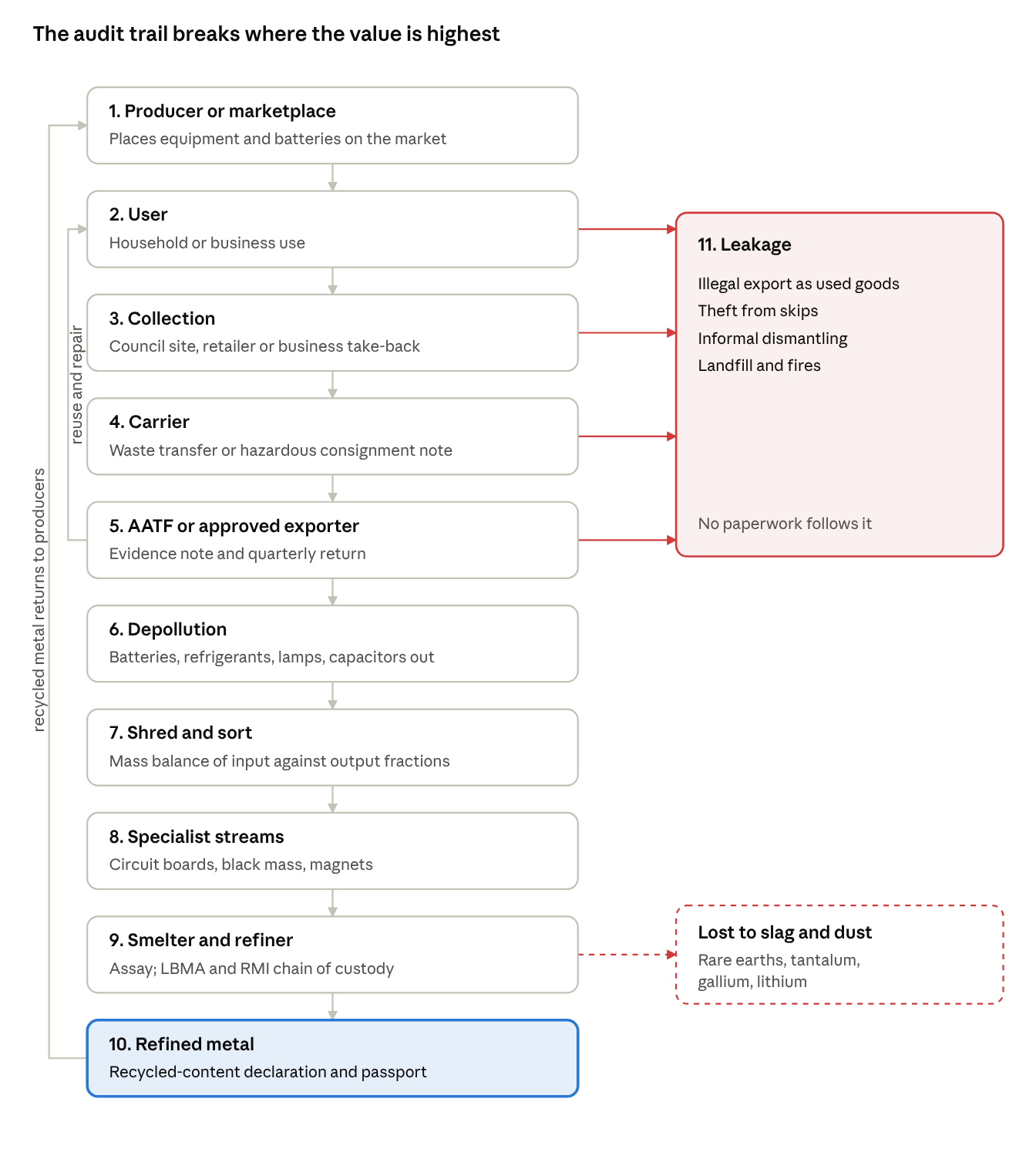
Material leaks out between collection and treatment, where paperwork is thinnest. Critical elements are lost again at the smelter unless they were separated first.
The audit trail, stage by stage
| Stage | Who holds it | Evidence or document | Standard or regulator | Where data or material leaks |
|---|---|---|---|---|
| 1. Placing on the market | Producer or online marketplace | Producer registration; tonnage reported to a compliance scheme | WEEE Regulations; SI 2025/910; EU Batteries Regulation in NI | Overseas sellers who never register; batteries hidden inside products |
| 2. Use and reuse | Household or business | Asset register (businesses only) | Data protection law | Devices kept in drawers; data-bearing devices shredded instead of reused |
| 3. Collection | Council recycling centre, retailer take-back, business | Waste transfer note | Duty of care; DAERA code of practice (20 Aug 2025) | Small WEEE in the general bin; theft from skips; battery fires in lorries |
| 4. Transport | Registered carrier | Transfer note; hazardous consignment note for fridges, CRTs and lamps | Hazardous Waste Regulations (NI) 2005; NIEA | Unregistered carriers; paper notes never reconciled |
| 5. Treatment or export | Approved treatment facility (AATF) or approved exporter | Evidence notes; quarterly returns | NIEA approval; waste shipment rules | Exports labelled as used goods. NI has 9 AATFs and 3 approved exporters (DAERA, 21 Jan 2026) |
| 6. Depollution | AATF | Depollution records; refrigerant recovery logs | EN 50625; F-gas rules | Refrigerant vented; batteries and capacitors left in the stream |
| 7. Shredding and sorting | AATF or downstream processor | Mass balance of input against output fractions | EN 50625 downstream monitoring | Fines and dust; precious metals lost in mixed fractions |
| 8. Black mass and magnets | Battery recycler or magnet processor | Recycling efficiency reports | EU Batteries Regulation recovery targets | Black mass shipped abroad; magnets lost to steel scrap |
| 9. Smelting and refining | Smelter or refiner | Assay and settlement statement | LBMA and Responsible Minerals Initiative chain of custody | Rare earths, tantalum, gallium and lithium lost to slag or dust |
| 10. Refined metal | Metal trader, then manufacturer | Recycled-content declaration; battery passport from 18 Feb 2027 | EU Batteries Regulation; ecodesign product passport | Recycled origin lost once metal is blended |
| 11. Leakage | Informal dismantlers, illegal exporters | None | Basel prior informed consent (from 1 Jan 2025) | Illegal export, landfill, incineration and fires |
The weak link is stage 5 to stage 9. An AATF evidence note shows that waste was treated. It does not show what was finally recovered, or where.
Why some elements come back and others do not
A chemist’s note. Copper smelters run hot and oxidising. Gold, silver and palladium are noble metals: they resist oxidation and dissolve into molten copper, which acts as a collector. Electrorefining then drops them into anode slimes, where they are recovered.
Rare earths, tantalum, gallium, lithium and aluminium behave differently. They bind to oxygen very strongly, so they form stable oxides that pass into the slag. There they are too dilute to recover at a profit. Some gallium, germanium and indium also escape as fume into flue dust.
The practical point follows from the chemistry. To recover the critical elements, they must be separated before the furnace: by dismantling, by removing magnets, or by battery-specific processing. A trail that ends with “sent to smelter” has already lost them.
Then and now (2023 to October 2026)
| Rule or instrument | 2023 | Now (with date) | What changed and why |
|---|---|---|---|
| UK WEEE Regulations 2013 reform | Consultation launched 28 Dec 2023: kerbside collection, retailer take-back, vapes, online marketplaces | Response of 10 Dec 2024 settled only the marketplace and vape measures (SI 2025/910, UK-wide). No decision on household collection or retailer duties found (searched 16 Nov 2026) | The cheap measures went first; the costly ones are still waiting |
| Vapes | Counted with toys and leisure equipment | Single-use vapes banned in NI from 1 Jun 2025. Separate vape category 7.1 from 29 Jul 2025 (SI 2025/910) | Litter, fires and producers who were not paying |
| EU Batteries Regulation 2023/1542 | Adopted 10 Jul 2023 | Applies in NI since 18 Feb 2024. NI enforcement regulations (SI 2026/1053) now in force; OPSS guidance updated 17 Oct 2026. Passport due 18 Feb 2027; due diligence moved to 18 Aug 2027 | EU states had not set up the bodies that check suppliers, so the deadline slipped |
| GB batteries regime | 2008/2009 rules | Still the 2008 rules in GB. A UK-wide aligned regime promised for consultation (8 Jul 2026) | The Windsor Framework moved NI first |
| UK critical minerals | 2023 strategy refresh | Vision 2035 (24 Nov 2025): 20% of UK demand from recycling by 2035; £50m programme (23 Jun 2026) | Supply security, with Chinese export controls in the background |
| EU Critical Raw Materials Act | Proposal | Regulation 2024/1252 in force 23 May 2024, with a 25% recycling benchmark for 2030 | EU dependence on single suppliers |
| Basel e-waste amendments | Prior consent only for hazardous e-waste | All e-waste shipments need prior informed consent from 1 Jan 2025. Within the EU, including NI to Ireland, untreated non-hazardous e-waste needs prior notification from 1 Jan 2027 (Commission draft act, 26 Oct 2026) | Agreed in 2022 to stop dumping disguised as second-hand trade |
| Digital waste tracking | Delayed | Receipt service live 28 Apr 2026. Mandatory for receivers from Oct 2026 in England and Wales, and from Jan 2027 in NI and Scotland (GOV.UK, updated 1 Oct 2026) | Waste crime and paper records that cannot be traced |
| UK Circular Economy Growth Plan | Promised | Still unpublished; ministers said “soon” on 15 Jun 2026 (none found, 16 Nov 2026) | A reshuffle in July 2026 and competing priorities |
Where the parties and governments stand (October 2026)
The split runs between a Westminster government slowly lining up with EU rules and unionist objection to EU law applying in NI. Most parties say little about e-waste itself.
| Party or government | Position (dated) |
|---|---|
| UK Government (Labour, PM Burnham) | Minister Mary Creagh said the NI battery regulations were needed for enforcement and promised a UK-wide consultation (8 Jul 2026). Vision 2035 set a 20% recycling target (24 Nov 2025). Emma Hardy became circular economy and waste crime minister (30 Jul 2026) |
| Conservatives (Badenoch) | Pledged to abolish the Environment Agency, which regulates WEEE in England (5 Oct 2026). Questioned the cost and lateness of the NI battery regulations (8 Jul 2026) |
| Reform UK (Farage) | Pledges to scrap net zero; supports recycling without detail (reported 9 Feb 2026). No published WEEE position found (searched 27 Oct 2026) |
| Liberal Democrats (Davey) | Welcomed the critical minerals ambition and pressed on import dependence (24 Nov 2025). No published WEEE position found (searched 27 Oct 2026) |
| Green Party E&W (Polanski) | Backs a broad right-to-repair law (undated report). No Polanski-era e-waste statement found (searched 27 Oct 2026) |
| Scottish Government (SNP, Swinney) | Circular Economy (Scotland) Act 2024 (Royal Assent 8 Aug 2024). Joined the vape ban (1 Jun 2025) |
| Welsh Government (Plaid, ap Iorwerth) | The previous government required workplaces to separate small WEEE from 6 Apr 2026. No published position from the Plaid government found (searched 27 Oct 2026) |
| NI Executive / DAERA (Muir) | Vape ban from 1 Jun 2025. Draft strategy Rethinking Our Resources (15 Jan 2026) targets 70% recycling by 2030 but does not address WEEE |
| DUP | Sammy Wilson opposed the NI battery regulations on cost to small firms (8 Jul 2026). Jim Shannon welcomed the critical minerals strategy (24 Nov 2025) |
| TUV | Jim Allister opposed criminal penalties enforcing EU law in NI (8 Jul 2026) |
| Green Party NI | Cllr Brian Smyth called for urgent updates to rules on lithium batteries (1 Oct 2026) |
| Sinn Féin, Alliance, UUP, SDLP | No published position found (searched 27 Oct 2026) |
-
Alignment against sovereignty. At Westminster the battery debate was about whether EU law should be enforced in NI, not about whether batteries need controls.
-
Producer pays or council pays. The LGA wants producers to fund the fridge backlog (1 Sep 2026). Producer-funded kerbside collection is still undecided.
-
Who regulates. The Conservative plan to abolish the Environment Agency would change who approves treatment sites in England.
-
Silence. Few parties have an e-waste policy, which leaves the field to officials and industry.
Who decides what
Most rules are set in London or Brussels. NI’s position depends on whether the EU instrument appears in Annex 2 of the Windsor Framework.
| Instrument | Who decides | Whose approval is needed | Position in Northern Ireland |
|---|---|---|---|
| UK WEEE Regulations 2013 | Defra | Consent of Scottish and Welsh ministers and DAERA | Applies. NIEA approves AATFs and exporters |
| EU Batteries Regulation | EU | Council and Parliament; NI scrutiny route for amendments | Applies under the Windsor Framework. OPSS enforces product rules; DAERA handles waste batteries |
| Ecodesign (ESPR) and product passport | EU | Delegated acts | Scope in NI depends on scrutiny of each act |
| Critical Raw Materials Act | EU | Council and Parliament | Application in NI not confirmed. UK Vision 2035 applies |
| Waste shipments | EU rules in NI; UK rules in GB | NIEA consent for notified shipments | EU rules govern NI–Ireland movements |
| Digital waste tracking | Defra with devolved administrations | Each administration’s regulations | Mandatory for receivers from Jan 2027 (DAERA, 25 Jun 2026; GOV.UK, 1 Oct 2026) |
| Vape ban | DAERA | NI Assembly | In force since 1 Jun 2025 |
Where the pillars compete
-
Export bans against livelihoods (E against S). WHO estimates up to 18 million children may be at risk from informal e-waste recycling (15 Jun 2021). The Basel tightening protects them, but it can also cut income from repair markets that rely on used imports.
-
Urban mining against primary mining (E against S). Recycled cobalt and nickel reduce demand for mined ore, and so the social risks of new mines. Yet recycling meets only about 1% of global rare-earth demand (UN Global E-waste Monitor, 20 Mar 2024).
-
Smelting against mining (E against E). Smelters burn plastics and need fossil-heavy heat. The balance usually favours recovery for precious metals, but furnace emissions fall on the communities near them.
-
Data security against reuse (S against E). Firms shred laptops to protect data. That destroys reuse, the most valuable stage.
-
Fire safety against convenience (S against E). Vapes were linked to 23% of reported battery fires (Circular Online, 15 Jul 2026). Banning their sale cut litter, but take-back still depends on retailers.
What it means for Northern Ireland firms and councils
-
Battery suppliers into NI now face OPSS enforcement, NI labelling and, from 18 Feb 2027, a passport for EV, light-transport and large industrial batteries. GB suppliers do not yet face the same.
-
Digital waste tracking becomes mandatory for NI receivers in January 2027 (DAERA), three months after England and Wales. Expect paper notes to run alongside it at first.
-
NI has nine AATFs and no metal refinery. Circuit boards, black mass and magnets leave NI for GB or the EU, and shipments to Ireland follow EU rules.
-
Councils carry fire risk, fridge storage and collection costs with no settled producer-funding model.
-
Manufacturers asked about recycled content, by customers or under ecodesign rules, will need evidence at refiner level, not just an AATF certificate.
-
A business is responsible for its own end-of-life equipment. Data-bearing devices need a sanitisation route that allows reuse.
Practical examples
-
A battery fire at a Belfast WEEE exporter. The fire service said a lithium battery was the probable cause of the September 2026 fire at a Belfast harbour scrapyard, which cost £75,455 to fight. Nothing here suggests any wrongdoing by the operator. NIEA said it is considering extra lithium-ion requirements for waste operators (Irish News, 1 Oct 2026).
-
Battery enforcement now live in NI. SI 2026/1053 switches off the GB-derived 2008 battery rules in NI and adds penalties for breaching the EU Batteries Regulation. Passports follow for EV, light-transport and large industrial batteries from 18 Feb 2027 (OPSS guidance, 17 Oct 2026).
-
Who can take NI’s e-waste. DAERA lists nine AATF approvals held by seven operators, and three approved exporters, in Belfast, Toomebridge and Lisburn (DAERA, updated 21 Jan 2026). A firm’s take-back contract will lead to one of these.
-
Digital waste tracking. The receipt service opened on 28 Apr 2026, voluntary at first. The Environment Agency puts the cost of waste crime at £1bn a year (EA blog, 30 Apr 2026). NI receivers must use it from January 2027 (GOV.UK, updated 1 Oct 2026).
-
The fridge backlog. The LGA found dozens of English councils had stopped or restricted fridge and freezer collections after a reprocessor closed, fires and summer heat. It asked producers to pay the extra storage costs (letsrecycle, 1 Sep 2026).
-
Workplace small WEEE in Wales. Welsh workplaces must present small WEEE separately for collection from 6 Apr 2026, subject to Senedd approval of the regulations (Welsh Government, 27 Jan 2026). It shows how a business duty can be added without waiting for UK reform.
Recommendations
-
Defra and DAERA: publish the decision on household collection and retailer duties. It was promised for 2025, and councils need funding certainty.
-
DAERA: give NI waste receivers a readiness timetable before January 2027. An Environment Agency blog of 30 Apr 2026 gave October 2026 for NI, so some sites may have planned for the wrong date.
-
Defra: run the promised UK-wide batteries consultation this autumn. Aligning GB with NI would end the two-tier market the DUP objected to.
-
NIEA: publish NI WEEE tonnages and export volumes by stream each year. No public NI breakdown could be found.
-
UK Government: tie Vision 2035 funding to UK pre-processing of magnets and black mass. These materials are lost if they go to a smelter first.
-
Firms: ask for downstream mass-balance evidence to refiner level. An evidence note proves treatment, not recovery.
-
Councils: collect batteries and vapes separately at kerbside and recycling centres, and log every fire. Fire data shapes insurance terms and producer funding claims.
-
Firms: choose certified data-wiping over shredding for IT. Reuse keeps value and cuts emissions.
Sources
-
Repeated fires at Belfast scrapyard, Irish News (1 Oct 2026)
-
Draft Batteries (Placing on the Market) (NI) Regulations 2026, committee debate (8 Jul 2026)
-
EU Batteries Regulations in Northern Ireland, GOV.UK/OPSS (updated 17 Oct 2026)
-
UK explanatory memorandum on battery due diligence delay, NI Assembly (17 Jun 2025)
-
WEEE (Amendment, etc.) Regulations 2025, explanatory memorandum
-
Digital waste tracking goes live, Environment Agency blog (30 Apr 2026)
-
UK Critical Minerals Strategy: Vision 2035, GOV.UK (Nov 2025)
-
Critical Minerals Strategy, written statement HCWS1085 (24 Nov 2025)
-
European Critical Raw Materials Act, European Parliament legislative train
-
Waste Separation Requirements (Wales) (Amendment) Regulations 2026, written statement (27 Jan 2026)
-
Tories vow to scrap Natural England and the EA, Farmers Weekly (5 Oct 2026)
-
What a Reform government could mean for waste, Circular Online (9 Feb 2026)
-
Battery and vape fires hit record high, Circular Online (15 Jul 2026)
-
LGA calls for producers to pay fridge costs, letsrecycle (1 Sep 2026)
-
Emma Hardy confirmed as minister, Circular Online (30 Jul 2026)
-
No firm date for Circular Economy Growth Plan, Circular Online (16 Jun 2026)
Robert J. Park is an independent environment, carbon and public-affairs consultant based in Larne, Northern Ireland. He helps firms and public bodies measure their carbon and make their case on policy.
Agree or disagree? Get in touch on LinkedIn or WhatsApp @robertjpark.