
Friends with benefits? Britain gets its sausage back and hands Brussels the pen
Update, 21 November 2026: the food and farm-goods (SPS) agreement was concluded at the UK–EU summit on 20 November and is aimed at 1 March 2028, not 2027. It is not yet law. This piece is as published; see what the summit agreed.
Status as at 16 November 2026. Friday’s summit has not happened yet, and no agreement text has been published. Not legal, tax or customs advice.
Voice, but no vote
On Sunday the BBC published an interview with Hamish Falconer, the EU relations minister. It was refreshingly candid. The food deal expected in Brussels on Friday 20 November will strip out reams of export paperwork and reopen the EU to products such as Lincolnshire sausages. In return, Great Britain will follow EU food and farming rules in full, now and as they change. Britain gets a “voice in the room”. And, as the BBC’s Faisal Islam reported him saying: “Yes, we will not have a vote under these arrangements.”
The paperwork is real. The BBC reports some Marks & Spencer lorries carrying over 300 pages of documents, and consignments refused because a form was signed in the wrong colour of ink. The minister also confirmed an exit clause is under discussion, because the EU worries about paying to rebuild border posts if a future government walks away. Both the Conservatives and Reform UK say they would undo the deal.
So Britain escapes the tyranny of the wrong pen by handing over the pen altogether. Voice without a vote is a suggestion box with a better chair.
My question is simple. If both sides agree their standards are already high and broadly the same, why is the price of trading obedience rather than recognition?
Two ways to be close
Dynamic alignment means one side copies the other’s rules in a defined area and keeps copying them as they change. Disputes go to an independent arbitration panel, but the Court of Justice of the EU has the final say on what EU law means. You get near-frictionless access. You give up the pen.
Mutual recognition means each side accepts, by treaty, that the other’s rules, inspectors, laboratories and certificates deliver the same result, even where the wording differs. Its looser cousin, equivalence, is one side’s own decision to accept the other’s standards, and it can be withdrawn. Either way, each keeps its own pen.
The first is all the commitment of a marriage with none of the vote. The second is friends with benefits: close, mutually rewarding, and honest that each party still has its own keys.
Who voted for this?
This is the part that should trouble Leavers and Remainers alike.
In 2016 the country voted to leave, on a promise of taking back control of its laws. In 2024 it elected a government whose manifesto ruled out the single market, the customs union and free movement. The Prime Minister says any bigger change to the relationship needs a mandate at a general election. He is right.
So apply the same test here. A treaty that binds Parliament to adopt rules it has not seen, written by institutions British voters cannot remove, is not a technical fix. It is a transfer of law-making. Nobody is voting on it: not in a referendum, not at an election, and not in Brussels, where the UK has no vote at all.
Mutual recognition passes the democratic test that dynamic alignment fails. Every rule stays one that MPs, MSPs, MSs and MLAs can amend, and that voters can punish them for. If Britain chooses to match an EU rule, as it often sensibly will, that is a decision. Under alignment it is an instruction.
And there is a practical point. A deal two major parties have pledged to repeal is not stable. A deal built on consent, that either side could defend at an election, is.
What Brussels will say (and it has a point)
Brussels has heard this proposition before. “Benefits without obligations” is what it turned down between 2017 and 2020, and the objection deserves an answer, not a wink.
- Volume and distance. The EU does recognise equivalence in its veterinary agreement with New Zealand (Council Decision 97/132/EC). But New Zealand is 18,000 km away and sends a fraction of what crosses the Channel daily. Equivalence still leaves some checks.
- The neighbours align. Switzerland and Norway get deep access by following EU rules. The EU sees that as the going rate.
- Cherry-picking. A British list of opt-outs looks, from Brussels, like wanting the market without the rulebook.
- Leverage. The EU sells far more food to Great Britain than it buys. Its exporters already have the access they need.
I accept that on food, this week, alignment is the only door open. But it should be the exception, time-limited and reviewed, with mutual recognition as the stated destination. And it should not be the template for everything that comes next.
Why recognition still suits both sides
- It lasts. The minister himself raised the risk of a future government tearing the deal up. An arrangement both sides own survives elections. One that one side merely tolerates gets a decade of resentment and a repeal pledge.
- Stability is worth money to the EU too. Irish beef, Dutch flowers and French cheese need the British market to stay open through changes of government.
- A neighbouring laboratory is useful. England has a working regime for precision-bred plants (gene-edited crops with changes that could have arisen through traditional breeding; regulations in force 13 November 2025). The EU has itself loosened its gene-editing rules this year, partly following where others led. Under alignment the British experiment may simply stop. Under recognition the EU gets to watch it run.
The dangers of dynamic alignment
- The exit is a turnstile that charges on the way out. A relationship you can only leave by paying to rebuild the border posts is not “no strings”.
- The ratchet has one direction and no British hand on it. Britain will be bound by rules not yet written, on pesticide residues, feed additives and more. The 2025 deal promises only “a short list of limited exceptions”, none of which may fall below EU standards.
- Voice is defined, and it is thin. The 2025 Common Understanding (the document agreed at the first summit, 19 May 2025) gives the UK early consultation. It expressly gives no seat in the Council or its working groups.
- Devolution gets squeezed. Food and farming are devolved. Rules arriving from Brussels via Westminster strain the Sewel convention (the understanding that Westminster does not normally legislate on devolved matters without consent).
- Scope creep. Alignment taken one sensible slice at a time still ends as a whole loaf of someone else’s rules. Food this week. Carbon next. Electricity after that.
The healthy eurosceptic case: what the pen is for
You do not have to think Brexit went well to see that some of its freedoms are worth keeping. The Prime Minister will say this week that the UK lost more than it gained. Perhaps. But the gains only exist if Britain keeps the power to use them.
- CPTPP. The Comprehensive and Progressive Agreement for Trans-Pacific Partnership is a free trade area of 12 countries including Japan, Canada, Australia, Mexico and Vietnam. The UK’s membership became complete on 1 September 2026, when it took effect with Canada. More than 99% of current UK goods exports to members are eligible for zero tariffs. The government’s own estimate is modest, around £2 billion a year in the long run, but the bloc is designed to grow.
- Lower tariffs, chosen in London. Tariffs of around 80% on Scotch whisky into Malaysia are being phased out. Outside the EU customs union, Britain can also cut its own tariffs on goods it does not make, which lowers costs for manufacturers and shoppers. A customs union would end that.
- Science-based food rules. CPTPP expects food safety rules to rest on scientific evidence, and members can challenge those that do not. One trade law academic, Prof. David Collins, has argued that binding Britain to every future EU food rule invites exactly that challenge. Others disagree. Recognition avoids the conflict. Alignment imports it.
- Reshoring. Bringing manufacturing home needs three things: stable rules, tariff-free inputs and affordable power. Origin rules that count British content generously (PEM and CPTPP both help) and a UK carbon border charge from January 2027 make domestic production more attractive. None of that requires handing over the rulebook.
- Cheap, independent energy. Here is the uncomfortable truth for both camps. Official figures show the UK had the highest industrial electricity prices of any International Energy Agency member in 2024. Brussels did not do that; Westminster’s own levies, network costs and gas dependence did. But it means the next slices of alignment matter. Linking carbon markets ties Britain’s carbon price to the EU’s, and joining the EU’s electricity market rules would bring more. Trade power freely with the neighbours, yes. But keep the freedom to cut policy costs on bills, back home-grown nuclear, wind and gas, and price energy for British industry. No factory reshores to the dearest electricity in the developed world.
The honest scale check: the food deal is put at about £5 billion a year, CPTPP at about £2 billion. Europe is still the bigger market, which is why the friction should go. The eurosceptic point is not “trade less with Europe”. It is “trade more with everyone, and do not sell the pen to do it”.
What the trade numbers actually say
I pulled HMRC’s trade statistics back to 2000 and built two dashboards.
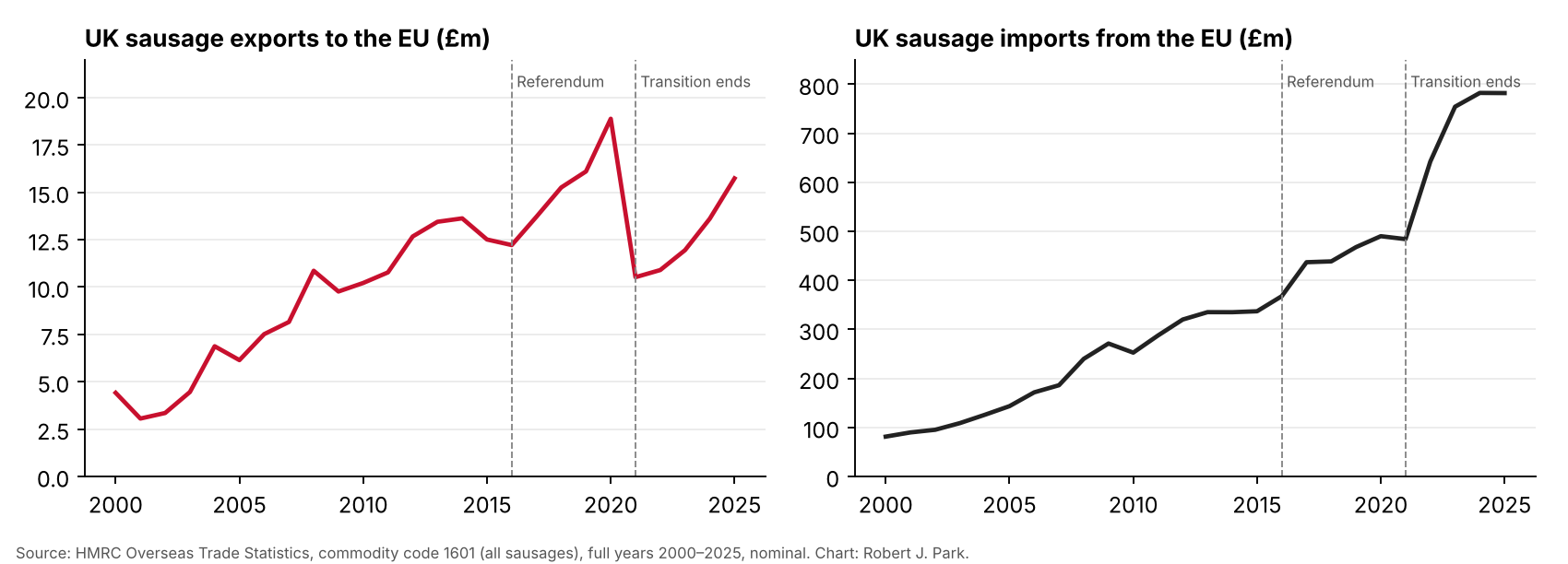
The sausage dashboard. UK sausage exports to the EU fell from £18.9 million in 2020 to £10.5 million in 2021, the first year of the new barriers. By 2025 they were back to £15.7 million in cash terms, but by weight they were still 28% below 2015. Meanwhile imports from the EU more than doubled, from £337 million in 2015 to £782 million in 2025. For every £1 of sausage Britain sells the EU, it buys about £50. That is who Friday’s deal really keeps the road open for. The NFU says food export volumes to the EU are down by over a third since 2019. (Code 1601 covers all sausages, salami and chorizo included, not only the fresh British banger. Figures are not adjusted for inflation.)
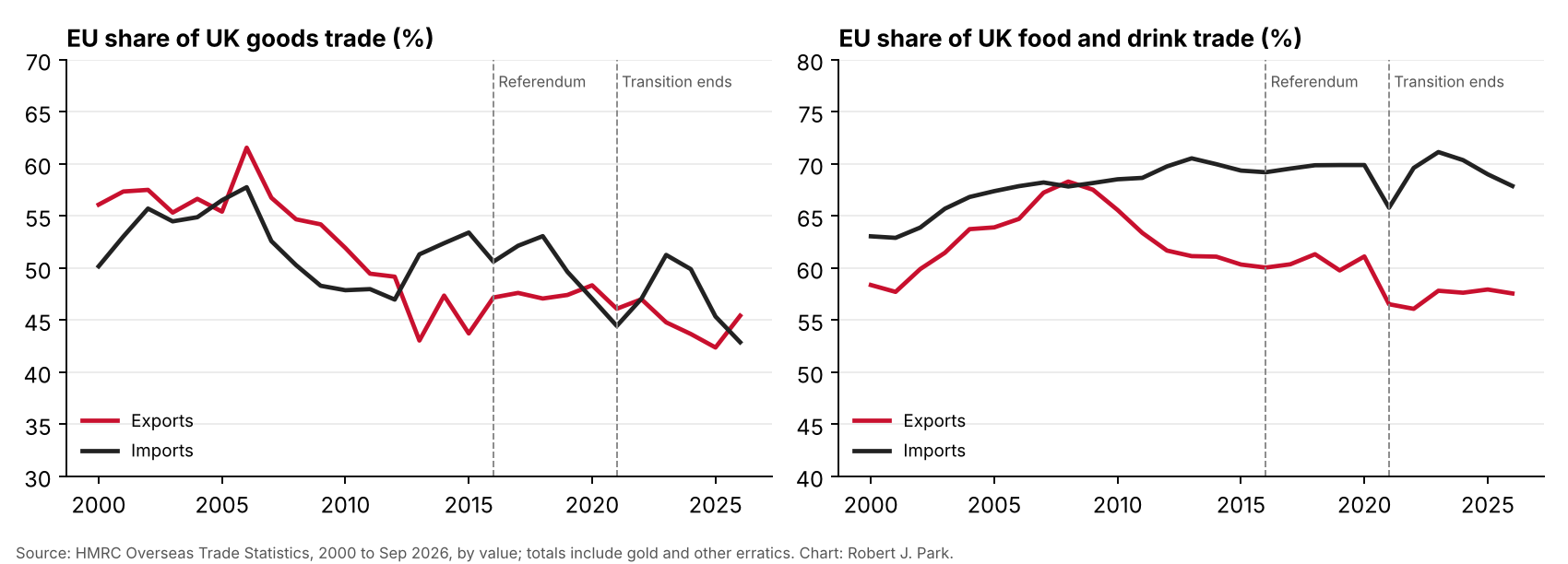
The trade diversion dashboard. Trade diversion means trade shifting to a different partner because barriers changed, not because price or quality did. The EU’s share of UK goods exports was 56.1% in 2000, 43.7% in 2015 and 42.4% in 2025. Most of that fall came before the referendum. On food and drink the EU still takes 57.9% of UK exports (60.3% in 2015) and supplies 69.0% of imports (69.4% in 2015). In other words: after five years of paperwork, the food trade did not go somewhere else. It stayed with the neighbours and paid more to get there. That is the best argument for removing the friction, and no argument at all for who should hold the pen. (Totals include gold and other erratic items; a changing share does not by itself prove diversion.)
Open the trade diversion dashboard
Beyond sausages: where the pen matters next
| Area | Position on 16 November 2026 | Alignment or recognition? |
|---|---|---|
| Food and farming (SPS) | SPS means sanitary and phytosanitary: animal, plant and food safety rules. Target start mid-2027 (GOV.UK, 9 March 2026). Government modelling puts the long-run gain at up to £5.1 billion a year by 2040. | Alignment is the price. Fight for the exceptions list, a written voice and a fair exit. |
| Carbon markets (ETS) | An ETS (emissions trading system) caps emissions and makes firms buy allowances. A UK–EU link is expected on Friday. | Honest answer: linking is alignment too. Here it is worth it, because one carbon price beats two. This is the one place where moving in together makes sense, provided both names are on the lease. |
| Carbon border charges (CBAM) | A CBAM (carbon border adjustment mechanism) charges imports for the carbon in them. The UK’s starts 1 January 2027, UK-wide. The EU exempts a country only if the two ETSs are fully linked and the carbon price is actually paid (Regulation (EU) 2023/956, Article 2). The government has put the cost to UK exporters at up to £800 million by 2030. | A link alone is not enough. Watch for dates, and for whether any exemption is backdated (press reports only, unconfirmed). |
| Sustainability reporting | The EU’s CSRD (Corporate Sustainability Reporting Directive) now covers only firms with over 1,000 staff and over €450 million turnover (Directive (EU) 2026/470). Its reporting standards are the ESRS. The UK’s equivalent, UK SRS (UK Sustainability Reporting Standards, built on the global ISSB standards), was published on 25 February 2026; listed companies must report against it for years starting 1 January 2027 (FCA PS26/19). | Textbook recognition. Report once, be read twice. |
| Rules of origin (PEM) | Rules of origin decide whether a product is “British enough” to enter the EU tariff-free. The PEM (Pan-Euro-Mediterranean) Convention is a shared origin rulebook across about 25 European and Mediterranean partners. It allows diagonal cumulation: counting parts from any member, say Turkey or Morocco, as local. The UK consulted in late 2025; 79% of respondents were in favour. No decision yet. | The cheapest win on the table. It is a common rulebook for origin only and changes no British law on food or carbon. It needs EU agreement. |
| Product testing | Conformity assessment is the testing and certification that proves a product meets the rules. UKAS is the UK’s national accreditation body. Britain already accepts the EU’s CE mark for most goods. The EU does not accept UK testing in return. | Two labs, one result, two invoices. A mutual recognition agreement fixes it. |
| Professional qualifications | The 2025 reset set up a dialogue, not a negotiation. | Recognition, profession by profession, with deadlines. |
Northern Ireland moved in five years ago. Ask us about the house rules.
Northern Ireland has lived under dynamic alignment for goods since 2021, through the Windsor Framework (the UK–EU deal that keeps NI inside the EU’s single market for goods). We know the feel of it: rules made elsewhere, scrutinised by a Stormont committee, with the Stormont Brake (an emergency objection that 30 MLAs can raise against a changed EU rule) as a handbrake rather than a steering wheel.
For NI, Friday’s food deal is largely good news. If Great Britain follows the same food rules, most Irish Sea checks on food should go. That matters to every NI retailer, processor and farm supplier who has spent five years on certificates and “Not for EU” labels.
But be clear about what it does not do.
- Customs stays. NI remains under the EU customs code. Declarations continue for many GB goods.
- The democratic deficit was meant to be cured, not exported. Great Britain now joins NI as a rule-taker on food.
- It is one slice. The UUP’s Steve Aiken told the Assembly on 3 November the deal deserved a cautious welcome but risked “tinkering around the margins”. The DUP leader, Gavin Robinson MP, said the government “lacks ambition” (BBC Radio Ulster, as reported by ITV).
- Carbon is still split. NI power stations sit in the EU ETS; the rest of NI industry is in the UK ETS. EU CBAM does not apply to goods made in NI, but GB-origin goods routed through NI are still caught (European Commission CBAM Q&A, 15 October 2026).
That is why the rest of the list matters more here than anywhere. Each fix removes a friction NI firms feel twice.
Friday: six things to watch
- The exceptions list. How short is it? Does it protect precision breeding and the ban on live exports for slaughter?
- The exit clause. A fair two-way review, or a penalty for changing government?
- The voice. Named committees, a right to be consulted and time to respond, or goodwill?
- Carbon dates. A firm date for the ETS link and a written commitment on CBAM exemption.
- The mandate. Will Parliament get a real vote on each new EU rule, or a rubber stamp? And will ministers commit to put any further alignment to voters first?
- The recognition track. Any mention of PEM, product testing or qualifications? If the reset has room for sausages but not for origin rules, it is a truce, not a partnership.
What firms can do now
- Food and drink: list every GB-sourced ingredient, additive and flavouring you use and check its EU status. Some will have to change.
- Steel, aluminium, cement, fertiliser, hydrogen: prepare for UK CBAM on 1 January 2027 whatever happens on Friday. Get supplier emissions data now.
- Selling to large EU or listed UK groups: expect sustainability data requests. A basic carbon inventory answers most of them once.
- Sourcing parts outside the UK and EU: ask your trade body where it stands on PEM.
Close the distance with Europe by all means. Do it as two democracies recognising each other, not as one taking dictation. Friday will tell us whether this is a partnership or a tenancy. The Liberal Democrats call the food deal a “patch, not a fix” and want the single market; Reform wants no alignment at all. Mutual recognition is the ground between them that respects both the 2016 vote and the geography. For a plain-English read on what the declaration means for your business, contact me at robert@robertjpark.co.uk.
Robert J. Park is an environment, carbon and public affairs consultant based in Larne, Northern Ireland. Download this piece as a briefing, *Friends with benefits?* (PDF, 9 pages). Not legal, tax or customs advice.
Which EU food rule would you most want Britain to keep the pen on, and has anyone asked you?
Jargon, briefly
CBAM carbon border adjustment mechanism · CPTPP Comprehensive and Progressive Agreement for Trans-Pacific Partnership · CSRD Corporate Sustainability Reporting Directive · ESRS the EU’s reporting standards under CSRD · ETS emissions trading system · ISSB International Sustainability Standards Board · PEM Pan-Euro-Mediterranean Convention on rules of origin · SPS sanitary and phytosanitary · TCA Trade and Cooperation Agreement, the 2020 UK–EU trade deal · UK SRS UK Sustainability Reporting Standards · UKAS United Kingdom Accreditation Service
Sources
- BBC News, “UK will have ‘voice’ but no vote on EU food rules in Brexit reset”, 15 November 2026 — https://www.bbc.co.uk/news/articles/c6wy4l8nl42wo; Faisal Islam on X, 16 November 2026 — https://x.com/faisalislam/status/2122231896146907285
- BBC News, “UK lost more than it gained from Brexit, Burnham to say ahead of EU summit”, 16 November 2026 — https://www.bbc.co.uk/news/articles/crp3e1n5kezpo
- GOV.UK, “UK secures full access to £13 trillion CPTPP trading bloc”, September 2026 — https://www.gov.uk/government/news/uk-secures-full-access-to-13-trillion-cptpp-trading-bloc
- GOV.UK, “CPTPP: 10 benefits for the UK” — https://www.gov.uk/government/publications/cptpp-benefits-for-the-uk/cptpp-10-benefits-for-the-uk
- DESNZ, International non-domestic energy prices (table 5.3.1) — https://www.gov.uk/government/statistical-data-sets/international-non-domestic-energy-prices
- Prof. David Collins, City Law Forum, 21 May 2025 (opinion on CPTPP and alignment) — https://blogs.city.ac.uk/citylawforum/2025/05/21/uk-eu-reset-may-break-international-law
- UK–EU Summit Common Understanding, 19 May 2025 — https://www.gov.uk/government/publications/ukeu-summit-key-documentation/uk-eu-summit-common-understanding-html
- UK government Summit Explainer, May 2025 (£800 million CBAM figure) — https://assets.publishing.service.gov.uk/media/682f29c5e9440506ee9539bd/UK_EU_SUMMIT_-_EXPLAINER.pdf
- DBT, SPS GDP impact method note, 22 May 2025 — https://data.parliament.uk/DepositedPapers/Files/DEP2025-0789/DBT_SPS_GDP_Impact_method_note.pdf
- GOV.UK (NIO and Defra), 9 March 2026 — https://www.gov.uk/government/news/businesses-in-northern-ireland-urged-to-prepare-for-smoother-gb-ni-and-eu-trade
- HMRC Overseas Trade Statistics, via uktradeinfo.com (data to September 2026, extracted 16 November 2026)
- HMRC, CBAM policy summary — https://www.gov.uk/government/publications/carbon-border-adjustment-mechanism-cbam-policy-summary/carbon-border-adjustment-mechanism-cbam-policy-summary
- Regulation (EU) 2023/956 — https://eur-lex.europa.eu/legal-content/EN/TXT/HTML/?uri=CELEX:32023R0956
- European Commission, CBAM Questions and Answers, updated 15 October 2026 — https://taxation-customs.ec.europa.eu/document/download/013fa763-5dce-4726-a204-69fec04d5ce2_en?filename=CBAM_Questions+and+Answers.pdf
- DAERA, Emissions trading schemes — https://www.daera-ni.gov.uk/articles/emissions-trading-schemes
- Directive (EU) 2026/470 — https://eur-lex.europa.eu/legal-content/EN/TXT/PDF/?uri=OJ:L_202600470
- UK Sustainability Reporting Standards, 25 February 2026 — https://www.gov.uk/guidance/uk-sustainability-reporting-standards
- FCA PS26/19, 30 September 2026 — https://www.fca.org.uk/publications/policy-statements/ps26-19-aligning-listed-issuers-sustainability-disclosures-international-standards
- DBT, PEM call for evidence response, 26 March 2026 — https://www.gov.uk/government/calls-for-evidence/pan-euro-mediterranean-convention-on-rules-of-origin-pem
- Genetic Technology (Precision Breeding) Regulations 2025, SI 2025/581 — https://www.legislation.gov.uk/uksi/2025/581/made
- Council Decision 97/132/EC (EU–New Zealand) — https://eur-lex.europa.eu/eli/dec/1997/132/oj/eng
- NI Assembly Official Report, 3 November 2026 — https://aims.niassembly.gov.uk/officialreport/report.aspx?eveDate=2026-11-03&docID=505199
- ITV News, 3 November 2026 — https://www.itv.com/news/2026-11-03/uk-eu-agri-deal-demonstrates-lack-of-ambition-from-government-dup-claims