
ESOS and the audit that pays only if you act
Part of the Policy series: where the rules stand in Northern Ireland, who decides them, and what to do about it. Updated as the rules change.
The argument in brief
On 7 September 2026 the government published its Modernising Corporate Reporting consultation, which closes on 30 November 2026. It said DESNZ would consult separately later in 2026 on reforming Streamlined Energy and Carbon Reporting (SECR) and the Energy Savings Opportunity Scheme (ESOS). Five days earlier GOV.UK updated its ESOS Phase 4 guidance. On 1 October the British Industrial Competitiveness Scheme (BICS) opened to cut electricity levies for manufacturers in Great Britain only. The Budget of 28 October 2026 then funded the NI Executive to set up its own version, with no amount stated.
That has been a lopsided deal for Northern Ireland. NI manufacturers carry the full UK-wide ESOS duty but are shut out of the GB relief. The NI version funded on 28 October 2026 is still to be designed, so the Executive can link relief to the audit. ESOS requires firms to audit and to report. It does not require them to act on what the audit finds, and the evidence shows audits alone change little.
Firms that tie the audit to their carbon data and their energy contracts can make it pay. Firms that treat it as paperwork will pay consultants and save little.
This piece sets out the arguments on each side; the recommendations are the author’s. Facts checked to 30 October 2026; rechecked and updated 16 November 2026.
The lifecycle at a glance
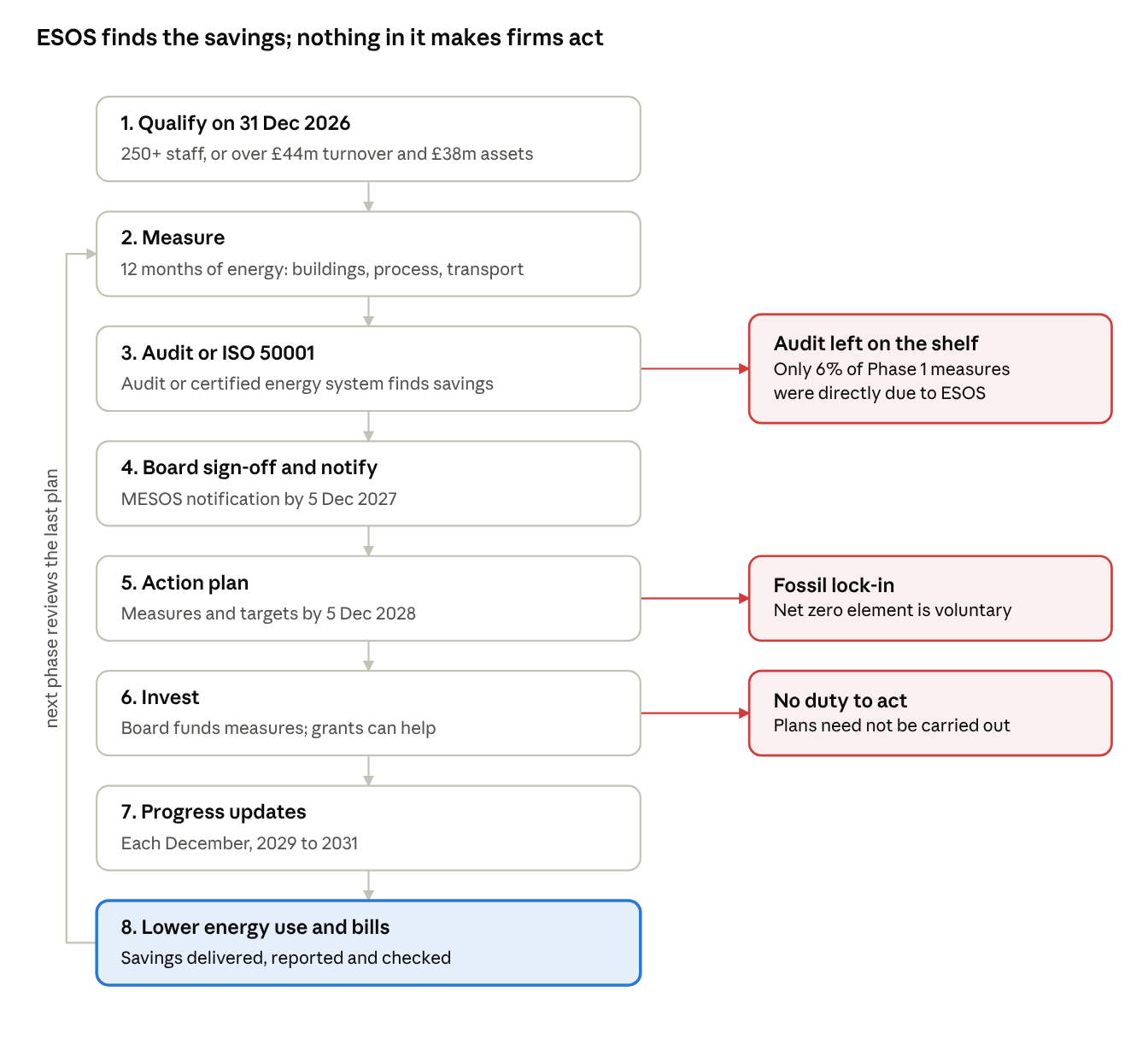
The law requires the audit, the plan and the progress updates, but not the investment at stage 6. Savings reach the bill only when the board funds the measures; each new phase then reviews what was done.
Then and now (2023 to October 2026)
| Rule or instrument | 2023 | Now (with date) | What changed and why |
|---|---|---|---|
| ESOS timetable | Phase 3 qualification date 31 Dec 2022 | Phase 4 qualification date 31 Dec 2026. Notification due 5 Dec 2027; action plan 5 Dec 2028; progress updates 2029, 2030 and 2031 (GOV.UK, 2 Sep 2026) | A third progress update added to evidence delivery |
| ESOS compliance routes | Audits, ISO 50001, DECs and Green Deal Assessments | DECs and GDAs removed by SI 2026/701 (made 23 Jun, in force 22 Jul 2026) | They said little about processes or transport |
| ESOS action plans | Introduced for Phase 3 | Phase 4 report must review the last plan and explain measures not carried out | Weak follow-through; the response was disclosure, not a duty to act |
| ESOS net zero element | Proposed for Phase 4 | Postponed to Phase 5; voluntary under PAS 51215-1 and -2:2025, which MESOS cannot yet accept (GOV.UK, Sep 2026) | Burden kept down pending the 2026 evaluation |
| Phase 3 progress updates | None due | Second update due 5 Dec 2026, signed by a board director | Action plan cycle |
| SECR | In force since 2019 | Review (May 2026) says keep and amend. DESNZ said on 7 Sep 2026 it will consult on SECR and ESOS later in 2026; not found as at 27 Oct 2026 | Costs averaged about £7,100 a year, about three times the estimate |
| Non-domestic MEES (England and Wales) | EPC E from Apr 2023; C (2027) and B (2030) proposed | Interim response (18 Jun 2026) dropped C by 2027; buildings over 1,000 m² to reach B by 2031 where cost-effective | Timetable judged unrealistic; legislation to come |
| Climate Change Agreements | Old scheme extended | New scheme from 1 Jan 2026, targets to 2030, levy discounts to March 2033 | Relief for energy-intensive sites in return for targets |
| Climate Change Levy rates | Main rates set at each Budget; CCA holders pay reduced rates | From 1 Apr 2028 the electricity main rate is frozen at the 2027–28 level; gas and solid fuel rise by RPI; LPG stays frozen; CCA reduced rates stay fixed percentages of the main rates (Budget, 28 Oct 2026) | Improves the payback on ESOS measures that switch heat from gas to electricity |
| Industrial Energy Transformation Fund | Open; NI sites eligible | Closed July 2025, no successor (GOV.UK, 25 Jun 2026) | Ended at a spending review |
| Industrial electricity relief in NI | NI excluded from the GB Supercharger | BICS is GB only; the Budget (28 Oct 2026) funds the NI Executive to set up its own version, no amount stated | Opens a route to BICS-type relief for NI manufacturers; design and timing rest with the Executive |
Where the parties and governments stand (October 2026)
All parties agree energy costs are hurting firms. They split on whether reporting duties like ESOS are part of the cure or part of the cost.
| Party or government | Position (dated) |
|---|---|
| UK Government (Labour) | Kept ESOS and tightened disclosure (SI 2026/701, Jun 2026). Will keep SECR with amendments (26 May 2026). BICS covers GB only (10 Aug 2026). Budget (28 Oct 2026) funds an NI version run by the Executive and freezes the CCL electricity rate from April 2028 |
| Conservatives (Badenoch) | Pledged to scrap mandatory sustainability and climate reporting, naming the carbon reporting framework (9 Nov 2025). ESOS not named |
| Reform UK (Farage) | Richard Tice pledged to end net zero and bring in a “Great Repeal Act” (24 Feb 2026). No ESOS position found |
| Liberal Democrats (Davey) | Daisy Cooper proposed low-interest SME energy-saving loans and business rates relief for efficiency investment (16 Apr 2026) |
| Green Party E&W (Polanski) | Called for an extended price cap (March 2026). No position on business audits found |
| Scottish Government (Swinney) | Climate Change Plan (24 Mar 2026) gives SEPA a role in efficiency at priority sites; keeps a Scottish IETF |
| Welsh Government (ap Iorwerth) | No business energy efficiency position found (searched 27 Oct 2026) |
| NI Executive: Economy (Archibald, SF) | Called NI’s share of energy support “clearly inadequate” (26 Mar 2026). No NI business efficiency duty proposed |
| Alliance | Sorcha Eastwood MP sought fuel duty and VAT cuts funded by windfall taxes (13 Apr 2026) |
| SDLP | Colum Eastwood called NI’s exclusion from GB industrial energy relief a blow (2023–24, under the Conservative government) |
| DUP, UUP, TUV | DUP MP Jim Shannon asked what help NI manufacturers outside BICS would get (16 Apr 2026). No DUP, UUP or TUV position on ESOS found (27 Oct 2026) |
-
Scrap or reform. The Conservatives would remove carbon reporting; Labour would streamline it. Neither plans to abolish ESOS.
-
Relief or duty. NI parties focus on prices and relief. None has engaged with the audit duty their firms already carry. With an NI version of BICS now funded (28 Oct 2026), the Executive can decide whether relief comes with audit conditions.
-
GB or NI. BICS and the earlier Supercharger exclude NI because of the all-island electricity market. ESOS covers NI in full. The Budget (28 Oct 2026) funds the Executive to build its own BICS instead.
-
Homes or firms. Devolved efficiency agendas lean towards homes.
Who decides what
Most business energy duties in NI are set in London. Most of the support is set in Belfast.
| Instrument | Who decides | Whose approval is needed | Position in Northern Ireland |
|---|---|---|---|
| ESOS | DESNZ; Environment Agency administers | UK Parliament SI | Applies in full; NIEA regulates NI-registered firms |
| SECR | DESNZ and DBT | UK SI under the Companies Act | Applies to qualifying NI companies |
| CCAs and Climate Change Levy | DESNZ and HM Treasury | UK Parliament | Available to eligible NI sites; the levy is UK-wide, with the electricity main rate frozen from 1 Apr 2028 (Budget, 28 Oct 2026) |
| BICS | DBT and DESNZ (GB); NI Executive (NI version) | UK Government | GB only; NI Executive funded to design an NI version (Budget, 28 Oct 2026) |
| Non-domestic MEES | DESNZ for England and Wales | UK SI | No NI non-domestic MEES |
| EU Energy Efficiency Directive 2023/1791 | EU | Member state transposition | Does not apply in NI |
| Invest NI grants | DfE and Invest NI | NI Executive budget | NI only |
Where the pillars compete
-
Compliance cost against savings (E against S). The 2014 impact assessment expected an average saving of only about 0.7% per firm, and the SECR review found costs about three times the estimate. For a mid-size firm, fees can take most of the first year’s savings.
-
Audits without a duty to act. Only 6% of Phase 1 measures were directly attributed to ESOS. Phase 3 audits found 47 TWh of potential savings, but DESNZ had no data on delivery (PIR, 2025).
-
Relief against fuel poverty (E against S). GB funds BICS from the Exchequer and savings elsewhere in the energy system (written statement, 16 Apr 2026). DfE’s Head of Energy Group, Richard Rodgers, said an NI version was hard to fund without harming fuel poverty work (reported early 2026). Exchequer funding for an NI version, announced on 28 Oct 2026, eases this if it stays off household bills.
-
Efficiency against electrification (E against E). With the net zero element postponed, Phase 4 audits can favour cheap fixes to gas plant and lock in fossil equipment for another decade.
-
Rebound (E against E). Lower unit energy costs can expand output and claw back savings. ESOS counts kWh saved per measure, not absolute use.
What it means for Northern Ireland firms and councils
-
Check status on 31 December 2026. You qualify with 250 or more staff, or turnover over £44m and a balance sheet over £38m. Group membership counts.
-
Plan to the deadlines. Use a 12-month reference period that overlaps 31 Dec 2026 and ends before 5 Dec 2027. Get lead assessor and board sign-off. Notify on MESOS by 5 Dec 2027, then the action plan by 5 Dec 2028.
-
Phase 3 firms: second progress update due 5 Dec 2026. The Phase 4 report must explain dropped measures.
-
Penalties are real. Failing to carry out an audit can cost up to £50,000. Failing to notify or keep records can cost £5,000 plus £500 a day for up to 80 days (Linklaters, 4 Aug 2026).
-
Councils are usually outside ESOS. GOV.UK says public sector bodies do not usually need to comply. Council-owned companies should check their own status.
-
NI support is narrower. No IETF, and the funded NI version of BICS is not yet designed (28 Oct 2026). Invest NI’s Technical Consultancy can fund follow-through, but its Energy Efficiency Capital Grant is paused for review and not taking applications. The €13m NI share of the Shared Island Sustainability Challenge Fund opened 12 Oct 2026.
-
Cross-border groups face two regimes. Sites in the Republic face EU audit duties above 10 TJ and energy management systems above 85 TJ by 11 Oct 2027.
Practical examples
-
Savings found, delivery unknown. Phase 3 audits identified 47 TWh a year of potential savings, about 5% of participants’ energy use. DESNZ said it had no data on savings actually achieved (ESOS review, April 2025).
-
An NI firm that acted. Simplyfruit in Craigavon used an Invest NI energy efficiency grant. In a year it saved over £16,000 and 200,000 kWh, and cut over 50 tonnes of CO2 (DfE, 30 Aug 2022).
-
Cash is the barrier for smaller firms. A Utility Regulator study of 42 NI small businesses found they valued efficiency but could not meet upfront costs. Few knew what support existed (Utility Regulator, 14 Oct 2026).
-
NI manufacturers outside GB relief. Jim Shannon (DUP) said Magellan Aerospace, T.G. Eakin and Mash Direct may not qualify for BICS. Peter Kyle replied that the Government was working with the Assembly on NI help (Commons, 16 Apr 2026).
-
Cross-border money for follow-through. The €26m Shared Island Sustainability Challenge Fund, with a €13m NI share, backs projects in flexible electrification and hard-to-abate industry. Invest NI, Enterprise Ireland and InterTradeIreland deliver it (News Letter, 12 Oct 2026).
Recommendations
-
DESNZ: publish the SECR and ESOS consultation before Phase 4 audits are bought. Firms need the rules before paying for 2027 work.
-
DESNZ: consult on a single energy and carbon data return feeding SECR, ESOS and UK SRS. It would remove double counting and cut fees.
-
DESNZ and the Environment Agency: publish Phase 3 implementation data first. Any duty to act should rest on evidence.
-
DfE: link Invest NI capital grants to ESOS action plan measures. The audit then becomes a route into funding.
-
NI Executive and DfE: make the funded NI version of BICS conditional on cost-effective audit measures. The Budget (28 Oct 2026) gave funding but no design, so conditions can be built in from the start. Relief should buy lower demand as well as lower bills.
-
NI Executive: say whether and when it intends a non-domestic MEES. Landlords and tenants need a timetable or a clear no.
-
Firms: book a lead assessor early in 2027 and combine ESOS with a carbon inventory and an energy contract review. One data set then serves SECR, customers and CBAM.
-
Boards: set a payback threshold now and fund measures that meet it. ESOS pays back only when the action plan is carried out.
Sources
-
GOV.UK: Energy Savings Opportunity Scheme (updated 2 Sep 2026)
-
SI 2026/701, ESOS (Amendment) Regulations 2026 (made 23 Jun 2026, in force 22 Jul 2026)
-
DBT: Modernising Corporate Reporting consultation, para 150 on SECR and ESOS (7 Sep 2026)
-
GOV.UK: Industrial Energy Transformation Fund (updated 25 Jun 2026)
-
Hansard: Commons sitting of 16 Apr 2026, BICS statement and debate
-
Invest NI: £20m Energy Efficiency Capital Grant (8 May 2024)
-
Invest NI: Reduce waste and save energy (updated 24 Aug 2026)
-
DfE: Energy efficiency for NI businesses, Simplyfruit (30 Aug 2022)
-
Utility Regulator: Small business experience of energy stress (14 Oct 2026)
-
News Letter: Shared Island Sustainability Challenge Fund (12 Oct 2026)
-
Derry Now: Executive will push for energy supports (26 Mar 2026)
-
4NI: Alliance calls for cross-party effort on energy (13 Apr 2026)
-
City AM: Conservatives pledge to scrap ESG reporting (9 Nov 2025)
-
Hansard: Commons sitting of 16 Apr 2026, BICS debate (Daisy Cooper)
-
GOV.UK: Industrial energy and resource efficiency rebound effects (24 Mar 2026)
-
HM Treasury and HMRC: Budget 2026 Overview of Tax Legislation and Rates (28 Oct 2026)
-
HM Treasury and NIO: Breathing space for Northern Ireland families and businesses (28 Oct 2026)
Robert J. Park is an independent environment, carbon and public-affairs consultant based in Larne, Northern Ireland. He helps firms and public bodies measure their carbon and make their case on policy.
Agree or disagree? Get in touch on LinkedIn or WhatsApp @robertjpark.
This piece is general information for Northern Ireland businesses, not tax, legal or financial advice. Check your own position with your adviser before acting on it.