
Closed for booking: how restricting the tip pushes rubbish into lay-bys and lanes

Part of the Policy series: where the rules stand in Northern Ireland, who decides them, and what to do about it. Updated as the rules change.
The argument in brief
On 14 July 2026 Lincolnshire County Council’s Executive voted to bring back booking at all 11 of its household waste recycling centres. Reform UK has run the council since May 2025. The next day South Holland District Council voted to object, with one councillor calling the plan unfair to people who work. The county’s own report puts the saving at about £1.02 million a year, and that figure assumes 20% less waste arrives at the sites.
That assumption is the weak point. Booking systems, van bans, permit caps and residency checks save money by turning waste away. Councils say the waste turned away belongs to traders and people from outside the area. Few councils publish evidence for that, and no government measures where turned-away waste ends up.
Meanwhile England recorded 1.26 million fly-tipping incidents in 2024/25, up 9% on the year, and 37% were on pavements and roads. The tip is tidier. The verge, the lay-by and the river bank may pay for it. Councils have real reasons to restrict access, and this piece sets them out fairly. Still, the case for restriction rests on savings that are counted and costs that are not.
This piece sets out the arguments on each side; the recommendations are the author’s. Facts checked to 30 October 2026; rechecked and updated 16 November 2026.
The lifecycle at a glance
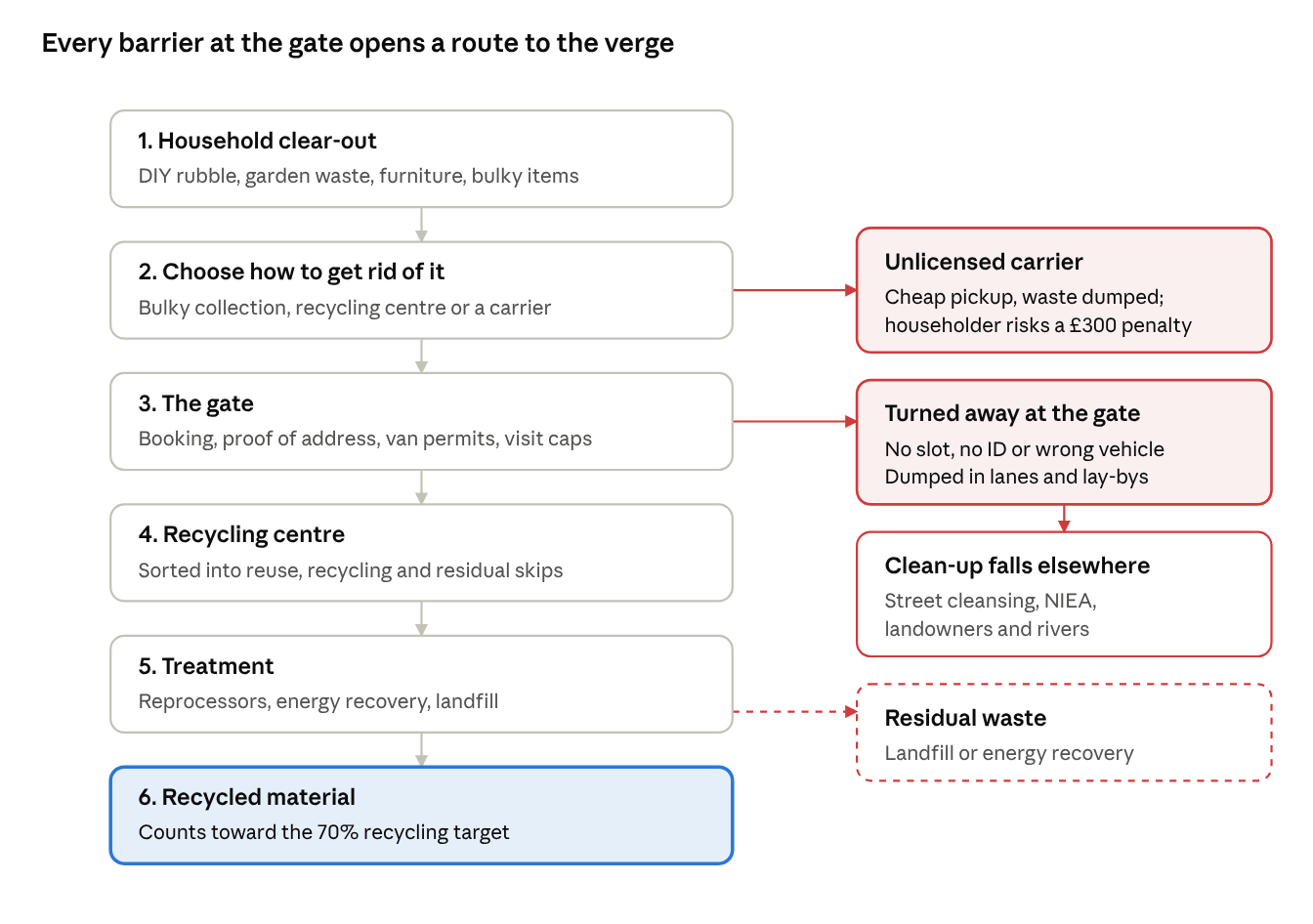
Waste leaks out at two points before it reaches a recycling centre: a cheap unlicensed carrier, or a gate that turns it away. The council’s waste budget counts the tonnes refused; the clean-up lands on other budgets.
Then and now (2023 to October 2026)
| Rule or instrument | 2023 | Now (with date) | What changed and why |
|---|---|---|---|
| DIY waste charges, England | Many councils charged householders for rubble and plasterboard | Free within limits: two 50-litre bags or one fitted item, up to four visits in four weeks (SI 2023/1243, from 31 Dec 2023). Gloucestershire proposed charging above the limits (7 Jul 2026) | Research for Defra found councils named HWRC charging as the biggest service factor in fly-tipping |
| Booking systems, England | Defra kept them “under review” (20 Dec 2023) | Ministers have “no plans” to assess their effect on fly-tipping (30 Jun 2025) and “no current plan” to review guidance (28 Jan 2026) | Treated as a local matter; Labour has kept the Conservative position |
| Free household waste deposit, England | Environmental Protection Act 1990 duty | Reconfirmed by a minister (28 Jan 2026) | No change |
| Ards and North Down | Booking at all nine sites from 4 Sep 2023 | Still in force. Vans and double-axle trailers capped at six visits a year; proof of address required (read 27 Oct 2026) | First NI council to make booking permanent; cited landfill costs and the 70% target |
| Mid and East Antrim | ID checks, no booking | Vans and double-axle trailers need an annual permit and a booked slot at Larne, Ballymena and Carrickfergus; 12 visits a year (read 27 Oct 2026) | Aimed at commercial misuse; van-only households get the same cap |
| Fly-tipping enforcement, England | Fixed penalties and prosecutions | Waste Crime Action Plan (20 Mar 2026) adds driving licence points and conditional caution pilots. The Budget funded tax liabilities from clearing six illegal waste sites (28 Oct 2026) | Tougher on offenders rather than wider access |
| NI waste strategy | No current strategy | Draft Rethinking Our Resources (16 Jan 2026) covers enforcement and tracking but sets no access standard for recycling centres | Access left to councils |
Where the parties and governments stand (October 2026)
The split does not follow party lines. Councils of every colour bring in booking when budgets are tight, and opposition groups of every colour campaign against it.
| Party or government | Position (dated) |
|---|---|
| UK Government (Labour) | Will not assess booking’s effect on fly-tipping (30 Jun 2025). No review of guidance planned (28 Jan 2026). No new position on booking since July 2026 found. The Budget raised landfill tax by RPI from 1 Apr 2027 and funded clearance of six illegal waste sites (28 Oct 2026) |
| Conservatives | In government ended DIY charges and declined to restrict booking (20 Dec 2023). Derbyshire’s Conservative cabinet approved number-plate residency registration (29 Nov 2024) |
| Reform UK (councils) | Lincolnshire approved booking (14 Jul 2026). West Northamptonshire brought in booking on 3 November 2025. Derbyshire is consulting on closing the Glossop site and started registration on 28 Sep 2026. No national policy found |
| Liberal Democrats | Hertfordshire’s Lib Dem administration scrapped planned booking (10 Jun 2025). Helen Morgan MP welcomed Shropshire dropping booking for cars (12 Feb 2025) |
| Green Party | A Derbyshire Green councillor opposed the Glossop closure on travel distance (2026). No national position found |
| Scottish Government | No published position found (searched 27 Oct 2026). Councils decide; Highland van booking from 1 Jun 2026 |
| Welsh Government | 48,367 fly-tipping incidents, up 15% (24 Feb 2026). No position on booking found |
| NI Executive / DAERA (Muir) | Says fly-tipping on public land is mainly for councils (Jan 2026). No access standard in the draft strategy |
| DUP | A Derry councillor called for residency checks on Republic-registered vehicles (17 Jun 2020). No current party policy found |
| Independent MLA Alex Easton | Called on Ards and North Down to scrap booking, blaming it for rising fly-tipping (12 Nov 2023) |
| Alliance, UUP, SDLP, Sinn Féin, TUV | No published party position found (searched 27 Oct 2026) |
-
No UK government measures where turned-away waste goes, and Westminster has said in writing it has no plans to.
-
Reform councils say booking cuts waste and favours residents. Lib Dem councils protect opening hours. Both are answering the same cost pressure.
-
England’s DIY rule is the only national limit on what councils can do at the gate. Scotland, Wales and NI have none.
-
In NI, residency rules bite hardest along the border and at council boundaries. No party has an Assembly-level policy.
Who decides what
Access is almost entirely a council decision. National governments set the free-deposit duty and fly-tipping penalties.
| Instrument | Who decides | Whose approval is needed | Position in Northern Ireland |
|---|---|---|---|
| Booking, permits, van rules, hours | Council executive or committee | Council procedure only | Same; each of the 11 councils sets its own rules |
| Free deposit of household waste | Environmental Protection Act 1990 s.51 (England and Wales) | Parliament or Senedd | Waste and Contaminated Land (NI) Order 1997, Art. 25(1)(b): councils must provide places to deposit household waste free of charge; no NI equivalent of the DIY rule found |
| DIY waste limits | SI 2023/1243 (England only) | Parliament | Does not apply |
| Fly-tipping fixed penalties | Each legislature | Respective legislature | Belfast: £400 for fly-tipping, £300 for duty of care breaches |
| Packaging EPR payments to councils | Defra and the devolved administrations | All four | Applies in NI |
Where the pillars compete
-
A tidy site against a dirty verge. Lincolnshire’s £1.02m saving depends on 20% less tonnage. Some will be trade waste, rightly refused. Some will be household waste that ends up elsewhere. The saving shows in the waste budget; the clean-up lands on street cleansing, the NIEA, landowners and rivers. Landfill tax, which applies in NI, rises by RPI from 1 Apr 2027 (Budget, 28 Oct 2026). Each refused tonne will save councils a little more.
-
Recycling rates against total waste. Turning waste away can lift a site’s recycling percentage while dumping rises outside it. The percentage looks better. The environment may not be.
-
Queues and safety against access. Lincolnshire reports queues backing onto the A17, and police once asked for a site to close. Booking fixes this by rationing. An extra day’s opening would cost about £1.5m a year. The council has promised a phone booking line.
-
Van-only households. Mid and East Antrim allows a household whose only vehicle is a van 12 visits a year; Ards and North Down allows six. A tradesperson’s family clearing a house is rationed like a business.
-
Digital exclusion. Research for Defra found phone bookings were only 2–4% of the total. Councils read that as low demand. It may show people giving up.
What the evidence shows on booking and fly-tipping
The honest answer is that nobody knows. The 2022 study for Defra found no published evidence either way and warned that Covid made the effect impossible to isolate. Its survey of 41 councils recorded their own views: councils with booking did not blame it for fly-tipping, and councils without it were more sceptical. West Northamptonshire reported over 21,000 visits in the first weeks after its 3 November 2025 launch and credited booking with shorter queues; it published no fly-tipping comparison. Shropshire scrapped booking for cars in February 2025. Councils sometimes treat the absence of evidence as proof the system is safe. It shows only that nobody has measured.
What it means for Northern Ireland firms and councils
-
The rules differ across all 11 councils. Ards and North Down require booking for everyone. Newry, Mourne and Down require it only for vehicles over 1.95 metres. The table below sets out each council’s rules as published.
-
Trade outlets vary by council. Derry and Strabane, Mid Ulster, and Armagh, Banbridge and Craigavon take paid trade waste. Mid and East Antrim’s commercial permits cover only cardboard, garden waste and “old for new” items. Construction and demolition waste is excluded.
-
NI cannot measure the problem. Belfast’s own October 2025 report says councils record fly-tipping differently. The NIEA’s 17.72 tonnes for 2025 covers only the large incidents it handles. The UK Budget’s funding for clearing six illegal waste sites was not stated to cover NI (28 Oct 2026).
-
The border adds cost. In 2020 about one vehicle in ten at Derry’s Pennyburn site was Republic-registered. Monaghan’s civic amenity sites charge €4 just to enter.
-
Duty of care falls on householders. Householders who do not check their carrier can face a £300 penalty in Belfast. Tighter access pushes households towards cheap “man with a van” offers.
Access rules at the 11 NI councils, from council pages read 27–28 October 2026 unless dated. “Not stated” means the council page is silent.
| Council | Cars | Vans and trailers | Trade waste |
|---|---|---|---|
| Antrim and Newtownabbey | Residents only; photo ID with address (read 16 Nov 2026) | Medium and large vans must book, online or by phone; car trailers allowed | Not accepted |
| Ards and North Down | Online booking for all; proof of residency | Six visits a year per address | Not stated |
| Armagh, Banbridge and Craigavon | No booking stated; numbers on site may be limited | Not stated | Registered business users; charges may apply |
| Belfast | No booking | Vans must book | Not stated |
| Causeway Coast and Glens | Waste must be pre-sorted; no booking stated | Not stated | Not stated |
| Derry and Strabane | Booking at Glendermott Road and Eglinton by day (from 28 Sep 2026) | Large vans book at the three main sites; no trailers at two sites | Paid voucher, £51.50 to £113.30 excluding VAT |
| Fermanagh and Omagh | Compulsory booking planned for Omagh-area sites, with phone option and unlimited visits (11 Nov 2025) | Not confirmed | Not confirmed |
| Lisburn and Castlereagh | Photo ID and proof of address | Not stated | Not stated |
| Mid and East Antrim | No booking | Permit and booking at Larne, Ballymena and Carrickfergus; 12 visits a year | Cardboard, garden and “old for new” permits only |
| Mid Ulster | Not stated | Not stated | Pre-paid swipe card at Cookstown, Drumcoo and Magherafelt |
| Newry, Mourne and Down | No booking; one visit a day | Vehicles over 1.95m book online or by phone | Domestic use only |
Practical examples
-
Ards and North Down: booking for everyone. Since 4 September 2023 all nine sites need an online booking. Vans and double-axle trailers are capped at six visits per address a year, and visitors must show proof of residency. The council page offers no phone route (read 28 Oct 2026). Conditions of use
-
Mid and East Antrim: permits at Larne. Van-only households need a permit and a booked slot at Larne, Ballymena or Carrickfergus, up to 12 visits a year. A missed booking counts against the cap unless cancelled an hour ahead (read 28 Oct 2026). Council page
-
Derry and Strabane: a paid door for traders. Commercial operators can use council sites with a voucher bought in advance, from £51.50 for a small van to £113.30 for a 7.5-tonne lorry, excluding VAT. That gives small traders a legal outlet (read 28 Oct 2026). Commercial charges
-
Newry, Mourne and Down: book only the big vehicles. Cars, small vans and single-axle trailers can still turn up. Vehicles over 1.95 metres book a free slot online or by phone, a scheme launched in January 2023. Council launch, 6 Jan 2023
-
Omagh plans booking with safeguards. Fermanagh and Omagh’s director of environment said planned booking for Omagh-area sites would allow unlimited visits and a phone option. It forms part of a £4 million safety programme (reported 11 Nov 2025). We Are Tyrone
-
The bill for the big dumps. English councils spent £19.3 million clearing 52,000 fly-tips of tipper-lorry size or larger in 2024/25. Small-van loads were the most common size, at 31% (25 Feb 2026). Defra statistics
Recommendations
-
Councils: make booking optional for cars. Keep slots for busy times and allow drive-up otherwise. Shropshire shows it can work.
-
Councils: replace van bans and low caps with free, simple permits. Allow at least 12 visits a year, with more on request, and take applications by phone and in libraries.
-
DAERA: extend England’s free DIY allowance to NI by regulation. Two bags or one fitted item per visit is cheaper than clearing it from a lane.
-
Councils: publish fly-tipping figures for 12 months before and after any access change, by ward and on a common method. A saving claimed without this has not been shown.
-
DAERA and councils: agree an NI-wide access standard. Set minimum hours, a non-digital booking route, reciprocal access at boundaries and van rights for households.
-
DAERA and Defra: tie part of EPR payments to measured access. Councils that cut access while fly-tipping rises should have to explain why.
-
NI Executive and Dublin: open talks on cross-border civic amenity pricing. Price gaps drive waste across the border.
-
Legislators: write a public realm duty into any future bill. Require councils to assess effects on streets, verges and waterways before cutting waste services.
Sources
-
Fly-tipping statistics for England, 2024 to 2025 (25 Feb 2026)
-
HWRCs: DIY waste charges and booking systems, government response (20 Dec 2023)
-
Booking system to be reintroduced at tips, Spalding Voice (14 Jul 2026)
-
District council to oppose booking system, Spalding Voice (16 Jul 2026)
-
West Northamptonshire: successful start for booking (28 Nov 2025)
-
Shropshire six months after U-turn, Shropshire Star (19 Aug 2025)
-
Waste Crime Action Plan briefing, Addleshaw Goddard (31 Mar 2026)
-
Antrim and Newtownabbey recycling centres (read 28 Oct 2026)
-
Ards and North Down HRC conditions of use (read 28 Oct 2026)
-
Armagh, Banbridge and Craigavon recycling centres (read 28 Oct 2026)
-
Causeway Coast and Glens Household Recycling Centre Guide (2024/25)
-
Lisburn and Castlereagh: visiting recycling centres (read 27 Oct 2026)
-
Newry, Mourne and Down large-vehicle booking launch (6 Jan 2023)
-
Causeway Coast and Glens tops NIEA fly-tip stats (8 Jan 2026)
-
Budget 2026 Overview of Tax Legislation and Rates, HM Treasury and HMRC (28 Oct 2026)
-
Live sector reactions to the Autumn Budget 2026, letsrecycle (29 Oct 2026)
Robert J. Park is an independent environment, carbon and public-affairs consultant based in Larne, Northern Ireland. He helps firms and public bodies measure their carbon and make their case on policy.
Agree or disagree? Get in touch on LinkedIn or WhatsApp @robertjpark.