
Faith, reason and the common home: the Catholic Church in science, business and the environment
The idea that the Church and science are old enemies doesn’t fit the record. Over five centuries the Catholic Church has founded sciences, set accounting and labour standards, and, more recently, put the climate at the centre of its teaching. It has also turned the world’s smallest state into a reporting party under the Paris Agreement. This post summarises the evidence. The full briefing, with tables and 38 sources, is a free PDF.
Download the briefing (PDF, 9 pages) · Open the dashboard
Why a carbon consultant is writing about the Church: few institutions have run schools, hospitals and observatories for centuries, and fewer still publish an emissions inventory for a state of 0.44 km². This is the record as evidence, not a statement of faith.
Science
- The calendar. The calendar we use was promulgated by Pope Gregory XIII in 1582. It was worked out from astronomical data, with the Jesuit mathematician Christopher Clavius as a key figure in the reform.
- Founders of sciences. Bishop Nicolas Steno is counted among the founders of geology. Fr Angelo Secchi helped launch astrophysics. The Augustinian friar Gregor Mendel grew some 28,000 plants in his abbey garden in Brno and presented the laws of heredity in 1865. Mgr Georges Lemaître, a Belgian priest, proposed the expanding universe and its “primeval atom”, the model we now call the Big Bang.
- Institutions that last. The Pontifical Academy of Sciences traces its roots to the Accademia dei Lincei, founded in 1603, of which Galileo was a member. Its members have included Planck, Bohr and Schrödinger, appointed without regard to religion. The Vatican Observatory, re-founded in 1891, helped make the first photographic atlas of the sky, with nuns as its “computers”. Since 1993 it has run a 1.8-metre research telescope in Arizona.
- A fair record. The Galileo case was a real error. In 1992, after a commission set up by John Paul II had reported, he acknowledged the errors of Galileo’s judges.
Business and economics
- Bookkeeping. In 1494 the Franciscan friar Luca Pacioli published the first printed account of double-entry bookkeeping. Every company ledger, and every carbon ledger built on the same logic, descends from it.
- Fair work. Leo XIII’s Rerum novarum (1891) argued for a living wage and workers’ right to form unions. Pius XI’s Quadragesimo anno (1931) set out subsidiarity, which is now a principle of EU law. In May 2026 Leo XIV’s first encyclical, Magnifica humanitas, carried that tradition into the age of AI.
- Co-operatives. Fr José María Arizmendiarrieta founded a technical school in Mondragón in 1943. Its first worker co-operative followed in 1956 and a co-operative bank in 1959. Mondragon now has about 70,000 workers, each with one share and one vote.
- Values-led investing. The Vatican’s Mensuram Bonam (2022) gives Catholic investors a framework: engage, invest in what does good, exclude what does harm. It notes that ESG is a useful start but not the same thing.
Environment
- Laudato si’ (2015) made care for creation, and for the poor who suffer most from environmental damage, central to Catholic teaching. The Vatican’s academies laid the scientific groundwork that April with Climate Change and the Common Good.
- Treaty commitments. In 2022 the Holy See joined the UN climate convention and the Paris Agreement for Vatican City State. It has filed two emissions targets since.
- Action at scale. The Vatican’s Laudato Si’ Action Platform has signed up more than 13,600 dioceses, schools, hospitals, orders, businesses and families in five years.
- Closer to home. In August 2018 the all-island Irish Catholic Bishops’ Conference committed to divest from the top 200 oil and gas companies within five years. Trócaire made the case to the bishops’ finance committee.
The Church’s footprint worldwide
The Church’s own statistics, published on 16 October 2026 (figures to the end of 2024):
| Measure | Figure |
|---|---|
| Catholics | 1.42 billion (17.8% of the world) |
| Schools (nursery, primary, secondary) | 230,924, with 64.1 million pupils |
| University students | 4.09 million |
| Hospitals | 5,397 |
| Dispensaries | 13,646 |
| Homes for the elderly, chronically ill or disabled | 16,263 |
| All health and charity centres | 101,110 |
No official figure exists for the Church’s land holdings or global carbon footprint. Property is held by thousands of separate dioceses, orders and charities. Totals quoted online have no verifiable source, so I have left them out.
The Vatican offices that do this work
- Dicastery for Promoting Integral Human Development (2016): the economy and work, care for creation, health and migration. It runs the Laudato Si’ Action Platform.
- Pontifical Academy of Sciences and Pontifical Academy of Social Sciences (1994): independent academies on science, economics and law.
- Vatican Observatory: astronomy research and education from Castel Gandolfo and Arizona.
- Secretariat of State: treaties, the UN climate process and the Vatican’s emissions targets, with the Governorate.
- Governorate of Vatican City State: the state’s buildings, energy and vehicles, and its “Ecological Conversion 2030” plan.
- APSA: the Holy See’s property and investments. It co-leads the new solar farm.
- Laudato Si’ Higher Education Centre: runs Borgo Laudato Si’, the ecology training centre at Castel Gandolfo that Leo XIV opened in September 2025.
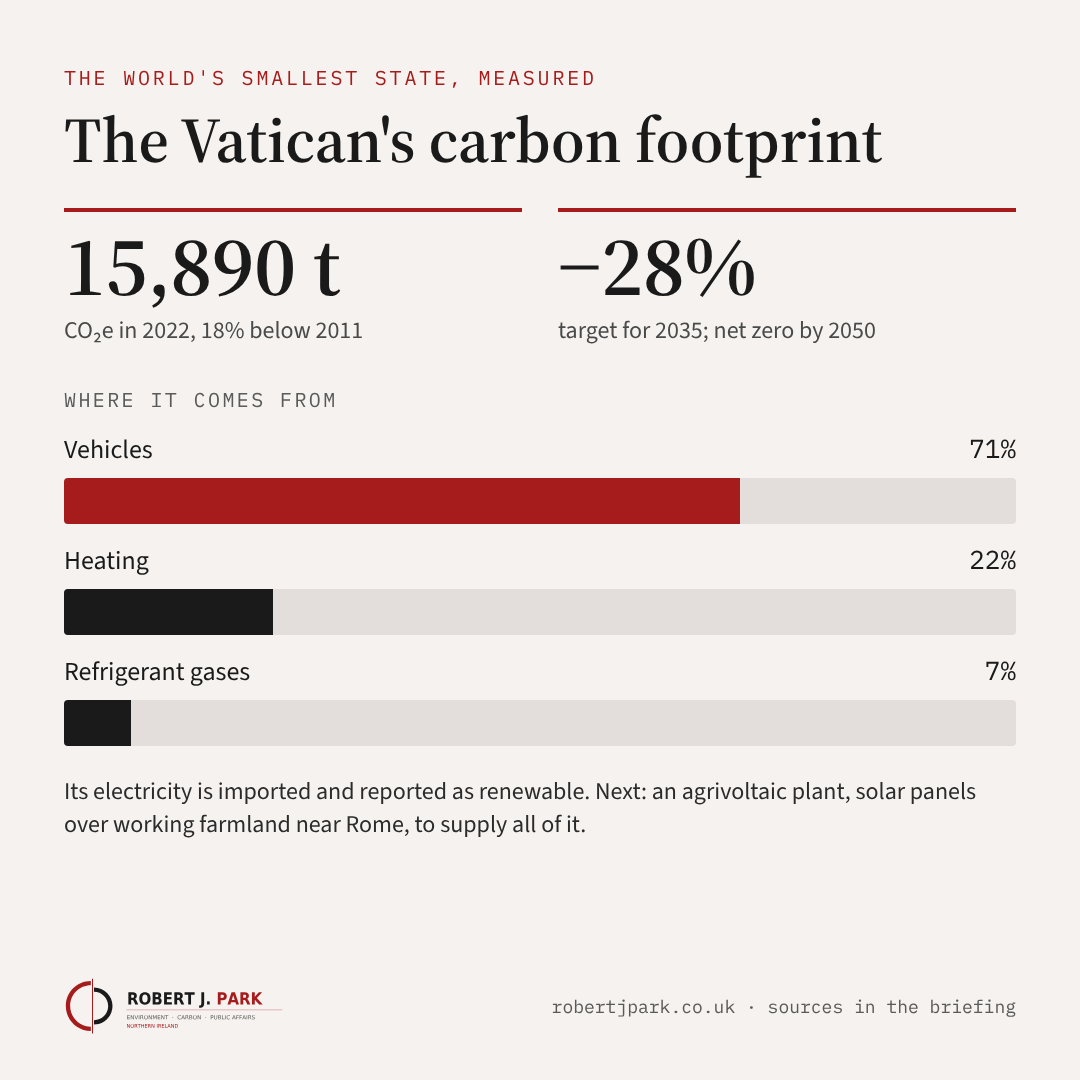
The Vatican’s own footprint
- Size: 0.44 km², 887 residents and about 6,000 daily workers. It also holds sites in Italy, including Castel Gandolfo and about 430 hectares at Santa Maria di Galeria. APSA manages 4,281 property units in Italy and about 1,200 abroad.
- Carbon: 15,890 tonnes CO₂e in 2022, 18% below 2011. Vehicles produce 71%, heating 22% and refrigerant gases 7%. That is 0.0000432% of the world’s emissions, and it is still reported to the UN.
- Targets: 20% below 2011 by 2030, at least 28% by 2035, and net zero by 2050.
- Energy: all electricity is imported and, according to the Vatican’s UN report, renewable. Solar panels went onto the Paul VI Hall in 2008 and the Vatican Museums’ entrance in 2024. An agrivoltaic plant, with solar panels over working farmland at Santa Maria di Galeria, is meant to supply all of the state’s electricity. The Italy–Holy See treaty for it came into force on 27 May 2026, and the plant is reported at 80–90 MW.
What this means for businesses here
The world’s smallest state measures its emissions, sets a base year and publishes dated targets. Most Northern Ireland manufacturers are bigger emitters than the Vatican and publish nothing. Their EU customers will increasingly ask for these numbers under CBAM and CSRD. The Vatican’s biggest source turned out to be its vehicles, not its buildings, which is a reminder to measure before you assume. For farms and food processors with land and large power bills, agrivoltaics is worth a serious look.
If your customers are asking for carbon numbers, a free first call on the CBAM Desk is the place to start.
Figures checked against the sources in the briefing as at 9 November 2026. This post is general information, not legal, financial or investment advice. Full sources are in the PDF.